Hanetsuki Keeps New Year in the Air With a Wooden Paddle
· 16 min read
Hanetsuki is Japan's New Year game of badminton without a net, and hanetsuki is still played with a decorated wooden paddle and a feathered shuttlecock as a wish for health in the new year.
Some games ask for a scoreboard. Hanetsuki asks only that the shuttlecock stays in the air. Two players stand facing each other in the cold light of the New Year, wooden paddles in hand, and bat a feathered shuttle back and forth with no net between them. The longer it flies, the better the year ahead is supposed to be. It is a modest ambition for a game, and hanetsuki has kept it for more than a thousand years.
That is the whole game, and it is also a small piece of the Japanese New Year. Hanetsuki is played with a rectangular wooden paddle called a hagoita and a brightly coloured shuttlecock called a hane, and it has been part of the holiday for centuries. Girls played it most, often in kimono, in the days after New Year, and the loser went home with a smear of black ink on her cheek.
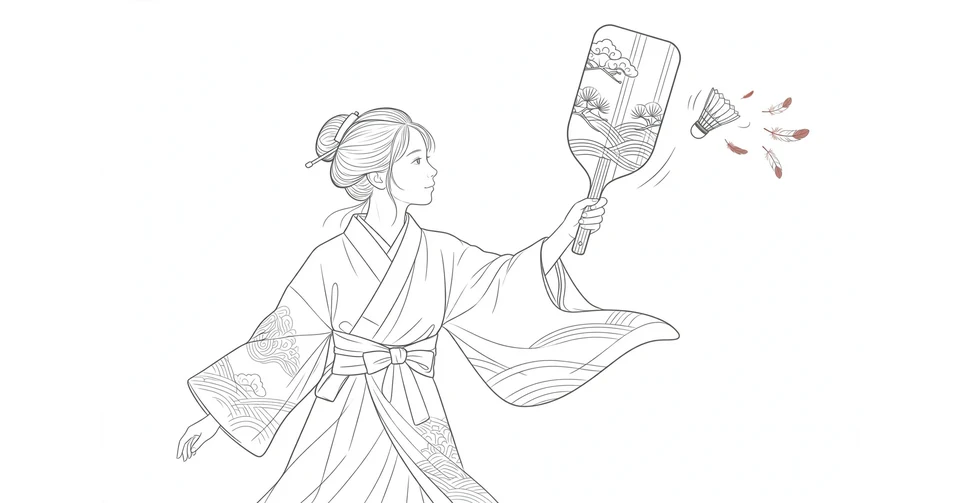
I came across hanetsuki while reading about matsunouchi, the week Japan keeps the pine up for its guest, where it was described in passing as a form of badminton played with wooden paddles. One line was enough to make me curious, because a game that survives for more than a thousand years without ever becoming a sport must be doing something other than entertaining people. Hanetsuki turns out to be a wish disguised as a game, a small ritual of health and protection that happens to be fun.
How hanetsuki is played
The rules of hanetsuki are so simple that a child can learn them in a minute, and that simplicity is part of the point. There is no court, no net, and no referee. The game is often described as badminton without a net, and an overview of hanetsuki gives the same plain definition: a traditional game played with a wooden paddle and a feathered shuttlecock. Two players stand opposite each other, each holding a hagoita, and take turns hitting the hane back and forth. The only real aim is to keep the shuttlecock from touching the ground. If it falls, the player who missed gets a mark drawn on the face with black ink, and the game goes on until one player's face is completely smeared.
There are two traditional ways to play. The first is called oibane, or chase shuttlecock, in which two players rally the hane between them and try to keep the exchange alive for as long as possible. Timing and angle matter more than force, because a hard hit sends the light shuttle flying off in an unexpected direction. The second is called agebane, or high shuttlecock, a solo game in which one player hits the hane upward again and again, counting consecutive hits and trying to beat a personal best. Both forms share the same heart, which is keeping something fragile in the air through attention and patience. That is the whole appeal of hanetsuki: nothing is measured except the time the shuttle spends in the air.
The ink penalty sounds harsh, but it was always part of the joke. Old photographs and woodblock prints show girls laughing with inked cheeks, and the game was never really about winning. A face covered in ink meant you had played long enough and missed often enough to be part of the fun, and in a holiday full of formal greetings and careful behaviour, a smear of ink was a small and welcome piece of mischief. Hanetsuki rewards steadiness rather than strength, and the best players are the ones who stay calm and watch the shuttle all the way onto the paddle.
Anyone can play hanetsuki, and the sources are clear that it was never limited to one gender, even though it became known as a girls' game. What matters is not who holds the paddle but how long the hane stays up. In that sense the game is generous. A grandmother and a grandchild can play it together, and the rally itself is the entertainment, not the score at the end.
The paddle and the feathered shuttle
The hagoita is a rectangular wooden paddle, usually made from a light wood such as paulownia, and it is the soul of the game. A playing hagoita, the kind actually used for hanetsuki, is plain and practical, light in the hand, with a firm surface and simple decoration, built to survive many rallies. A decorative hagoita is something else entirely, a piece of craft that happens to be shaped like a paddle. The finest decorative paddles are called oshi-e hagoita, and a complete guide to the craft of hagoita explains how their raised pictures are made by padding silk and cloth over the wood so that the figures stand out in three dimensions, almost like small relief sculptures.
The faces on a decorative hagoita are often kabuki actors in bright costumes, beautiful women from the old theatre and print traditions, or auspicious designs such as a treasure ship loaded with good fortune. In recent decades the portraits have widened to include movie and television stars and famous athletes, which is a reminder that the craft follows the culture rather than freezing it. A good hagoita is judged by its picture, its balance, and the care of its maker, and the best of them are collected as art.
The hane is a small and clever object. At its base sits a seed from the soapberry tree, known in Japanese as mukuroji, with several feathers fixed into it. The soapberry seed is heavy enough to fall straight and light enough to be batted upward, and the feathers slow it in the air so that a rally can last. In the early days of the game, the soapberry nut itself was the shuttlecock, and the feathers came later as the game took its modern shape. The choice of material was never an accident. The soapberry tree was associated with protection from illness, and folk tradition read its name as a wish that a child would not suffer from sickness. The hane also resembles a dragonfly in flight, and the dragonfly eats mosquitoes, so the little shuttle carried a double promise, that the insects of summer would keep their distance and the children of the house would stay well.
That is why a hagoita, and the hanetsuki it serves, is more than sporting equipment. It is a charm you can hold, a wish made from wood and feathers, and it explains why the paddles outlived the game itself. People stopped playing in the street, but they kept buying the paddles, because the wish attached to them had not gone out of date.
From court ritual to a girls' game
The history of hanetsuki begins earlier than most people expect, and the exact dates are worth handling with care, because the sources do not all agree. What they agree on is this. The ancestor of the game was called gi-cho, a ritual game played among court nobles in the Nara period, which ran from 710 to 794. In gi-cho, players used a stick shaped like a spatula to bandy a ball, and the game was a Shinto rite performed in the hope that girls would grow up healthy. It was, in a sense, the girls' counterpart to kemari, the ancient court football played by boys, and both games were prayers before they were pastimes.
Between the Nara ritual and the familiar paddle game lies a long stretch, including the whole Heian period, for which the record is thin. The game survived those centuries of court life and came out the other side changed. By the Muromachi period, which ran from 1336 to 1573, the stick had become a hagoita and the ball had become a feathered soapberry seed, and the game had taken almost exactly the form it keeps today. Court nobles even held hanetsuki tournaments, and the game was already becoming a New Year pastime rather than a rite performed only on formal occasions.
The centuries that followed added layers of meaning rather than changing the rules. In the Sengoku period, the age of warring states, the decorations on the paddle began to matter more than the game, and the hagoita took on the character of a lucky charm. In the Edo period, from 1603 to 1868, samurai families began giving a hagoita to celebrate the birth of a girl, and the custom spread from the warrior houses to ordinary families. A hagoita became the standard year-end gift for a home with a daughter, a present that said, in wood and cloth, may she grow up healthy and may bad luck be knocked away.
The wordplay helped. The verb phrase behind hagoita suggests knocking away, and the paddle became a symbol of batting evil spirits aside. A gift for a baby girl's first New Year, her hatsu-shogatsu, was understood as a shield for the year ahead, and the paddle would be displayed in the home from mid-December through the middle of January, guarding the season. By the end of the Edo period, hanetsuki belonged to the holiday itself, as much a part of New Year as the pine at the gate. That is how a game became a decoration, and how a decoration became a custom that families kept even after they stopped playing.
Ukiyo-e artists loved the scene. Kitagawa Utamaro painted women playing hanetsuki at New Year around 1804, and other print makers followed with girls in kimono, paddles raised, the hane caught in mid-air. The prints are a useful record, because they show the game exactly as people remember it, played outdoors in the cold, in fine clothes, with laughter and ink. They also show how deeply the game belonged to the holiday. In the prints, hanetsuki is not a curiosity but a normal part of New Year, as ordinary as the pine decorations at the gate.
Why a game became a lucky charm
The belief at the heart of hanetsuki is simple and practical. Traditionally, the longer the shuttlecock remains in the air, the greater the protection from mosquitoes the players will receive during the coming year. It sounds like a small thing, and in a modern city it is, but in a Japan before window screens and repellent, mosquitoes were a real threat, and a game that promised fewer bites was a game worth playing. The dragonfly shape of the hane made the logic visible. Dragonflies eat mosquitoes, so a shuttle that looks like a dragonfly in flight would keep the insects away, and a long rally meant a long summer without bites.
Behind the mosquito belief sits a larger idea, which is that the New Year is a time for driving away misfortune. Playing hanetsuki was understood as a way of warding off evil spirits and protecting children from illness, and the soapberry seed at the heart of the hane carried that meaning in its name. It is a small belief, but hanetsuki has carried it faithfully into the present. The paddle, the shuttle, the ink on the cheek, and the laughter all pointed in the same direction, toward a year that began with health and good luck rather than fear.
I find this the most charming part of hanetsuki, because it treats play as a serious thing. We tend to separate games from rituals, as if one is frivolous and the other is solemn, but hanetsuki refuses that split. It is a game and a prayer at the same time, and the prayer works better because it is fun. A child who keeps the hane in the air for a minute is not thinking about evil spirits. She is thinking about the shuttle, the paddle, and the next hit, and the wish rides along quietly underneath the fun. That is a wise way to build a tradition, because it does not depend on belief to survive. It depends on enjoyment, and enjoyment is much harder to lose.
The same logic runs through the other New Year games of Japan. Karuta turns a hundred poems into Japan's fastest card game, and like hanetsuki it takes something serious, in that case classical poetry, and turns it into a contest of speed and attention. The holidays are full of these double meanings, where a game is also a lesson and a lesson is also a celebration, and hanetsuki is one of the oldest examples.
The market where the paddles gather
If you want to see hanetsuki as a living tradition rather than a memory, the best place is Asakusa in mid-December. Every year from December 17 to 19, the grounds of Senso-ji temple fill with stalls selling nothing but hagoita, in a market called Hagoita-ichi, the paddle market. About 50 stalls take part, and the event draws some 300,000 visitors over its three days, which makes it one of the clearest signs in Tokyo that the year is ending.
The market began around 350 years ago, in the Edo period, as a year-end market selling New Year goods and lucky charms on the temple grounds. It grew around December 18, which is the last Kannon festival day of the year at Senso-ji, known as Osame no Kannon, when crowds already came to the temple. Over time the paddles became the stars of the market, and today the stalls are piled high with oshi-e hagoita showing kabuki actors, beauties, and the celebrities of the year, alongside simpler paddles for families who want a charm rather than a showpiece. Every paddle on those stalls is a reminder that hanetsuki is still part of how Tokyo says goodbye to the year.
The prices tell the story of a craft that ranges from souvenir to artwork. The smallest paddles cost around 1,000 yen, and the largest and finest can cost hundreds of thousands. The most popular size measures about 60 centimetres and sells for around 60,000 yen, which is a serious purchase and a serious gift. The ornamental paddles can be as long as 180 centimetres, nearly six feet, or as short as 18 centimetres, small enough for a child's hand, and each one is made to be displayed rather than played with. The decorative hagoita sold at the market are not meant for rallies. They are New Year ornaments, displayed at home as wishes for health and protection, especially for a baby girl's first New Year.
There is a lovely piece of theatre at the market. When a customer buys a paddle, the seller often closes the sale with a rhythmic hand clap called sanbon-jime, three sets of three claps followed by one, a traditional way of sealing a deal and wishing good fortune. It is a small ceremony, and it suits the market, because buying a hagoita is not really shopping. It is choosing a wish for the year ahead, and the clap is the punctuation at the end of the sentence.
The market also shows how the craft keeps changing. The traditional paddles still feature kabuki actors and treasure ships, but the stalls also carry faces from the year's films, television, and sports, and the designs follow the news as surely as any newspaper. A hagoita from a given year is a portrait of that year, and collectors value them partly for that reason. The market is at once old and current, a 350-year-old event selling this year's faces, and that combination is why it still draws crowds.
Hanetsuki today
Hanetsuki is not as popular as it used to be, and it would be dishonest to pretend otherwise. Children play it far less than they did, partly because the open spaces where it was played have shrunk and partly because the New Year itself has changed, with families spending the holiday indoors and in front of screens. The game survives mainly as a memory, a school event, or a demonstration at a cultural festival, and most people under a certain age have seen a hagoita as a decoration long before they have seen one used in a rally.
But the paddle itself is doing well. Decorative hagoita are still sold throughout Japan, and the Hagoita-ichi market in Asakusa still draws its crowds every December. The craft has found new life in places the old players never imagined. Contemporary artists use hagoita as canvases, galleries exhibit paddles as works of art, and do-it-yourself kits let people decorate plain paddles bought at 100-yen shops, which turns an old craft into a personal project. Workshops and school events still teach hanetsuki to children who have never held a paddle, and the game is easy enough to learn in a single afternoon.
There is a quiet lesson in that survival. Hanetsuki lasted because it was never only one thing. It was a ritual, a game, a gift, a decoration, and a craft, and when one of those roles faded, the others carried it forward. The rally in the street may be rare now, but the wish is still on sale in Asakusa every December, and the paddle is still given to a baby girl for her first New Year. The game changed its shape to stay alive, which is what living traditions do.
I think hanetsuki deserves one more rally, even if it is only in a living room or a school hall. The rules fit in a single sentence, the equipment fits in a bag, and the reward is the rally itself, the small triumph of keeping something light in the air for a little longer than seems possible. That is a good way to begin a year, with attention, patience, and a little laughter, and it is a game that asks nothing of its players except that they keep looking up.
Hanetsuki began as a prayer for girls to grow up healthy, and it became a game that anyone could play, and then a charm that anyone could hang on a wall. The thread that runs through all of it is the simplest one, that the new year should begin with health and good fortune, and that a few minutes of play is a fine way to ask for it. The hane is still in the air, in a sense, as long as the paddles are still made and the market still opens in December. Hanetsuki is waiting, patient as ever, for someone to pick up a paddle and keep it flying.
More in Culture & Society
- Takoage Sends New Year Wishes Up on a Paper Kite
- Karuta Turns a Hundred Poems Into Japan's Fastest Card Game
- Hatsuyume Is the First Dream Japan Reads Like a Fortune
- Japanese Manga and How It Became the World's Most Read Comics
- Hatsu-Hinode Is the First Sunrise Japan Wakes Up For
- Matsunouchi Is the Week Japan Keeps the Pine Up for Its Guest
Latest posts
- Japanese Stationery and the Small Tools Japan Takes Seriously
- Toshikoshi Soba Is the Long Noodle Japan Eats at Midnight
- Osouji Is the Cleaning Japan Does Before the Gods Arrive
- Japanese Anime and How a Niche Hobby Conquered the World
- Toshigami Is the Guest Japan Prepares the Whole House For
- Urajiro Is the Fern That Wishes a Family Twice Over
- A Shimekazari Hangs the New Year Over the Front Door
- Make-Koshi Is the Eight Loss Line That Sends a Sumo Wrestler Down
- Japanese Arcades and the Game Centers That Refuse to Die
- Danpatsu-Shiki Is the Haircut That Ends a Sumo Career
- Kachi-Koshi Is the Eight Win Line That Moves a Sumo Wrestler Up
- Tachiai Is the One Second That Decides a Sumo Bout
- A Gunbai Points at the Winner and Nobody Argues
- Izakaya, the After-Work Pubs Where Japan Unwinds
- Dondo-Yaki Is the Fire That Closes the Japanese New Year