Urajiro Is the Fern That Wishes a Family Twice Over
· 23 min read
Urajiro is the small fern whose paired fronds and pale white underside carry two wishes at once, a happy married life and a sincere heart, on Japan's New Year decorations.
Urajiro is the small fern tucked into Japan's New Year decorations that carries two wishes at once. Its fronds spring in pairs from the stem, so it has long been read as a sign of a happy married life and a family that grows. The underside of each leaf is pale, almost white, and that pale underside is read as purity and a sincere heart. One plant, two wishes, and both of them are about the people inside the house rather than about wealth or luck.
The plant behind the symbol is Gleichenia japonica, a fern native to Japan, and its Japanese name is urajiro. The name itself points to the pale underside, the back of the leaf that faces outward when the frond is tucked into a decoration. It is not a rare plant or a difficult one. It grows in the undergrowth of forests and on hillsides across Honshu, Kyushu, Shikoku, and the Ryukyu Islands, forming low thickets of forked green fronds. What makes urajiro special is not where it grows but what people have learned to see in it, and that way of seeing has survived for well over a century.
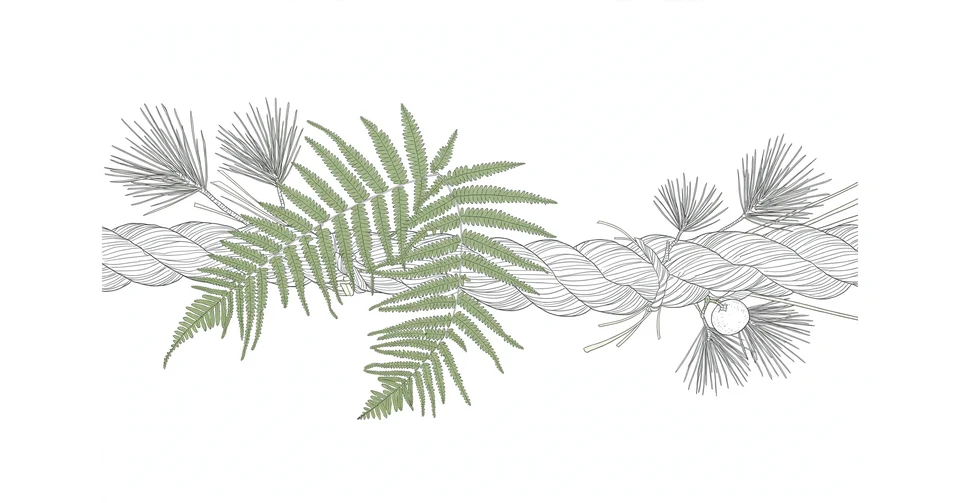
Most visitors to Japan in late December walk past urajiro without noticing it. The straw rope above the door catches the eye, and so does the bright orange tucked into it, and the white paper streamers fluttering in the wind. The fern is the quiet part of the decoration, a few green fronds folded into the straw, easy to miss. Yet if you ask what the decoration is wishing for, urajiro gives you the most personal part of the answer. The rope marks a boundary, the pine promises endurance, and the orange promises continuity, but urajiro is the part that wishes for the marriage inside the house to be happy and for the family to grow in honesty. It is a small plant carrying the largest hopes a household has.
What urajiro looks like in the wild
To understand why urajiro was chosen, it helps to look at the plant itself. Urajiro, or Gleichenia japonica, is a terrestrial fern with long creeping rhizomes, and its fronds fork into two at each division, branching again and again in a series of paired divisions. The result is a frond that looks like a small green fan, or like a hand held open, with the leaflets arranged in neat mirrored rows along each branch. The fronds are leathery and glossy green on top, stiff enough to hold their shape when cut, and they stay green through the winter, which matters for a decoration hung in December.
The underside is where urajiro earns its name. Turn a frond of urajiro over and the green gives way to a pale, almost white surface, a waxy bloom that covers the back of the leaflets. In the forest the pale underside is easy to miss, because the fronds lie flat and green side up. In a decoration, though, the fronds are tucked into the straw rope so that the pale side shows, and the contrast between the green top and the white back becomes the whole point. The plant carries its own two faces, green on one side and white on the other, and the custom reads both of them.
Urajiro grows widely across Japan. According to the United States Department of Agriculture germplasm records, Gleichenia japonica is native to Honshu, Kyushu, Shikoku, and the Ryukyu Islands, and its Japanese name is recorded there as urajiro. It is a plant of forest edges and poor soils, often forming dense undergrowth beneath hinoki cypress plantations, where it spreads by its creeping rhizomes into thick green carpets. It is not a plant that needs tending. It grows where it grows, and people have always been able to gather it from the hillsides near their homes. That availability is part of the story. A wish that depends on a rare flower is a wish only the rich can make, but a wish made from a common fern belongs to everyone.
Older books knew urajiro under a different Latin name, and that detail is worth noting because it shows how long the custom has been observed. An account of Japanese New Year decorations published in 1887 calls the fern Polypodium dichotomum, the name botanists used at the time, and describes the same paired fronds and the same meaning. The science has moved on and the name has changed, but the plant and the reading of it have stayed the same. When a custom survives a change of scientific name without changing its meaning, it is a sign that the meaning was never about the name. It was about what the eye could see.
Why the paired fronds mean a happy marriage
The first of the two wishes is the one most often explained, and it comes straight from the shape of urajiro. The fronds of urajiro spring in pairs from the stem, two leaves of equal size growing side by side from the same point, and that pairing has long been read as a picture of a married couple. The 1887 account puts it plainly, saying that urajiro symbolises conjugal life because the fronds spring in pairs from the stem, and that between the paired leaves nestles, as offspring, the little leaf bud. A modern guide to the decorations says the same thing in fewer words, that two symmetrical leaves symbolize marital harmony. The reading has not changed in more than a century, and it does not need much explanation. Two leaves, equal and together, growing from one stem. It is a picture of a marriage that a child could understand.
There is a second layer to the pairing, and it is the part that turns a wish for a marriage into a wish for a family. Urajiro does not only branch in pairs. It keeps branching, each fork splitting into two again, so that one stem becomes many fronds. A writer in the nineteenth century, Lafcadio Hearn, explained it as the hope of exuberant posterity, writing that even as the fern branches and branches, so may the happy family increase and multiply through the generations. The little leaf bud nestled between the paired leaves is the offspring in the picture, the next generation already present between the parents. Urajiro is not only a wish for a couple to stay together. It is a wish for that couple to become a family, and for the family to keep growing the way the fern grows, by dividing and spreading without losing its shape.
I find this the most touching part of the whole decoration, and it is the reason I keep coming back to urajiro rather than to the grander symbols around it. The pine wishes for long life, and the bitter orange wishes for a family line that continues, but both of those are wishes about duration, about lasting. Urajiro wishes for something warmer than duration. It wishes for two people to grow old together in the same house, side by side the way the fronds grow side by side, and for children to appear between them the way the leaf bud appears between the paired leaves. It is a wish for togetherness rather than for longevity, and togetherness is the harder thing to wish for, because it cannot be bought or stored. It has to be lived, day by day, by two people who choose to stay.
The pairing also carries a quiet idea about equality that the old writers noticed and then politely stepped around. The 1887 account observes that the paired leaves are uniform, and then remarks that these uniform graceful leaves might suggest dangerous ideas of the equality of the sexes, though the writer adds that the simile has not in Japan been pushed to so desperate a length. The joke is dated, and the nervousness in it belongs to its century, but the observation underneath it is sound. The two fronds are equal. Neither one is larger than the other, neither one shades the other, and the picture only works if both are present. A marriage in which one partner is a decoration and the other is the whole plant would not look like urajiro at all. Whether the old writers were ready to say so or not, the fern was already saying it. Two equal leaves, one stem, and a bud between them.
The white underside and the sincere heart
The second wish carried by urajiro is written on the back of the leaf, and it is the reason the plant has the name it does. The pale underside of the frond is read as purity and a sincere heart. A modern guide to the decorations states it directly, that the pale underside represents purity and a sincere heart, and an older description of the same custom says the white underside represents honesty. The two versions agree, and the difference between them is only a matter of emphasis. Purity is the state of the heart, and honesty is what that heart does in the world. Urajiro asks for both.
It is worth pausing over why a white underside should mean sincerity, because the connection is not obvious until you think about what an underside is. The top of a leaf is the face it shows to the sky, the side that is seen, admired, and photographed. The underside is the side that is hidden, the side that faces the ground and is rarely looked at. To say that the hidden side is white is to say that there is nothing to hide. A person with a sincere heart is the same all the way through, the same on the side nobody sees as on the side everybody sees. The fern wears its honesty on the part of itself that is hardest to see, and the custom reads that as a promise. May the people in this house be as honest in private as they are in public.
There is also a practical side to the symbolism that makes it easy to remember. When fronds of urajiro are tucked into a straw rope, the maker turns some of them so that the pale underside faces outward, and the decoration shows a flash of white among the green. Anyone passing the door can see it. The white is not hidden away in the decoration. It is displayed, the way a sincere heart is displayed in the way a person treats their neighbours. I like that the custom does not ask for purity as a private matter only. It puts the white where it can be seen, and it lets the neighbours judge the household by it. A wish that is visible is a wish that can be lived up to, or failed, in public.
The two wishes belong together, and that is the real point of the fern. A happy marriage without honesty is a performance, and honesty without love is a cold house. Urajiro puts the two together on a single frond, the paired leaves for the marriage and the white underside for the heart, so that the decoration wishes for both at once and refuses to separate them. If you had to choose one plant to stand for a family, it would be hard to do better than a plant that grows in pairs and is white on the side nobody sees. The fern does not ask for much. It asks for the two things that matter most, and it asks for them in the same breath.
Urajiro on the shimekazari
The place where most people meet urajiro is the shimekazari, the small decorated straw rope hung above the front door for the New Year. Urajiro is one of the core elements of that decoration, alongside the straw rope itself, the white zigzag paper streamers called shide, the pine, and the bitter orange called daidai. Each element carries a wish, and urajiro carries the wish for the family. A guide to the New Year decorations lists the fronds among the essential parts of a shimekazari, and the older accounts describe them as part of the decoration from the beginning. The shimekazari is a sentence written in objects, and urajiro is the clause about the family.
The fronds sit in the rope in a particular way, and the placement is part of the meaning. They are tucked into the twisted straw so that the paired leaves spread outward and the pale underside shows, usually near the centre of the decoration where the eye falls first. On a round tamakazari, the thick circular rope common in eastern Japan, urajiro often sits at the top of the ring with the pine and the orange, a small green fan against the straw. On a simpler loop, the fern may be the only green in the whole decoration, a single pair of fronds against the pale straw. However the rope is shaped, urajiro is never an afterthought. It is placed where it can be seen, because the wish it carries is one the household wants its neighbours to see.
The rope itself gives urajiro its context, and the two belong together. The shimekazari is the household version of the shimenawa, the great sacred rope of the shrine, brought down to the size of a doorway and dressed for a family. A fuller account of that rope and its meaning is told in an earlier article on this site about the sacred rope itself, and urajiro is part of what makes the household version different from the shrine version. A shrine rope marks a place that is always sacred. A household rope marks a home that is sacred for the New Year, and the fern is what makes it a home rather than a shrine. Shrines do not need a wish for a happy marriage. Houses do.
The details of how the shimekazari is made and hung, and what each of its parts means, are told at length in the article on this site about the decorated rope above the front door, which is where the seed of this article came from. That article quotes the line that started this one, that the fern fronds do double work, and it is worth reading the whole decoration through that line. Every part of the shimekazari does one job, and only the fern does two. The straw marks the boundary, the paper marks the sacred, the pine promises endurance, and the orange promises continuity. Urajiro alone carries two wishes, and it carries them both on a single small frond.
Urajiro in the kadomatsu and at the shrine
Urajiro is not confined to the rope above the door. It also appears in the kadomatsu, the paired arrangements of pine and bamboo that stand at the gate, and in the decorations of the shrine itself. The 1887 account describes a New Year arch built of pines and bamboo with a straw rope stretched between them, and in the centre of that arch, among the lobster, the yuzuriha, and the bitter orange, stand the graceful fronds of urajiro. The kadomatsu is a larger and grander decoration than the rope above the door, a landmark at the gate rather than a sign over the threshold, but urajiro is there too, carrying the same wish in a bigger setting. The family is wished for at the gate as well as at the door.
The same account notes that the shime, the straw rope, is found at every Shinto shrine, hung in front of the shrine or around the eaves all year round, and that urajiro is sometimes attached to it there as well. That detail matters, because it shows that the fern is not only a New Year plant. At a shrine, the rope is permanent, and the fern attached to it is a standing wish rather than a seasonal one. The household hangs its rope for a week or two, but the shrine keeps its rope all year, and the fern on it keeps wishing for the same things, a happy marriage, a growing family, and a sincere heart, long after the New Year decorations have come down. The season ends. The wish does not.
There is a difference between urajiro on a shrine rope and urajiro on a household rope, and it is a difference of scale rather than of meaning. On a shrine rope, the fern is part of a boundary that separates the sacred from the ordinary, and its wish is a general one, for the community that worships there. On a household rope, the same fern wishes for the particular people inside one house. The plant does not change. The address changes. I think that is a generous feature of the custom. It does not invent a separate symbol for the shrine and another for the home. It uses the same small fern in both places, and it trusts the same wish to work at both scales. A family and a community want the same things, after all, and a symbol that can carry both is a symbol worth keeping.
How the fronds are chosen and prepared
A shimekazari is only as good as its materials, and urajiro is chosen with care, because a frond that does not show its meaning clearly cannot carry the wish. The maker looks for fronds in which the pairing is clear, two leaves of equal size springing from the same point on the stem, with the small leaf bud visible between them. A frond that has lost one of its pair, or one that is torn or uneven, is not used, because the picture it makes is a broken one. The pale underside matters just as much. The frond must show the white back of the leaf clearly, without stains or damage, because the white is the part that means purity and a sincere heart. A green frond with a dull underside says nothing. A frond with a bright pale underside says what the decoration needs it to say.
The fronds of urajiro are cut fresh and used while they are still supple, so that they can be tucked into the twisted straw without snapping. Urajiro is leathery and stiff, which helps, and a fresh frond holds its shape in the rope rather than wilting flat against it. Once in place, the fronds dry slowly over the days the decoration hangs, the green fading a little and the fronds stiffening into the shape the rope gave them. That drying is part of the life of the decoration. It is hung green and taken down dry, and the change is a small record of the days it spent above the door. The wish does not fade with the green. If anything, the drying makes the wish seem more durable, as if it had been tested by the winter air and held.
Most households today buy their decorations rather than making them, and the fern arrives already chosen and placed by the maker, whether in a supermarket, a home centre, or a shrine stall. The buyer still chooses, though, even if the choice is made with the eyes rather than the hands. A good shimekazari shows the urajiro clearly, the paired fronds spread and the pale underside visible, and a buyer who knows what to look for can tell a careful decoration from a careless one at a glance. The knowledge is not secret. It is the kind of knowledge that is passed on by looking, by standing in a shop in December and noticing which rope has the fern placed well and which one has it buried in the straw. I would rather buy a simple rope with a well placed fern than an elaborate one in which the fern is hidden, because the simple rope is the one that understands what the decoration is for.
What happens to urajiro after the new year
Nothing about the New Year decorations is thrown away casually, and urajiro is no exception. The decorations are taken down at the end of the period called matsunouchi, usually around 7 January in Tokyo and the Kanto region, and around 15 January in the Kansai region around Kyoto and Osaka. The dates differ by region, a difference that goes back centuries, but the principle is the same everywhere. The decoration has done its work, the deity of the year has been welcomed, and the rope comes down. The urajiro comes down with it, dry now, its green faded, its shape set by the weeks it spent above the door.
In many regions the decorations are taken to a shrine and burned in a ritual bonfire called dondo-yaki, usually held around the middle of January. The fire takes the straw, the pine, the paper, and the fern together, and the rising smoke is understood to carry thanks upward and to send the deity off properly. A guide to the decorations describes the burning as returning the sacred energy of the decorations to the divine, and notes that the ritual is usually held around 15 January. The urajiro that wished for a family for two weeks goes up in the same fire as the rope that marked the boundary and the orange that wished for continuity. The whole decoration is returned at once, and the wish goes up with the smoke.
The burning is not the only respectful way to end the decoration. Where a shrine fire is not available, the tradition is to wrap the decoration in white paper, sprinkle it with salt, and dispose of it separately from other rubbish. The salt is a purifier, the same salt used at shrines, and the white paper is the same clean wrapping used for sacred things. Even in disposal, the fern is treated as something that held a blessing, not as waste. A thing that has carried a wish for a family for two weeks is not thrown away like an old newspaper, and I think there is a lesson in that for how we treat other things we have finished with. The end of a thing deserves as much care as the beginning, and a wish that has been honoured for two weeks deserves a proper farewell.
There is also a quieter ending that some households choose, which is to keep the decoration rather than burn it. The old accounts note that some of the more elaborate decorations are treasured as folk art rather than destroyed, and a well made shimekazari can be kept for years as a reminder of the New Year it welcomed. The fern in a kept decoration dries completely and keeps its shape, a small green fan that has become a keepsake. Whether it is burned or kept, the fern has done its work by then. The wish was made, the weeks passed, and the family inside the house is the same family, a little older, still together. That is the whole of what the fern asked for.
Why a fern carries two wishes at once
It is worth asking why one small plant was given two wishes when every other part of the decoration was given one. The straw has its job, the paper has its job, the pine has its job, and the orange has its job, and each of them does that job well. Only urajiro was asked to do double work, and the reason, I think, is that the two wishes it carries cannot be separated. A happy marriage and a sincere heart are not two separate blessings that happen to share a plant. They are the same blessing seen from two sides, the way the frond itself has two sides, green on the top and white on the back.
A marriage that lasts is a marriage in which both people are honest with each other, and honesty between two people is only possible when each of them is honest with themselves. The paired fronds show the marriage, and the white underside shows the honesty that makes the marriage possible. Take away the pairing and the white is only a colour. Take away the white and the pairing is only a shape. Together they are a picture of what a family needs, two people side by side, and a heart that is the same on the side nobody sees as on the side everybody sees. Urajiro does double work because the work is double, and it cannot be done by half a plant.
That is also why urajiro is the part of the decoration I would save if I could only save one part. The rope is impressive, and the orange is bright, and the pine is handsome, but they are wishes about the house and the year. The fern is a wish about the people, and people are the reason the house exists at all. A house with a strong rope and a weak marriage is a house that has missed the point, and the fern is there to make sure the point is not missed. It is small, and it is quiet, and it is easy to walk past, but it is the part of the decoration that knows what matters most.
The custom has lasted because it asks for so little and gives so much. A fern from the hillside, a rope of straw, a few leaves, and an orange, and in return a household gets a picture of everything it hopes for, hung above its own front door where it can be seen every day. The fern does not promise that the marriage will be easy, or that the family will grow without trouble, or that honesty will always be rewarded. It only wishes for those things, and it wishes for them in a form that can be seen and touched. That is enough. A wish that is made with care, and hung where it can be seen, is a wish that has already begun to work.
Urajiro is the fern that wishes a family twice over, once for togetherness and once for honesty, and it does so with nothing more than a pair of leaves and a pale white back. Walk past a shimekazari this December and look for the fern among the straw. It will be there, green on one side and white on the other, doing its double work quietly above the door. The year will turn, the decorations will come down, and the fire will take them in January, but the wish will have been made, and a house that has wished for togetherness and honesty is a house that has already begun to live by them. That is the whole of it, and it is enough.
More in Culture & Society
- Matsunouchi Is the Week Japan Keeps the Pine Up for Its Guest
- Toshigami Is the Guest Japan Prepares the Whole House For
- A Shimekazari Hangs the New Year Over the Front Door
- Make-Koshi Is the Eight Loss Line That Sends a Sumo Wrestler Down
- Japanese Arcades and the Game Centers That Refuse to Die
- Danpatsu-Shiki Is the Haircut That Ends a Sumo Career
Latest posts
- Osouji Is the Cleaning Japan Does Before the Gods Arrive
- Japanese Anime and How a Niche Hobby Conquered the World
- Kachi-Koshi Is the Eight Win Line That Moves a Sumo Wrestler Up
- Tachiai Is the One Second That Decides a Sumo Bout
- A Gunbai Points at the Winner and Nobody Argues
- Izakaya, the After-Work Pubs Where Japan Unwinds
- Dondo-Yaki Is the Fire That Closes the Japanese New Year
- Hakkeyoi Is the Word That Starts a Sumo Bout
- A Yobidashi Calls the Wrestlers and Sweeps the Ring
- A Dohyo Is Sacred Ground Long Before the First Bout
- A Kadomatsu Guards the Door Until the New Year Fire
- A Shikona Gives a Wrestler His Second Name
- Japanese Street Food, From Takoyaki Stalls to Festival Yatai
- Komusubi Is the Smallest Chair at Sumo's Top Table
- A Sekiwake Waits One Win From Sumo's Highest Door