Chihayafuru Made a Card Game Feel Like a Sport
· 15 min read
Chihayafuru took competitive karuta, a card game built on a hundred classical poems, and turned it into a sports story about training, rivals, and the long road to a national title.
A card game about old poems should not feel like a sport. There is no ball, no track, and no finish line, only a reader's voice, a hundred cards on a tatami mat, and two players kneeling in silence. Yet Chihayafuru makes the moment a card is taken feel like a goal scored in the final minute, and it does so for fifty volumes without ever changing the rules of the game.
Chihayafuru follows Chihaya Ayase, a schoolgirl who falls in love with competitive karuta after meeting a quiet transfer student who plays it brilliantly, and it treats her obsession the way a good sports story treats any obsession. There is practice, there is defeat, there are rivals who get better every year, and there is a championship at Omi Shrine that sits at the end of a very long road. The poems are the playing field, and memory is the muscle.
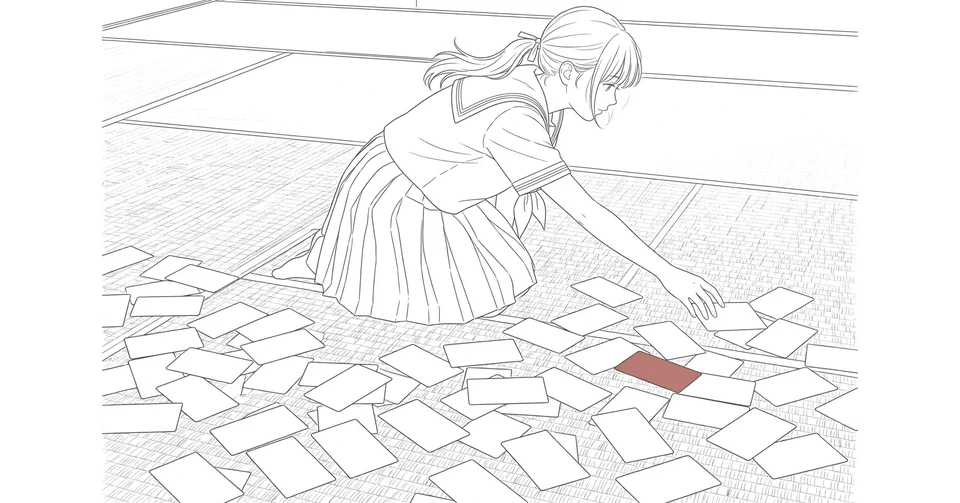
This article looks at how Chihayafuru works as a story, from its first chapter in a primary school classroom to its anime in three seasons and its three live action films, and at what happened to the real game after the manga found its readers. The poems at the centre of it all come from the hyakunin isshu, a collection of one hundred waka chosen by Fujiwara no Teika in the 1230s, and the game itself is explained in karuta turns a hundred poems into Japan's fastest card game.
A girl, a transfer student, and a hundred poems
Chihaya Ayase starts the story as a girl in the sixth grade who has never had a dream of her own. Her older sister is a model, and Chihaya has spent her childhood cheering from the sidelines, content to be the loud, cheerful sister of someone beautiful. Then Arata Wataya transfers into her class from Fukui prefecture. He is quiet, he is poor, and he is mocked by the other children, but he can play karuta with a speed and certainty that stops Chihaya in her tracks.
Arata introduces Chihaya and their classmate Taichi Mashima to the game, and the three of them play together through their last year of primary school. Then life does what it does to childhood friendships. Arata moves back to Fukui, Taichi drifts into a different world of grades and expectations, and Chihaya is left alone with a dream she only just found. The rest of the story is about getting the three of them back to the same table.
In high school, Chihaya starts a karuta club at Mizusawa High School, drags in new members one by one, and sets her sights on the national high school championship at Omi Shrine. Her personal goal is larger than any team trophy. She wants to become Queen, the title held by the best woman player in Japan. Arata, meanwhile, has stopped playing, weighed down by family trouble and guilt, and Taichi has to decide whether the game is worth the time it steals from his studies. Chihayafuru keeps all three of them moving toward the same championship from different directions, which is the oldest trick in sports storytelling, and it works here because each of them wants something different from the same game.
The title of the series comes from the seventeenth poem of the hyakunin isshu, by the courtier Ariwara no Narihira, which begins with the word chihayaburu. It is a pillow word, an old poetic epithet, and it can be translated as swift in fury or awesome. Chihaya's name echoes it, and the echo is deliberate. Chihayafuru is named after a single word from a single poem, and readers learn the poems alongside the heroine, one card at a time.
How Chihayafuru turns memorising into training
The hardest problem Yuki Suetsugu had to solve was making memorisation look dramatic. A sports manga usually has a ball to follow, a race to time, or an opponent to hit. Competitive karuta has a hundred poems, and a player wins by recognising a poem from its first syllables and taking the matching card before the opponent does. That is a contest of memory and hearing, and on the page it could easily look like two people staring at paper.
Suetsugu solves it by treating memory as a physical skill. Chihaya trains her ears the way a sprinter trains her legs. She practices her card placement, arranging the cards in her territory so that the ones she is likely to need sit closest to her hand. She learns the sound of each poem's opening, the kimariji, the deciding syllables that tell one card apart from another. Chihayafuru draws the moment of recognition as a physical event, a hand moving before thought catches up, and it draws the mistakes just as clearly, a finger brushing the wrong card and handing it to the other side.
The ranking system gives the training a shape. Players climb from Class E to Class A, and only Class A players can enter the qualifying rounds for the Master and Queen title matches. Chihaya's climb is slow and full of setbacks, and Chihayafuru is honest about what that costs. She injures a finger during a national tournament match and has to keep playing through the pain, and later she loses matches she should have won because her hearing, her greatest gift, lets her down. I find this honesty refreshing. A story that only showed its heroine winning would be a poster, not a story, and Chihayafuru is at its best when it lets Chihaya fail in front of people she respects and then shows her going back to practice the next day.
The club itself is part of the training. Mizusawa starts with five members who barely know the game, and each of them brings a different weakness to the table. One is slow but steady, one is brilliant but careless, one joins only because a girl he likes is in the club. Suetsugu gives each of them a reason to stay, and the team matches become the place where those reasons are tested. A team match in karuta is five individual matches played side by side, and Chihayafuru uses that format to cut between five small dramas at once, which keeps the tension high even when the cards on the table have not moved.
Rivals, injuries, and the long road to Omi Shrine
Every sports story needs rivals, and Chihayafuru has some of the best in the genre. Shinobu Wakamiya is the reigning Queen, the youngest in the history of the game, and she plays with a cold elegance that makes Chihaya look clumsy by comparison. Watching her is Chihaya's education. Hisashi Suou, the reigning Master, is older, quieter, and almost impossible to beat, and his matches are lessons in patience. There are also rivals Chihaya's own age, players from powerhouse schools like Hokuou and Fujisaki, who force Mizusawa to improve or go home.
Chihayafuru is structured around the calendar of the real game. The national high school championship is held every July at Omi Shrine in Otsu, and the Master and Queen title matches are held every January in the hall beside the same shrine. That rhythm gives the manga its seasons. A year of practice ends in a July tournament, a winter of qualifying ends in a January title match, and the characters grow older between one summer and the next. By the end of Chihayafuru, Chihaya has gone from a primary school girl to a university student, and the reader has watched her grow up in real time across fifteen years of serialisation.
The injuries matter because they are the price of the sport. Karuta looks gentle from the outside, but competitive players slam their hands onto tatami and cards at full speed, and fingers and wrists take the impact. Chihaya's finger injury is not a single dramatic scene but a long problem that changes how she plays, forcing her to rely on hearing and placement rather than speed. Taichi's struggle is different and quieter. He is talented, but he is also the kind of person who measures everything, and Chihayafuru asks whether a person who always calculates can ever play with the abandon the game demands. These are not the injuries of a boxing manga, but they hurt just as much, because they threaten the one thing each character wants most.
Suetsugu drew from her own life for this material. She belonged to a karuta club in high school, and she has said that the school years are the time when a person can dedicate the most genuine part of themselves to something. That experience shows in the small details, the way a club room smells of tatami, the way a reader's voice sounds in a quiet hall, the way a team celebrates a win that nobody outside the room would understand. Chihayafuru feels true because its author has sat on that floor.
Three seasons of anime and three films
Chihayafuru was serialised in Kodansha's Be Love magazine from December 2007 to August 2022, and it was collected in fifty volumes, with more than twenty seven million copies in circulation by the time the run ended. The count kept growing after the final volume, passing twenty nine million by February 2025. Chihayafuru won the second Manga Taisho award in 2009 and the 35th Kodansha Manga Award in the shojo category, and it was praised for combining the energy of a sports story with a serious respect for classical literature. The Anime News Network encyclopedia entry lists the full staff of the first season, and the Chihayafuru manga page on Wikipedia records the publication history and the adaptation dates in detail.
The Chihayafuru anime came from Madhouse, directed by Morio Asaka, and it aired on Nippon TV in three seasons. The first season ran for twenty five episodes from October 2011 to March 2012, the second for twenty five episodes from January to June 2013, and the third for twenty four episodes from October 2019 to March 2020, after a delay from its original spring 2019 slot. That is seventy four episodes plus an original video animation, and the long gap before the third season only made its return more anticipated. The anime is faithful to Chihayafuru's pace, letting a single match breathe across an episode, and its soundtrack gives the reader's voice a weight that print cannot.
The live action films took a different approach. Chihayafuru: Kami no Ku was released in March 2016, Chihayafuru: Shimo no Ku followed in April of the same year, and Chihayafuru: Musubi completed the trilogy in March 2018. Suzu Hirose played Chihaya, and the films condensed the high school story into three cinema outings that brought the game to audiences who had never read a manga. The films were popular enough to earn a five episode tie in series on Hulu Japan and, years later, a television drama sequel called Chihayafuru: Meguri, which premiered on Nippon TV in July 2025 and is set ten years after the films. A story about a card game now has a sequel, a spinoff manga that began in December 2023, and a drama continuation, which is a lot of afterlife for a series that began with a girl who had no dream of her own.
The real game changed after Chihayafuru
The most remarkable thing about Chihayafuru is what it did outside the page. Competitive karuta was a small world before the manga, known mostly to people who had played it at school or at New Year. After Chihayafuru and its anime, new players started turning up at clubs across Japan, and the game gained an audience abroad as well. The first international tournament was held in September 2012, with players from the United States, China, South Korea, New Zealand, and Thailand taking part, and in 2020 a new tournament, the Ogurayama Cup, was established to introduce fans to the joys of watching the game. A manga about a card game does not usually create a tournament, and that is a measure of how far the series reached.
The effect is easy to understand once you watch a match. Competitive karuta is genuinely thrilling to watch, because the whole contest happens in the silence between a syllable and a slap, and a single mistake can decide a match that has lasted an hour. What the game lacked was an audience that knew what to look for, and Chihayafuru gave millions of people exactly that. Readers learned the poems alongside Chihaya, so when they watched a real match, they recognised the cards and understood the stakes. Chihayafuru was a guidebook disguised as entertainment, and the guidebook worked.
There is a risk in a story like this, and it is worth stating plainly. A game can become a fashion and then fade when the fashion passes, and karuta has seen its popularity fall and rise more than once in its history. But Chihayafuru did something that a fashion alone cannot do. It showed the game from the inside, as a discipline, and it gave its readers a reason to learn the poems rather than only to watch the matches. A reader who memorises a poem because a character loves it has already joined the tradition, whether or not that reader ever kneels on a tatami mat. The poems do not care how you arrived. They only ask to be remembered.
The growth has lasted. Karuta clubs report new members who cite the manga as their reason for joining, the high school championship at Omi Shrine draws crowds that follow the storylines of the real players, and the international scene keeps growing, with world championships now bringing together teams from ten countries and more. Chihayafuru ended, but the game it celebrated is larger than it was before the first chapter appeared.
Why poetry works as a sports story
It is worth asking why this particular story works, because on paper it should not. A hundred poems from the seventh to the thirteenth century, written in classical Japanese that even native speakers have to study, do not sound like the raw material for a sports manga. Yet the poems are exactly what makes the sport work as drama.
A waka is thirty one syllables, and a karuta player has to know all hundred of them well enough to recognise each one from a few sounds. That means the contest is fought inside the players' heads before it is fought with their hands. Chihayafuru can show a character hearing the first syllables of a poem and, in the same instant, seeing the card across the table, remembering the poem's meaning, and feeling the pressure of the match. The poetry gives the sport an inner life that a ball game cannot offer, because every point in karuta is also a small act of remembering.
The poems also give the story its emotional range. The hundred verses cover love, parting, travel, the seasons, and the moon, and the characters in the manga attach their own feelings to particular cards. A poem about waiting becomes a card about a character who is waiting for a friend. A poem about parting becomes a card about a team that is about to split up. Suetsugu uses this quietly, letting a card mean one thing in a match and another thing in a character's life, and the double meaning is what makes the matches feel like more than a game.
There is also something to be said for the slowness of it. A karuta match is played in silence, broken only by the reader's voice, and Chihayafuru respects that silence. It does not fill every panel with shouting or speed lines. It lets the reader sit with the tension, the way a real audience sits in the hall at Omi Shrine, waiting for the next syllable. In a genre that often mistakes noise for excitement, that restraint is the bravest choice Chihayafuru makes.
Chihayafuru's real achievement is that it never apologises for its subject. It never suggests that karuta would be more interesting if it were faster, louder, or more like another sport. It insists that a game about memorising poetry is already dramatic, because the drama is in the people playing it, and the people are worth watching. Fifteen years, fifty volumes, and more than twenty seven million copies later, that insistence looks less like a gamble and more like good judgment.
If you have never watched a karuta match, start with the first episode of the anime and listen for the moment the reader begins a poem. You will hear a hall go quiet, you will see two players lean forward, and you will understand in a few seconds why a story about old poems can feel like a sport. The cards are small, the poems are old, and the silence between the syllables is where the whole game lives.
More in Music & Entertainment
Latest posts
- The Two Lives of Japanese Coffee
- Oshi-e Hagoita Turns Silk Into a Picture You Can Touch
- Hyakunin Isshu Gave Karuta Its Hundred Poems
- Hagoita Is the Paddle Japan Turns Into New Year Art
- Takoage Sends New Year Wishes Up on a Paper Kite
- Hanetsuki Keeps New Year in the Air With a Wooden Paddle
- Japanese Stationery and the Small Tools Japan Takes Seriously
- Karuta Turns a Hundred Poems Into Japan's Fastest Card Game
- Hatsuyume Is the First Dream Japan Reads Like a Fortune
- Japanese Manga and How It Became the World's Most Read Comics
- Toshikoshi Soba Is the Long Noodle Japan Eats at Midnight
- Hatsu-Hinode Is the First Sunrise Japan Wakes Up For
- Matsunouchi Is the Week Japan Keeps the Pine Up for Its Guest
- Osouji Is the Cleaning Japan Does Before the Gods Arrive
- Toshigami Is the Guest Japan Prepares the Whole House For