Japanese Arcades and the Game Centers That Refuse to Die
· 11 min read
Japanese arcades survived the death of the arcade everywhere else. Inside the multi-story game centers of Tokyo and Osaka, crane games, rhythm games and photo booths still pull in crowds every night.
Walk into a game center in Akihabara on a Friday night and the first thing that hits you is the sound. A hundred machines are singing at once, coins clatter into trays, a taiko drum thumps from the third floor, and somewhere near the entrance a crane game drops its claw with a soft mechanical sigh. Japanese arcades were supposed to die decades ago. Home consoles, then smartphones, were meant to finish them. Instead they grew taller, louder, and stranger, and they are still full.
Japanese arcades, called game centers or gesen in slang, are multi-story entertainment buildings where entry is free and you pay per machine, usually 100 to 300 yen a play. That simple formula hides something no other country has kept alive at this scale. Japanese arcades are not a nostalgia trip. They are a living business that reinvented itself around things a phone cannot do, and that is why they are still standing on the busiest streets in Japan.
What a Japanese arcade actually is
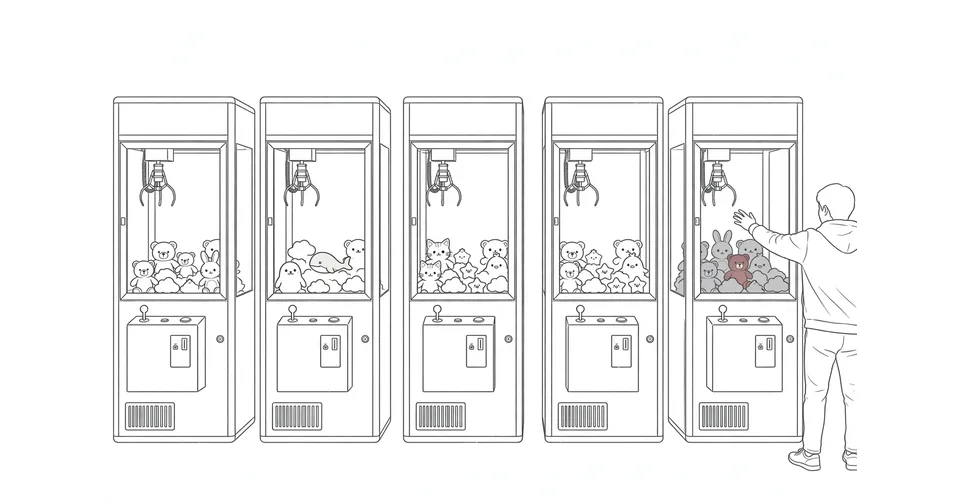
The first surprise for a first-time visitor is the layout. Japanese arcades are vertical. A typical game center in Tokyo has three to six floors, and the floors almost always follow the same order. The ground floor belongs to the crane games, rows of glass boxes filled with plush toys, anime figures, and snacks, placed at street level because they pull passersby inside. The middle floors hold the video games, racing simulators, fighting games, and the rhythm games where regulars do things that look physically impossible. One floor is usually given over to medal games, coin pushers and jackpot machines that run on tokens you cannot cash out. There is no gambling for money in Japanese arcades, even when a machine looks like a slot machine, and that line matters to how the whole place works.
The second surprise is who is inside. The old image of Japanese arcades as dark rooms full of teenagers is out of date. Office workers stop in after work, couples play crane games on dates, parents bring small children to the medal floor, and serious players in their thirties and forties compete on rhythm games with the focus of athletes. Japanese arcades survived because they stopped being a room for one kind of customer and became a building for everyone, open late, brightly lit, and safe enough that nobody thinks twice about walking in alone.
How the crane game took over
If one machine explains why Japanese arcades are still alive, it is the crane game. Japan calls it kuren gemu, and most people know it by the name UFO Catcher, after the Sega machine launched in 1985. The idea is older than that. Taito built the Crown 602 in 1965, the first crane game made in Japan, and Sega followed with the Skill Diga in 1966. The machines sat quietly in the background for years while video games had their boom. Then, in the 1980s, operators started using crane games as counterprogramming to video games, and it worked. By the 1990s, customers were queuing outside game centers to play them.
Today crane games bring in more than half of the revenue of many Japanese arcades, and the scale is hard to believe until you see it. The Guinness World Record for the most claw machines under one roof belongs to an arcade in Yokohama, Asobi Town, with 555 of them. The prizes are the trick. Under police guidelines, a prize must have a shop price of about 1,000 yen or less, a limit raised from about 800 yen in March 2022. The figures and plush toys inside the machines are usually arcade exclusives you cannot buy in a shop, which is exactly why fans keep feeding coins into the slot.
The machines are also designed to be winnable, or at least to feel winnable. Japanese arcades depend on repeat customers who trust the game, so the claw is calibrated to give a genuine chance, and staff will often reset a prize or nudge it into a better position if you ask. That honesty is part of the business model. A rigged machine earns once and loses the customer forever, and in a building full of alternatives, nobody comes back to a machine that cheats. For a deeper look at the machines themselves, the history of the crane game in Japan is told well by Japan Insider, which traces the Crown 602, the UFO Catcher, and the record-breaking Yokohama arcade in one place: https://japaninsider.com/japan-crane-games-ufo-catcher/
The rhythm game floor
Go up one or two floors and the mood changes. This is where Japanese arcades become a spectator sport. Dance Dance Revolution, launched by Konami in 1998, turned a dance floor into a game controller, and it still draws crowds who gather to watch a good player. Taiko no Tatsujin, the drum game from Namco, lets anyone pick up a pair of sticks and hit a giant red drum to the beat, and it is one of the friendliest machines in the building for a beginner because the rules need no Japanese at all.
The rhythm game floor is also where Japanese arcades show their competitive side. Fighting games, music games, and mahjong machines have regulars who play at a level that takes years to reach, and some of them travel between cities for tournaments held inside the arcades themselves. The machines are built for this. Specialized cabinets with force-feedback steering wheels, drum peripherals, and dance platforms are things a living room cannot copy, and that is the point. Japanese arcades survived the home console by offering hardware that only makes sense in a big shared room.
There is a quiet lesson in that for anyone who likes games. Japanese arcades did not try to beat the phone at convenience. It doubled down on the one thing the phone cannot give you, which is a room full of people reacting to what you just did. When a crowd gathers behind a rhythm game player, the game stops being software and becomes a small live performance, and that is worth 100 yen.
Purikura and the photo booth that became a culture
No floor in Japanese arcades is quite as strange to an outsider as the purikura corner. Purikura are photo booths that print sticker photos, and they grew out of the Print Club machines launched by Atlus and Sega in 1995. What started as a novelty became a youth culture of its own. The booths let you decorate the photo with stamps, frames, and handwritten notes, and the results are meant to be shared with friends, not kept as a record of what you actually look like.
The booths in Japanese arcades are designed with almost comic seriousness. Some have curtains for privacy, skin-smoothing filters, and eye-enlarging effects, and the whole ritual of posing, decorating, and splitting the printed sheet between friends is a social event in itself. Purikura remains an in-store experience with no home equivalent, which is the same logic that keeps the rest of Japanese arcades alive. If you can do it on your phone, Japanese arcades do not bother. If you cannot, that is where the arcade lives.
The chains that run the show
Four big names dominate Japanese arcades, and knowing them helps you choose where to go. Each chain has a slightly different personality, and regulars have strong opinions about which one is best for what.
| Chain | Known for | Where to find it |
|---|---|---|
| GiGO | Former Sega arcades, the biggest chain, best for rhythm games and crane games | Akihabara, Ikebukuro, Dotonbori |
| Taito Station | UFO catchers, retro Taito titles, the Space Invaders logo | Akihabara flagship, stations nationwide |
| Round1 | Huge multi-floor complexes with bowling, karaoke, and sports zones | Suburbs and big cities |
| Namco | Taiko no Tatsujin and character merchandise prizes | Shopping malls nationwide |
GiGO is the newest name with the oldest roots. GENDA acquired Sega's arcade operations and rebranded them as GiGO in 2022, and the name stands for Get into the Gaming Oasis. Taito Station is the other giant, with around 160 locations, and its Akihabara flagship spreads across several floors, two of them dedicated to crane games. Square Enix absorbed Taito in 2005, but the name and the little Space Invaders logo survived. Round1 is the outlier, less a game center than an entertainment complex, with arcade floors sitting above bowling lanes and karaoke rooms. Namco, part of Bandai Namco, is the one you are most likely to find inside a shopping mall.
The big chains of Japanese arcades cluster in the same neighborhoods for a reason. Akihabara has about a dozen arcades along Chuo-dori, and the densest game center area in Japan is still there, a short walk from the station. If you want one first stop, go to Akihabara after dark, when the neon is on and every floor is full. The electric town itself deserves a wander first, and my guide to the neighborhood explains how it grew from radio parts shops into the center of it all: https://bayu.id/read/akihabara-and-how-tokyo-s-electric-town-learned-to-sell-everything
How to play without wasting money
Japanese arcades are cheap to enter and easy to overspend in, so a few habits help. First, bring 100 yen coins. The base currency of the gesen is the 100 yen coin, and while some machines take IC cards, the coin slot is still the default. Change machines exist on every floor, and the 100 yen shop next door is a good place to break a 1,000 yen note if you need small change for the day: https://bayu.id/read/inside-japan-s-100-yen-shops-where-everything-costs-a-coin
Second, watch before you play. On a crane game, look at how the claw grips, whether the prize is wedged against the glass, and whether the machine lets you move the claw twice. Staff will help if you ask, and they will often tell you honestly when a prize is not winnable from its current position. Third, set a budget in your head before you start, and treat it like a ticket, not a challenge. The prize inside the machine is worth about 1,000 yen at most, so spending 5,000 yen to win it is a bad trade no matter how good the plush toy looks. A practical guide to claw machines, with prices, rules, and where to play in Tokyo and Osaka, is worth reading before your first visit: https://japanpocketguide.com/things-to-do/claw-machines-japan/
Fourth, remember that the best machines are not always the newest ones. The retro corner, usually tucked away on an upper floor, holds the old cabinets that built the culture of Japanese arcades: Space Invaders, which Taito released in 1978 and which legend says caused a shortage of 100 yen coins across Japan, and the fighting and shooting games that older players still gather around. Those corners are quieter, cheaper, and often the most interesting floor in Japanese arcades.
Why Japanese arcades still matter
There is a temptation to treat Japanese arcades as a curiosity, a loud leftover from another era that Japan forgot to throw away. I think that misses what actually happened. Arcades elsewhere died because they sold the same thing a home console sold, only worse. Japanese arcades survived because they changed what they were selling. They stopped selling games and started selling a place: a bright, noisy, shared room where a stranger will cheer when you finally win the plush toy, and where a teenager and a salaryman can stand at the same machine as equals.
That is a rarer thing than it sounds. Most public space in a big city is either a shop, where you are a customer, or a station, where you are passing through. A game center is neither. It asks nothing of you except a coin and a little patience, and it gives you a reason to stay. The machines will keep changing, the chains will keep rebranding, and the prizes will keep tracking whatever anime is popular this season. But the room itself, with its noise and its lights and its small daily dramas, seems in no hurry to go anywhere. Osaka, for its part, makes the same point with its own arcades in Dotonbori and Namba, where a new three-floor flagship opened in 2024 and filled up immediately: https://www.osakatourism.org/osaka-arcades/
If you go, go at night, bring a pocketful of 100 yen coins, and give yourself one rule: when the coins are gone, the game is over. Japanese arcades have lasted this long because they know exactly what they are, and the fastest way to understand them is to stand inside one and listen.
More in Culture & Society
- A Shimekazari Hangs the New Year Over the Front Door
- Make-Koshi Is the Eight Loss Line That Sends a Sumo Wrestler Down
- Danpatsu-Shiki Is the Haircut That Ends a Sumo Career
- Kachi-Koshi Is the Eight Win Line That Moves a Sumo Wrestler Up
- Tachiai Is the One Second That Decides a Sumo Bout
- A Gunbai Points at the Winner and Nobody Argues
Latest posts
- Izakaya, the After-Work Pubs Where Japan Unwinds
- Dondo-Yaki Is the Fire That Closes the Japanese New Year
- Hakkeyoi Is the Word That Starts a Sumo Bout
- A Yobidashi Calls the Wrestlers and Sweeps the Ring
- A Dohyo Is Sacred Ground Long Before the First Bout
- A Kadomatsu Guards the Door Until the New Year Fire
- A Shikona Gives a Wrestler His Second Name
- Japanese Street Food, From Takoyaki Stalls to Festival Yatai
- Komusubi Is the Smallest Chair at Sumo's Top Table
- A Sekiwake Waits One Win From Sumo's Highest Door
- Tanabata Festival and the Star-Crossed Lovers Behind the Bamboo Wishes
- A Maegashira Climbs the Numbered Ladder One Bout at a Time
- An Ozeki Stands One Step From the Top and Cannot Afford to Slip
- An Oyakata Is the Father a Sumo Stable Cannot Replace
- A Tokoyama Spends Ten Years Learning to Dress a Topknot