Oshi-e Hagoita Turns Silk Into a Picture You Can Touch
· 19 min read
An oshi-e hagoita is a wooden paddle dressed in padded silk, and this article explains how the raised picture is built, where the craft began in Edo, and how to judge a fine one.
Hold an oshi-e hagoita in your hands and the first surprise is how light it feels for something that looks so rich. The paddle is paulownia wood, pale and soft to the touch, and the picture on its face rises toward you in shallow relief. A kabuki actor in a bright robe, a beauty in a long sleeved kimono, or a scene from a famous play seems to lean out of the wood. You want to run a finger along the folds of the sleeve, and that small urge is the whole point of the craft. An oshi-e hagoita is not a painting you look at from a distance. An oshi-e hagoita is a picture you can almost touch.
The word oshi-e means a pressed or pushed picture, and the technique is exactly what the name suggests. Cloth is cut into small pieces, stuffed with cotton wadding, and pasted onto the paddle in layers until a flat design becomes a low relief. The result is a kind of soft sculpture made from silk, cotton, paper, and thread. In Tokyo the craft is known formally as Edo oshi-e hagoita, and the Tokyo Metropolitan Government certified it as a traditional craft on July 15, 1985. The main workshops still stand in the old downtown wards of Sumida, Koto, and Katsushika, not far from the river and the temple markets where oshi-e hagoita have been sold for centuries.
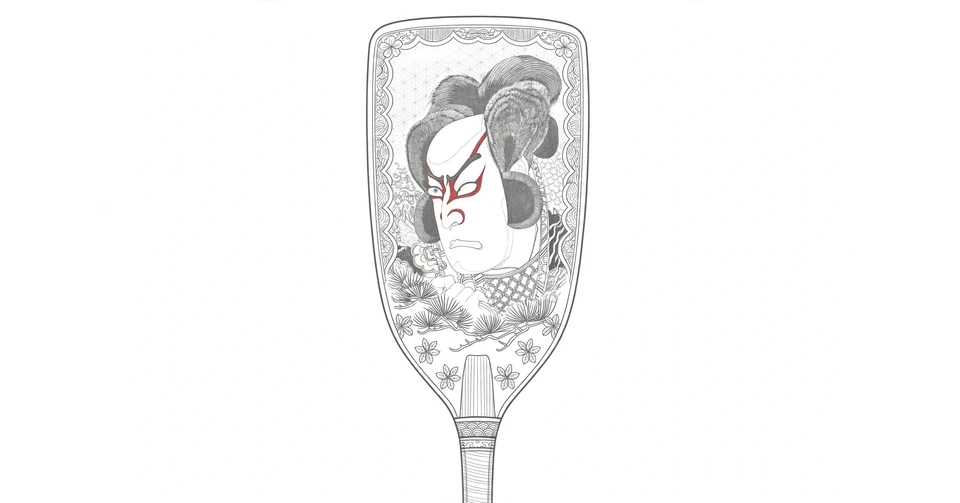
Most visitors to Japan meet the oshi-e hagoita first as a New Year decoration, and that is a good place to start. The hagoita began as the paddle for hanetsuki, a New Year game a little like badminton, played with a shuttlecock of soapberry seeds and feathers. Over time the playing paddle became a lucky charm, given to girls for their first New Year with a prayer for sound health. You can read the story of that game and its charm in our article on the paddle Japan turns into New Year art. The oshi-e hagoita is the most elaborate branch of that story, the point where a piece of sporting equipment became a small stage for the theatre of Edo.
What makes an oshi-e hagoita different from an ordinary decorated paddle is the depth. A painted paddle shows you a picture. An oshi-e hagoita builds the picture up from the surface, piece by piece, until the sleeve of a kimono casts a real shadow and the fold of a robe has a real edge. The effect is gentle rather than dramatic. Nothing sticks out more than a few millimetres, yet the whole face of the paddle feels alive, as if the figure is stepping forward to greet you. I think that restraint is what makes the craft so charming. It never shouts. It invites you closer, and the closer you look, the more you find.
What an oshi-e hagoita actually is
At its simplest, an oshi-e hagoita is a paulownia paddle carrying a padded collage. The Tokyo Metropolitan Government describes the technique plainly: cotton wadding is stuffed between a stencil outline and a fabric base, and the finished collage is fixed to the paddle with paste using a spatula. That short description hides a great deal of handwork. Every element of the picture is made separately, shaped, backed with Japanese paper, and then assembled on the board like a puzzle in which each piece has its own height and curve.
The materials are modest, and that modesty is part of the tradition. Paulownia wood forms the paddle because it is light, fine grained, and easy to shape. Silk and cotton textiles make up the picture itself. Cotton wadding gives the picture its lift. Silk thread becomes the hair of the figures. The official list of traditionally used raw materials names exactly these four, and a fine oshi-e hagoita uses nothing fancier. Gold leaf and silver foil appeared on some extravagant paddles in the past, but the heart of the craft is cloth and cotton, not precious metal.
The shape of the oshi-e hagoita matters too. It is a near trapezoid, wider at the top and narrower toward the handle, and the craftsman must fill that shape with a composition that feels balanced. The Tokyo craft page notes that design craftsmen work on their plans after seeing the real dramas staged, because the poses and gestures of kabuki and traditional dance are difficult to reproduce from imagination alone. A good oshi-e hagoita therefore carries a little of the theatre inside it, not just a picture of it. The actor leans, the dancer turns, and the cloth follows the movement.
How a raised picture is built, step by step
The making of an oshi-e hagoita begins long before any cloth is cut. First the design is sketched on the paulownia board, and the composition is planned so that the figure fills the paddle without crowding it. The face is the centre of the whole design, and everything else, the sleeves, the fan, the hair ornaments, the folds of the robe, is arranged to support it. A design that looks simple from a distance usually turns out to have dozens of separate pieces when you look closely.
Next comes the cutting. Each piece of the picture is cut from silk or from paper backed fabric, following the outline of the sketch. Then the padding begins. Cotton wadding is placed between the stencil outline and the fabric base, and the piece is shaped with a spatula and paste until it holds a soft curve. A sleeve is not flat cloth. It is cloth with a little hill of cotton inside it, pressed into the shape of a fold. A cheek is a small mound. A petal is a curve. Each piece is finished on its own, with Japanese paper pasted to its back, and only then is it fixed to the paddle.
The layering is where the skill of the oshi-e hagoita maker shows. The pieces are pasted onto the board one at a time, from the back of the picture toward the front, so that each layer overlaps the one beneath it in the right order. A robe lies under a sash. A hand rests over a sleeve. A hair ornament sits on top of the hair. The craftsman works with a spatula and paste, smoothing each piece into place and pressing the edges down so that no seam shows. When the layering is done, the picture has a real depth, shallow but unmistakable, and the light falls across it the way light falls across a relief carving.
The face is made last, and it is made differently from everything else. The surface is smoothed with successive layers of gofun, a powder made from crushed seashells, until it is as even as porcelain. Then a fine tipped brush paints the eyes, the mouth, and the nose. The hair is laid in with silk thread, strand by strand. In the workshops of Tokyo this face work is sometimes a separate speciality, and the saying among craftsmen is that the face decides the paddle. A beautiful face can carry a modest composition. A careless face can sink the finest cloth work.
The face that decides everything
It is worth pausing on that saying, because it explains so much about how an oshi-e hagoita is judged. The face of a figure in an oshi-e hagoita is tiny, often no bigger than a thumb, yet it carries the whole expression. The eyes must sit at exactly the right height. The line of the mouth must suggest the character, proud for a hero, gentle for a beauty, sly for a villain. The gofun surface must be smooth enough that the brush lines stay clean. There is no room to hide a mistake at this scale, and no way to paint over one without starting again.
The faces also change with fashion. The Tokyo craft page observes that craftsmen reflect changing fashions on the faces of their figures, seeking beautiful and vivid expressions. A beauty painted in one decade may have a slightly different brow or a different shade of lip from a beauty painted in another. Collectors learn to read these small changes the way readers of old woodblock prints learn to read the style of an era. The face is not only a portrait. It is a date stamp, a signature, and a small piece of social history.
I find this the most moving part of the oshi-e hagoita craft. Everything else about an oshi-e hagoita can be learned by practice, cutting, padding, pasting, layering, but the face asks for something closer to portraiture. The craftsman must know the actor, or at least know the role, well enough to catch the expression in a few brush strokes. That is why the best workshops send their designers to watch the plays. They are not copying a costume. They are trying to remember how a particular actor holds his chin when he is angry, or how a dancer lowers her eyes at the end of a scene.
From Edo streets to the kabuki stage
The oshi-e hagoita did not appear all at once. It grew out of older ways of decorating a paddle, and the Tokyo craft page traces that growth with a patience that suits the subject. In ancient times the paddles were known by older names such as Kogiita and Hanekoita, and the shuttlecocks had their own names too. A record from the fifth day of the first month in the fourth year of the Eikyo era describes the imperial family and the aristocracy gathering at a palace to play the game in teams of men and women. The paddle was already a social object then, not just a toy.
As the centuries passed, decoration became more elaborate. One early style, called kaki-e hagoita, had pictures drawn directly on the surface of the paddle. Another, called hari-e hagoita, fixed paper and cloth to the paddle. There were also extravagant sagicho hagoita coloured with gofun, some inlaid with gold and silver leaf or decorated with maki-e lacquer. Each style pushed the oshi-e hagoita a little further from the game and a little closer to art. When the Edo period began in 1603, craftsmen started sticking material to thick cardboard backings and using cotton wadding to add thickness, and from those methods the oshi-e technique developed.
The great leap came in the Bunka and Bunsei eras, from 1804 to 1829, when the culture of the common people of Edo flowered and kabuki boomed. Woodblock artists were publishing prolifically, and the faces of famous actors were everywhere in the city. Advances in the oshi-e technique made it possible to put those likenesses on a paddle, and the genre called yakusha hagoita, the actor paddle, was born. The Tokyo craft page tells us that as each year drew to a close there was competitive demand for the role depictions of that year popular kabuki stars, and the sale of these paddles acted as a barometer of an actor popularity. In other words, an oshi-e hagoita was the Edo equivalent of a poster, a fan magazine, and a popularity chart, all in one object you could hang on the wall.
The idea for the padded style is believed to have originated in the late Edo period, sometime between 1804 and 1830, which matches the Bunka and Bunsei flowering exactly. A workshop in Sumida Ward called Hagoita no Kogetsu, profiled by The Mainichi, still works in this tradition. Its second generation master spent forty years specialising in the craft, and its main products are wooden paddles measuring around sixty centimetres. The method, the newspaper wrote, has basically been preserved since its development in the Edo period. That continuity is rare, and it is worth respecting. A craft that survives by changing a little each generation, rather than by freezing itself, has a better chance of lasting.
The Hagoita-ichi market at Senso-ji
If you want to see an oshi-e hagoita in its natural setting, go to Asakusa in December. Every year from December 17 to 19, the grounds of Senso-ji Temple fill with stalls selling paddles of every kind, and the finest oshi-e hagoita are the stars of the show. The market is called Hagoita-ichi, the paddle market, and it is part of the older year end fair known as Toshi-no-Ichi. The temple fair day of Kannon, the principal image of Senso-ji, falls on the 18th of every month, and the last one of the year is called Osame no Kannon. The market gathers around that day, and the whole temple precinct turns into a celebration of the year ending and the new one approaching.
The scale of the market is part of its charm. Dozens of stalls line the grounds, each with its own oshi-e hagoita designs and kimono patterns, and the paddles stand in rows like a crowd of small actors waiting for their cue. The colourful oshi-e hagoita, often showing kabuki actors, are the highlight, but there are also novelty paddles showing the news and celebrities of the year, and a zodiac paddle sold only during the market by the preservation society. Browsing alone is a pleasure, because no two stalls are quite the same. When you buy a paddle, the sellers send you off with rhythmic hand clapping, a small ceremony that turns a purchase into a blessing.
The market has deep roots. According to the city tourism bureau, it dates back to the Edo period and has continued for about 360 years without a break, even through the Great Kanto Earthquake and the war years. In the Edo period, paddles painted with kabuki actors faces were sold at the year end market, and by the late Edo period the hagoita stalls stood out. From the Edo era to the Taisho era, giving a paddle to a family with children at year end became a custom, and by the mid Showa era the fair was known as the Hagoita Market. For this year, the market runs from December 17 to 19, opening at 9 in the morning and closing at 7.30 in the evening, or 7 on the final day. You can check the current Hagoita Market listing for the exact hours before you go.
Standing in that market, it is easy to understand why the craft has survived. An oshi-e hagoita is not kept behind glass in a museum. It is sold in the open air, in the cold, among food stalls and crowds, to families buying a charm for a new baby and to collectors hunting for the face of a favourite actor. The craft lives because it is still used, still given, still argued over at a stall. A tradition that only survives in a display case is a memory. A tradition that survives in a market is a habit, and habits are harder to kill.
How to tell a fine one from a cheap one
Not every paddle with a raised picture is a fine oshi-e hagoita, and learning to tell the difference is part of the pleasure of collecting. The first thing to look at is the face. On a good oshi-e hagoita the gofun surface is smooth and even, the eyes are level, and the expression is clear. On a cheap one the face looks flat or lumpy, the features sit slightly off, or the paint looks hurried. Remember the craftsman saying: the face decides the paddle. Start there, and you will rarely go wrong.
Next, look at the cloth. On a fine oshi-e hagoita the silk has a soft sheen and the colours are clear, even in the smallest pieces. The edges of each piece are tucked and pasted cleanly, with no fraying and no glue showing. The padding should feel even when you look at it from the side. A sleeve should rise in a smooth curve, not a sudden bump, and the layers should overlap in a natural order, like real clothing. On a cheap paddle the padding is often uneven, the pieces are cut roughly, or the cloth looks thin and dull. Mass produced paddles sometimes use printed fabric instead of layered pieces, and the picture, though colourful, has no real depth when you tilt it toward the light.
Then look at the composition of the oshi-e hagoita. A good oshi-e hagoita fills the paddle without crowding it. The figure has room to breathe, and the empty space around the figure feels deliberate. The pose should make sense: a hand holding a fan, a sleeve falling the way a sleeve falls, a head turned at an angle the body can actually manage. A poor composition feels cramped or stiff, as if the figure was squeezed onto the board. The Tokyo craft page notes that craftsmen use the maximum area of the near trapezoidal board to express dynamics, and that ambition shows. A fine paddle feels like a small stage. A cheap one feels like a picture pasted on a board.
Finally, look at the back and the handle. A well made paddle is finished on the back too, often with a simple paper or cloth covering, and the handle is smooth and comfortable in the hand. The wood should be light, with a fine grain, and the paddle should feel balanced. Price is a rough guide but not a reliable one: a small fine paddle can cost less than a large showy one, and a famous workshop name adds value only when the work itself is good. Trust your eyes first. If the face is beautiful, the cloth is clean, and the composition breathes, you are probably holding a good oshi-e hagoita.
There is one more test, and it is the simplest. Tilt the paddle slowly under a light and watch the shadows move across the relief. On a fine oshi-e hagoita the shadows shift gently, and each fold of cloth reveals itself in turn. On a flat imitation nothing changes. That moving shadow is the signature of the craft, and no printer can fake it.
Why the craft survives
Crafts die for many reasons, and the survival of the oshi-e hagoita is not an accident. Three things protect the oshi-e hagoita. The first is the market. As long as families buy a paddle for a girl first New Year, and as long as the Hagoita-ichi fills the grounds of Senso-ji every December, there is a reason to keep making them. The second is the theatre. As long as kabuki has stars, there will be faces worth putting on a paddle, and as long as collectors follow those stars, there will be buyers who can tell a fine face from a poor one. The third is the certification itself. When Tokyo certified Edo oshi-e hagoita as a traditional craft in 1985, it gave the workshops a name, a standard, and a reason to train the next generation properly.
But there is a quieter reason too, and it matters more than the others. An oshi-e hagoita is a slow object in a fast city. It takes many steps to make, many materials, and many hours of handwork, and it cannot be hurried without showing it. In a year when everything else arrives instantly, an object that asks for patience has a strange kind of value. People buy it not because they need a paddle, but because they want something made by a person who took the time. I think that is why the craft will outlast many louder traditions. It does not compete with the new. It offers something the new cannot give.
The workshops face real pressures, of course. Silk is expensive. Young craftsmen need years of training before their faces are good enough to sell. The market lasts only three days a year, and a workshop must earn enough in those days, and in orders through the year, to survive. Some workshops have adapted by making smaller paddles for desks and walls, and by taking commissions from kabuki fans who want a particular actor in a particular role. That adaptation is healthy. A craft that only repeats the past becomes a museum piece. A craft that finds new sizes and new buyers, while keeping its technique honest, stays alive.
A picture you can touch
The best way to understand an oshi-e hagoita is to stand in front of one and let your eyes travel slowly across the relief. Start at the face, small and smooth and carefully painted. Follow the line of the silk hair down to the shoulders. Watch how the sleeve rises from the board, how the sash crosses the robe, how the fan opens in the hand. Notice the shadows, shallow and soft, that give the oshi-e hagoita its depth. Then step back and see the paddle as a whole, a piece of paulownia wood that a craftsman turned into a small theatre.
It began as a game. The paddle once hit a shuttlecock across a New Year courtyard, and the game itself, hanetsuki, is still played and still loved. You can read about how hanetsuki keeps the New Year in the air to see where the paddle started. But the oshi-e hagoita went further than the game. It took the paddle and made it into a portrait, a charm, and a record of the actors and beauties of Edo, all in silk and cotton no thicker than a fingertip.
I keep coming back to the touch of an oshi-e hagoita. Most art asks you to look and not touch. An oshi-e hagoita asks you to look closely enough that you almost feel the cloth, and the almost is the point. The picture is raised just enough to catch the light and the eye, and just flat enough to hang on a wall. It is a small, patient answer to a loud world, and it has been giving that answer for more than two centuries. If you ever find yourself in Asakusa in mid December, go and look. The faces will be waiting in rows, and one of them will catch your eye, and you will understand, without anyone explaining it, why people have been buying these paddles for so long.
More in Culture & Society
- Hyakunin Isshu Gave Karuta Its Hundred Poems
- Hagoita Is the Paddle Japan Turns Into New Year Art
- Takoage Sends New Year Wishes Up on a Paper Kite
- Hanetsuki Keeps New Year in the Air With a Wooden Paddle
- Karuta Turns a Hundred Poems Into Japan's Fastest Card Game
- Hatsuyume Is the First Dream Japan Reads Like a Fortune
Latest posts
- The Two Lives of Japanese Coffee
- Chihayafuru Made a Card Game Feel Like a Sport
- Japanese Stationery and the Small Tools Japan Takes Seriously
- Japanese Manga and How It Became the World's Most Read Comics
- Toshikoshi Soba Is the Long Noodle Japan Eats at Midnight
- Hatsu-Hinode Is the First Sunrise Japan Wakes Up For
- Matsunouchi Is the Week Japan Keeps the Pine Up for Its Guest
- Osouji Is the Cleaning Japan Does Before the Gods Arrive
- Japanese Anime and How a Niche Hobby Conquered the World
- Toshigami Is the Guest Japan Prepares the Whole House For
- Urajiro Is the Fern That Wishes a Family Twice Over
- A Shimekazari Hangs the New Year Over the Front Door
- Make-Koshi Is the Eight Loss Line That Sends a Sumo Wrestler Down
- Japanese Arcades and the Game Centers That Refuse to Die
- Danpatsu-Shiki Is the Haircut That Ends a Sumo Career