Kabuto Gave the Samurai a Helmet Worthy of His Sword
· 17 min read
The kabuto was far more than a steel bowl on a samurai's head. It was armour, identity, and theatre, shaped over six centuries from riveted plates into a work of art.
A samurai's sword gets the glory, but his helmet did the talking before the blade ever left its sheath. The kabuto was the first thing an enemy saw across a battlefield, and it was the last thing a samurai put on before a fight. It guarded his head, carried his crest, and told everyone in sight exactly who he was.
In Japanese, the word kabuto can refer to any combat helmet, yet the rest of the world knows it as the samurai helmet. It grew from simple iron bowls found in 5th century tombs into one of the most recognisable objects in Japanese culture. Six centuries of war, craft, and ceremony turned a piece of armour into art, into a family treasure, and into a decoration that still appears in Japanese homes every spring.
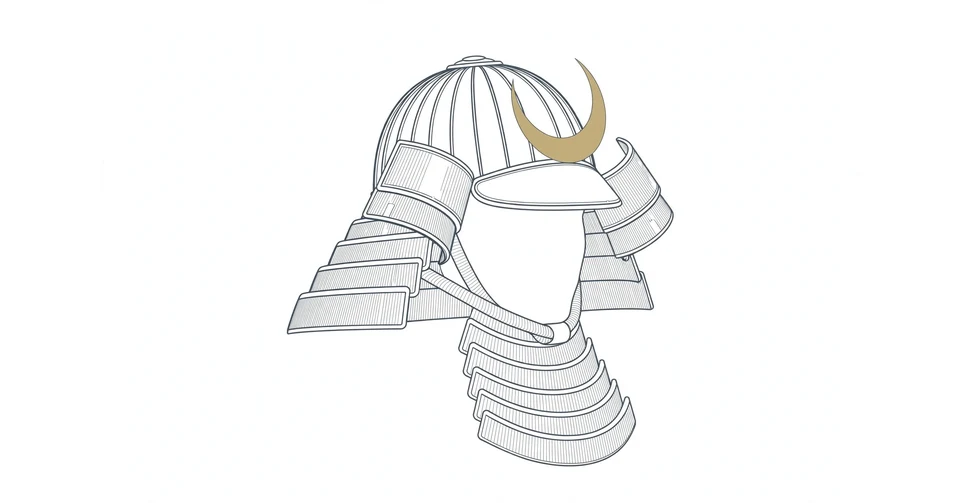
The story of the samurai hairline explains the problem the helmet had to solve. A samurai helmet, the kabuto, was heavy, and it had to sit steady on the head in battle. That single demand shaped every plate, cord, and crest that followed, and it is the reason the kabuto looks the way it does. A helmet that slides at the wrong moment is worse than no helmet at all, so the men who made it spent centuries perfecting the fit, and the men who wore it treated it as part of themselves.
What a kabuto actually is
At its simplest, it is a domed helmet with a neck guard. At its finest, it is a small building of iron, lacquer, silk, and gold, assembled by families of armourers whose names were signed on the work the way a painter signs a canvas. The earliest Japanese helmets date from the 5th century, when a style called mabizashi-tsuke kabuto arrived from China and Korea with a pronounced central ridge. The samurai kabuto as we know it first appeared in the 10th century, in the Heian period, alongside the great boxy armour called o-yoroi. From that point on, the helmet belonged to the samurai class and their retainers, and it stayed with them for nearly nine hundred years.
It was never a single piece of metal. It was a kit of parts, each with a job and a name, and understanding those parts is the quickest way to read a helmet the way a samurai would have read it. The full list of parts is long, but the pieces that matter most are the bowl, the neck guard, the crest, and the cord, and each of them has a story of its own.
The parts of a kabuto
The heart of the helmet is the hachi, the dome. It is made of overlapping elongated plates called tate hagi-no-ita, riveted together and arranged vertically, radiating from a small opening at the top. A typical hachi used anywhere from three plates to more than a hundred, and the way the rivets were finished gave each helmet its character. A hoshi-bachi, or star bowl, kept its rivet heads raised and proud. A suji-bachi filed the rivets flat but left raised ribs where the plates met. A hari bachi filed everything flush, so the dome looked smooth and unbroken. Some of the finer hachi were signed by their makers, usually from one of several known families, such as the Myochin, Saotome, Haruta, Unkai, or Nagasone families, and a signature like that was a promise of quality.
At the very top of the hachi sits a small opening called the tehen, usually fitted with an ornamental grommet called tehen kanamono, often worked to resemble a chrysanthemum. The opening is also known as the hachimanza, the seat of Hachiman, the war god. It was once thought to be there so the warrior's topknot could pass through, although that practice was largely abandoned after the Muromachi period. The opening may have been kept for ventilation, or simply because it was a natural result of the way the plates were riveted together. Either way, it became one of the most quietly beautiful details on the whole helmet, a small flower of soft metal at the crown.
Below the bowl, a brim called the mabizashi shades the forehead, and wing-like projections called fukigaeshi flare out to the sides. The cloth lining inside the hachi is the ukebari, and it is the part that touched the wearer's head, which is why its comfort mattered as much as any plate. At the back of the hachi, a ring called the kasa jirushi no kan held a small helmet flag, so a commander could be spotted from behind as well as from the front.
The part that does the most quiet work is the shikoro, the suspended neck guard. It is usually made of three to seven semicircular lames of lacquered metal or oxhide, articulated by silk or leather lacing so it can flex as the wearer turns his head. Some shikoro were far more elaborate, built from a hundred or more small metal scales in a row, and some were made of mail sewn to a cloth lining. The shikoro had to stop a downward cut at the neck without locking the head in place, and that balance between protection and movement is the whole craft of the helmet in miniature.
The crests are what most people remember. A kabuto can carry a maedate at the front, wakidate at the sides, a kashiradate at the top, and an ushirodate at the rear. Together they are called datemono, or tatemono, and they could be a family crest, an animal, a mythical creature, or a prayer made solid. Horns are particularly common, and many kabuto carry kuwagata, stylised antlers that sweep out from the bowl like the horns of a stag beetle. Mounting points called tsunamoto held the crests in place, so a crest could be changed without rebuilding the helmet.
| Part | What it does |
|---|---|
| Hachi | The domed bowl of riveted plates that covers the crown |
| Tehen | The small opening at the top, often dressed with a chrysanthemum grommet |
| Mabizashi | The brim or visor that shades the forehead |
| Shikoro | The suspended neck guard of overlapping lames |
| Fukigaeshi | The wing-like projections at the sides of the bowl |
| Maedate | The front crest, the most visible mark of identity |
| Shinobi-no-o | The chin cord that holds the helmet steady |
The last item on that list deserves more attention than it usually gets. The shinobi-no-o is the chin cord that secures the helmet to the head, usually tied under the chin or fastened to the wearer's face armour. A Japanese proverb, katte kabuto no o wo shimeyo, means literally to tighten the string of the kabuto after winning the war, and it warns against relaxing after success. The English equivalent would be not to rest on your laurels. The cord was a small thing, but it carried a large idea, that victory is the moment to be most careful, not least. Another old expression, kabuto wo nugu, to take off the kabuto, meant to surrender, because removing the helmet was the visible sign that a fight was over.
The menpo, the face the helmet did not cover
The kabuto protects the crown, the sides, and the back of the neck, but it leaves the face open. That opening was covered by a separate piece called the menpo, a mask of facial armour that guarded the cheeks, chin, and jaw. The same chin cord that held the kabuto often secured the menpo as well, so the two pieces worked as a pair, and putting on a full set of armour meant assembling the face along with the head.
I find the menpo telling, because it shows that the samurai understood a helmet as a system rather than a single object. The bowl stopped blows from above, the shikoro stopped cuts to the neck, and the menpo stopped cuts to the face, and each piece was made by a different hand and fitted to the wearer. The helmet was the centre of that system, the piece the rest of it hung from, and that is why it carried the crest and the cord and the name of the man inside it.
How a kabuto sat on a shaved head
It did not sit on ordinary hair. The samurai shaved the front of his head and tied the rest into a topknot, a style that balanced heat, hygiene, and the practical need to keep hair out of the way under a heavy helmet. The chonmage gathered the hair into a tight knot that helped anchor the helmet, and the shaved pate gave the lining a stable surface to rest on. The old idea that the topknot passed through the tehen opening may explain why the opening was there at all, even though the practice faded after the Muromachi period and the opening stayed on as a mark of tradition.
There is a simple lesson in that fit. A helmet is not only judged by how much force it can take, but by how still it stays while its owner moves, and the samurai solved that problem by shaping the head itself to the helmet. The lining, the cord, and the hairstyle were all part of the same answer, and none of them would have worked alone. A modern helmet designer would recognise the logic at once, even if the tools have changed.
From dozens of plates to three: how war changed the helmet
For the first centuries of its life, the helmet was built the slow way. Until the early Muromachi period, a helmet was made by combining dozens of thin iron plates, and only daimyo and samurai of commander rank wore the crest ornaments called datemono, which were shaped like a pair of hoes. In the middle of the Muromachi period, as large group battles became more common, ordinary samurai began to wear datemono in the shape of a hoe, the sun, the moon, or their flag on their kabuto, to show their courage and to distinguish friend from foe in the crush of battle.
Then the 16th century changed everything. The scale of war grew, and the matchlock guns called tanegashima spread across Japan, and the old o-yoroi and do-maru armours became outdated almost overnight. The answer was a new style of armour called tosei-gusoku, and its helmet was made by combining only three or four pieces of iron plate. These helmets were more bulletproof than the old style and could be mass produced, which mattered when armies were suddenly counted in tens of thousands rather than hundreds. The history of Japanese armour shows the same pattern across the whole suit, lighter, simpler, and made to be produced quickly, because the gun had changed what armour was for.
In the Azuchi-Momoyama period that followed, the tosei-gusoku kabuto took on a simple and bold design, in keeping with the confident culture of the age. The plain bowl was a practical answer to a practical problem, but it left the samurai with a new problem of their own. If every kabuto now looked the same, how would anyone know who you were?
The strange helmets
The answer was the kawari kabuto, the strange helmet. To offset the plain, utilitarian form of the new helmet, and to give its wearer visibility and presence on the battlefield, armourers began to build fantastic shapes on top of the simple bowls. Many were made in harikake, a technique of papier-mache mixed with lacquer over a wooden armature, although some were constructed entirely of iron. The shapes mimicked forms from Japanese culture and mythology, including fish, cow horns, the head of the god of longevity, bolts of silk, head scarves, the Ichi-no-Tani canyon, and axe heads. Some were rendered realistically, while others had an almost futuristic feel, and a kawari kabuto shaped like an octopus, made in the 18th century, now sits in the Stibbert Museum.
There is something wonderfully human in this turn. The moment the helmet became standard, the samurai made it personal again, and they did it with paper and lacquer rather than iron, because the crest only had to survive a day of battle and be seen from a distance. A paper crest was lighter, cheaper, and safer than an iron one, since a heavy ornament could injure the wearer if it caught a blow, and it could be as large and as strange as the wearer's imagination allowed. The helmet had begun as protection and become a uniform, and the kawari kabuto turned the uniform back into a portrait.
Famous helmets and the men who wore them
A few helmets are so famous that they have outlived the men who wore them and become symbols of whole cities. The best known belongs to Date Masamune, the daimyo of Sendai, who lived from 1567 to 1636. His black lacquer five-piece cuirass armour, designated an Important Cultural Property of Japan, is held by the Sendai City Museum, and its helmet carries a sweeping gold crescent moon as its maedate. The crescent is still the emblem of Sendai, and it appears on statues, souvenirs, and festival dress across the city. The armour is shown to the public only for limited periods each year, to protect the fragile lacquer and silk from light and wear.
Another fine example is a gusoku kabuto attributed to Sakakibara Yasumasa, from the Edo period in the 17th century, held by the Tokyo National Museum and designated an Important Cultural Property. It is a quieter helmet than Masamune's, and that is part of its interest. Not every famous kabuto shouted, and the ones that whispered often belonged to men who did not need to be noticed, because their reputation had already arrived before them.
These helmets survive because families, shrines, and museums kept them when the age that made them ended. Tokugawa Ieyasu, the founder of the shogunate, owned dozens of suits of armour, which are now held by Kunozan Toshogu, Nikko Toshogu, Kishu Toshogu, the Tokugawa Art Museum, and the Tokyo National Museum, among others. A helmet that once rode into battle now sits behind glass, and the journey from one to the other is the story of Japan itself.
Peace turned the helmet into a status symbol
The kabuto changed its job in the Edo period. After the Tokugawa shogunate defeated the Toyotomi clan in the Summer Siege of Osaka, Japanese society became more peaceful, and medieval armour styles were revived. O-yoroi and do-maru style kabuto were made again, not because anyone expected to wear them into battle, but because they spoke of lineage, and of a past that the new peace wanted to remember. Ornamental kawari kabuto were made in this period with figures of animals, kami, and various other objects mounted on top of them, and the list of materials grew to include iron, gold-copper alloy, lacquer, leather, silk, wood, gesso, and bone.
The samurai of the Edo period continued to wear plate and lamellar armour as a symbol of status, long after the battlefield had stopped demanding it. A helmet in a lord's hall said that his family had fought, that it remembered how to fight, and that it still held the rank its ancestors had earned. The helmet had become a certificate written in iron and lacquer, and the more elaborate it was, the clearer the message. Armour continued to be worn and used until the Meiji era in the 1860s, and the last use of samurai armour came in 1877, during the Satsuma Rebellion, when the old world made its final stand.
I think there is a gentle irony here that the samurai themselves would have recognised. The kabuto reached its greatest beauty only after it stopped being needed, when armourers were free to make helmets that no one would ever bleed in. The objects that survive in museums today are mostly the peacetime ones, the gorgeous ones, and that is worth remembering when we picture a samurai. The working helmets were used hard, repaired, and worn out. The beautiful ones were kept.
Where to see one today
The easiest place to see a kabuto is in a Japanese home on Children's Day, May 5, when households display miniature helmets and samurai armour in keeping with the tradition of Tango no Sekku. In feudal times, real samurai armour, kabuto, and long swords were displayed for the same festival, and the miniature versions kept that custom alive after real armour left daily life. A small helmet on a shelf is a wish for a child's health and strength, and it is also the most democratic form of the helmet, one that belongs to every family rather than only to the old warrior class.
For the real thing, the great collections are the reward for a patient traveller. The Tokyo National Museum holds helmets from the 15th century onward, including the Sakakibara Yasumasa kabuto. The Sendai City Museum holds the armour of the Date family. Oyamazumi Shrine is renowned as a repository of armour, and it houses 40 percent of the armour that the government of Japan has designated as National Treasures and Important Cultural Properties. Kasuga Grand Shrine also holds a large collection of valuable armour, and a full suit of o-yoroi there, laced with hundreds of metres of braided silk cord, shows how much labour a single set of armour once demanded. The fullest overview of the kabuto gathers the parts, the types, and the history in one place, and it is a good companion for a first visit to any of these collections.
Some of the most famous pieces are shown only for limited periods, and that restraint is part of the care they receive. Lacquer cracks in dry air, silk fades in light, and iron rusts in humidity, so a helmet that survived four hundred years needs darkness and stillness more than it needs an audience. The wait is worth it. Standing in front of a kabuto that a named man wore into a named battle is one of the closest encounters with history that a museum can offer.
Why the kabuto still matters
The helmet matters because it is honest about what a helmet is for. It protects, it identifies, and it remembers, and it does all three at once, without pretending that any one of those jobs is separate from the others. A soldier needs protection, a commander needs to be recognised, and a family needs its past to be visible, and the kabuto answered all three needs in a single object that a man could carry on his head.
That is also why it outlived the age that made it. The sword is the symbol of the samurai, but the sword is hidden in its sheath for most of its life, while the helmet is always on display. It was the public face of a private code, and it still speaks clearly today, on a festival shelf, in a museum case, or in the crest of a city that remembers its founder. A helmet that could do all of that was worth far more than the iron it was made from, and the samurai knew it, which is why they never stopped making it beautiful.
More in Culture & Society
- Omiyage and the Japanese Art of Bringing Something Back
- How the Katana Became the Soul of the Samurai
- The Menpo Gave the Samurai a Face Worth Fearing
- Christmas in Japan and the Fried Chicken Dinner That Started It All
- Kiso Yoshinaka Rode Out of the Mountains and Nearly Took Japan
- Sakayaki Gave the Samurai His Signature Hairline
Latest posts
- Japan Goes Maple Hunting Every Autumn and Calls It Momijigari
- The Archer on the Tower Was Hangaku Gozen
- Koyo Turns Japan Into a Country That Forecasts Leaves
- Inside Japan's 100 Yen Shops, Where Everything Costs a Coin
- Tomoe Gozen Rode Into Battle When Women Were Told to Stay Home
- A Chonmage Is the Knot Every Sumo Wrestler Wears Before the Fan
- Onna-Bugeisha Held the Castle While the Men Were Away
- Momiji-Gari Is Japan's Autumn Answer to Hanami
- Akihabara and How Tokyo's Electric Town Learned to Sell Everything
- The Naginata Gave Japan's Women Warriors a Blade of Their Own
- Momiji Turns Japan Red Every Autumn
- How an Oichomage Turns a Wrestler Into a Sekitori
- Ginkgo and the Gold That Falls on Tokyo Every Autumn
- Japanese Castles and the Samurai Fortresses That Still Stand
- A Kamidana Brings the Shrine Into the Japanese Home