How the Katana Became the Soul of the Samurai
· 21 min read
The katana is the most famous sword in the world, yet it arrived late in Japanese history. This is the story of how a shorter blade forged from poor steel became the soul of the samurai.
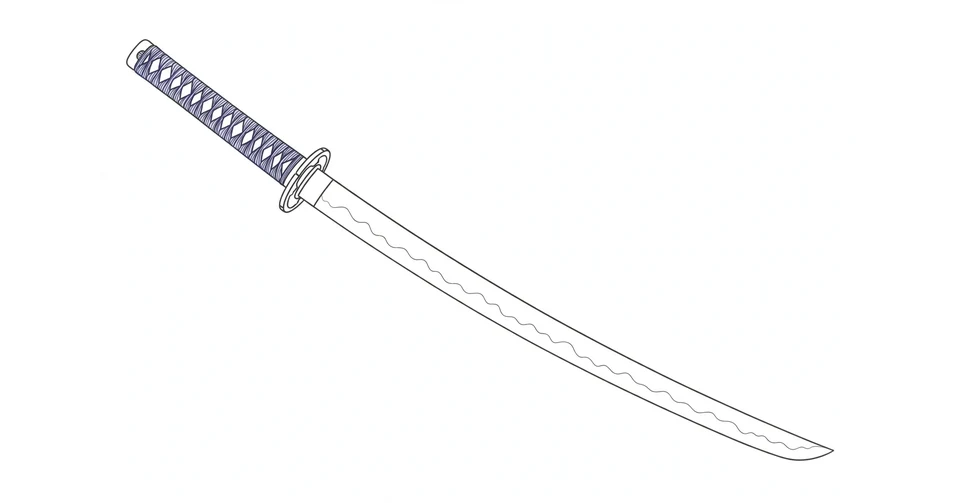
Ask someone anywhere in the world to picture a Japanese sword and they will picture a katana. A single curved edge, a long two handed grip, a wavy line running along the blade. The image is so familiar that it feels ancient, as if it had always been there. It had not. The katana arrived late, and it arrived by accident, shaped by bad steel, changing warfare, and a law that turned a weapon into a badge of rank.
The surprise is that the most famous sword in Japan was never the main weapon of war. On the battlefield, bows, spears, and later guns did the killing. The katana was the weapon of close quarters, of the sudden draw, of the duel in a narrow corridor. It became a symbol precisely because it outlived the battlefield and found a second life in law, ritual, and craft. That is the real story of this sword: not a perfect weapon, but a stubborn survivor.
To understand it, start with the sword it replaced. Tomoe Gozen, the woman warrior who rode with Minamoto no Yoshinaka and fought at Awazu in 1184, carried a tachi, not a katana. Calling her sword a katana is an anachronism, and it is a useful one, because the gap between the two swords explains everything that followed. Her tachi was long, deeply curved, and worn hanging from the belt with the edge facing down, made for a rider who needed to cut downward from a horse. The blade that came later was shorter, straighter, and worn thrust through the sash with the edge facing up, made for a fighter on foot who needed to draw and cut in a single motion.
A sword that arrived late
The curved Japanese sword began with the tachi, which developed in the Heian period between the 10th and 12th centuries, when mounted warfare dominated. Before that, Japanese swords were straight blades copied from the Asian mainland, worn on the left hip with the edge facing down. The switch to the curved sword came with the wars against the Emishi in the north and the rise of mounted warrior clans, and by the time of the Genpei War of 1180 to 1185 the long tachi was the sword of the elite horseman. The Heike Monogatari describes Tomoe Gozen as a swordswoman worth a thousand, and the blade she carried into that world was a tachi. If you want the full story of the rider herself, read Tomoe Gozen rode into battle when women were told to stay home.
The katana grew out of the foot soldier's sword. In the Kamakura period, from 1185 to 1333, lower ranking warriors fighting on foot carried a short sword called a sasuga as a spare weapon beside their long naginata. During the Nanboku-cho period, from 1336 to 1392, these short swords were gradually lengthened until they became the uchigatana, the striking sword, which is the proper Japanese name for what the world calls the katana. The oldest such blade in existence today is called the Hishizukuri uchigatana, forged in the Nanboku-cho period and later dedicated to Kasuga Shrine. The word katana itself is older than the weapon: it first appears in the Nihon Shoki of 720, where it simply means a one sided blade.
What pushed it forward was a change in how wars were fought. The Onin War of the late 15th century turned into a large scale civil war in which farmers called ashigaru were mobilised in great numbers to fight on foot. In the Sengoku period that followed, ashigaru fought in close formation with spears, and from the late 16th century they fought with muskets introduced from Portugal. The long tachi, made for a horseman with room to swing, became awkward in a crowded infantry fight. The katana, shorter and worn edge up through the sash, could be drawn and used to cut in one movement, even in a narrow space. By the 15th century it had become the mainstream sword, and many old tachi were cut down at the tang and shortened into the new form, a remaking called suriage. Some of the most famous blades in Japan today are old tachi that were shortened this way, including many forged by the great smith Masamune.
There is a quiet irony in this. It became famous as the samurai sword at exactly the moment when the samurai stopped being the men who decided battles. The blade that symbolises the warrior class was perfected for foot soldiers, mass produced for farmers turned soldiers, and exported in huge numbers. At least 200,000 swords were shipped to Ming dynasty China in official trade between the late 15th and early 16th centuries. It was a practical tool before it was a sacred object, and remembering that order keeps the romance honest.
How a katana is made
A katana begins not in a forge but in a clay furnace called a tatara. Iron sand and charcoal are fed into the furnace for about three days and nights, and when the furnace is broken open, the smith finds a large bloom of steel called a kera. The best parts of that bloom are tamahagane, jewel steel, a raw material with uneven carbon content and inclusions of slag. It is poor steel by the standards of a modern mill, and that poverty is the whole secret of the katana. The smiths of Japan had no rich iron ore, so they learned to make a superb blade from flawed material, and the methods they invented are still admired today. A good overview of the craft, with photographs from a working smithy, is the Japanese swords story from the Art Research Center at Ritsumeikan University.
The tamahagane is sorted by hardness, flattened, stacked, and forge welded into a block. Then comes the famous folding. The block is heated, hammered flat, cut, and folded back on itself, usually around fifteen times, which drives out impurities and evens out the carbon. Each fold doubles the layers, so a blade folded fifteen times contains tens of thousands of layers, and the fine grain of that layered steel, called hada, is one of the beauties collectors look for. The folding is not magic. It is patient labour, and the result is a steel that is cleaner and more uniform than the raw material the smith started with.
Most katana combine two steels. A harder, higher carbon jacket called kawagane wraps around a softer, lower carbon core called shingane. The hard jacket takes and holds an edge. The soft core absorbs shock and keeps the blade from snapping. This pairing solves a problem that every sword faces: a blade that is hard all the way through is brittle, and a blade that is soft all the way through will not cut. It carries both answers in one body, and the skill of the smith is in joining them so cleanly that the join disappears.
The final transformation happens in the quench. The smith coats the shaped blade with a paste of clay, charcoal, and stone powder, thick on the spine and thin on the edge. The blade is heated until it glows the right colour, judged by eye in a darkened forge, and plunged into water. The thinly coated edge cools very fast and becomes martensite, a very hard crystal structure. The thickly coated spine cools more slowly and stays tougher. Martensite takes up slightly more volume than the softer steel, so the edge expands and the blade bends backward. Much of the blade's curve, its sori, is born in that sudden cooling. The boundary between the hard edge and the tough spine appears as a visible line, the hamon, and each smith shapes it with the clay into patterns that are straight, wavy, like clove buds, or like rolling waves. The hamon is therefore both a fingerprint and a proof of the quench, and no two are exactly alike.
After the quench, the blade passes to other hands. A polisher grinds and refines the surface over many stages, bringing out the grain and the hamon, and a single polish can take weeks. Then the fittings are made: the guard, the handle, the scabbard, the small ornaments tucked into the handle. A blade like this is never the work of one person. It is the work of a chain of craftsmen, and a weakness in any link shows in the finished sword.
I find something moving in the patience of that process. A modern factory could stamp out a blade in minutes, and it would cut. What it could not do is carry the evidence of weeks of attention in its surface. The katana is a reminder that craft is not decoration added to a tool. In this case, the craft is the tool, and the beauty of the finished blade is a record of the labour that made it possible.
The parts of a katana
A katana looks simple from a distance, but it is a small assembly of named parts, and knowing their names changes how you look at one. The blade itself is the ha, and its length, the nagasa, defines the sword: a katana has a blade longer than two shaku, about 60 centimetres, and most fall between 60 and 80 centimetres. The curve is the sori. The tip is the kissaki, separated from the rest of the blade by a small angled line called the yokote. The ridge running along the side of the blade is the shinogi, and it lightens and strengthens the blade at the same time.
The part you never see in a museum photograph is the nakago, the tang hidden inside the handle, and it is where the smith signs the blade. The signature, the mei, is carved into the tang, and its position tells you how the sword was worn: a tachi worn edge down carries its signature on one side, and a katana worn edge up carries it on the other, so a shortened tachi keeps its signature on the wrong side. The tang is fixed to the handle with a single bamboo pin, the mekugi, which can be removed so the sword can be taken apart for cleaning. Nothing about it is glued or nailed shut. It is made to be opened, inspected, and put back together.
| Part | Japanese name | What it does |
|---|---|---|
| Blade | Ha | The cutting edge, hard steel formed in the quench |
| Curve | Sori | The gentle bend, largely set by differential cooling |
| Temper line | Hamon | The visible boundary between hard edge and tough spine |
| Tip | Kissaki | The point, shaped separately and finished by the polisher |
| Tang | Nakago | The hidden tail of the blade, carrying the smith's signature |
| Guard | Tsuba | The round or squared disc that protects the hand |
| Handle | Tsuka | The long grip, wrapped in cord over ray skin, made for two hands |
| Scabbard | Saya | The lacquered wooden sheath that protects the blade |
The fittings around the blade are an art of their own. The tsuba, the guard, is often the most decorated part of the sword, worked in iron or bronze with scenes of nature, animals, and legends. The handle is wrapped in silk cord over ray skin, and small ornaments called menuki are tucked under the wrapping to improve the grip and please the eye. The scabbard is lacquered wood, sometimes covered in fish skin and decorated with brass and copper. In the peaceful Edo period these fittings became ever more elaborate, and a katana could be a work of jewellery as much as a weapon. The blade was the soul, but the mountings were the clothing, and samurai of rank dressed their swords as carefully as they dressed themselves.
The five schools and the great smiths
By the later Middle Ages, Japanese swordmaking had settled into five great traditions, called the Gokaden, each tied to a region and a style. Yamashiro was the tradition of Kyoto, the old capital. Yamato was the tradition of Nara, associated with temple smiths. Bizen, in what is now Okayama Prefecture, was the largest school and the most productive. Soshu, in what is now Kanagawa Prefecture, was known for bold, wide blades. Mino, in what is now Gifu Prefecture, supplied the mass produced swords of the warring states era. Each tradition was passed from master to pupil, and each left a recognisable signature in the grain of the steel and the shape of the hamon.
The most celebrated smith of all was Masamune, who worked in the Soshu tradition in the Kamakura period. His blades are regarded as the finest ever made, and the standard against which later smiths measured themselves is still the Kamakura period tachi and katana. As of the 21st century, about 80 percent of Japanese swords designated as National Treasures were made in the Kamakura period, and about 70 percent of those are tachi, the older form. Masamune's son Sadamune carried the tradition forward, and the Soshu school's influence spread through the whole craft.
The other name every student of the katana learns is Muramasa, who worked in the Muromachi period in what is now Mie Prefecture. Muramasa's blades were sharp, practical, and famously associated with bloodshed in popular legend, which says his swords thirsted for blood and brought misfortune to the Tokugawa family. The legend is folklore, not history, and it probably grew because his blades were genuinely excellent cutting tools that happened to be used in violent times. But the story stuck, and it shows how quickly a katana stops being a piece of steel and starts being a character in a story.
The schools also show how the craft adapted to demand. In the 15th and 16th centuries, the Bizen and Mino schools mass produced swords for the ashigaru armies by dividing the labour, and these swords, called kazuuchimono, were lent to recruited farmers like spears and guns. At the other end of the scale, a master smith might make only a handful of blades in a year, each one signed and treasured. The katana lived at both ends of that scale at once: a common soldier's tool and a prince's treasure, made in the same country in the same century.
The katana as law and ritual
The katana became the soul of the samurai not on the battlefield but in the law. After the wars ended and the Tokugawa shogunate brought peace in the early 17th century, the sword stopped being primarily a weapon and became a mark of status. The shogunate required samurai to wear two swords, a pair called the daisho: the long katana and the short wakizashi. Only samurai could wear the daisho, and it represented their social power and personal honour. A farmer could not wear one. A merchant could not wear one. The pair at a man's hip told everyone in the street exactly who he was.
The shogunate went further and regulated the formal sword a samurai wore when visiting a castle: a daisho with a black scabbard and a hilt wrapped with white ray skin and black cord. The detail matters because it shows that the sword had become a uniform, governed like clothing. A samurai did not choose his formal sword the way a soldier chooses a rifle. He wore what the law prescribed, and the prescription was part of the order of the state.
That is also why the sword gathered ritual around it. The katana was carried into shrines as an offering to the kami, given as a gift between lords, and treated as a sacred object in its own right. The saying that the sword is the soul of the samurai captures this exactly: the blade was not merely carried by the warrior, it stood for him, and to lose it or to surrender it was a disgrace that went beyond the loss of a tool. Inazo Nitobe gave the idea its most famous English form in 1900 with his book Bushido, the Soul of Japan, which presented the sword as the outward sign of the warrior's inner code. The book was written for foreign readers and it simplified a complicated history, but the image it fixed has lasted for more than a century.
The ritual side of the sword also had a hard edge. In 1588, Toyotomi Hideyoshi banned farmers from owning weapons and carried out a sword hunt, forcibly removing swords from anyone identified as a farmer. The hunt made the sword the exclusive property of the warrior class, and it made the katana a symbol of a closed social order. The blade that had been mass produced for farmers was taken away from farmers, and the taking was the point. A katana on a farmer's hip was a threat to the order of things. A katana on a samurai's hip was the order of things.
I think this is the part of the story that is easiest to misunderstand. It is tempting to imagine the samurai loving their swords because the swords were beautiful, and the beauty was real. But the deeper truth is that the law made the sword precious by making it scarce and exclusive. The katana became sacred partly because ordinary people were forbidden to touch it, and scarcity has a way of turning a tool into a treasure.
When the katana lost its war
The katana survived the end of warfare, but it nearly did not survive the end of the samurai. In the late Edo period, political activists called shishi fought with practical, longer katana in the struggles that brought down the shogunate. Their blades were often longer than 90 centimetres, less curved, and made with a large sharp point suited to stabbing in indoor fights. The katana had one last moment as a weapon of revolution, and then the revolution abolished the class that carried it.
During the Meiji period, the samurai class was gradually disbanded and its privileges were taken away, including the right to carry swords in public. The Haitorei Edict of 1876 forbade the carrying of swords in public except for certain people such as former lords, the military, and the police. In 1889 the army adopted a French style sword that could be wielded with one hand, and the katana was judged unfit for modern war because it needed two hands. Skilled swordsmiths could no longer make a living, and many turned to making farm equipment, tools, and cutlery. The craft was kept alive by a few individuals, notably Miyamoto Kanenori and Gassan Sadakazu, who were appointed Imperial Household Artists, and by patrons who ordered swords and mountings to keep the workshops open.
War brought the sword back in a different form. Between 1875 and 1945, Japanese military swords called gunto were produced in large numbers, and during the buildup to the Second World War every officer was required to wear one. Traditionally made swords were produced, but the demand was so great that smiths with little knowledge of traditional methods were recruited, power hammers replaced hand forging, and blades were quenched in oil rather than water. These non traditionally made swords are called showato, and in Japan today they are not considered true Japanese swords. The katana had become a mass produced uniform item, and the craft that made it famous was nearly lost in the rush.
After the war, the occupation banned sword manufacture and sword martial arts between 1945 and 1953, and many swords were confiscated and destroyed. Since 1953, smiths have been allowed to work again, but under strict rules: a swordsmith must be licensed and serve a five year apprenticeship, and each licensed smith may produce only two long swords per month, or 24 per year. The limit is deliberate. It keeps the craft small, slow, and serious, and it means that a new katana is still a rare object made by a named person, not a product rolling off a line.
The katana today
Walk into the Japanese Sword Museum in Tokyo today and you will see what the katana became after it stopped being a weapon. The museum is run by the Society for the Preservation of Japanese Art Swords, the NBTHK, which was founded in February 1948 to save swords from confiscation and destruction after the war. The museum opened in May 1968 and moved to its present home in Ryogoku in 2018. Its collection holds about 190 items, mostly katana, along with mountings, armour, and documents of metalworking, and it includes three National Treasures, all of them tachi. The building is quiet, the lighting is low, and the swords stand in glass cases like paintings. That is the point. The katana is now treated as art, and the museum is its gallery.
The living craft survives alongside the museum pieces. Modern smiths still make tamahagane in a tatara, still fold the steel, still coat the blade in clay and quench it in water, and a few have been recognised as Living National Treasures for keeping the tradition alive. In 2014, the smith Kunihira Kawachi succeeded in reproducing a lost Kamakura period effect called midare utsuri, a misty pattern in the steel that no one had been able to recreate, and won the Masamune Prize, the highest honour for a swordsmith. No one had won the prize in the tachi and katana section for 18 years before him. The craft is small, the apprenticeship is long, and the work is still judged by standards set seven centuries ago.
The katana also lives in the body, in the martial arts that kept its movements alive after the battlefield closed. Iaido is the art of drawing the sword in one smooth motion, and every kata in it begins and ends with the sword sheathed. The practitioner draws, cuts, cleans the blade, and returns it, all against an imaginary opponent, and the whole art turns on the second before the fight begins. If you want to see what the sword looks like in that quiet second, read Iaido is the art of drawing the sword before the fight begins. Kendo, its louder sibling, kept the sword in a different way, with armour, bamboo swords, and scoring. Together the two arts mean that the katana is still handled, still studied, and still taught, not only looked at behind glass.
There is also a caution to carry into the present. Many of the katana sold around the world today are not Japanese swords at all. Mass produced copies, mostly made in China, copy the shape of the katana for martial arts practice and decoration, and a Japanese parliamentary association has warned that many katana distributed worldwide are fakes. A real katana is registered with the Japanese government, made by a licensed smith, and limited to 24 blades a year from each maker. The copies are not worthless. A blunt practice sword has its place in a dojo. But a copy is not the thing itself, and the difference is the whole story: the material, the method, and the person who made it.
The katana began as a horseman's sword, became a foot soldier's tool, then a badge of rank, then a forbidden object, then a museum piece, and finally a living craft kept alive by a few hundred licensed hands. It survived because at every turning point someone found a new reason to keep it: a smith who refused to make cutlery, a society founded in 1948 to save swords from destruction, a student kneeling in a quiet room to practise a draw that may never be needed. The blade itself never changed very much. What changed was what people asked it to be, and it answered every time.
That, I think, is why the katana still matters. It is not the sharpest sword ever made, and it was never the weapon that won Japan's wars. It matters because it carries a thousand years of answers inside a single curved line: answers about poor steel and patient hands, about law and honour, about what a society chooses to preserve when the reason for preserving it has gone. The samurai are gone. The katana remains, and it remains because people kept deciding that it was worth keeping. A sword that was once the soul of the samurai has become something quieter and perhaps more durable: proof that a craft can outlive the world that made it, as long as someone still cares enough to fold the steel one more time.
More in Culture & Society
- Omiyage and the Japanese Art of Bringing Something Back
- The Menpo Gave the Samurai a Face Worth Fearing
- Kabuto Gave the Samurai a Helmet Worthy of His Sword
- Christmas in Japan and the Fried Chicken Dinner That Started It All
- Kiso Yoshinaka Rode Out of the Mountains and Nearly Took Japan
- Sakayaki Gave the Samurai His Signature Hairline
Latest posts
- Japan Goes Maple Hunting Every Autumn and Calls It Momijigari
- The Archer on the Tower Was Hangaku Gozen
- Koyo Turns Japan Into a Country That Forecasts Leaves
- Inside Japan's 100 Yen Shops, Where Everything Costs a Coin
- Tomoe Gozen Rode Into Battle When Women Were Told to Stay Home
- A Chonmage Is the Knot Every Sumo Wrestler Wears Before the Fan
- Onna-Bugeisha Held the Castle While the Men Were Away
- Momiji-Gari Is Japan's Autumn Answer to Hanami
- Akihabara and How Tokyo's Electric Town Learned to Sell Everything
- The Naginata Gave Japan's Women Warriors a Blade of Their Own
- Momiji Turns Japan Red Every Autumn
- How an Oichomage Turns a Wrestler Into a Sekitori
- Ginkgo and the Gold That Falls on Tokyo Every Autumn
- Japanese Castles and the Samurai Fortresses That Still Stand
- A Kamidana Brings the Shrine Into the Japanese Home