Kiso Yoshinaka Rode Out of the Mountains and Nearly Took Japan
· 17 min read
Kiso Yoshinaka was the mountain-raised Minamoto cousin who smashed the Taira at Kurikara Pass in 1183, entered Kyoto as a hero, and lost everything at Awazu within months.
In the summer of 1183, a general raised in the mountains of central Japan marched into Kyoto as the saviour of the capital. The Taira clan, which had ruled the court for a generation, had fled the city in panic. The man who drove them out was not the famous Minamoto no Yoritomo, the founder of the Kamakura shogunate. It was his cousin, Kiso Yoshinaka, a warrior who had spent most of his life in obscurity and who would be dead within eight months.
Kiso Yoshinaka won the most famous victory of the Genpei War, received the title of Asahi Shogun from the retired emperor, and then destroyed his own triumph through arrogance, indiscipline, and a quarrel with his own family. His story is one of the great might-have-beens of Japanese history. If he had held Kyoto, the shogunate might have been born in the mountains of Shinano rather than in Kamakura, and the name every schoolchild learns might have been his.
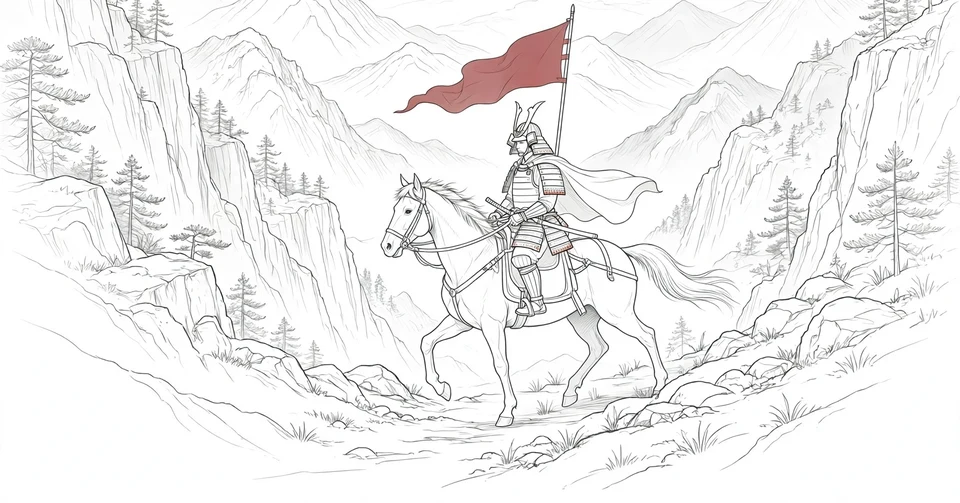
The reason Kiso Yoshinaka is so easy to forget is that the winners wrote the history. Yoritomo founded a government that lasted for a century and a half, and his chroniclers had every reason to present his cousin as a crude mountain warrior who briefly made a mess of Kyoto. The Tale of the Heike, the great epic of the war, gives Kiso Yoshinaka a vivid part, but it is Yoritomo who survives to the end of the story. Yet the facts underneath the epic are remarkable enough on their own. A man with a small mountain army defeated a Taira force many times his size, took the capital, and held the highest military title in the land. That deserves a closer look than the footnotes usually allow.
A boy raised in the mountains
Kiso Yoshinaka was born in 1154, in Musashi Province, into the Minamoto clan at a time when the Minamoto were losing. His father, Minamoto no Yoshikata, was killed in 1155 by Minamoto no Yoshihira in a feud inside the family, when the boy was still an infant. Yoshihira also sought to kill the child, and the boy was spirited away to Shinano Province, the mountain country that is now Nagano Prefecture.
He was raised there by Nakahara no Kaneto, together with Kaneto's son Imai Kanehira, who became his milk brother, his best friend, and his most loyal retainer. The two boys grew up together in the Kiso district, a region of deep valleys and steep forested mountains, and the place gave Kiso Yoshinaka his name. He was born a Minamoto, but he later changed his name from Minamoto to Kiso to reflect the mountains where he was raised, and history has remembered him as Kiso Yoshinaka ever since.
There is something important in that upbringing, and it explains both the strengths and the weaknesses of Kiso Yoshinaka. Kiso Yoshinaka was not raised at court, and he was not raised in the great warrior households of the east. He was raised in a mountain household by a family that had risked its life to shelter him. His followers were not hired retainers. They were the men he had grown up with, the sons of the household that saved him, and they followed him because of personal loyalty rather than politics. That loyalty carried him to Kyoto. It also meant that when he arrived in the capital, he arrived as an outsider who had never learned how the capital worked.
Little is known about his early adult life, and the sources are honest about that gap. There are almost no documents about Kiso Yoshinaka before 1183. What we know is that by 1181 Kiso Yoshinaka had answered Prince Mochihito's call for the Minamoto to rise against the Taira, and that he raised an army in Shinano and invaded Echigo Province, on the Japan Sea coast. The Taira sent a force to pacify the area, and Kiso Yoshinaka defeated it. Then the war stalled. A famine gripped the country for two years, and the fighting was put on hold while both sides struggled to feed their men.
Kiso Yoshinaka and the road to Kurikara
By the spring of 1183, conditions had improved enough for the Taira to seek revenge. Taira no Koremori, the son of Taira no Shigemori and the grandson of the late Taira no Kiyomori, took charge of a great expedition against Kiso Yoshinaka, backed by several senior Taira commanders. The Taira army departed Kyoto on 10 May 1183, and its numbers were large. The conservative figure given by the historian George Sansom puts the Taira at about 40,000 men against some 5,000 for Kiso Yoshinaka. The epics give larger numbers, as epics do, but even the conservative count leaves the mountain general outnumbered eight to one.
Before the Taira arrived, Kiso Yoshinaka had a different problem. His cousin Yoritomo, who was building his own power base in Kamakura, moved to fight him for dominance of the Minamoto clan in March 1183. The two cousins were persuaded to stand down and unite against the Taira, and to seal the agreement Kiso Yoshinaka sent his son Yoshitaka to Kamakura as a hostage. The reconciliation was real, but it was also humiliating, and it left Kiso Yoshinaka determined to beat Yoritomo to Kyoto, defeat the Taira on his own, and take control of the clan. That determination shaped everything that followed. Kiso Yoshinaka was not only fighting the Taira. He was racing his cousin.
The two armies met at Kurikara Pass, on the border of what are now Ishikawa and Toyama prefectures, on 2 June 1183. The pass was a narrow mountain road, and Koremori split his forces, sending one part up through the pass toward Tonamiyama and the other around through Noto Province to the north. Kiso Yoshinaka, seeing the Taira forces coming up the pass, displayed thirty white banners on Kurosaka Hill a few kilometres away, to trick his enemies into believing that his force was larger than it really was. White was the Minamoto colour, and thirty banners on a hilltop suggested an army that was not there. It was a delaying tactic, meant to keep the Taira at the top of the pass until night fell.
While the Taira waited, Kiso Yoshinaka divided his own forces into three. One group was sent to attack the Taira from the rear. A second was placed beneath the pass as an ambush party. The third he kept with him in the centre. To hide these movements, Kiso Yoshinaka kept the Taira occupied with a highly formal battle in the open: archery exchanges using whistling bulb arrows, followed by individual duels among a hundred samurai. The Taira, eager to earn their places in the chronicles and the epic poetry that would follow such a war, gladly indulged. While they duelled, the trap closed around them.
The night of the fire oxen
The most famous part of the Battle of Kurikara Pass is also the part that historians treat with the most caution. According to the tradition preserved in the Genpei Josuiki, a later chronicle of the war, Kiso Yoshinaka gathered a herd of oxen, tied lit torches to their horns, and released them down the pass directly into the Taira army as night fell. The terrified animals stampeded through the enemy ranks, and behind them came the Minamoto charge, driving the Taira down the slope into the valley where the ambush waited. A detailed account of the Battle of Kurikara Pass describes the stratagem as one learned from the ancient Chinese general Tian Dan, who used a similar trick with fire oxen centuries earlier.
Should we believe it? The honest answer is that we cannot be sure. The fire oxen appear in the Genpei Josuiki, which was written later than the events it describes, and the tale is only documented in the least verifiable of the Genpei War sources. Some modern retellings treat the oxen as fact. Others treat them as a storyteller's embellishment of a real night attack. What is not in doubt is the result. As the sun set, the Taira turned to find a Minamoto detachment behind them, holding far more flags than a single detachment should merit, giving the illusion of greater numbers. Panic spread through an army that was already tired, hungry, and far from home. The Taira broke and fled, and many were driven off the narrow paths and into the ravine below. The ground at the foot of the cliff was later called Jigokudani, the Valley of Hell, for the dead piled there.
Whether the oxen were real or not, the generalship was real. Kiso Yoshinaka had used deception, delay, and a night attack to destroy an army eight times his size, and he had done it with a plan that depended on his men moving quietly through mountain country in the dark. That is the kind of fighting a mountain army knows how to do, and a court army does not. The victory at Kurikara broke Taira power in the west, and it turned the tide of the whole Genpei War in favour of the Minamoto. It is worth remembering that the man who achieved it was not Yoritomo, who was still consolidating his base in the east. It was the cousin from the mountains, and for one summer he was the most important Minamoto in Japan.
The Asahi Shogun enters Kyoto
The Taira abandoned Kyoto, taking the child Emperor Antoku with them, and Kiso Yoshinaka marched into the capital in triumph. The retired emperor Go-Shirakawa, who had been kept under Taira control, welcomed him and issued a mandate for him to join with his uncle Minamoto no Yukiie in destroying the Taira leader Munemori and his army. Go-Shirakawa also bestowed on him the title of Asahi Shogun, the Morning Sun General. It was a glittering honour, and it placed Kiso Yoshinaka at the centre of Japanese politics.
It lasted only a few months, and the reasons for the collapse of Kiso Yoshinaka are a lesson in what happens when military talent is not matched by political judgment. The troops of Kiso Yoshinaka, hardened mountain fighters with no experience of the capital, acquired a reputation for indiscipline in Kyoto. The city that had welcomed him as a liberator began to see his army as an occupation. Meanwhile, Kiso Yoshinaka quarrelled with Go-Shirakawa over the succession, pressing to put his own candidate on the throne, and the retired emperor began to look east, toward Yoritomo, for help.
The break came when Kiso Yoshinaka learned that Go-Shirakawa had sought Yoritomo's assistance. He seized the retired emperor, burned his palace, and had himself named shogun. It was a coup, and it was a mistake. Whatever legitimacy the title of Asahi Shogun had given him, seizing the emperor destroyed it. A full biography of Minamoto no Yoshinaka records that Yoritomo responded by ordering his brothers Yoshitsune and Noriyori to destroy him, and the two armies that had been allies against the Taira were now marching against each other.
There is a temptation to treat this as a simple story of a rough soldier who could not handle power, and there is some truth in that. But it is worth asking what else he could have done. Kiso Yoshinaka had won the war in the west, yet Yoritomo controlled the east and the machinery of the Minamoto clan. Go-Shirakawa was playing the two cousins against each other, as retired emperors had done for generations. Kiso Yoshinaka had no base in the capital, no court allies, and no money beyond what his army could take. His coup was desperate, but desperation is not the same as stupidity. Kiso Yoshinaka saw the ground closing under him and reached for the one lever he had, which was force. The lever broke in his hand.
The fall at Awazu
The end came quickly. Early in 1184, Yoritomo's brothers advanced on Kyoto, and Kiso Yoshinaka was driven out of the capital. His army, which had once seemed unstoppable, fell apart. Kiso Yoshinaka was defeated at Uji and at Seta, and the retreat ended on a frozen field at Awazu, in Omi Province beside Lake Biwa, in what is now Shiga Prefecture.
The Tale of the Heike gives the scene its famous details. By the time the fighting reached Awazu, only a small group of survivors remained with him, and the forces closing in were led by his own kinsmen. Kiso Yoshinaka attempted to withdraw with Imai Kanehira, his milk brother and closest companion since childhood, and to find an isolated spot to kill himself with dignity. According to the story, his horse became trapped in a field of partly frozen mud, and his enemies were able to approach and kill him. Kanehira, seeing his lord dead, then killed himself. Kiso Yoshinaka was about thirty years old. He had entered Kyoto as a hero in the summer of 1183, and he was dead before the winter was over.
Kiso Yoshinaka was buried in Otsu, in Omi, and a temple was built in his honour during the later Muromachi period. Its name, Gichu-ji, uses the same two kanji as his given name, Yoshinaka. The Edo period poet Matsuo Basho, following his last wishes, was buried next to him there, a quiet tribute from a man who understood what it meant to live and die on the road. Kanehira's grave is also in Otsu, though not close to his lord's. The two boys who grew up together in the mountains of Shinano lie in the same town, as they had lived, side by side.
Tomoe Gozen and the household that went to war
No account of Kiso Yoshinaka is complete without the woman who rode beside him. Tomoe Gozen was one of two female attendants he brought with him from Shinano, and the Tale of the Heike praises her as a warrior worth a thousand, a strong archer and a superb horsewoman who fought at Awazu at the very end. The later chronicle Genpei Josuiki says she personally commanded a force of mounted warriors at Kurikara, an extraordinary claim that should be read with the same caution as the fire oxen.
Exactly what Tomoe Gozen was to Kiso Yoshinaka is a question the sources cannot settle. Later traditions describe her variously as his attendant, his companion, his concubine, his wife, or one of his military captains. The Heike Monogatari introduces her as one of two female attendants, and the word translated as attendant seems to mean a woman warrior attending her lord rather than a servant. Her background, as the Genpei Josuiki tells it, makes her part of his household from childhood: her mother was the wet nurse of the young Yoshinaka, and her brothers Imai Kanehira and Higuchi Kanemitsu grew up to be his closest lieutenants. She was not a stranger who wandered into a war. She was part of the household that went to war together, and the household went to war because its lord did.
Her story is the mirror image of the other great woman warrior of the age. Hangaku Gozen fought a generation later, in 1201, and she fought the opposite kind of war, holding one tower with a bow while an army came to her. Tomoe Gozen rode in the open field beside a moving army, and her legend is built on speed and daring. The contrast is a reminder that the women of the warrior class in early medieval Japan did more than one job, and that the tradition remembered each job clearly enough to give it its own heroine. Both women are remembered because they were trusted by the men around them, and trust, in that world, was earned on the battlefield.
Why Yoritomo is remembered and Kiso Yoshinaka is not
History remembers Yoritomo because Yoritomo built something that lasted. He founded the Kamakura shogunate, and the government he created ruled Japan for a century and a half. Kiso Yoshinaka built nothing. He won a battle, held a capital for a few months, and died. Institutions outlive individuals, and the man who builds the institution gets the chapter in the textbook while the man who only wins the battle gets a paragraph.
That is a fair way to judge rulers, but it is a poor way to judge lives. Kiso Yoshinaka matters not because of what he built but because of what he proved. Kiso Yoshinaka proved that a small army, well led and fighting on ground it knew, could destroy a much larger one. He proved that the Taira, who had seemed untouchable, could be beaten, and that proof changed the war. Without Kurikara, Yoritomo's road to power would have looked very different, and it is not clear that he would have reached Kyoto at all. Kiso Yoshinaka did the hard fighting, and the cousin from Kamakura collected the reward. That is a pattern that repeats through history far more often than we like to admit.
There is also a quieter lesson in his fall. Kiso Yoshinaka was at his best in the mountains, where he knew the ground, trusted his men, and fought on his own terms. He was at his worst in Kyoto, where he did not know the ground, did not understand the politics, and tried to solve every problem with force. The same qualities that made him a brilliant field commander made him a poor ruler of a capital. Knowing where you are strong is as important as being strong, and the moment he left the mountains he was fighting on someone else's ground. I think about that whenever I see someone succeed brilliantly in one setting and then fail in another, and the lesson is not to stay small. It is to learn the new ground before you try to rule it.
Why his story still matters
Kiso Yoshinaka is remembered in Japan, but mostly as a supporting character in someone else's story, the cousin who cleared the way for Yoritomo, the lord whose death sets the scene for Tomoe Gozen's famous last fight. That is a thin reward for a man who changed the course of a war. His grave at Gichu-ji in Otsu is still visited, and the Noh play Kanehira keeps his last hours alive on stage, with the ghost of his milk brother describing their deaths and his wish to move on to the other side. Basho chose to be buried beside him, which suggests that at least one great Japanese writer thought the mountain general deserved better company than the footnotes give him.
The real measure of his life is the summer of 1183, when Kiso Yoshinaka, a boy raised in hiding, rode out of the Kiso mountains, outwitted an army eight times his size, and walked into the capital of Japan as its liberator. He could not hold what he had won, and that failure is part of the story too. But for a few months, the future of Japan belonged to a man the histories barely remember, and that is worth sitting with. Victories are not always rewarded, institutions are not always built by the people who deserve to build them, and the names that survive are not always the names that mattered most at the time.
More in Culture & Society
- Christmas in Japan and the Fried Chicken Dinner That Started It All
- Sakayaki Gave the Samurai His Signature Hairline
- The Archer on the Tower Was Hangaku Gozen
- Tomoe Gozen Rode Into Battle When Women Were Told to Stay Home
- A Chonmage Is the Knot Every Sumo Wrestler Wears Before the Fan
- Onna-Bugeisha Held the Castle While the Men Were Away
Latest posts
- Koyo Turns Japan Into a Country That Forecasts Leaves
- Inside Japan's 100 Yen Shops, Where Everything Costs a Coin
- Momiji-Gari Is Japan's Autumn Answer to Hanami
- Akihabara and How Tokyo's Electric Town Learned to Sell Everything
- The Naginata Gave Japan's Women Warriors a Blade of Their Own
- Momiji Turns Japan Red Every Autumn
- How an Oichomage Turns a Wrestler Into a Sekitori
- Ginkgo and the Gold That Falls on Tokyo Every Autumn
- Japanese Castles and the Samurai Fortresses That Still Stand
- A Kamidana Brings the Shrine Into the Japanese Home
- An Omamori Carries a Shrine's Protection in Your Pocket
- Kongobuji Still Runs the Mountain Kukai Chose
- A Shinai Is a Sword That Refuses to Cut
- Pachinko and the Neon Rooms Where Japan Plays Its Loudest Game
- Kiai Is the Shout That Turns a Strike Into a Commitment