Inside Japan's 100 Yen Shops, Where Everything Costs a Coin
· 10 min read
Japan's 100 yen shops turn a single coin into a whole store, from Daiso's thousands of branches to the quiet logic that made bargain hunting a national habit.
Walk into a Japanese 100 yen shop with a single coin in your pocket and you can buy something. Walk in with ten coins and you can furnish a kitchen drawer. That is the whole idea, and it is why Japan's 100 yen shops have grown from a street stall into a retail empire with more than 10,000 stores across the country.
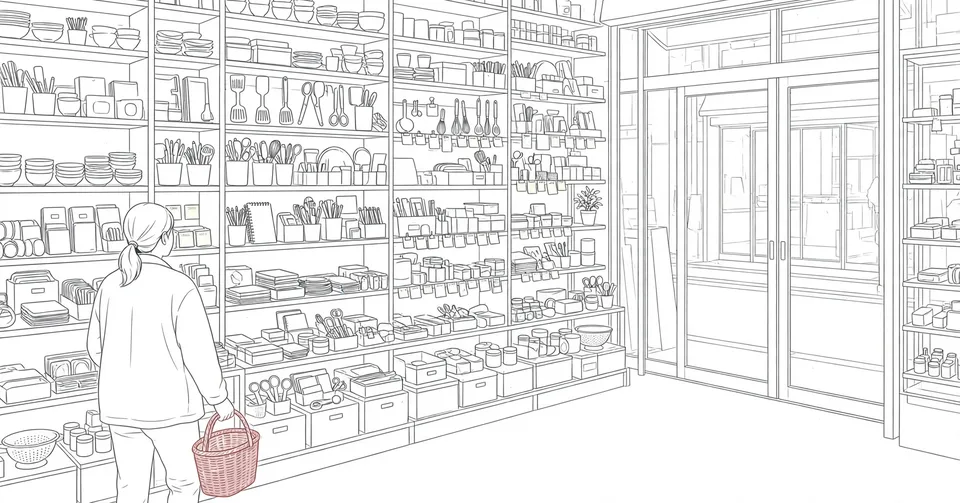
The format is simple. Almost everything on the shelves costs 100 yen before tax, which works out to 110 yen at the till for most goods and 108 yen for food, because food carries the lower 8 percent tax rate. The biggest chain, Daiso, runs more than 3,600 stores in Japan and around 1,900 more in about 25 countries, and its range covers over 70,000 items. Walk into any of these 100 yen shops and the layout is familiar within seconds. I go in for one thing, a sponge or a cable tie, and I leave with a basket. The pleasure of 100 yen shops is low stakes. Nothing in the shop can ruin your budget, so browsing feels like play instead of shopping.
How a street stall became Daiso
The story of Japan's 100 yen shops starts with a truck. In 1972, Hirotake Yano began selling household goods from a mobile stall called Yano Shoten in western Japan. He incorporated the business as Daiso Industries in December 1977, and in 1991 the company opened its first directly managed 100 yen shop in Takamatsu, Kagawa Prefecture. The timing was perfect. Japan's asset bubble had just burst, and the long years of low growth and flat prices that followed made a shop where everything cost one coin feel less like a discount store and more like common sense.
Daiso expanded at a speed that still surprises. By the early 2000s it was opening around 600 new 100 yen shops a year across Japan, roughly two new outlets every day. The first overseas store opened in Taiwan in 2001, and the chain now counts about 5,500 to 5,900 stores worldwide, with group sales of around 600 billion yen in the fiscal year ending March 2024. Yano died in 2024, and his son Hirokazu Yano now leads the company. The idea he built has outlived him by a long way, which is the real test of any shop.
The 100 yen shops share a shelf with another Japanese retail habit, the convenience store. Both promise that a small, ordinary errand can be finished in five minutes, and both are open where people actually live and work. The difference is that a konbini sells you dinner at midnight, while a 100 yen shop sells you the plate to eat it from. If you want to understand why Japan's convenience stores became a destination in their own right, the 100 yen shop is the other half of the same answer. Everyday life in Japan is organised around small shops that do one thing well.
What Japan's 100 yen shops actually sell
The price is the promise, so it helps to know exactly what it covers. A general item marked 100 yen costs 110 yen after the 10 percent consumption tax. Food and drink are taxed at 8 percent, so a snack marked 100 yen costs 108 yen. Since 2004, Daiso has also sold items at multiples of 100 yen, such as 200, 300, 400 and 500 yen, and as of 2016 about 98 percent of its range still sat at the base price. The shelf edge tells you the price before tax, and the till tells you the rest. There are no surprises, which is the point.
What 100 yen shops do best is the small stuff of daily life. Kitchen tools, storage boxes, cleaning supplies, stationery, cables, batteries, bento boxes, chopsticks, socks, umbrellas, pet supplies, craft materials and seasonal goods all sit within reach of one coin. The seasonal aisle is the one worth watching. It turns over with the calendar, so a shop visited in February sells Setsubun beans and snow gear, while the same shop in July sells festival fans and insect repellent. That rotation is what keeps regulars coming back. It is also what makes 100 yen shops hard to leave empty-handed.
What to skip at 100 yen shops is just as clear. Anything that has to last for years or keep you safe is worth buying elsewhere. Cheap electronics, chargers and batteries vary in quality, and a 100 yen lock or a 100 yen bike light is a gamble rather than a bargain. The shops are honest about this in their own way. They sell a lot of things that are good enough, and very few things that pretend to be more.
The four chains that run the game
Four names cover almost all of Japan's 100 yen shops. They look similar from the street, but each one has a personality, and knowing the difference saves time.
| Chain | Stores in Japan | Known for |
|---|---|---|
| Daiso | About 3,600 | The widest range, over 70,000 items, from kitchenware to cosmetics |
| Seria | About 2,100 | Clean, minimalist design, and many products made in Japan |
| Can Do | About 1,300 | Character goods, snacks and seasonal items, part of the AEON group |
| Watts | About 1,900 | Everyday basics, often tucked inside supermarkets and shopping centres |
Daiso is the default. If a town has one 100 yen shop, it is usually a Daiso, and its shelves hold a little of everything. Seria is the one designers like. It was founded in 1987 in Gifu Prefecture, it keeps closer to a single price than the others, and its neutral colours and simple shapes make it the best of the four for home goods and gifts. Can Do, founded in 1993, leans cute and family friendly, with character goods and seasonal snacks, and its stores tend to be less crowded. Watts runs under several names, including Meets and Silk, and most of its branches sit inside other shops, so you often find one without looking for it.
Daiso has also grown two upmarket siblings. Standard Products, launched in March 2021, sells simple, slightly better made goods at a little above the 100 yen line, and THREEPPY does the same with a softer, more decorative feel. The chain 3COINS, often found next door to a Daiso, is not a 100 yen shop at all. Its name gives it away. Everything there starts at 300 yen. The family resemblance is real, but the price is not.
Finding one of Japan's 100 yen shops is easy once you know the trick. Search Google Maps for "100均", pronounced hyaku-kin, the Japanese shorthand for a 100 yen shop. The biggest branches sit in station buildings and shopping malls, and the flagship Daiso in Harajuku, on Takeshita-dori, is worth a visit on its own. It is several floors of exactly the same idea, stretched as far as it will go.
Why the price never moved
A price that has not moved in decades looks like stubbornness, but it is really a business model. The 100 yen shops work because the fixed price does half the selling. Customers can do the maths before they reach the till, so they browse freely and buy more. The chains make it work with volume, tight logistics, and their own product lines. Daiso's early investment in point-of-sale systems let it track exactly which of its tens of thousands of items sold and which did not, and the range is pruned constantly. A product that does not earn its shelf space is gone within weeks.
There is also something cultural in it. Japan spent decades with prices that barely rose, and the 100 yen coin became a unit of thought. That is one reason 100 yen shops feel so natural here, rather than like a novelty. A coffee from a vending machine costs about the same, and the two habits sit side by side in daily life. I find there is something honest about a shop that tells you the price before you walk in. Most shops make you hunt for it. A 100 yen shop puts it in the name, and then keeps its word for thirty years. That kind of trust is hard to buy at any price.
The model behind Japan's 100 yen shops has travelled well. Daiso's overseas stores charge more than the Japanese price, because shipping and rent cost more abroad, but the idea survives the translation. In Indonesia, Malaysia, Thailand, the United States and Brazil, the 100 yen shops sell the same promise in a different currency. A store where everything costs one small, round number turns out to be an idea that works in any language.
The tax-free change visitors should know
Visitors to Japan should know one practical detail before they plan a shopping spree. From 1 November 2026, Japan replaced its old point-of-sale tax exemption for tourists with a refund system at the airport. Under the old system, visitors could buy tax-free in the shop itself. Now the tax is paid at the till and claimed back when leaving the country.
In practice, this changes little at 100 yen shops, because tax-free shopping was already rare there. None of the big three chains states a tax-free service on its official pages, so visitors were paying the 110 yen all along. The change matters more as a reminder. At 110 yen an item, the tax is 10 yen, and chasing a refund on a basket of small goods costs more time than it saves. For most visitors, 100 yen shops are a place to pay the small tax and move on. Just pay the tax, enjoy the shop, and save the refund paperwork for bigger purchases. If you are curious how the small numbers add up over a month in Tokyo, the maths in what it really costs to live in Tokyo is a useful check. A 100 yen shop will not break that budget, but it will quietly test it.
How to shop them well
The best way to enjoy Japan's 100 yen shops is to go in with a list and permission to ignore it. Start with what you actually need, a travel adapter, a laundry net, a bento box, then allow yourself one aisle of wandering. The stationery aisle is the safest place to wander. Japanese pens, notebooks, washi tape and stickers are famously good, and at 110 yen each they are the cheapest souvenirs in the country that anyone will actually use.
Check the labels as you go, because 100 yen shops hide small differences in quality in plain sight. Seria marks many of its products as made in Japan, which is rare at this price and a useful sign of quality. Look for the seasonal aisle near the entrance, because it changes first and sells out fastest. And remember that the big 100 yen shops restock constantly, so the shelf you see on Tuesday is not the shelf you will see on Saturday. That is part of the charm. A 100 yen shop rewards the person who drops in often and punishes the person who assumes it will wait.
The basement food halls of Japan's department stores sell the most beautiful food in the country at prices to match. The 100 yen shops are the opposite end of the same street. They sell the most ordinary things in the country at a price anyone can afford, and they do it with the same care. Both belong on any honest list of what makes shopping in Japan different.
A shop where everything costs a coin should feel cheap, and somehow it does not. It feels considered. The shelves are tidy, the goods are chosen, and the price is a promise rather than a trick. That is why Japan's 100 yen shops have lasted through a bubble, a long deflation, a pandemic and a tax change without moving their number. The coin is still worth a hundred yen. The shop just worked out how to make it buy more than you expect.
More in Life & Style
- Akihabara and How Tokyo's Electric Town Learned to Sell Everything
- Kotatsu, Japan's Heated Table That Warms Winter
- The History of the Bicycle From Wooden Wheels to Japanese City Bikes
- A Shukubo Lets You Sleep Inside a Working Temple
- Kaburiyu Is How You Talk Your Body Into the Bath
- Ganbanyoku Is Bathing Without Water
Latest posts
- Tomoe Gozen Rode Into Battle When Women Were Told to Stay Home
- A Chonmage Is the Knot Every Sumo Wrestler Wears Before the Fan
- Onna-Bugeisha Held the Castle While the Men Were Away
- Momiji-Gari Is Japan's Autumn Answer to Hanami
- The Naginata Gave Japan's Women Warriors a Blade of Their Own
- Momiji Turns Japan Red Every Autumn
- How an Oichomage Turns a Wrestler Into a Sekitori
- Ginkgo and the Gold That Falls on Tokyo Every Autumn
- Japanese Castles and the Samurai Fortresses That Still Stand
- A Kamidana Brings the Shrine Into the Japanese Home
- An Omamori Carries a Shrine's Protection in Your Pocket
- Kongobuji Still Runs the Mountain Kukai Chose
- A Shinai Is a Sword That Refuses to Cut
- Pachinko and the Neon Rooms Where Japan Plays Its Loudest Game
- Kiai Is the Shout That Turns a Strike Into a Commitment