Tomoe Gozen Rode Into Battle When Women Were Told to Stay Home
· 15 min read
Tomoe Gozen was the mounted woman warrior of the Heike Monogatari who rode with Minamoto no Yoshinaka and fought at the Battle of Awazu in 1184, and her story still challenges how we picture women in medieval Japan.
In the winter of 1184, on a frozen field beside Lake Biwa, a woman on horseback rode out to meet an enemy warrior while her lord's army fell apart around her. Her name was Tomoe Gozen, and the medieval epic that remembers her calls her a warrior worth a thousand. She was not guarding a castle gate. She was not waiting at home. Tomoe Gozen rode into battle in the open field, and that is what makes her different from almost every other woman warrior in Japanese history.
The story comes from The Tale of the Heike, the great war epic of the Genpei War of 1180 to 1185. Tomoe Gozen served Minamoto no Yoshinaka, a cousin of Minamoto no Yoritomo who rose from the mountains of central Japan to take Kyoto, and then lost everything within months. She appears in the epic only briefly, in a single passage near the end of Yoshinaka's story, yet that passage made Tomoe Gozen the most famous woman warrior in Japan.
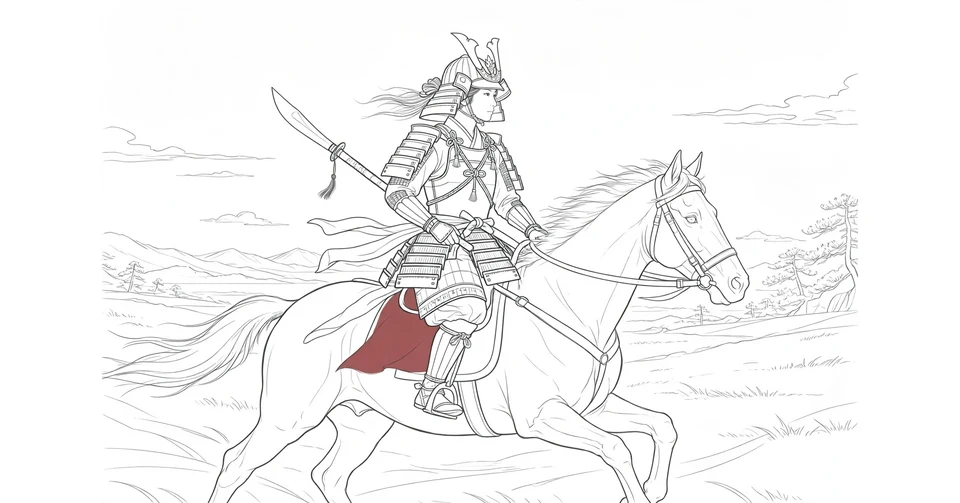
Whether Tomoe Gozen was a real person is a question historians still cannot settle. The Heike Monogatari is our main source, and it is literature as much as history. Tomoe Gozen matters because of what she shows us about the world she rode through: a world where a woman could be praised as a captain, a rider, and an archer, and where the same world would still order her to leave the field because she was a woman.
Who Tomoe Gozen was
Tomoe Gozen is a name that needs a little unpacking before the story can begin. Tomoe was her given name. Gozen was not a surname. It was an honorific, a respectful form of address given to women of status, usually translated as lady. So Tomoe Gozen means, roughly, Lady Tomoe, and the epic calls her by that title because she belonged to a warrior household of standing.
The later chronicle Genpei Josuiki gives her a background. According to that tradition, she was born around 1157, the daughter of a warrior named Nakahara Kaneto, and her mother was the wet nurse of the young Yoshinaka. That made Tomoe Gozen and Yoshinaka milk siblings of a sort, raised in the same household in the mountains of Shinano, and her brothers Imai Kanehira and Higuchi Kanemitsu grew up to be Yoshinaka's closest lieutenants. She was not a stranger who wandered into a war. She was part of Yoshinaka's household from childhood, and the household went to war together.
Yoshinaka himself was a Minamoto, but his branch of the family had been pushed to the margins. His father was killed when Yoshinaka was still an infant, and the boy was raised in secret by the Nakahara family in Kiso, a mountain region in what is now Nagano Prefecture. That is why he is usually called Kiso Yoshinaka. Exactly what Tomoe Gozen was to him is uncertain. Later traditions describe her variously as his attendant, his companion, his concubine, his wife, or one of his military captains. The Heike Monogatari introduces her as one of two female attendants Yoshinaka brought with him from Shinano, and the word translated as attendant, binjo, seems to mean a woman warrior attending her lord rather than a servant. The honest answer is that we cannot choose confidently between the possibilities, and anyone who does is guessing.
The Genpei War that made Tomoe Gozen
To understand Tomoe Gozen, it helps to understand the war that made her famous. The Genpei War ran from 1180 to 1185, and it was the climactic struggle between two great warrior networks, the Taira and the Minamoto, for control of Japan. The Taira had dominated the imperial court in Kyoto for a generation. The Minamoto had been pushed aside, and in 1180 they rose in a series of revolts that spread across the country. The war destroyed Taira power and opened the way for warrior government under Minamoto no Yoritomo.
Yoshinaka entered the war from the mountains, and his rise was spectacular. In June 1183 his forces defeated the Taira at the Battle of Kurikara, and the victory broke Taira power in the west. The Taira abandoned Kyoto, and Yoshinaka marched into the capital as a hero. For a brief moment he was one of the most powerful figures in Japan. The Genpei Josuiki says Tomoe Gozen personally commanded a force of mounted warriors at Kurikara, an extraordinary claim for a woman of her time, and one that should be read with the same caution as everything else in the tradition.
The triumph did not last. Yoshinaka's troops acquired a reputation for indiscipline in Kyoto, and his ambitions brought him into conflict with the retired emperor Go-Shirakawa and with his own cousin Yoritomo. By the autumn of 1183 the two Minamoto leaders were moving toward open war. Yoritomo sent forces west under his brothers Noriyori and the celebrated Yoshitsune to bring Yoshinaka to heel. Yoshinaka was defeated, and by January 1184 his once formidable following was collapsing around him. The retreat ended on a frozen field at Awazu, in Omi Province beside Lake Biwa. It is there, at the very end of Yoshinaka's story, that Tomoe Gozen steps into the light.
What the Heike Monogatari actually says about Tomoe Gozen
Tomoe Gozen appears in only one extended passage of the Heike Monogatari, in Book 9, just before the Battle of Awazu. The passage is short, but it is unusually vivid, and it is worth reading closely because almost everything we think we know about her comes from these few lines. A good research overview of Tomoe Gozen and her sources lays out the two primary texts, the Heike Monogatari and the Genpei Josuiki.
In Helen Craig McCullough's translation, the text describes Tomoe Gozen as especially beautiful, with white skin, long hair, and charming features. She was a remarkably strong archer, and as a swordswoman she was a warrior worth a thousand, ready to confront a demon or a god, mounted or on foot. She handled unbroken horses with superb skill, and she rode unscathed down perilous descents. The description concentrates on precisely the abilities that medieval Japanese audiences admired most in an elite warrior: horsemanship, archery, and physical courage.
That combination is significant. The Heike Monogatari does not present Tomoe Gozen as a woman awkwardly attempting male warfare. It presents her as an exceptionally accomplished practitioner of the established warrior arts, judged by the same standards as the men around her. It is also worth noting what the passage does not say. It does not say she fought with a naginata, the polearm that later became the classic weapon of samurai women. She is a mounted battlefield warrior, armed with bow and sword, and that is what makes her exceptional.
Tomoe Gozen at the Battle of Awazu
The Battle of Awazu in 1184 provides the setting for the defining episode of Tomoe Gozen. By the time the fighting reached the plain south of Lake Biwa, Yoshinaka's army had been shattered. Only a small group of survivors remained with him, and the forces closing in on them were led by his own kinsmen, Yoshitsune and Noriyori, fighting under Yoritomo's orders. The Genpei Josuiki says only seven warriors reached Awazu. Whatever the true figure, the outcome was never in doubt.
According to the Heike Monogatari, she continued fighting alongside the survivors. Yoshinaka eventually ordered her to leave. The scene is uncomfortable to modern readers because his reasoning is explicitly connected with her being a woman. Yoshinaka supposedly said it would be unseemly to let people say that Lord Kiso kept a woman with him during his last battle. He did not doubt her courage. He worried about what her presence would say about him after his death. It is a wonderfully medieval response, and a painful one: the same lord who trusted her as a captain sent her away because her sex would embarrass his memory.
She obeyed, but she apparently decided that she needed one final opponent first. In the Genpei Josuiki version, she first fought Hatakeyama no Shigetada, a captain of the pursuing force who tried to capture her alive. Hatakeyama seized the sleeve of her armor, but she broke free on her strong battle horse, which later tradition names Harukaze, or Spring Wind. Then came the famous last fight. The warrior who confronted her is identified in the Heike tradition as Onda no Hachiro Moroshige, a strong fighter leading thirty horsemen. She charged him, grappled with him, pulled him against the front of her saddle, and took his head. In some versions the opponent is named differently, Uchida Ieyoshi instead of Onda Moroshige, and the details vary between manuscripts. The core of the scene is the same in every version. She proves her ability one final time, defeats a formidable opponent, and then discards her armor and rides east, disappearing from the narrative before Yoshinaka's death.
Yoshinaka did not escape. Attempting to withdraw with Imai Kanehira, he became trapped near Awazu. According to the literary tradition, his horse became stuck in muddy ground, and he was struck by an arrow and killed. Kanehira, seeing his lord dead, then killed himself. Yoshinaka was about thirty years old. Tomoe Gozen had ridden away just before it, and storytellers have been wondering where she went ever since.
I keep returning to the order Yoshinaka gave her, because it is the most human moment in the whole story. He was a man about to die, and his last concern was not his life but his reputation. Tomoe Gozen obeyed him, and then she disobeyed him in the only way that mattered, by finding one more fight before she left. She did what she was told, and she did it on her own terms. That contradiction feels true in a way that the grand battle scenes do not.
Was Tomoe Gozen a real person
This is the question any serious account of Tomoe Gozen has to confront, and the answer is frustratingly simple: possibly, but we cannot prove it. She appears prominently in the literary tradition surrounding the Genpei War, particularly in the Heike Monogatari. But she is absent from several sources that historians would dearly like to see mentioning her. The Azuma Kagami, the important Kamakura period chronicle compiled by the shogunate itself, does not record her. Nor do surviving court diaries confirm her exploits.
That silence matters, but it does not settle the question. The Tale of the Heike was shaped through oral performance before reaching the textual forms that survive today. It was chanted by blind monks called biwa hoshi, to the accompaniment of the biwa lute, and it describes real people, real political struggles, and recognisable battles. But it is not a modern campaign diary. Speeches are reconstructed and numbers can be exaggerated. The oldest surviving copy, the Kakuichi text of 1371, came almost two centuries after the events it describes.
The Genpei Josuiki adds detail, but it is a fourteenth century work too, and it has never been translated into English in full. Many scholars believe she was a real person around whom a powerful legend was built. Others are more cautious. Her deeds may have been exaggerated, or several traditions combined into one character. A careful survey of the evidence on Tomoe Gozen reaches the same conclusion: the question is genuinely unresolved, and anyone claiming absolute certainty either way is asking the sources to do more than they can. She is questionable because of her evidence, not because a woman fighting would somehow have been unimaginable. The problem is the paperwork, not the possibility.
Tomoe Gozen and the women who held the gate
Tomoe Gozen is often grouped with the onna-bugeisha, the trained women of samurai households, but the comparison needs care. In our earlier story about the onna-bugeisha who held the castle while the men were away, the defenders stayed in one place and held it. Hangaku Gozen, the most famous of them, commanded a castle garrison against the army of the shogunate during the Kennin Rebellion of 1201 and directed the defense from a tower. Her victory was measured in weeks survived, not ground taken. She was the opposite kind of warrior. She did not hold a gate. She rode out through it, and she fought in the open field beside a moving army.
The weapons tell the same story. The defender's weapon was the naginata, the blade Japan gave its women warriors, a polearm whose length let its user keep an attacker at a distance in a gateway or a narrow castle passage. Tomoe Gozen, as the Heike Monogatari describes her, fought with a bow and a sword from horseback, the weapons of an elite mounted warrior. The difference is about which job each woman was doing, and the tradition remembered both jobs clearly enough to give each its own heroine.
The weapons and the horse of Tomoe Gozen
If she fought during Yoshinaka's campaigns, her equipment would have belonged to the military culture of late twelfth century Japan, not the later Sengoku period equipment most familiar today. Her sword would have been a tachi, a curved sword worn suspended from the belt with the cutting edge facing down, not the later katana. Calling her sword a katana is an anachronism, and it is one of the small errors that creep into popular accounts of her. The Heike Monogatari describes her carrying an unusually large sword, but translating that into an exact surviving sword classification would be unwise.
Her main weapon was the yumi, the long asymmetrical bow used from horseback and on foot. The Heike Monogatari emphasises her as an archer because its audience understood exactly what that implied. She wore lamellar armor called yoroi, associated particularly with mounted warriors, and a helmet called a kabuto. Her horse was not a detail. It was an essential component of elite mounted warfare, and the epic praises her ability to handle unbroken horses as one of her defining gifts.
| Equipment | Likely role |
|---|---|
| Yumi | Long asymmetrical bow used from horseback and on foot |
| Tachi | Curved sword worn suspended edge down |
| Yoroi | Lamellar armor associated particularly with mounted warriors |
| Kabuto | Helmet protecting the head while allowing considerable visibility |
| Horse | Essential component of elite mounted warfare |
What happened to Tomoe Gozen after Awazu
After the episode at Awazu, Tomoe Gozen disappears from reliable evidence. Several later traditions attempt to continue her biography, and they disagree with each other. One claims she abandoned warfare and became a Buddhist nun. Another associates her with Wada Yoshimori, an important warrior of the early Kamakura period. The Genpei Josuiki says that after Awazu she was ordered by the victorious Yoritomo to report at his capital in Kamakura, where she was sentenced to death as an enemy and then pardoned through the intervention of Wada Yoshimori, whom she married.
None of this is securely documented. There is no reliable contemporary evidence demonstrating that Tomoe Gozen married Wada Yoshimori or lived until the often repeated date of 1247. That date comes from later tradition, which says she died at ninety years old, but it should be presented as tradition rather than fact. The safest historical conclusion is much shorter. After Awazu, she disappears, and storytellers filled the silence with the endings they preferred.
Tomoe Gozen in art and theatre
Tomoe Gozen may have left only a tiny historical footprint, but her cultural footprint is enormous. A handful of medieval passages developed into centuries of paintings, plays, novels, and modern representations. Edo period printmakers fixed her familiar image: beautiful, composed, and heavily armed, often on horseback. These images tell us considerably more about how later Japanese society imagined her than about what she actually looked like. No authenticated contemporary portrait survives.
Why Tomoe Gozen still matters
There is a temptation to approach Tomoe Gozen with only one question, and that question is whether she was real. That undersells her. Her importance does not disappear if some or even much of her biography was created through literary tradition. If she was historical, she shows a woman participating directly in the mounted warrior culture of late Heian Japan. If her deeds were embellished, they show that medieval audiences could imagine a woman possessing the highest qualities of an elite warrior. If she was largely invented, why did storytellers place such a woman beside Yoshinaka at the moment of his destruction? None of those possibilities makes her insignificant.
The women of medieval Japan were told to stay home, and most of them did, holding gates and guarding households. She is remembered because she did the opposite. She rode into battle in the open field, and she did it well enough that the storytellers who watched her lord fall could not leave her out of the story. Whether she was real or invented, the world that imagined her believed a woman could ride, shoot, and fight beside the best warriors of her age. That belief, written down eight centuries ago, is worth sitting with.
More in Culture & Society
- A Chonmage Is the Knot Every Sumo Wrestler Wears Before the Fan
- Onna-Bugeisha Held the Castle While the Men Were Away
- The Naginata Gave Japan's Women Warriors a Blade of Their Own
- How an Oichomage Turns a Wrestler Into a Sekitori
- Ginkgo and the Gold That Falls on Tokyo Every Autumn
- A Kamidana Brings the Shrine Into the Japanese Home
Latest posts
- Inside Japan's 100 Yen Shops, Where Everything Costs a Coin
- Momiji-Gari Is Japan's Autumn Answer to Hanami
- Akihabara and How Tokyo's Electric Town Learned to Sell Everything
- Momiji Turns Japan Red Every Autumn
- Japanese Castles and the Samurai Fortresses That Still Stand
- An Omamori Carries a Shrine's Protection in Your Pocket
- Kongobuji Still Runs the Mountain Kukai Chose
- A Shinai Is a Sword That Refuses to Cut
- Pachinko and the Neon Rooms Where Japan Plays Its Loudest Game
- Kiai Is the Shout That Turns a Strike Into a Commitment
- Toro Stone Lanterns Light the Way Through Japan's Sacred Places
- An Ofuda Brings the Kami Home on a Slip of Paper
- Kagura Suzu Are the Bells That Let the Kami Hear the Dance
- Japanese Knives From Samurai Swords to Kitchen Counters
- Tenkasu Turns Tempura Scraps Into Japan's Favorite Crunch