Onna-Bugeisha Held the Castle While the Men Were Away
· 17 min read
The onna-bugeisha were the trained women of samurai households who guarded the home and the castle while the men were away on campaign, and their story changes how we picture the samurai world.
Picture a castle gate in medieval Japan. The lord and his retainers have ridden out to war, and the road behind them is empty. The gate does not stand open and unguarded. It is watched by the women of the household, and they know exactly what to do if an enemy appears. In the samurai world, these women had a name. They were called onna-bugeisha, and their duty was to hold the home until the men came back.
The idea still surprises people. The popular image of the samurai is a man in armor with a katana, and the women of his house are imagined waiting quietly inside. The truth is more interesting. Daughters of samurai families trained with weapons from a young age, and the household expected them to fight if the walls were attacked. An onna-bugeisha was not a soldier who marched to distant battles. She was the last line of defense for everything the family owned, including its children, its stores, and its name. That was the work of the onna-bugeisha, and it was understood as a duty, not a choice.
This article grows out of a distinction made in our earlier story about the naginata. That piece explained that some women fought offensively on the battlefield and are called onna-musha, while others defended the home and the castle and are called onna-bugeisha. The line between the two was never as neat as a dictionary suggests, and modern historians argue about the terms, but the distinction is still useful. It points to a job that history books often skip, which is guarding the gate.
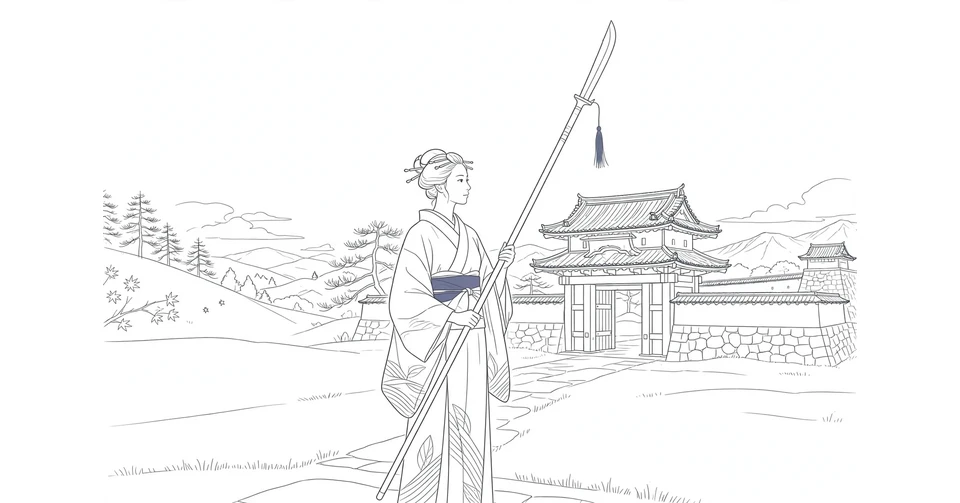
That image is the heart of this story. A woman stands at the gate with a polearm in her hands, calm and ready, while the castle waits behind her. She is not posing for a portrait. She is on duty, and the duty was real enough that families planned for it, trained for it, and remembered the women who carried it out.
What the word onna-bugeisha actually means
The word breaks apart neatly. Onna means woman, and bugeisha means a person trained in the martial arts. An onna-bugeisha, then, is a woman trained in the martial arts. The related word onna-musha means a woman warrior, someone who actually fought. The difference sounds small, but it matters. Training is a preparation, while fighting is the act itself, and the women of samurai households lived in the space between the two.
Modern historians have complicated the picture. Many now prefer the term onna-musha for all of these women, because the old sources use the two words loosely and sometimes interchangeably. Some writers use onna-bugeisha only for defenders of the home, and others use it for any trained woman warrior at all. There is no single ruling to settle the question, and pretending otherwise would be dishonest. The working distinction used here follows our earlier article on the naginata, where onna-musha attack on the battlefield and onna-bugeisha defend the home and the castle. In this article, onna-bugeisha means the defenders, and onna-musha means the attackers. It is a useful map, even if the historical ground is messier than the map suggests.
The tradition itself reaches back a long way. The semi-legendary Empress Jingu, said by tradition to have ruled as regent in the third century after her husband died, is often named as the earliest model of the warrior woman in Japan. Her story belongs more to legend than to documented history, and it should be read that way, but it shows how old the idea was. Centuries later, the journal of the courtier Toin Kinkata, who lived from 1291 to 1360, mentions several female cavalries across Japan, most of them from western Japan. That is a different kind of evidence. It is a contemporary writer noticing, in passing, that armed women were a normal sight in some regions. The onna-bugeisha were not a rumor or a single famous exception. In some places and periods, they were part of how a household worked.
What strikes me about this is how practical it all was. The samurai household was not only a family. It was a small fortress, a storehouse, and a seat of local power, and it could be attacked while its men were away. Training the women of the house was not a gesture toward equality. It was a cold calculation about survival, and it gave those women a skill, a status, and a responsibility that most histories of the period simply leave out.
Why the naginata belonged to the women of the house
Every onna-bugeisha is pictured with the same weapon, and the reason is practical rather than romantic. The naginata is a polearm, a long wooden shaft tipped with a curved, single-edged blade. Its length let its user keep an attacker at a distance, and its sweeping movements relied on leverage and timing rather than brute strength. For a defender standing in a gateway or a narrow castle passage, where an enemy could only come at her from one direction, that was exactly the right tool.
For the onna-bugeisha standing in a gateway, that reach was the difference between holding the door and losing it. The weapon was not exclusive to women. Men used the naginata on the battlefield too, and it was once nearly as common as the spear. But over time the weapon became closely tied to samurai women, and for good reason. A sword fight rewards reach and upper body strength, and a polearm cancels out some of that advantage. A woman guarding a door did not need to be stronger than the man trying to force it. She needed to be trained, patient, and willing to strike first. The naginata gave her all three. Our earlier story about the naginata, the blade Japan gave its women warriors tells the full story of the weapon itself, from its battlefield origins to its later life in girls schools.
The bow mattered as much as the blade. Samurai daughters learned archery alongside the naginata, because a defender who could shoot from a tower or a wall was worth several fighters at the gate. The ceremonial side of that archery tradition still survives in Japan today as yabusame, the horseback archery that turns a ritual into a moving prayer. Hangaku Gozen, the most famous castle defender among the onna-bugeisha, was remembered above all as an archer.
There was also a smaller, quieter weapon. Samurai women commonly carried a kaiken, a short dagger kept close to the body. It was a last resort, a weapon for the moment when the gate had already fallen and the fight had come inside. The onna-bugeisha carried it because her duty did not end when the wall was breached. Its presence tells us something important about the onna-bugeisha. Their training was not only about winning battles. It was about refusing to be helpless, even when everything else had failed. I find that detail more moving than any battlefield victory, because it shows a kind of courage that had nothing to do with glory.
Hangaku Gozen defended Tossaka Castle in 1201
If one woman embodies the onna-bugeisha, it is Hangaku Gozen. She was a member of the Jo clan of Echigo, in what is now Niigata Prefecture, and she came to prominence during the Kennin Rebellion of 1201, an uprising against the young Kamakura shogunate. When her uncle Jo Nagamochi and her nephew Jo Sukemori made their stand, Hangaku took charge of the defense of Tossaka Castle, the clan's wooden fortress, and led its garrison through the spring of that year.
The sources describe her as a remarkable archer who directed the defense from a tower, dressed in armor, shooting down attackers as they approached the walls. Later accounts claim she shot one hundred arrows and killed an opponent with each one. That number should be treated with doubt, since it has the shape of a storyteller's exaggeration rather than a quartermaster's count. What the chronicles agree on is the shape of the event. The castle held out against a much larger shogunate force, and the defense only collapsed when Hangaku was wounded by an arrow in the thigh and could no longer stand. She was captured and taken to Kamakura, where she was presented to the young shogun Minamoto no Yoriie in June 1201.
The records disagree on the size of the armies involved, with some accounts giving much larger numbers than others, so it is wiser not to repeat a figure that cannot be checked. Even without the numbers, the story is striking. A woman commanded a castle garrison against the army of the shogunate, and the men who captured her were impressed enough to spare her life and bring her to the capital. Some traditions say she later married a retainer of the shogunate and lived quietly afterward, but the details of her later life are thin, and they should be read as tradition rather than fact.
Hangaku matters here because she was not a battlefield raider like Tomoe Gozen, the famous warrior of the Genpei War who rode out as a captain and fought in the open field. No other onna-bugeisha left so clear a record of holding a castle against an army. Hangaku stayed in one place and held it. That is the onna-bugeisha in its purest form, a defender whose victory was measured not in ground taken but in weeks survived. The castle was her home ground, and she knew every approach to it. An attacker had to come to her, and she made him pay for every step.
Hojo Masako defended the government instead of a gate
Not every onna-bugeisha held a weapon, and Hojo Masako is the proof. Masako, who lived from 1157 to 1225, was the wife of Minamoto no Yoritomo, the founder of the Kamakura shogunate and the first shogun, appointed in 1192. When Yoritomo died in 1199, the new government was young and fragile, and his heir was still a teenager. Masako took Buddhist vows, shaved her head, and became a nun, yet she did not withdraw from public life. Instead, she became one of the most powerful political figures of her age, guiding successions, managing conflicts within her own family, and holding the shogunate together through years of crisis.
Later generations remembered her as the ama-shogun, the Nun Shogun. The nickname is vivid, but it was never a formal office. Masako was never appointed shogun, and the real power of the regency lay with her father and then her brother as shikken, or regent. What she held was influence, authority, and the trust of the warrior vassals, and she used all of it. Her defining moment came during the Jokyu War of 1221, when the retired emperor Go-Toba tried to overthrow the Kamakura government. Masako addressed the assembled vassals and urged them to defend the legacy of Yoritomo. Her speech helped rally the shogunate's forces, and the imperial side was defeated.
Masako never fought with a naginata, and calling her an onna-bugeisha in the strict sense would stretch the word too far. But she belonged to the same world, and she carried the same duty in a different form. Her story belongs in any account of the onna-bugeisha, even though she never carried a blade. The household she defended was not a castle with a gate. It was a government, a family, and a political order, and she held it together after the men who built it were gone. I find her the most interesting figure in this story precisely because she breaks the warrior image. Her weapon was a speech to frightened vassals, and it worked. The gate she guarded was made of loyalty and obligation, and she understood that it needed defending just as much as any wall of stone.
The women of Aizu and the last stand
The most famous chapter in the story of the onna-bugeisha comes at the very end of the samurai age. During the Boshin War of 1868 to 1869, the Aizu domain in what is now Fukushima Prefecture stood loyal to the old shogunate while imperial forces closed in. In October 1868, the imperial army reached Aizu, and the domain's castle, Tsuruga Castle, came under attack. The women of Aizu had been trained with the naginata, as samurai daughters were, and some of them decided that training was for exactly this moment.
Their leader was Nakano Takeko, born in April 1847, who was 21 years old when the war reached her home. Takeko and her companions were onna-bugeisha who chose to fight beyond the walls, blurring the line between defender and attacker. Takeko gathered a small group of women, including her own mother and her teenage sister, and led them into the fighting on her own initiative. The senior retainers of Aizu did not allow women to join the domain's army officially, so Takeko and her companions fought independently, as an ad hoc corps. Later generations gave the group a name, the Joshitai, or Women's Army, but the women themselves had no such title when they marched out.
On the morning of 16 October 1868, at the Yanagi bridge near Aizu, Takeko led a charge against imperial troops armed with modern rifles. She fought with her naginata and is credited with killing several enemy soldiers before she was fatally wounded. She was 21, and she died the same day. Her sister carried her head to the family temple, Hokai-ji, where it was buried with honor, and her naginata was donated to the temple. A monument to her stands in Fukushima today. The Japan Tourism Agency's own account of the women of Aizu in the Boshin War records the same outline, and it also names Niijima Yae, a contemporary of Takeko who defended Tsuruga Castle with a gun during the same battle, a feat few women were given the chance to attempt.
There is a temptation to turn Takeko into a simple heroine, and the temptation should be resisted. She charged riflemen with a polearm, and the outcome was never in doubt. The imperial forces had the numbers and the guns, and Aizu fell. What her story shows is not that the naginata could beat a rifle. It shows that the duty of the onna-bugeisha survived for nearly seven centuries, from the towers of Tossaka Castle to the bridges of Aizu, and that it ended only when the samurai class itself ended. The Battle of Aizu is often called the last stand of the onna-bugeisha, and even if a few women are said to have fought again in the minor battles of the Satsuma Rebellion that followed, the pattern is clear. When the samurai world ended, its women warriors ended with it.
How samurai daughters were trained to guard the house
For most of their history, the onna-bugeisha never fought at all. Their lives were quiet, and their training was a preparation for a day that might never come. Understanding that training matters, because it shows that the role was a normal part of samurai life, not a desperate improvisation.
Daughters of samurai families learned the naginata from childhood, along with archery and the basics of swordsmanship. A young onna-bugeisha began her training as a child, when the polearm was taller than she was. In the peaceful Edo period, which ran from 1603 to 1868, the training continued even though there were no wars to fight. Neo-Confucian ideas pressed women toward more subservient roles, and the status of women warriors declined, but the practice did not die. Female-led schools of swordsmanship survived, and women continued to teach the naginata to the next generation. The weapon had become part of a daughter's education, alongside literature, poetry, and etiquette, in an ideal called bunbu-ryodo, the way of both the pen and the sword.
That ideal is worth pausing over. A samurai daughter was expected to be educated and graceful, and she was also expected to know how to hold a gate. The two halves of the ideal were not seen as contradictory. The household needed both, a woman who could manage its affairs and a woman who could defend them. The kaiken dagger, the naginata in the storehouse, and the lessons in archery were all part of the same curriculum, and they all pointed at the same possibility. One day the men might be away, and the women would be the ones standing between the family and whatever came through the gate.
There is something sobering about a curriculum built around a day you hope never arrives. It suggests a society that understood its own fragility. Castles fell, lords died on campaign, and messengers brought bad news. The families that survived were the ones that had planned for the worst, and part of that planning was to make sure the women of the house were not helpless. The onna-bugeisha were the result of that planning, and their training was the quietest and most practical part of the samurai tradition. In that sense, every onna-bugeisha was a plan made flesh, a household's answer to its own worst day.
What the household as a fortress tells us
A castle in medieval Japan was not only a military building. It was a home, a storehouse, and a symbol of the family's standing, all in one place. The lord's wife managed its stores, its servants, and its daily life, and when danger came she was expected to manage its defense as well. That is the simplest way to understand the onna-bugeisha. They were not women who happened to fight. They were the people responsible for the place where the family lived, and fighting was part of the responsibility.
This changes the usual picture of the samurai world. The lone swordsman on a battlefield is only half the story. An onna-bugeisha was, above all, a person with a post to hold. The other half is a woman at a gate, a mother teaching her daughter to hold a polearm, a widow keeping a government together with a speech. The history of the onna-musha and the onna-bugeisha, from the semi-legendary Empress Jingu to the women of Aizu, shows a tradition that lasted for centuries and shaped how samurai households actually worked. A good overview of that long history, including the golden age of women warriors after the Onin War and the decline of their status in the Edo period, is the History Guild's account of Japan's fearsome warrior women.
What stays with me is the patience of it. Most onna-bugeisha never fought a battle. The onna-bugeisha who never fought still mattered, because her readiness was the point. They trained for years, kept a weapon ready, and went about their lives, and the training was its own kind of discipline. It said that the home was worth defending, and that the people who lived in it were responsible for defending it, whoever they were. That is a modest idea, and it is a demanding one. It asks everyone in a household to be ready, not only the ones who carry a title or wear armor. The women at the gate understood that long before anyone wrote it down, and their story is worth remembering for exactly that reason.
More in Culture & Society
- A Chonmage Is the Knot Every Sumo Wrestler Wears Before the Fan
- Tomoe Gozen Rode Into Battle When Women Were Told to Stay Home
- The Naginata Gave Japan's Women Warriors a Blade of Their Own
- How an Oichomage Turns a Wrestler Into a Sekitori
- Ginkgo and the Gold That Falls on Tokyo Every Autumn
- A Kamidana Brings the Shrine Into the Japanese Home
Latest posts
- Momiji-Gari Is Japan's Autumn Answer to Hanami
- Akihabara and How Tokyo's Electric Town Learned to Sell Everything
- Momiji Turns Japan Red Every Autumn
- Japanese Castles and the Samurai Fortresses That Still Stand
- An Omamori Carries a Shrine's Protection in Your Pocket
- Kongobuji Still Runs the Mountain Kukai Chose
- A Shinai Is a Sword That Refuses to Cut
- Pachinko and the Neon Rooms Where Japan Plays Its Loudest Game
- Kiai Is the Shout That Turns a Strike Into a Commitment
- Toro Stone Lanterns Light the Way Through Japan's Sacred Places
- An Ofuda Brings the Kami Home on a Slip of Paper
- Kagura Suzu Are the Bells That Let the Kami Hear the Dance
- Japanese Knives From Samurai Swords to Kitchen Counters
- Tenkasu Turns Tempura Scraps Into Japan's Favorite Crunch
- Goshuin Collects Your Shrine Visits One Red Stamp at a Time