Sakayaki Gave the Samurai His Signature Hairline
· 17 min read
Sakayaki was the shaved patch on the front of a samurai's head, a practical answer to the weight of a helmet that became one of the clearest signs of rank and identity in Edo Japan.
Picture a samurai in a woodblock print and the first thing you notice is not the swords at his waist. It is the hairline. The front of the head is shaved smooth and gleaming, while the remaining hair is pulled back into a tight knot that sits on the crown like a small folded fan. That shaved patch has a name, sakayaki, and it did more work than any other part of the hairstyle. It kept a helmet steady, it kept a warrior cool, and it told everyone in the room exactly who he was before he said a word.
Sakayaki was never only decoration. It began as a practical answer to the problem of wearing a heavy iron helmet in battle, and it ended as a mark of identity so strong that an entire government felt it had to legislate against it. Between those two points it became the most recognisable feature of the samurai, the detail that still lets anyone in the world pick a samurai out of a crowd of historical figures. The knot gets most of the attention, but the shaved forehead is what makes the silhouette unmistakable.
This article is about that shaved patch itself: what sakayaki is, why samurai shaved the front of the head, how its shape changed as a boy became a man, how it was maintained day after day, how it differed between samurai, townsmen, and sumo wrestlers, and how it vanished in the first years of Meiji Japan. The story of a patch of bare skin turns out to be a story about war, status, discipline, and the price of looking modern.
What sakayaki actually is
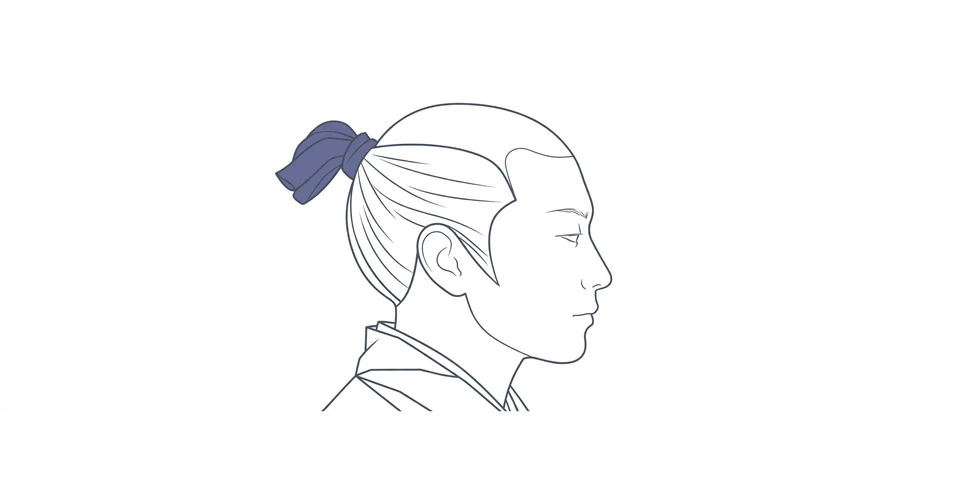
Sakayaki is the shaved front and top of the head, written in Japanese as 月代, and it is one half of the famous samurai hairstyle. The other half is the chonmage, the topknot into which the remaining hair is gathered, oiled, and tied. The two belong together. Without the sakayaki, the knot is only a knot. With it, the whole head becomes a statement, and that statement was legible to everyone in Edo Japan.
The shave covered the forehead and the crown, the pate, while the hair at the sides and back was left long. That long hair was then drawn up, treated with oil and wax, and folded forward into the knot that sat on top of the shaved area. The contrast was the point. A broad band of bare skin in front, a dark knot of hair behind it, and a clean line between the two where the razor had done its work. From the side, the profile was as distinctive as a uniform, and in a society that read rank in every detail of dress, that profile worked like a name tag.
It is worth being precise about what the word names. Sakayaki is not the topknot, and it is not the whole hairstyle. It is the shaved patch alone. A man could be described as wearing a chonmage, and the sakayaki was the part of that style that required the most regular attention, because hair grows back. The knot could be retied in minutes, but the sakayaki had to be shaved again and again, and that repetition is what turned a haircut into a discipline.
The practice was old by the time the samurai made it famous. Men in Japan had tied their hair up for centuries, partly to hold court headgear in place, and the shaved forehead grew out of that older habit. What the warriors did was take a courtly convenience and turn it into a martial one, and then the peace of the Edo period turned the martial habit into a social code. Each stage kept the shape and changed the meaning, which is how a practical shave became a symbol.
Why a samurai shaved the front of his head
The first reason was the helmet. A samurai helmet, the kabuto, was heavy, and it had to sit steady on the head in battle. Hair under a helmet is slippery, hot, and uncomfortable, and a knot of loose hair at the front would have pushed the helmet forward or made it wobble at the worst possible moment. Shaving the front of the head gave the helmet a firm seat, and it kept the hair out of the warrior's face when he most needed a clear view. The history of the chonmage traces this practical origin back to the use of hair to hold the kabuto steady, and it is the least romantic and most convincing explanation for the style.
The second reason was heat. Japan is humid in summer, and a helmet traps warmth against the scalp. A shaved forehead let sweat evaporate instead of pooling under iron, and it kept the head cooler on a long march or a long day standing guard. Kokugakuin University, in its answer to why samurai adopted the topknot, puts it plainly: warriors removed hair from the front of their heads to keep cool inside the helmet, and the practice that grew from that need was called sakayaki.
The early method was not even shaving. Before razors became common, the hair was pulled out with tweezers, a slow and painful process, and the Portuguese missionary Luis Frois, who travelled in Japan in the sixteenth century, wrote that the heads of warriors on the battlefield were smeared with blood from the plucking. That detail is worth pausing over, because it shows how seriously the style was taken. Men were willing to bleed for it before it was even fashionable, which tells you that the sakayaki was never a casual choice. It was a commitment made with tweezers, one hair at a time.
Over time the razor replaced the tweezers, and the painful ritual became a routine one. The reason for the shave stayed practical for a long while, and the sources agree that helmet comfort is the most likely origin. But practicality alone does not explain why the sakayaki survived centuries of peace, when no one was wearing a helmet to breakfast. For that, you have to look at what the shaved patch came to mean once the fighting stopped.
How the sakayaki changed as a boy became a man
The sakayaki was not one fixed shape. It changed with the age of the wearer, and in Edo Japan those changes were public. A boy typically had the crown of his head shaved around the age of eleven or twelve, and what remained was cut into a squared off style called sumi-maegami when he was about fourteen or fifteen. That partially shaved head marked him as a youth, a wakashu, and it was understood as a stage of life rather than a finished style. Then, around seventeen or eighteen, his forelocks were shaved off as well, and the full shaved pate of an adult was complete.
This slow unveiling of the forehead was a coming of age written on the scalp. There was no certificate and no ceremony that the whole town could see, but there was a head, and the head told the story. A boy with a partially shaved crown was a boy. A young man with squared forelocks was on his way. A man with the full sakayaki was an adult, and everyone he passed on the street could read that without asking. In a world without identity cards, the hairline did the work of a document.
The shape of the sakayaki also varied with the man who wore it. The knot of a samurai was more pronounced than that of an artisan or a merchant, and the shaved area that framed it was part of that difference. The sakayaki of a great lord and the sakayaki of a low retainer were the same idea at different volumes, and the eye learned to judge the volume. Rank, in Edo Japan, was something you wore, and the forehead was one of the places you wore it.
I find something quietly honest in a system that puts age and standing where everyone can see them. Modern life hides age behind hair dye and hides rank behind job titles on a screen, and we pretend that neither matters while quietly obsessing over both. The sakayaki did not pretend. It announced a man's stage of life on the most visible part of his body, and it asked him to carry that announcement with dignity. There is a certain relief in a culture that says plainly what ours whispers.
Keeping a sakayaki smooth
A sakayaki is a promise that has to be renewed constantly, and the style was no exception. Hair grows, stubble shows, and a patch that was smooth on Monday would be rough by the end of the week. Keeping a sakayaki presentable meant regular shaving with a razor, and it meant doing it carefully, because a nick on the forehead is not something a man can hide. The maintenance was part of the discipline, and a neglected sakayaki was a visible sign of a neglected duty.
Neatness mattered to the samurai in a way that went beyond vanity. The house codes and writings of the warrior class return again and again to the importance of a neat appearance, and hair was at the centre of that concern. A samurai's hair was part of his equipment, as much as his swords, and letting it grow wild was like letting a blade go rusty. The daily routine of oiling the remaining hair, waxing it into shape, and keeping the sakayaki smooth was a small ritual of readiness, a way of saying each morning that the man was prepared for whatever the day required.
Most men did not do all of this alone. Barbers, known as kamiyui, dressed hair for a living, and a samurai of standing would have his hair attended to by someone skilled with a razor. The tools were simple, a razor, a comb, oil, and wax, but the skill was in the steadiness of the hand and the evenness of the line. A good sakayaki had a clean edge, a smooth surface, and a shape that suited the man's head, and achieving that week after week was a craft in itself.
There is a lesson in the sheer repetitiveness of it. We tend to think of identity as something you decide once, but the sakayaki suggests otherwise. It was an identity that had to be remade every few days with a razor, and the moment a man stopped remaking it, it began to disappear under new growth. That is true of most things we claim to be. A reputation, a skill, a principle, all of them grow stubble if they are not maintained, and the sakayaki made that truth visible on the forehead. It is a humbling thought, and I think a useful one: who you are is not what you decided once, but what you keep shaving into shape.
Samurai, townsmen, and sumo: three different sakayaki
The samurai version was the fullest and the most strictly observed. By the early Edo period a shaven pate had become required of the samurai classes, and by the middle of the seventeenth century the style was treated as mandatory, with beards forbidden alongside it. The message was unmistakable. A samurai showed his forehead, kept his face clean shaven, and wore his knot pronounced, and the combination marked him as a man of the warrior class wherever he went. The sakayaki was, for him, closer to a uniform than to a fashion.
Townsmen adopted a modified version. Common people in the early modern period followed the same basic idea, shaving the front of the head and folding the remaining hair forward into a knot, but their version was softer and less pronounced than the samurai style. A merchant or an artisan wore the sakayaki too, because by the mid Edo period it had become a general fashion rather than a warrior monopoly, but his knot was smaller and his sakayaki less emphatic. The difference was deliberate. It let a street crowd tell a samurai from a shopkeeper at a glance, and it kept the social order legible even as the style spread.
The exception proves the rule. Ronin, samurai without a lord, were not required to shave their heads, and that made them easy to recognise. A man with a full head of hair in a crowd of shaved foreheads stood out immediately, and the standing out was the point. The sakayaki was a sign of belonging to a lord and a class, and a man who belonged to no one carried no sign. His unshaven head was itself a label, and it was not a flattering one. The patch marked membership, and its absence marked the lack of it.
Sumo kept a version of the tradition alive, but changed it. In modern sumo the pate is no longer shaved as a rule, though the hair there may be thinned or shaved in a practice called nakazori, done around once every three months, to help the topknot sit neatly. The plain knot every wrestler wears is the chonmage that grew out of this history, and the wrestlers who rise to the salaried ranks earn the fanned ginkgo leaf shape described in How an Oichomage Turns a Wrestler Into a Sekitori. Sumo kept the knot and softened the shave, which is a fitting compromise for a sport that preserves the past without pretending the present never happened.
Kabuki actors are the other keepers of the style, wearing the topknot on stage as part of roles that demand it. Between sumo and kabuki, the sakayaki survived as a working hairstyle rather than a museum piece, worn by men doing a job rather than men dressing up for a photograph. That is a narrower survival than the samurai would have imagined, but it is a real one, and it keeps the shape alive in front of audiences who might otherwise know it only from prints.
The edict that ended the sakayaki
The end came in 1871, in the fourth year of the Meiji era, when the new government issued the ordinance known as the Dampatsurei, or the hair cutting edict. It is often described as a law that forced every samurai to cut off his topknot, and that is the version most people have heard. The fuller story is a little more careful, and it is worth telling properly, because the difference matters.
The edict of 23 September 1871, sometimes called the Zanpatsu Datto Rei, formally gave men freedom over their hairstyle, allowing samurai to cut their topknots and lay aside their swords if they chose, rather than ordering every head shaved by force. It was an invitation wrapped in a strong expectation. The government wanted Japan to look modern and Western to the outside world, and the topknot was the most visible sign of the old order. Officials were encouraged to set the example, and the pressure to conform did the rest. In March 1873 Emperor Meiji himself had his hair cut, and officials and then ordinary men followed in large numbers.
That is how a hairstyle dies, not always by a ban, but by a change in what is respectable. The sakayaki had once been the mark of a man of standing, and within a few years of the edict it became the mark of a man left behind. The topknot faded from the streets of Tokyo and the castle towns, and by the end of the century it survived almost only in the two worlds that refused to give it up, the sumo ring and the kabuki stage. A style that had taken centuries to build was undone in a decade, not by a single law, but by a whole country deciding that the future had a different hairline.
There is a melancholy to that speed. A man who had shaved his forehead every week of his adult life could wake up one morning and find that the thing he had maintained so carefully now marked him as old fashioned. Governments change fashions faster than people change loyalties, and the sakayaki is a reminder that identity is partly a matter of timing. Wear the right sign in the wrong decade and the sign turns against you. That is not a reason to cling to every old custom, but it is a reason to be gentle with people whose customs have just gone out of fashion.
What the sakayaki left behind
The sakayaki never really disappeared. It lives on in every woodblock print, every period drama, and every film in which a samurai appears, because no actor playing a samurai can be recognised without it. The sakayaki became the visual shorthand for an entire era, the way a particular hat can stand for an entire century. A modern audience may not know the word, but it knows the shape, and the shape still carries the meaning: discipline, rank, and a code that asked a great deal of the men who followed it.
It also left behind a way of thinking about appearance. The sakayaki treated the body as a public document, and it assumed that the people around you had a right to read it. Modern Japan, like most of the modern world, has moved in the opposite direction. Hair is private now, a matter of personal taste, and a shaved forehead says nothing about rank or loyalty. We have gained freedom and lost legibility, and it is worth asking whether the trade was entirely a good one. A society that can read nothing from appearance must find other ways to know who can be trusted, and those other ways are often less honest than a hairline.
The word itself survives too, still used whenever the style is discussed, and the knot it framed survives in the sumo ring, where a young wrestler grows his hair long enough to tie one and a champion wears the fanned leaf that marks his rank. The sakayaki may be gone from the street, but the idea behind it, that a man's head can carry his history, is still being acted out every tournament, under television lights, in front of crowds who may not know the history but can feel its weight.
I keep returning to the tweezers. Before there were razors and barbers and edicts, there were men pulling their own hair out one strand at a time so that a helmet would sit straight. That is a strange thing to do, and it is also a familiar one. Every generation has its own version of it, some small pain accepted for the sake of belonging, some daily discipline that looks absurd from the outside and feels necessary from the inside. The sakayaki is gone, but the impulse behind it is not. We still shape ourselves to fit the helmets we have chosen to wear, and we still hope the people around us will recognise the shape and know what it means.
Look at the forehead next time you see a samurai on screen, and you will see more than a haircut. You will see a practical answer to a helmet, a boy growing into a man, a rank made visible, a razor kept busy for a lifetime, and an edict that ended it all in a few short years. A patch of bare skin, the sakayaki, carried all of that, and it carried it in plain sight. That is a lot of meaning for a place where hair used to be, and it is why the sakayaki deserves its own story, apart from the knot it framed.
More in Culture & Society
- Christmas in Japan and the Fried Chicken Dinner That Started It All
- Kiso Yoshinaka Rode Out of the Mountains and Nearly Took Japan
- The Archer on the Tower Was Hangaku Gozen
- Tomoe Gozen Rode Into Battle When Women Were Told to Stay Home
- A Chonmage Is the Knot Every Sumo Wrestler Wears Before the Fan
- Onna-Bugeisha Held the Castle While the Men Were Away
Latest posts
- Koyo Turns Japan Into a Country That Forecasts Leaves
- Inside Japan's 100 Yen Shops, Where Everything Costs a Coin
- Momiji-Gari Is Japan's Autumn Answer to Hanami
- Akihabara and How Tokyo's Electric Town Learned to Sell Everything
- The Naginata Gave Japan's Women Warriors a Blade of Their Own
- Momiji Turns Japan Red Every Autumn
- How an Oichomage Turns a Wrestler Into a Sekitori
- Ginkgo and the Gold That Falls on Tokyo Every Autumn
- Japanese Castles and the Samurai Fortresses That Still Stand
- A Kamidana Brings the Shrine Into the Japanese Home
- An Omamori Carries a Shrine's Protection in Your Pocket
- Kongobuji Still Runs the Mountain Kukai Chose
- A Shinai Is a Sword That Refuses to Cut
- Pachinko and the Neon Rooms Where Japan Plays Its Loudest Game
- Kiai Is the Shout That Turns a Strike Into a Commitment