Momiji-Gari Is Japan's Autumn Answer to Hanami
· 16 min read
The custom of momiji-gari is Japan's autumn leaf viewing tradition, a thousand year old outing that takes people from the Heian court to the temple gardens of Kyoto in search of red maple leaves.
Every spring, Japan gathers under cherry blossom. Every autumn, it does the same thing in reverse, going out to meet the red leaves instead of waiting for them to come to town. The custom is called momiji-gari, and it is one of the oldest seasonal habits in the country, older than most of the temples people visit to practise it.
The word itself gives the game away. Momiji-gari joins momiji, the red autumn leaf, to gari, hunting, so the whole phrase means hunting for autumn leaves. Nobody hunts anything in the literal sense. The hunt is a slow walk, a long look, and the quiet satisfaction of finding a maple at its best. Our earlier story on momiji, the maple Japan watches turn red, traced the tree behind the season. This one follows the custom itself, from the Heian court to the crowded temple gardens of Kyoto, and explains why a walk to look at leaves has survived for more than a thousand years.
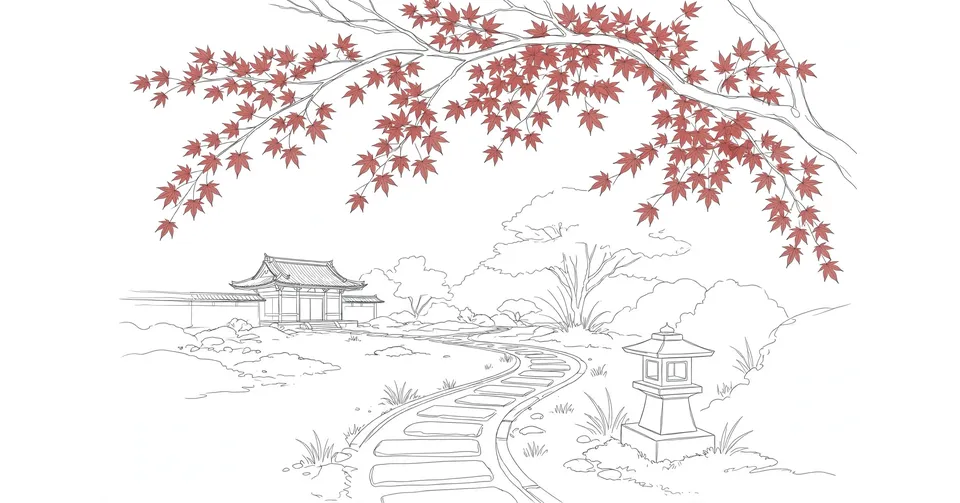
To practise momiji-gari you need almost nothing. A free afternoon, a place with old trees, and the patience to look slowly will do. The custom asks for less than hanami, which needs a picnic, a blue tarp, and a fight for a good spot under the blossom. Momiji-gari asks only that you show up and pay attention, which may be why it has lasted so long. It is a tradition built for ordinary days, and it rewards anyone willing to walk a little further than usual.
What momiji-gari actually means
The Japanese word momiji-gari is written with characters that mean red leaves and hunting, and it is usually translated as autumn leaf hunting. The hunting part puzzles people at first, because the whole point is to look and leave everything where it is. The explanation is older than the custom itself. The word gari originally described hunting animals, and over time the Japanese began to use it for any seasonal outing that involved going out to search for something in the countryside. Mushroom gathering became kinoko-gari, and digging for clams at low tide became shiohi-gari. Looking for autumn leaves became momiji-gari, and the name stuck even though the only thing anyone takes home is a photograph.
There is a small distinction worth knowing before you go. Momiji usually means the maple leaf itself, especially the Japanese maple whose leaves turn the deepest red. Koyo is the wider word for the whole phenomenon of leaves changing colour, red and yellow and orange together. In practice people use the two words loosely, and nobody at a temple garden will correct you. But the difference explains why the custom has two names in English, autumn leaf viewing and momiji-gari, and why the weather forecasts that track the season are usually called koyo forecasts rather than momiji forecasts. Momiji-gari is the outing. Koyo is the season it belongs to.
The custom sits beside hanami the way autumn sits beside spring. Japan Guide puts it simply, saying that colourful leaves are to the Japanese autumn what cherry blossoms are to spring. The two seasons mirror each other in the national calendar. Weather services publish forecasts for both, newspapers run front pages on both, and families plan holidays around both. Cherry blossom season lasts about two weeks at its best, while the momiji-gari season stretches for weeks as the colour moves down the country. That longer window changes the feeling of it. Hanami is a sprint. Momiji-gari is a slow walk, and it forgives you if you are a week late.
How a court pastime became a people's season
Momiji-gari began among the court aristocracy of the Heian period, which started in 794 when Kyoto became the imperial capital. The story, as the Japan National Tourism Organization tells it, is wonderfully practical. The nobles had cherry trees in their own gardens for spring, but no trees for autumn colour, so they travelled out to the mountains to seek the leaves, composing poetry and music with the red slopes as their backdrop. They did not go to admire nature in the abstract. They went because the beauty they wanted was somewhere else, and the journey was part of the pleasure.
References to the custom appear in the Kokin Wakashu, the poetry collection compiled in the early tenth century, and in The Tale of Genji, the great novel of the period, which even has a chapter called Momijiga, meaning beneath the autumn leaves. The custom also entered the theatre. The Noh play Momijigari tells of the warrior Taira no Koremochi meeting a noblewoman and her entourage on a mountain covered in red leaves, and the story was later adapted for kabuki. A tradition that appears in poetry, in the great novel of its age, and on the stage is a tradition that has already become part of how a culture thinks about itself.
For centuries momiji-gari stayed aristocratic. It was only in the middle of the Edo period, in the eighteenth century, that ordinary townspeople began to go out to the hills and valleys to enjoy the colours, holding banquets under the maples and turning a court pastime into a popular one. The timing matters. The Edo period was a long stretch of peace after generations of conflict, and travel among ordinary people was becoming common. Visits to the shrine at Ise and pilgrimages to Kumano grew popular in the same years, and a plant guidebook called the Kadanchi Kinsho, which introduced seasonal sights and natural attractions, had just been published. Momiji-gari spread because the country was ready for it. People had the peace, the roads, and the guidebooks to go looking for beauty on their own.
That slow spread is the most interesting thing about the history of momiji-gari. It explains why the custom still feels both refined and democratic. A temple garden can charge for entry and draw crowds in formal dress, while a neighbourhood park a few streets away can offer the same red leaves for free. The aristocrats invented the outing, but the townspeople made it a habit, and a habit is harder to kill than a fashion. I think that is the real reason momiji-gari survived when so many court customs faded. It stopped belonging to the court and started belonging to anyone with an afternoon to spare.
The koyo front and the forecast habit
Japan is a long country, stretching about 2,000 kilometres from north to south, and the autumn colour does not arrive everywhere at once. It moves like a slow wave. Japan Guide describes the pattern clearly. Each year, starting in mid September, the koyo front slowly moves southwards from the northern island of Hokkaido until it reaches the lower elevations of central and southern Japan around late November, and some trees around Tokyo and Kyoto remain colourful into December. The colour starts on the mountaintops, even within a single region, and works its way down.
This moving front is what makes momiji-gari a planning exercise as much as a walk. The best time to see autumn leaves in Japan is generally between early November and early December, but that is only a rough guide. The exact peak depends on altitude, latitude, tree species, and the weather of that particular year. A cold snap can hurry the colour along. A warm autumn can delay it. Every year, forecasters publish koyo forecasts the way they publish cherry blossom forecasts, estimating when the maples will colour in each region, and people plan their trips around them. The forecasts are estimates, not promises, and experienced leaf viewers treat them as a starting point rather than a guarantee.
There is something quietly charming about a country that forecasts leaves the way other countries forecast rain. It says that the changing of the seasons is treated as public information, worth measuring and sharing. The koyo forecast is not a tourist gimmick. It is the modern version of the Heian courtier watching the mountains and deciding that this week, this slope, would be worth the journey. The tools changed. The instinct did not. I find that continuity reassuring. In a century when so much of travel is about ticking boxes, momiji-gari still runs on the oldest schedule there is, the one written by temperature and altitude.
Where to go, from Hokkaido to Kyoto
The famous spots for momiji-gari run the whole length of the country, and the season gives you a reason to travel it in order. In Hokkaido, Sounkyo in Daisetsuzan National Park is one of the first places the colour arrives, usually around the beginning of October, with towering rocks and red maples in a painted valley. Nearby Jozankei, an hour from Sapporo, pairs the leaves with hot springs, and its best time is also around early October. Onuma Quasi-National Park, with Mount Komagatake rising behind two lakes, peaks around the end of October.
Further south, the Tohoku region holds some of the most dramatic scenery of the season. Oirase Gorge in Aomori is famous for its stream running between banks of coloured trees, with the best viewing around early November. Naruko Gorge in Miyagi is known for trees rooted in rocky cliff faces nearly 100 metres above the ground, also at its best in early November. Ura-bandai in Fukushima, a cluster of lakes at the foot of Mount Bandai, peaks around the same time, and the largest lake, Hibara, is ringed with islands wrapped in autumn colour.
In the Kanto region around Tokyo, Nikko is the classic destination. The town is home to Toshogu Shrine, a World Heritage Site, and the leaves around Lake Chuzenji and Kegon Falls are at their best around early November. Mount Takao, only about 50 minutes from Shinjuku by train, peaks around mid November, and the cable car ride up the mountain passes through coloured trees the whole way. Kamikochi in Nagano, a mountain resort at the foot of the Northern Alps, is best in early November, and the autumn leaves reflected in Taisho Pond are one of the great sights of the season.
Kyoto, where momiji-gari began, keeps the season longest. Arashiyama, on the western edge of the city, is at its best in early December, with the mountains behind the Togetsukyo Bridge and the Hozugawa River cruise enclosing visitors in colour on both sides. The temples of the city light up their maple gardens at night during the peak weeks, and the evening illuminations have become a momiji-gari tradition of their own, a quieter cousin of the lantern lit yozakura evenings that draw crowds in spring. Our story on yozakura, Japan's cherry blossoms after dark describes that springtime glow. The autumn version trades pink for red and feels, to me, even more dramatic, because the colour seems to burn against the dark.
| Region | Spot | Best time |
|---|---|---|
| Hokkaido | Sounkyo, Daisetsuzan | Early October |
| Hokkaido | Jozankei Onsen | Early October |
| Tohoku | Oirase Gorge | Early November |
| Tohoku | Naruko Gorge | Early November |
| Kanto | Nikko | Early November |
| Kanto | Mount Takao | Mid November |
| Kansai | Arashiyama, Kyoto | Early December |
The table is a guide, not a timetable. Every spot on it peaks a little earlier or later depending on the year, and the smaller places that never make a list are often the better choice. A famous temple garden at peak season can be shoulder to shoulder, while a shrine two stations down the line, with three old maples and nobody else around, can give you the same red leaves in silence. Momiji-gari rewards the person who is willing to get off one stop early.
Momiji-gari and hanami, two halves of one habit
It is tempting to treat hanami and momiji-gari as rivals, spring against autumn, pink against red. The truth is closer to a partnership. Japan has about 1,200 species of trees, and their appearances change visibly with each of the four seasons. The two great viewing seasons exist because the country has two great moments of colour, and the culture built a custom around each one. Hanami celebrates a beginning, the blossom that opens the year. Momiji-gari celebrates an ending, the leaf that colours brilliantly one last time before dropping for winter. One looks forward. The other looks back. Together they frame the year.
The differences between the two customs are worth noticing. Hanami is social and noisy, a picnic under the blossom with friends, food, and drink. Momiji-gari is quieter and more solitary. You walk rather than sit. You look up rather than spread a tarp. The cherry blossom season is short and frantic, with everyone racing the same two weeks. The momiji-gari season is long, stretching over two months from Hokkaido to Kyoto, so there is time to choose your moment. If you miss the peak in one place, another place a little further south is still turning. That generosity of timing is part of the appeal. Hanami can feel like a deadline. Momiji-gari feels like an invitation.
There is also a difference in what the two seasons ask of you. Hanami asks you to be there when the blossom opens, which is a matter of days. Momiji-gari asks you to pay attention for longer, to notice the slow change from green to yellow to red, and to catch a tree on the day it looks its best. The maple does not bloom and fall in a week. It changes gradually, and the change is the show. I think that is why momiji-gari suits people who like to walk alone or in pairs rather than in crowds. It is a custom for lookers rather than revellers, and Japan has always made room for both.
The two customs also share a deeper idea. Both treat nature as something to visit rather than something to own. You do not pick the blossom, and you do not break off the maple branch. The hunt in momiji-gari ends with looking, and the looking is the whole point. In a culture that has always paired the appreciation of the seasons with poetry, that restraint is not an accident. It is the custom.
How to enjoy momiji-gari well
The practical side of momiji-gari is simple, but a few habits make the outing better. First, check the koyo forecast before you travel, and then check it again closer to the day. Forecasts are updated as the season moves, and a spot that was predicted to peak next week may already be turning. The detailed autumn leaves guide from Japan Guide tracks the koyo front as it moves south, and it is a good place to start planning a route.
Second, go early in the day if you can. The most famous spots fill up by late morning, especially on weekends, and the light is better in the morning anyway. A maple leaf photographed against the sun looks like stained glass, and the backlight effect is strongest when the sun is low. Leaves dotted with fresh raindrops are beautiful too, so a grey day is no reason to cancel. Some of the best momiji-gari happens in light rain, when the wet leaves shine and the crowds stay home.
Third, dress for a mountain walk even if you are only going to a temple garden. Wear non-slip footwear, because stone paths and fallen leaves get slippery, and bring a jacket or a sweater, because temperatures drop quickly in the evening. A compact picnic blanket of about one metre by two metres is worth carrying if you plan to sit for a while, since the ground in gardens and forests is often damp. The advice comes from a forest guide who has visited more than 3,000 forests and natural attractions in Japan, and it is the kind of practical wisdom that only comes from doing the thing hundreds of times. His full introduction to the custom is worth reading in the Live Japan guide to momijigari.
Fourth, remember the food. Autumn in Japan has its own flavours, and the momiji-gari regions have turned the leaf into souvenirs. In Minoh, north of Osaka, shops sell momiji tempura, maple leaves fried in tempura batter, a speciality of the town for generations. On Miyajima, the maple shaped sweet called momiji manju has been loved since the Meiji era, and it was created to represent Momijidani, the island's famous maple viewing valley. Tasting the local version of the leaf is a small pleasure, and it connects the walk to the place in a way that a photograph never quite does.
Finally, follow the one rule that has held since the Heian period. Look, do not take. Do not break branches, do not climb trees for a better angle, and do not step into planted areas to get closer. The gardens that host momiji-gari are often centuries old, and the trees in them are older than the visitors. A tradition that has survived a thousand years deserves to be enjoyed without damaging what makes it beautiful.
A quieter way to watch the leaves
Momiji-gari has survived for more than a thousand years because it asks so little and gives so much. It asks for an afternoon, a walk, and attention. It gives back a season that moves slowly enough to notice, a reason to travel the length of the country, and a habit that belongs to everyone, from the courtier composing poetry in the mountains to the office worker getting off the train one stop early. The leaf will turn whether anyone watches or not. The custom is simply the decision to watch.
If you have never tried momiji-gari, start small. Find the nearest park with an old maple, go on a weekday morning, and give yourself an hour with no plan beyond looking. The red will do the rest. And if you find yourself coming back the next week, and the week after, to see how the same tree has changed, you will understand why the Heian aristocrats left the city to find it. Some pleasures do not need improving. They only need repeating, once a year, every autumn, for as long as the maples keep turning.
More in Food & Travel
- Momiji Turns Japan Red Every Autumn
- Japanese Castles and the Samurai Fortresses That Still Stand
- Kongobuji Still Runs the Mountain Kukai Chose
- Tenkasu Turns Tempura Scraps Into Japan's Favorite Crunch
- Tanuki Udon Is the Bowl Named After a Raccoon Dog
- Wagyu Beef and Why One Small Steak Costs More Than Dinner
Latest posts
- A Chonmage Is the Knot Every Sumo Wrestler Wears Before the Fan
- Tomoe Gozen Rode Into Battle When Women Were Told to Stay Home
- Onna-Bugeisha Held the Castle While the Men Were Away
- Akihabara and How Tokyo's Electric Town Learned to Sell Everything
- The Naginata Gave Japan's Women Warriors a Blade of Their Own
- How an Oichomage Turns a Wrestler Into a Sekitori
- Ginkgo and the Gold That Falls on Tokyo Every Autumn
- A Kamidana Brings the Shrine Into the Japanese Home
- An Omamori Carries a Shrine's Protection in Your Pocket
- A Shinai Is a Sword That Refuses to Cut
- Pachinko and the Neon Rooms Where Japan Plays Its Loudest Game
- Kiai Is the Shout That Turns a Strike Into a Commitment
- Toro Stone Lanterns Light the Way Through Japan's Sacred Places
- An Ofuda Brings the Kami Home on a Slip of Paper
- Kagura Suzu Are the Bells That Let the Kami Hear the Dance