How an Oichomage Turns a Wrestler Into a Sekitori
· 17 min read
An oichomage is the ginkgo-leaf topknot that marks a sumo wrestler as a sekitori, dressed each day by a specialist hairdresser and cut away only at retirement.
Watch a sumo tournament for a few minutes and your eyes will settle on the hair. Every wrestler wears a topknot, but the men at the top wear something different, a wide fan of dark hair spread across the back of the head like the leaf of a ginkgo tree. That fan is the oichomage, and it is the clearest sign in sumo that a wrestler has arrived.
The oichomage is not a decoration a wrestler chooses for himself. It is a mark he earns by climbing into the two salaried divisions, juryo and makuuchi, where wrestlers are known as sekitori. A junior wrestler in the lower divisions wears a simpler knot. A sekitori wears the oichomage. The difference is visible from the far side of the arena, and everyone in the sumo world can read it at a glance.
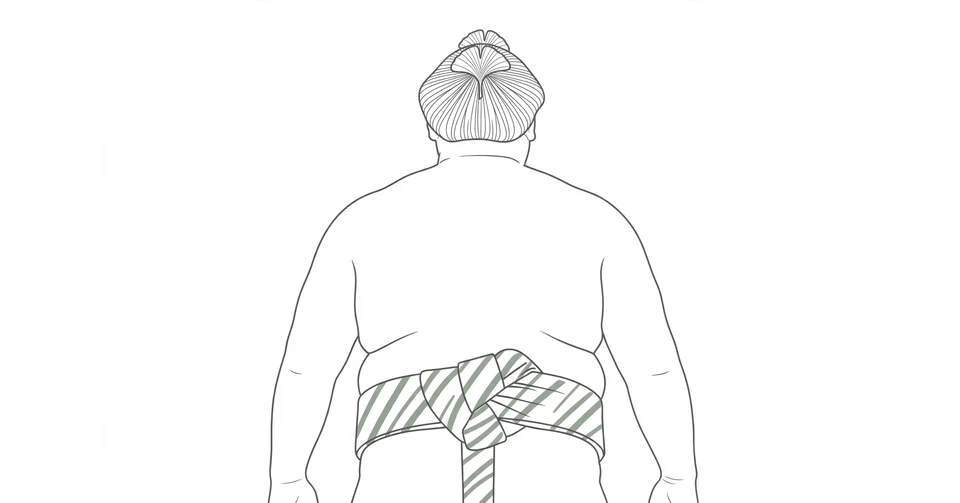
This article explains what the oichomage is, how it differs from the simpler topknot, who dresses it, what it takes to keep it in place through a tournament, and what happens on the day it is cut away for good.
What an oichomage is
The word oichomage comes from oicho, meaning big ginkgo, and mage, meaning topknot. The style starts from the same base as every other sumo topknot, the chonmage, a knot with roots in the samurai hairstyles of the Edo period. What makes the oichomage different is the finish. The end of the topknot is splayed out into a semicircle, fanned wide like a ginkgo leaf, and held in that shape with oil and wax. As our earlier piece on the white silk mawashi put it, a sekitori's hair is dressed in the oichomage, an elaborate topknot fanned out into the shape of a ginkgo leaf, where a junior wears a simpler knot. That one sentence carries the whole idea. The fan is the reward, and the plain knot is the waiting room. You can read more about the white silk that marks the same rank in White Silk Means You Made It as a Sekitori.
Every professional wrestler wears a chonmage as soon as his hair is long enough to tie one. Wrestlers with sekitori status are required on certain occasions, such as during a honbasho tournament, to wear the more elaborate form. On ordinary days inside the stable, a sekitori may wear the flatter everyday knot, and the oichomage comes out for the tournament and for formal events. That rhythm matters. The fan is not everyday wear. It is the public face of the rank, put on when the world is watching.
The history behind the knot is older than professional sumo itself. The chonmage can be traced to the Heian period, and it became the standard hairstyle of the samurai in the Edo period, when the shape of a man's topknot could signal his social standing. Then, in 1871, the Meiji government issued the Dampatsurei edict and ordered men of the samurai classes to cut their hair short, as part of a drive to modernise Japan's appearance. Sumo, however, kept the privilege of wearing the samurai topknot. The wrestlers never gave it up. Today the only remaining wearers of the chonmage in modern Japan are sumo wrestlers and kabuki actors, which makes the oichomage a living piece of the Edo period, still worn in public every two months when a tournament begins. The history of the chonmage shows how a hairstyle that once belonged to every samurai narrowed down to these two worlds, and how sumo became its guardian.
There is something quietly honest about a sport that wears its hierarchy on the head. In most workplaces, rank hides behind job titles and closed doors. In sumo, it sits in plain sight, fanned out like a leaf, and nobody can fake it. A wrestler cannot buy the fan or borrow it. He has to win his way to it, bout by bout, and the hair tells the truth before he ever steps into the ring.
The ginkgo leaf behind the oichomage
The ginkgo is not a random choice of leaf. It is one of the oldest tree species on earth, famous for its endurance, and its fan-shaped leaf is instantly recognisable in Japan, where ginkgo trees line streets and temple grounds and turn gold in autumn. An oichomage shaped like that leaf carries the suggestion of longevity and strength, two qualities a wrestler needs if he wants to survive in the top divisions. The shape is also practical as a signal. A semicircle of dark hair, the oichomage spread wide and gleaming with wax, can be recognised from the cheapest seat in the arena. The audience does not need a programme to know who the sekitori are. The hair announces them.
That announcement matters because sekitori status changes everything in a wrestler's life. A sekitori receives a salary, wears finer clothing in public, is attended by lower-ranked wrestlers, and is given privileges that juniors do not have. The oichomage is the visible seal on that change. When a wrestler is promoted to juryo for the first time, the moment his hair is dressed in the fan is the moment his new life becomes real, not only to him but to everyone who sees him. It is a promotion you can see from across the room, and that is exactly the point. Sumo does not whisper about rank. It displays it.
The oichomage also ties the wrestler to the long story of his sport. Sumo is often called Japan's oldest sport, and its rituals have survived centuries of change, from the samurai era through the Meiji reforms to the present day. The oichomage sits inside that story as a small, daily act of continuity. Every time a tokoyama spreads the fan, he is repeating a gesture that has been repeated for generations, and every time a sekitori walks to the ring wearing it, he is carrying a piece of the Edo period into a modern arena. For more on that long history, see Sumo, Japan's Oldest Sport.
I find the choice of a leaf rather touching. Sumo could have marked its champions with gold or jewels, and in a way the white silk mawashi already does something like that. But the oichomage is made of nothing more than the wrestler's own hair, oil, and wax. It grows out of him, it belongs to him, and it can be taken away. That fragility is what gives it meaning. A crown can be stored in a box and passed on. A topknot has to be earned, maintained, and eventually surrendered, and that makes it a truer measure of a career.
The simpler knot the juniors wear
Below the sekitori ranks, every wrestler wears the plain chonmage, a smaller and simpler topknot without the fanned leaf. The base is the same. The hair is gathered, oiled, folded, and tied. What is missing is the spread, the wide semicircle that turns a knot into a statement. A junior's knot says that he belongs to the sumo world. It does not yet say that he has risen in it.
The contrast is deliberate, and it shapes the daily life of a stable. Juniors do the chores, cook the meals, and attend the sekitori. Their hair marks them as apprentices, and the plain knot is a reminder that they are still climbing. There is no shame in it. Every sekitori once wore the plain knot, and every yokozuna started there too. The knot simply records where a wrestler stands on the ladder, and the oichomage waits at the top of it. Win enough bouts and the knot changes. Lose, and it stays the same.
For a wrestler who never reaches sekitori, tradition holds that the retirement ceremony may be the one time he wears the fuller oichomage, a single day of wearing the fan he spent his career chasing. Sources differ on how universal that custom is, and some accounts treat it as a courtesy rather than a rule, so it is best understood as a tradition rather than a guarantee. Even so, the idea is poignant. A man can spend a decade in the lower divisions and still, on his last day, have his hair dressed as if he had made it. Sumo gives him the fan for a farewell, even if it never gave it to him for a tournament.
The tokoyama who dress the oichomage
No wrestler dresses his own oichomage. That work belongs to the tokoyama, the specialist hairdressers employed by the Japan Sumo Association, and it is a craft that takes years to learn. A tokoyama normally joins the association around the age of fifteen and works his way up through the classes, starting at fifth class and rising as he gains skill and seniority. The Japan Times, in its guide to the role, reports that it takes about ten years before a hairdresser reaches the level where he can sculpt the oicho mage worn by wrestlers in the top two divisions, and that normally only two hairdressers hold the special rank at the very top, the only men allowed to style a yokozuna's hair. The tokoyama and their long training are a reminder that the fan on a wrestler's head is the product of a decade of someone else's discipline.
The tools of the trade are as specialised as the skill. A tokoyama works with an array of combs, each made for a specific task, crafted from a particular wood by a single company based in Nagoya. Ordinary combs would snap under the work, because a wrestler's hair is very thick and often filled with sand after a morning of training on the clay ring. The tokoyama's combs are built to survive that punishment and can last up to a decade. The only part of his kit that a hairdresser chooses himself is the traditional styling scissors. The rest, including the combs, is bought and distributed by the Sumo Association.
The dressing of an oichomage relies on bintsuke, a thick, sweet-smelling wax and oil that is worked into the hair to give it hold and shine. The hair is combed, oiled, and shaped with a firm hand, and the fan of the oichomage is spread with a metal pick called a magebo, which teases the end of the knot outward into its semicircle. A special tool called a maekaki is used only for making this style. The scent of bintsuke is one of the smells of the sumo world, as recognisable in the arena as the smell of the clay ring, and it clings to a wrestler's hair long after the dressing is done.
The work is daily and demanding. The tokoyama comb, wax, and style the hair every day, in a rough and intense manner, because the knot has to survive training, sweat, and the impact of bouts. Some wrestlers also have the crown of the head thinned or shaved, a practice called nakazori, to help the topknot sit more neatly, and this is done around once every three months. None of this is glamorous. It is repetitive, physical work done behind the scenes, early in the morning, by men whose names the audience never learns. And yet without them, the most recognisable symbol of sumo would not exist.
I think the tokoyama deserve more attention than they get. The wrestler takes the applause and the fan takes the photographs, but the fan is made by hands that trained for ten years to spread it. There is a lesson in that for any craft. The visible achievement always rests on invisible labour, and the people who do that labour rarely ask for credit. They simply show up every morning, combs in hand, and make someone else look like a champion.
Keeping an oichomage through a tournament day
A tournament day tests the oichomage in ways a quiet morning never does. The wrestler wakes early, trains, eats, and then has his hair dressed again for the walk to the arena. The knot must hold through the heat of the day, through the sweat of the warm-up, and through the bout itself, where two men weighing well over a hundred kilograms collide and one of them may be thrown to the clay. A topknot that comes loose in the ring would be an embarrassment, and the tokoyama's work is judged, in part, by whether the fan survives the day intact.
The fan also has to look right from every angle. The wrestler bows, crouches, and circles his opponent, and the audience sees the back of his head as often as his face. The semicircle must stay even and full, the wax must keep its shine, and the shape must still read as a ginkgo leaf when the bout is over. This is why the dressing is done with such care, and why a senior tokoyama's skill is so valued. A good oichomage is not only a hairstyle. It is a piece of stagecraft that has to perform under pressure.
There is a rhythm to this care that mirrors the rhythm of the sport. Sumo runs on routine, on early mornings and repeated gestures, on the same salt thrown into the same ring day after day. The daily dressing of the oichomage belongs to that rhythm. It is one more small discipline inside a life made of disciplines, and it keeps the wrestler connected to the tradition he represents. A man who lets his hair be dressed every morning by someone else is a man who has accepted that his career is not entirely his own. It belongs to the stable, to the association, and to the history of the sport, and the oichomage is the daily reminder of that belonging.
The day the oichomage is cut
Every oichomage has a last day. When a wrestler retires, he marks the end of his career by cutting off his topknot in a ceremony called the danpatsu-shiki, the hair-cutting ceremony. The cutting takes place in a dedicated ceremony even if the wrestler actually retired several months earlier, so the ceremony is a farewell held on sumo's own schedule, not on the day the decision was made. For lower-ranked wrestlers the ceremony is often a quieter affair, held at the usual end-of-tournament party. For the top-ranked wrestlers it becomes a grand occasion, a charity tournament with exhibition matches and performances by prestigious guests, and the cutting of the topknot closes the day.
The ceremony follows a pattern that has changed little. The retiring wrestler sits at the centre of attention, dressed in formal kimono, while his guests come forward one by one. Each guest pays a symbolic participation fee and cuts only a few strands of his hair with gold-plated scissors, under the guidance of a referee. Hundreds of people may take part, from stablemates and rivals to family members, sponsors, and supporters, and each small snip is a goodbye from someone who shared a part of the career. The last hairs holding the topknot together are cut by the retiring wrestler's master, and from that moment the wrestler is officially retired. By the end of the ceremony, the oichomage that took a decade of training to shape is gone. It is customary for the retired wrestler to keep his severed topknot in a box or a glass case after the ceremony, a keepsake of the life he has left behind.
Where the ceremony is held depends on the career behind it. It can take place almost anywhere, and it is often held in a hotel, but a wrestler must have served at least thirty tournaments as a sekitori to perform his ceremony at the Ryogoku Kokugikan, the great sumo arena in Tokyo. That rule turns the venue itself into a final measure of achievement. The arena is reserved for those who spent long enough at the top, and the right to say goodbye there has to be earned like everything else in the sport.
One of the most famous danpatsu-shiki belonged to Takamiyama, the Hawaii-born wrestler who became the first foreigner to win a top division championship. When his topknot was cut in February 1985, more than 11,000 well-wishers watched in person while millions more followed on television, and around 230 friends and dignitaries took turns with the gold-plated scissors as he sat for over an hour and a half. By the time his stablemaster made the final cut, tears were streaming down his face. He was no longer Takamiyama the wrestler. He would now be known as Azumazeki Oyakata, a coach and elder of the association. The ceremony did not only end a career. It renamed a man.
There is a reason the cutting of the topknot moves people so deeply. Hair is personal in a way that a uniform is not. It grows with you, it carries the smell of your work, and it is the first thing people see when you walk into a room. To have it cut away, strand by strand, by the people who knew you best, is to have your identity dismantled in public, gently, by many hands, until nothing is left but the man underneath. The tears that wrestlers shed at the danpatsu-shiki are not only sadness. They are the release of years of discipline, pressure, and pride, all coming out at once in a single snip of the scissors.
Modern life rarely gives us endings like this. Careers end with an email, relationships end with a message, and chapters close without anyone marking the moment. Sumo refuses to let a career end quietly. It gathers the community, it hands out the scissors, and it makes the ending something everyone witnesses together. I think there is wisdom in that refusal. An ending that is seen and shared is easier to carry than one that happens alone, and a man who has his topknot cut by two hundred friends knows, in a way no speech could tell him, that his years in the ring mattered to other people.
The knot that tells a life story
The oichomage begins as a reward, becomes a daily discipline, and ends as a farewell. A wrestler earns it by winning his way into the salaried ranks, and from that day on it announces him before he speaks. It is dressed each morning by a craftsman who trained for a decade to shape it, and it is kept in place through sweat, collisions, and long tournament days. Then, one day, it is cut away, strand by strand, by the people who shared the career, and the man walks out of the arena with ordinary hair and a new name.
That arc is what makes the oichomage more than a hairstyle. It is a record of a life, written in hair. The plain knot says a man has begun. The fan says he has arrived. The cutting says he has finished, and that his finishing deserves witnesses. Few symbols in sport carry so much meaning in so little material, just hair, oil, wax, and a steady hand.
The next time you watch a sumo tournament, look at the hair before you look at the bout. Find the wide fan spread like a ginkgo leaf, and you will have found a sekitori wearing his oichomage, a man who climbed out of the lower divisions and earned the right to wear his rank where everyone can see it. Look a little longer and you will see the tokoyama's work, the years of training behind a single shape, and the quiet promise that one day, when the career is over, the fan will be cut away with the same care with which it was made.
More in Culture & Society
- The Naginata Gave Japan's Women Warriors a Blade of Their Own
- Ginkgo and the Gold That Falls on Tokyo Every Autumn
- A Kamidana Brings the Shrine Into the Japanese Home
- An Omamori Carries a Shrine's Protection in Your Pocket
- A Shinai Is a Sword That Refuses to Cut
- Pachinko and the Neon Rooms Where Japan Plays Its Loudest Game
Latest posts
- Momiji Turns Japan Red Every Autumn
- Japanese Castles and the Samurai Fortresses That Still Stand
- Kongobuji Still Runs the Mountain Kukai Chose
- Kiai Is the Shout That Turns a Strike Into a Commitment
- Toro Stone Lanterns Light the Way Through Japan's Sacred Places
- An Ofuda Brings the Kami Home on a Slip of Paper
- Kagura Suzu Are the Bells That Let the Kami Hear the Dance
- Japanese Knives From Samurai Swords to Kitchen Counters
- Tenkasu Turns Tempura Scraps Into Japan's Favorite Crunch
- Goshuin Collects Your Shrine Visits One Red Stamp at a Time
- Hamaya Is the Arrow That Breaks Demons at New Year
- Saisen Is the Small Coin You Offer Before You Pray
- Japanese Gardens and the Quiet Art of Borrowed Scenery
- Tanuki Udon Is the Bowl Named After a Raccoon Dog
- A Himorogi Is the Shrine Before Shrines Had Walls