The Naginata Gave Japan's Women Warriors a Blade of Their Own
· 16 min read
The naginata is a long shaft topped with a curved blade, a weapon that began on Heian battlefields and became the signature arm of Japan's women warriors, and it is still practised today as a modern martial art.
Picture a Japanese sword and you probably picture a katana, short enough to wear at the hip and quick enough to draw in a single motion. Now imagine that same curved blade mounted on the end of a wooden shaft as tall as the person holding it. That is a naginata, and it changes everything about how a fight works. Reach replaces speed, sweeping arcs replace close cuts, and a fighter who is smaller or weaker than the opponent is no longer at an obvious disadvantage.
The naginata has a quiet place in the family of Japanese martial arts. Practitioners of kendo, iaido, aikido, kyudo, jodo and naginata all wear hakama for training, and the weapon shares the dojo with far more famous cousins. Yet for centuries it was the weapon most closely tied to the women of samurai households, the ones who defended the home while the men were away at war. Its story runs from Heian battlefields to girls' school gymnasiums, and it is still being written in dojos around the world today.
There is something quietly radical about a weapon designed around leverage instead of muscle. The naginata does not ask its wielder to be the strongest person in the room. It asks for timing, distance and calm, and it rewards those qualities so generously that women used it to hold castles and face down cavalry. That is the story worth telling, not as a curiosity but as a serious thread in the history of Japan.
What a naginata actually is
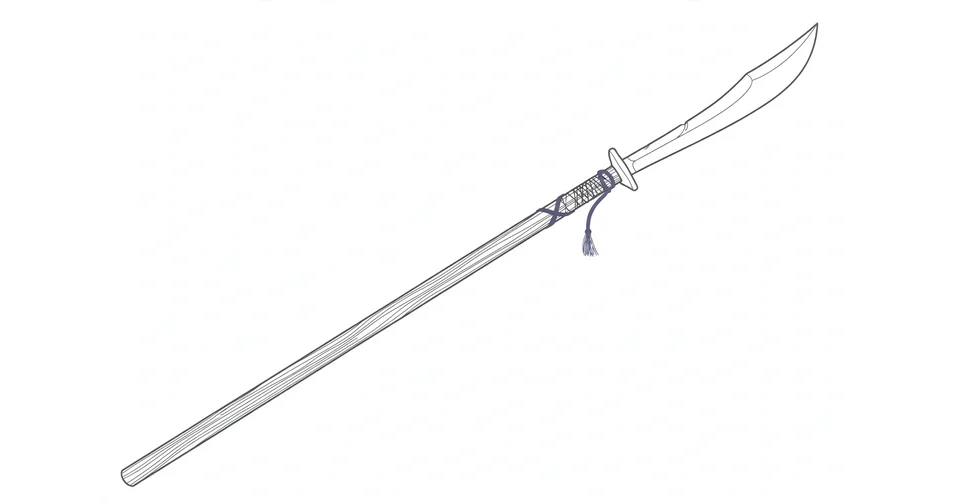
A naginata is a polearm, a curved single edged blade mounted on a long wooden shaft. The blade is forged in the same way as a traditional Japanese sword, with a long tang that runs deep into the shaft and is held in place by a small wooden peg. The blade is usually 30 to 60 centimetres long, the shaft between 120 and 240 centimetres, and the whole weapon often stretches past two metres from tip to butt. Held upright, it stands taller than most of the people who carry it.
The name itself gives a clue to how it works. Naginata is often translated as mowing sword, and the image fits. The weapon is swung in wide arcs, cutting at ankle height, sweeping at shoulder height, and thrusting when the distance closes. The shaft is oval in cross section rather than round, so the wielder can feel the direction of the blade through the grip alone, without looking down. It is a weapon built for keeping enemies at a distance, and that distance is its whole advantage.
Against a swordsman, that distance is decisive. A katana reaches less than a metre beyond the hand. A naginata reaches more than two. The swordsman must cross open ground to land a single cut, and every step forward passes through the arc of the blade. Against a horseman the advantage is even clearer, since the long shaft can reach up to the rider or sweep at the legs of the horse. It is no accident that the weapon became famous for pulling mounted warriors out of the saddle.
There are smaller and larger versions too. The ko-naginata, with a shorter blade and a more compact shaft, was lighter and easier to use indoors, where a full length weapon would catch on beams and doorframes. The o-naginata, with a blade of 50 to 70 centimetres and a shaft over two metres, was the battlefield version, made for open ground and mounted opponents. The differences matter because they show a weapon being adapted to real situations, not a single ceremonial object frozen in time.
Born on Heian battlefields
Nobody knows exactly where the naginata came from, and honest histories admit the gap. One theory holds that it developed from the hoko yari, an older polearm of the late first millennium. Another holds that it came from lengthening the hilt of the tachi, the long sword of the Heian court, until the grip became a shaft. The Samurai Museum in Berlin traces both origin theories and notes that the term naginata first appears in historical documents in 1146, in the Heian period, which ran from 794 to 1185, but the earliest reliable evidence of the weapon in use dates from a little later, around the middle of the Kamakura period. The safest thing to say is that it emerged in the Heian period and came into its own during the wars that followed.
Those wars gave it a stage. The Genpei War of 1180 to 1185, fought between the Minamoto and Taira clans, was a conflict of mounted archers and close fighting, and the naginata proved itself against cavalry again and again. By the Kamakura period it was standard equipment across several warrior classes, carried by foot soldiers, by samurai and by the armed men of the great temples.
What strikes me about this beginning is how ordinary it is. The naginata did not start as a woman's weapon or a symbol of anything. It started as a practical answer to a practical problem, which was how a foot soldier could fight a horseman and live. Everything that came later, the schools, the symbolism, the association with women, grew out of that plain beginning. Weapons rarely stay in the role they were invented for, and this one travelled further than most.
The warrior monks who made it feared
The most famous early users of the naginata were the armed men of the great temples, remembered today as sohei, or warrior monks. The temples of Enryaku-ji on Mount Hiei and Kofuku-ji in Nara fielded large bodies of armed men, and the long handled naginata was their signature weapon. At the Battle of Uji in 1180, temple forces used the naginata against Taira cavalry in one of the first datable accounts of the weapon in coordinated combat.
The popular image is worth a second look. The historian Mikael Adolphson showed that the term sohei does not appear in a single contemporary source from the Heian or Kamakura periods, and was only invented in the Edo period, when scholars and artists romanticised the past. The people of the time were called akuso, shuto or daishu, and they were not a uniform warrior class in the way later woodblock prints suggest. The armed temple men were real, and their naginata were real, but the tidy label is a later invention. I find that correction reassuring rather than disappointing. It is a reminder that the past is usually messier than the pictures we inherit, and that checking the label is part of respecting the people behind it.
Whatever we call them, the temple fighters gave the weapon its fearsome reputation. A body of men with polearms could hold a bridge or a mountain pass against cavalry, and the temples used that power in their long disputes with the court and with each other. The naginata became a symbol of reach and discipline, a weapon that turned a defensive position into a killing ground. The great temples on Mount Hiei became infamous for fielding whole regiments of naginata wielders, and for centuries after, anyone who saw the curved blade on its long shaft knew what it meant.
Tomoe Gozen and the women of the Genpei War
The figure who ties the naginata to women most famously is Tomoe Gozen, a warrior of the late twelfth century who fought in the Genpei War. The Tale of the Heike, the great epic of the war, describes her as a warrior worth a thousand, a skilled archer and swordswoman who served the general Minamoto no Yoshinaka as a trusted captain. At the Battle of Awazu in 1184 she is said to have fought at the front of the army, and the epic credits her with defeating enemy leaders in single combat. She lives on in folk tales, books and even video games to this day, and the naginata is almost always in her hands in those retellings.
How much of her story is fact is hard to say, and it is better to admit that than to pretend otherwise. The sources are thin and the epic is literature as much as history. But the uncertainty about one woman should not hide the wider pattern. Women of samurai families were trained in martial arts, and many fought when their households were attacked or their men were away. Some fought offensively on the battlefield and are called onna-musha. Others defended the home and the castle, and are called onna-bugeisha. The distinction matters, and Tomoe Gozen belongs firmly in the first group, a battlefield commander rather than a household defender.
The reason the naginata suited these women is practical rather than romantic. Its long shaft lets a fighter keep a stronger opponent at a distance, and its sweeping cuts use momentum and leverage rather than brute strength. A woman with a naginata did not need to match a swordsman muscle for muscle. She needed to keep him where her blade could reach him and his could not reach her, and to read his movement a half second before he made it. That is a skill built on anticipation and quick reaction, not on size, and it is why the weapon became the choice of so many women warriors between the twelfth and nineteenth centuries.
There is a temptation to treat all of this as legend, a colourful footnote to the real story of male samurai. That temptation should be resisted. The women were there, they trained, and they fought, and the weapon they chose tells us something about how they fought. They fought cleverly, at a distance, with a tool that turned patience into power.
Nakano Takeko and the last stand at Aizu
If Tomoe Gozen is the legend, Nakano Takeko is the documented proof. In 1868, in the final year of the Tokugawa period, the domain of Aizu in northern Japan held out against the new imperial army. The women of Aizu samurai families had a strong combat tradition, and about twenty of them formed a platoon of naginata fighters known as the Joshigun, the women's army. The group included Koko Nakano and her two daughters, Takeko, aged twenty two, and Masako, aged sixteen.
When the rebel forces in their region were pushed back into the fortified town of Aizu-Wakamatsu, the women sprang into action to help defend their clan and its stronghold, Tsuruga Castle. During the fighting around the castle they marched out to rescue the female head of the clan, who they believed had been abducted, only to find the report was false. On their way back they ran into advancing imperial troops at Yanagi Bridge, and the battle that followed is one of the best documented episodes of women fighting in Japanese history.
Takeko is said to have killed twenty to thirty enemy fighters with her naginata before she was shot. The number is a claim from the reports of the battle, not a figure anyone can verify today, and it should be read with that caution. What is better attested is what happened next. Wounded and dying, she asked her younger sister Masako to cut off her head and carry it away for burial, so that it would not be taken by the enemy as a trophy. Most of the other women in the platoon were also killed in that battle. The story is told in more detail by the Yanagi Jutaijutsu school in Berlin, which traces how the weapon became a symbol of female empowerment in Japan.
There is no comfortable way to end a story like that, and there should not be. Takeko was twenty two years old, highly educated and highly trained, and she died defending a castle for a cause that was already lost. Her courage is not in doubt. The waste of it is the point. War takes the best trained and most loyal people first, and the women of Aizu were among them. Remembering her means remembering the cost, not just the romance.
How the naginata became a women's art
After the wars ended, the naginata changed its role again. In the Edo period, which brought more than two centuries of peace under Tokugawa rule, the weapon became a symbol of status in samurai households and was often part of the dowry of a noblewoman. A bride who arrived with a naginata arrived with a statement about who she was and what her family expected of her. The weapon that had pulled horsemen from the saddle was now carried into marriage as a mark of honour.
The change was not only symbolic. Girls in samurai families learned the weapon as part of their education, and after the Meiji Restoration of 1868, when traditional weapons were increasingly regulated and their use moved into martial arts schools, the naginata found its clearest home. Many schools were run by women from former samurai families, and the art passed from mother to daughter and teacher to student in a line that had never really broken. In the Showa era the government introduced naginata practice into girls' physical education, and the art became an ordinary part of growing up for many young women in Japan.
It is worth pausing on how unusual that path is. Most weapons lose their meaning when the wars end, and become museum pieces or curiosities. The naginata did the opposite. It moved from the battlefield into the home and the school, and in doing so it became more important, not less. The women who kept it alive were not preserving a relic. They were practising a living skill, and they were doing it on their own terms, in schools they ran themselves. That continuity is the real reason the weapon is remembered today as a women's art, and it was earned over generations rather than declared by anyone.
Naginata today, from dojo to world championships
Modern practice is called atarashii naginata, or new naginata, and it is a sport as much as a martial art. The practice weapon, the shiai-yo, has an oak shaft and a bamboo blade, and measures between 210 and 225 centimetres long, weighing over 650 grams. Practitioners wear protective armour and a hakama, and compete under clear rules with referees at organised events, just as kendo players do. If you want to see how the way of the sword lives on in modern practice, the story of kendo shows the same transformation from battlefield skill to disciplined sport.
The All Japan Naginata Federation was founded in 1955 to set uniform competitive rules, and the International Naginata Federation now organises the sport beyond Japan, including the World Naginata Championships. The art is taught in schools and universities across Japan, and there are practitioners in Europe, the Americas and elsewhere, though it remains far rarer outside Japan than kendo or judo. The gap is a shame, because the art has something distinctive to offer, a kind of fighting that rewards reading the opponent over overpowering them.
Competition has five scoring targets, and learning them is a good way to understand how the art works:
- Men, a strike to the head
- Kote, a strike to the wrist
- Do, a strike to the trunk
- Sune, a strike to the shin
- Tsuki, a thrust to the throat
Each target teaches a different lesson about distance. Men and kote reward the high sweeping cut, do and sune punish a fighter who leaves the body open, and tsuki is the shortest and most dangerous technique of all, a straight thrust that ends the exchange in a single movement. Watching a match, you see two people circling at a distance that looks almost polite, and then the whole thing is decided in less than a second. The politeness is the point. The art is built on control, and control is what makes the speed safe.
The clothing is part of the form too. Practitioners train in keikogi and hakama, and the hakama turns the training hall into a formal space, just as it does for kendo, iaido and kyudo. That shared uniform is a reminder that the naginata was never really separate from the other Japanese arts. It was always one member of a family, and the family is still training together.
Why the naginata still matters
The naginata matters because it proves that strength is not the only way to win a fight. Its whole design is an argument for leverage over muscle, for timing over force, and for the idea that a smaller fighter with a better plan can hold the ground. That argument was useful on a Heian battlefield, it was useful to the women who defended their homes and castles, and it is useful in a modern dojo, where the lesson has nothing to do with violence at all.
There is also a quieter lesson in how the weapon survived. It survived because women kept practising it when nobody else would, in schools they ran, in lessons they taught their daughters, in a tradition that passed hand to hand rather than through institutions. Institutions forget things. People who practise every week do not. The naginata is still here because generations of women refused to let it become a museum piece, and that stubbornness is worth more than any single battle it ever won.
Stand in a dojo today and watch a naginata match, and you are watching something very old and very new at the same time. The weapon is the same curved blade on the same long shaft. The fighter is often a schoolgirl or a university student, someone who would have been unimaginable on a twelfth century battlefield and entirely at home in a twenty first century gymnasium. The distance between those two pictures is eight centuries of women picking up the same weapon and making it their own. That is a long time for any tradition to last, and the naginata has lasted it beautifully.
More in Culture & Society
- How an Oichomage Turns a Wrestler Into a Sekitori
- Ginkgo and the Gold That Falls on Tokyo Every Autumn
- A Kamidana Brings the Shrine Into the Japanese Home
- An Omamori Carries a Shrine's Protection in Your Pocket
- A Shinai Is a Sword That Refuses to Cut
- Pachinko and the Neon Rooms Where Japan Plays Its Loudest Game
Latest posts
- Momiji Turns Japan Red Every Autumn
- Japanese Castles and the Samurai Fortresses That Still Stand
- Kongobuji Still Runs the Mountain Kukai Chose
- Kiai Is the Shout That Turns a Strike Into a Commitment
- Toro Stone Lanterns Light the Way Through Japan's Sacred Places
- An Ofuda Brings the Kami Home on a Slip of Paper
- Kagura Suzu Are the Bells That Let the Kami Hear the Dance
- Japanese Knives From Samurai Swords to Kitchen Counters
- Tenkasu Turns Tempura Scraps Into Japan's Favorite Crunch
- Goshuin Collects Your Shrine Visits One Red Stamp at a Time
- Hamaya Is the Arrow That Breaks Demons at New Year
- Saisen Is the Small Coin You Offer Before You Pray
- Japanese Gardens and the Quiet Art of Borrowed Scenery
- Tanuki Udon Is the Bowl Named After a Raccoon Dog
- A Himorogi Is the Shrine Before Shrines Had Walls