Christmas in Japan and the Fried Chicken Dinner That Started It All
· 10 min read
Christmas in Japan is a season of fried chicken, strawberry cake, and lights, not a religious holiday. Here is how a 1974 marketing campaign became a national tradition.
Christmas in Japan looks nothing like the Christmas most of the world knows, and that is exactly what makes it worth understanding. There is no day off work, no family gathered around a tree on the morning of the 25th, and no turkey on the table. Instead, millions of people queue up for fried chicken, couples book restaurants weeks in advance, and whole city districts glow with light.
The short answer is that Christmas in Japan is a secular, commercial, and romantic season. Only about one percent of the population is Christian, so the holiday carries almost no religious meaning for most people. What it does carry is a set of traditions that are entirely Japanese: a bucket of KFC on Christmas Eve, a strawberry sponge cake, and an evening spent under illuminations with someone you love.
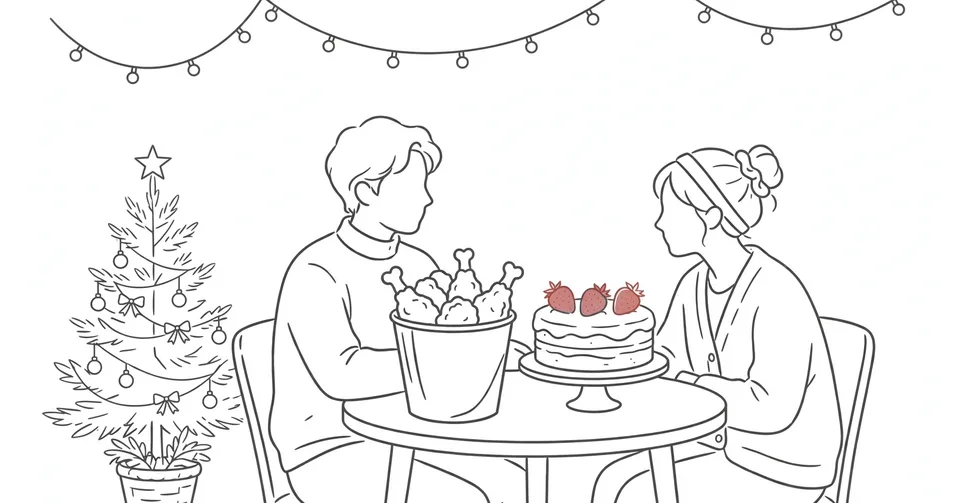
The season starts early. By the first week of November, department stores put up their trees, television commercials switch to Christmas songs, and KFC opens its Christmas bookings. The build-up lasts almost two months, which makes Christmas in Japan feel longer than in most countries, even though the day itself is an ordinary working day. It is a festival of atmosphere rather than a festival of rest, and once you accept that, its quirks start to make sense.
How a 1974 Marketing Campaign Became a National Tradition
The most famous fact about Christmas in Japan is also the strangest: the national Christmas dinner is fried chicken from KFC. The story starts in 1974, when KFC Japan ran a campaign with the slogan "Kentucky for Christmas", or in Japanese, "Kurisumasu ni wa Kentakkii". Turkey was hard to find in Japan in the 1970s, and the company saw an opening. Fried chicken, served in a bucket meant for sharing, became the substitute, and the substitute became the tradition.
The campaign worked so well that it never really ended. In 1985, KFC introduced the Christmas Party Barrel, a set built for the occasion, and it is still the centerpiece of the season. For the 2025 season, bookings opened on 4 November, with collection between 19 and 25 December. The Party Barrel Original held eight pieces of Original Recipe chicken, a chicken meat gratin, and a strawberry and vanilla mousse cake, priced at 5,490 yen, or 4,990 yen for orders placed by 12 December.
Today, more than three million Japanese families order KFC for Christmas in Japan, and the chain's stores are at their busiest on Christmas Eve, with long queues of people collecting pre-ordered buckets. Some order weeks or even months ahead. The lesson is hard to miss: a tradition does not have to be old to be real. Fifty years of repetition, backed by a marketing campaign that never stopped, was enough to make fried chicken feel as natural at Christmas in Japan as turkey feels elsewhere.
I find this oddly reassuring. Traditions are often treated as things handed down from ancient times, but here is one that was plainly invented by a fast food company, and it still brings families to the same table every December. The origin is commercial, but the feeling people attach to it is genuine.
Christmas Eve Belongs to Couples, Not Families
If Christmas Day belongs to families in much of the West, Christmas Eve in Japan belongs to couples. December 24th is treated as one of the most romantic nights of the year, closer in spirit to Valentine's Day than to a family holiday. Partners go out for dinner, exchange gifts, stay in hotels, or walk together through illuminated streets.
Restaurants in Tokyo, Osaka, and Kyoto are often fully booked weeks in advance, and many offer special Christmas menus that are far more elaborate than an ordinary dinner. The pressure is real enough that single people have a word for spending the night alone with a bucket of chicken: "kurisumasu katsu", a play on words that roughly means Christmas celibacy. It is said as a joke, but the joke only works because the expectation is so widely shared.
This is the mirror image of New Year in Japan. While Christmas Eve is for couples, New Year belongs to families, with temple visits, traditional food, and rituals meant to welcome the new year. The two holidays sit side by side on the calendar, and together they divide the season neatly: romance first, family second. If you want to understand how the year ends here, you have to see both halves, and the contrast explains why neither holiday looks quite like its Western namesake.
The Strawberry Cake That Started in 1910
Next to the chicken bucket, the second food of Christmas in Japan is the Christmas cake. It is a light sponge cake topped with whipped cream and strawberries, sold by bakeries across the country and eaten on the 24th or 25th. The cake is so standard that it is easy to assume it has always existed, but it has a clear starting point: the Yokohama confectioner Fujiya sold its first Christmas cake in December 1910.
The cake spread slowly at first, then quickly as Christmas became a commercial season after the war. Today it is part of the standard set, and KFC even includes a small cake in its Party Barrel. The combination of fried chicken and strawberry sponge cake sounds strange on paper, yet it is the pairing that defines the holiday for most Japanese families. Like the chicken itself, the cake shows how a borrowed custom can be reshaped until it feels local, and that reshaping is the heart of Christmas in Japan.
Illuminations, Markets, and the Season of Light
If there is one thing that unites Christmas in Japan, it is light. Cities compete to build the brightest displays, and illuminations have become the public face of the season. Tokyo, Osaka, Nagoya, and Kobe all host elaborate light displays in parks, shopping districts, and station plazas, and they draw crowds every evening from late November through Christmas Day.
Christmas markets have joined the illuminations in recent years, selling mulled wine, sausages, ornaments, and gifts in open-air stalls that borrow openly from German tradition. They are popular with couples and groups of friends, and they give the season a place to gather outdoors, even in the cold. The markets are new, the illuminations are newer, and both fit the same pattern as the chicken and the cake: take something foreign, keep the parts that work, and make it Japanese.
For visitors, the illuminations are the easiest part of Christmas in Japan to enjoy. They cost nothing to walk through, they run for weeks, and they turn ordinary streets into something worth a detour. A good plan for Christmas in Japan is to pick one display, arrive just after sunset, and let the crowd carry you along. A useful guide to Christmas in Japan lists the major displays by city, and it is worth checking before you go, since dates shift slightly every year.
What Christmas in Japan Is Not
It helps to be clear about what Christmas in Japan is not, because the differences are the point. Christmas in Japan is not a national holiday. The 25th of December is a normal working day, and in 2026 it falls on a Friday, which means most people will be at their desks. There is no widespread tradition of family gift giving, no Santa Claus visiting children at home, and no nativity scene in public spaces. Churches hold services, and the small Christian minority observes the day religiously, but for the majority the holiday is a secular celebration of joy, romance, and light.
| Christmas in Japan | Christmas in much of the West | |
|---|---|---|
| Main meal | Fried chicken, usually KFC | Turkey, ham, or roast |
| Main dessert | Strawberry sponge cake | Christmas pudding, mince pies |
| Who it is for | Couples on Christmas Eve | Family on Christmas Day |
| Work on 25 December | Normal working day | Public holiday |
| Religious meaning | Almost none for most people | Central for many |
The table above sums up Christmas in Japan at a glance, and in real life it is messier. Some families do exchange gifts, some people do go to church, and plenty of people simply ignore the holiday altogether. But the general shape holds, and it is why visitors who expect a familiar Christmas often feel pleasantly lost. For more detail on the customs, this guide to quirky Japanese Christmas traditions covers the food, the romance, and the illuminations in one place.
How to Spend Christmas in Japan
A little planning goes a long way, because the popular parts of the season sell out. If you want the full Christmas in Japan experience, order the KFC Christmas set in November, as soon as bookings open, and collect it on Christmas Eve. Book a restaurant at least two weeks ahead if you plan to eat out on the 24th, and expect set menus with Christmas pricing. If you want illuminations, go on a weekday evening to avoid the weekend crowds, and dress warmly, because most displays are outdoors.
For a quieter version of the season, visit a Christmas market in the early evening, buy something warm to drink, and walk home through a lit-up shopping street. That is closer to how most people actually experience Christmas in Japan than any single event. The holiday here is not about one big day. It is about a month of small, bright moments layered over ordinary life.
The season also pairs well with the rest of the Japanese calendar. Golden Week in spring is the country's busiest holiday season, a week when the whole nation seems to travel at once, and the contrast with Christmas is instructive: one holiday is about movement and family, the other about light and couples. Japanese festivals run through the year in the same way, from snow sculptures in winter to fireworks in summer, and Christmas sits among them as the most borrowed and the most transformed of all.
If you stay into the New Year, the mood changes completely. The lights come down, the couples go home, and families gather for the most important holiday of the year, with temple visits at midnight and traditional food served in lacquered boxes. The best introduction to that shift is the hatsumode tradition, the first shrine visit of the year, which draws millions of people in the first three days of January. Christmas in Japan ends the year with romance and light, and the New Year begins it with family and ritual, and the two together say more about the country than either one alone.
Christmas in Japan is, in the end, a reminder that traditions are not only inherited. They can be invented, marketed, and adopted, and still become something people genuinely care about. A fried chicken dinner that started as an advertising slogan now anchors the holiday for millions of families, and a strawberry cake first sold in 1910 is as much a part of December as any carol. That is not a lesser kind of tradition. It is just a newer one, and it works because it fits the people who keep it.
More in Culture & Society
- Kiso Yoshinaka Rode Out of the Mountains and Nearly Took Japan
- Sakayaki Gave the Samurai His Signature Hairline
- The Archer on the Tower Was Hangaku Gozen
- Tomoe Gozen Rode Into Battle When Women Were Told to Stay Home
- A Chonmage Is the Knot Every Sumo Wrestler Wears Before the Fan
- Onna-Bugeisha Held the Castle While the Men Were Away
Latest posts
- Koyo Turns Japan Into a Country That Forecasts Leaves
- Inside Japan's 100 Yen Shops, Where Everything Costs a Coin
- Momiji-Gari Is Japan's Autumn Answer to Hanami
- Akihabara and How Tokyo's Electric Town Learned to Sell Everything
- The Naginata Gave Japan's Women Warriors a Blade of Their Own
- Momiji Turns Japan Red Every Autumn
- How an Oichomage Turns a Wrestler Into a Sekitori
- Ginkgo and the Gold That Falls on Tokyo Every Autumn
- Japanese Castles and the Samurai Fortresses That Still Stand
- A Kamidana Brings the Shrine Into the Japanese Home
- An Omamori Carries a Shrine's Protection in Your Pocket
- Kongobuji Still Runs the Mountain Kukai Chose
- A Shinai Is a Sword That Refuses to Cut
- Pachinko and the Neon Rooms Where Japan Plays Its Loudest Game
- Kiai Is the Shout That Turns a Strike Into a Commitment