A Chonmage Is the Knot Every Sumo Wrestler Wears Before the Fan
· 17 min read
A chonmage is the plain topknot every sumo wrestler wears, a knot with roots in the samurai hairstyles of the Edo period that still marks the start of a wrestling life.
Watch a sumo wrestler walk to the ring and you will notice the hair before you notice the size. Every man in the sport wears his hair tied up in a neat knot on the crown of his head, and that knot has a name. A chonmage is the plain topknot every professional wrestler wears, the base from which the famous ginkgo leaf fan of the sekitori is built, and it is one of the oldest things in Japanese sport.
The chonmage is not a fashion choice. It is a piece of samurai history that survived the end of the samurai themselves, a knot with roots in the hairstyles of the Edo period that ordinary Japanese men were once ordered to abandon. Sumo kept it, and today a chonmage is one of the first things a young wrestler grows when he joins a stable, long before he wins his first bout.
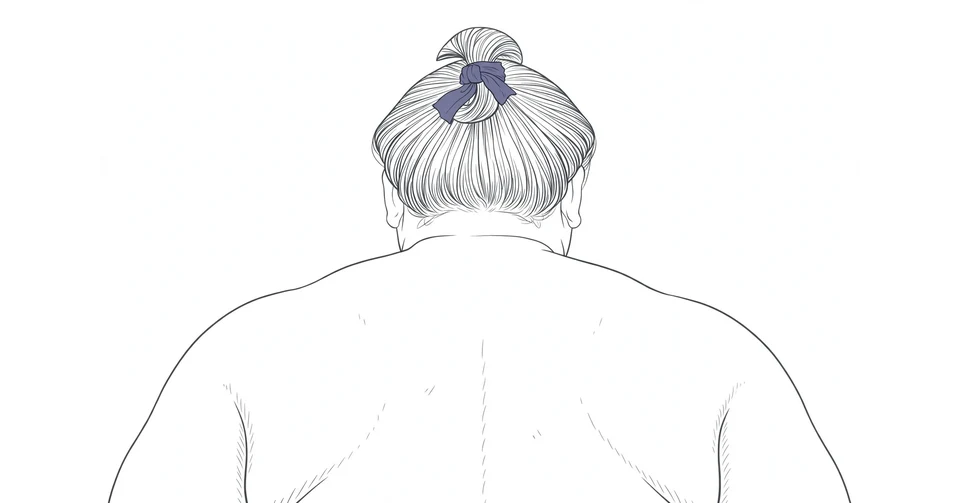
This article explains what a chonmage is, where it came from, how it is tied and kept, who dresses it, and what happens on the day the chonmage is cut away. The knot looks simple from the stands, but it carries centuries of Japanese history on the crown of a wrestler's head, and it tells you where he stands in the sport before he ever touches the clay.
What a chonmage is
A chonmage is a traditional Japanese topknot worn by men, written in Japanese as 丁髷. The word names a way of dressing the hair rather than a single fixed shape. The hair is grown long, gathered at the crown of the head, oiled and waxed, and folded forward into a small knot that sits on top. In the Edo period that knot came with a shaved crown, the sakayaki, and the shape and size of the knot could signal the social standing of the man who wore it. A samurai wore his more pronounced than a merchant or an artisan, and the knot was as much a uniform as the swords at his waist.
The modern sumo version of the chonmage is a little different from the Edo original. The crown is no longer shaved as a rule, though the hair there may be thinned or shaved in a practice called nakazori, done around once every three months, to help the knot sit neatly. What remains is the same idea that the samurai carried: long hair, oil, wax, and a knot folded onto the crown. The history of the chonmage traces the style back to the Heian period, long before the samurai made it their own, and follows it through the Edo period to the two worlds that still wear it today.
That survival is what makes the chonmage remarkable. Plenty of Japanese traditions live on in museums, festivals, or period dramas, but the chonmage is worn every day by working athletes, in public, under television lights, every two months when a tournament begins. It is not a costume put on for a ceremony. It is a hairstyle a man wakes up with, trains in, eats in, and fights in, and it has to survive all of that without coming undone.
I find that ordinariness moving. A museum piece is protected behind glass because it is fragile, but a chonmage is protected by being useful. The chonmage survived because sumo refused to let it become a relic, and because a stable full of young men still grows its hair long enough to tie one. Tradition usually needs a keeper, and here the keeper is a sport that never saw a reason to stop.
From a helmet strap to a status symbol
The chonmage did not begin as decoration. It began as a practical answer to a problem of war. A samurai helmet, the kabuto, needed to sit steady on the head in battle, and a knot of hair tied at the crown gave it something to grip. Over time the practical knot became a mark of standing, and by the Edo period the topknot was something a man wore to show who he was in a society that read rank in every detail of dress.
The rules around the knot tightened as the peace of the Edo period settled in. A shaven pate became required of the samurai classes by the early Edo period, and by the 1660s all men, commoner or samurai, were forbidden from wearing beards, with the sakayaki deemed mandatory. In a world without identity cards, the head told the story. The knot marked a man as a samurai, a merchant, or an artisan, and the men without a lord, the ronin, were not required to shave their heads at all, which made them easy to recognise at a glance.
Then came the order that almost ended the chonmage for good. With the Dampatsurei Edict of 1871, issued in the name of Emperor Meiji in the early Meiji era, men of the samurai classes were forced to cut their hair short as part of a drive to modernise the appearance of Japan. The topknot, once the mark of a man of standing, became a symbol of the old order that the new government wanted left behind. Within a few decades the chonmage had all but vanished from the streets of Japan, worn by almost no one except the men of two worlds that refused to give it up.
Those two worlds were sumo and kabuki. Both kept the chonmage because their traditions were built around it, and both still wear it now. In modern Japan the only remaining wearers of the chonmage are sumo wrestlers and kabuki actors, and the Japan Sumo Association employs specialist hairdressers to cut and prepare the wrestlers' hair. It is a strange fate for a hairstyle that once belonged to every samurai in the country: it survived by narrowing down to a wrestling ring and a stage, and it is still there, in plain sight, more than a century after the edict that was supposed to finish it.
There is a lesson in that narrowing that I keep coming back to. We usually think of survival as a matter of staying big, but the chonmage survived by becoming small and stubborn. It did not need the whole country to keep wearing it. It needed one sport that would not cut it off, and one theatre that would not either, and that was enough. A tradition does not have to be popular to live. It has to be kept by someone who refuses to let it go.
The chonmage every wrestler wears
In sumo the chonmage is the starting point, not the prize. All professional wrestlers wear a chonmage as soon as their hair is long enough to tie one, which means a new recruit spends his first months growing his hair out while he learns the far harder lessons of the stable. The knot is the first uniform he earns, and he earns it simply by belonging. It says that he is a rikishi, a man of the sumo world, even if he has not yet won a single bout.
The plain chonmage is what the wrestlers of the lower divisions wear every day. A junior's chonmage is gathered, oiled, folded, and tied, and the result is a small, neat knot without the spread that marks the men above them. It is the same base as every other knot in the sport, and the difference between a junior and a sekitori is not in the knot itself but in the finish. A junior's chonmage says that he belongs. It does not yet say that he has risen.
That finish is the oichomage, the wide fan shaped like a ginkgo leaf that a sekitori wears on formal occasions and during a honbasho tournament. The oichomage starts from the same base as the plain knot, the chonmage, and the end of the knot is splayed out into a semicircle and held in shape with oil and wax. You can read the full story of that fan in How an Oichomage Turns a Wrestler Into a Sekitori, which traces the knot from its samurai roots to the rank it marks today. The plain knot is the waiting room, and the fan is the reward, and every wrestler in the lower divisions can see the difference every morning in the mirror and on the heads of the men he serves.
The rules are simple and visible. A wrestler with sekitori status is required on certain occasions, such as during a tournament, to wear the more elaborate form, while on ordinary days inside the stable he may wear the flatter everyday knot. The chonmage therefore changes with the calendar. It is plain in the stable, fanned out in the arena, and the rhythm of that change is part of the rhythm of the sport. A fan in the ring is a promise that the man wearing it has won his way there, and a plain knot in the stable is a reminder that the work continues.
For a wrestler who never reaches the salaried ranks, tradition holds that his retirement ceremony may be the one time he wears the fuller oichomage, a single day of wearing the fan he spent his career chasing. Sources differ on how universal that custom is, and it is best understood as a tradition rather than a guarantee. Even so, the idea carries a quiet kindness. A man can spend a decade in the lower divisions wearing the plain chonmage, and still, on his last day, have his hair dressed as if he had made it. Sumo gives him the fan for a farewell, even if it never gave it to him for a tournament.
The tokoyama who dress the chonmage
No wrestler dresses his own chonmage. That work belongs to the tokoyama, the specialist hairdressers employed by the Japan Sumo Association, and it is a craft that takes years to learn. A tokoyama normally joins the association around the age of fifteen and works his way up through the classes, starting at fifth class and rising as he gains skill and seniority. The Japan Times, in its guide to the tokoyama, reports that it takes about ten years before a hairdresser reaches the level where he can sculpt the ginkgo leaf topknot worn by wrestlers in the top two divisions, and that normally only two hairdressers hold the special rank at the very top, the only men allowed to style a yokozuna's hair.
The tools for dressing a chonmage are as specialised as the skill. A tokoyama works with an array of combs, each made for a specific task, crafted from a particular wood by a single company based in Nagoya. Ordinary combs would snap under the work, because a wrestler's hair is very thick and often filled with sand after a morning of training on the clay ring. The tokoyama's combs are built to survive that punishment and can last up to a decade. The Sumo Association buys the combs and distributes them, and the only part of his kit that a hairdresser chooses himself is the traditional styling scissors.
The dressing of a chonmage relies on bintsuke, a thick, sweet-smelling wax and oil that is worked into the hair to give it hold and shine. The hair is combed, oiled, and shaped with a firm hand, and the tokoyama comb, wax, and style the hair every day, in a rough and intense manner, because the knot has to survive training, sweat, and the impact of bouts. The scent of bintsuke is one of the smells of the sumo world, as recognisable in the arena as the smell of the clay ring, and it clings to a wrestler's hair long after the dressing is done. For the fan of the oichomage the end of the knot is spread with a metal pick called a magebo, which teases the hair outward into its semicircle, and a special tool called a maekaki is used only for making that style.
The work is daily and demanding, and it is done behind the scenes, early in the morning, by men whose names the audience never learns. And yet without them, the most recognisable symbol of sumo would not exist. A chonmage is not only a knot. It is a knot made by someone else's hands, and those hands trained for a decade to make it look effortless.
I think the tokoyama deserve more attention than they get. The wrestler takes the applause and the knot takes the photographs, but the knot is made by hands that trained for ten years to tie it. There is a lesson in that for any craft. The visible achievement always rests on invisible labour, and the people who do that labour rarely ask for credit. They simply show up every morning, combs in hand, and make someone else look like a champion.
Why a knot can carry a whole career
A chonmage is small. It is a fold of hair, a little oil, a little wax, and a string to hold it together. But in sumo it carries more meaning than almost anything else a wrestler wears, because it is the one thing that follows him from his first day in the stable to his last day in the ring. The white silk mawashi marks the same rank from the waist down, and you can read about that companion symbol in White Silk Means You Made It as a Sekitori. The knot marks it from the head, and together the two signs leave no doubt about where a man stands.
The chonmage also ties the wrestler to the long story of his sport. Sumo is often called Japan's oldest sport, and its rituals have survived centuries of change, from the samurai era through the Meiji reforms to the present day. The chonmage sits inside that story as a small, daily act of continuity. Every time a tokoyama ties the knot, he is repeating a gesture that has been repeated for generations, and every time a wrestler walks to the ring wearing it, he is carrying a piece of the Edo period into a modern arena.
Part of the power of the chonmage is that it cannot be bought or borrowed. A wrestler cannot purchase a better knot or rent one for the day. He grows the hair himself, he waits for it to reach the length it needs, and the shape of it changes only when his results change. That honesty is rare in a world where status is so often rented. The knot is grown, not bought, and that makes it a truer measure of a career than almost any other symbol in the sport.
It also asks something of the man who wears it. Hair is personal in a way that a uniform is not. It grows with you, it carries the smell of your work, and it is the first thing people see when you walk into a room. To wear a chonmage is to accept that your identity is visible and that it is maintained by other people, by the tokoyama who dress it every morning and by the stable that feeds you and trains you. A man who lets his hair be dressed every morning by someone else is a man who has accepted that his career is not entirely his own. It belongs to the stable, to the association, and to the history of the sport, and the knot is the daily reminder of that belonging.
The day the chonmage is cut
Every chonmage has a last day. When a wrestler retires, he marks the end of his career by cutting off his topknot in a ceremony called the danpatsu-shiki, the hair-cutting ceremony. The cutting takes place in a dedicated ceremony even if the wrestler actually retired several months earlier, so the ceremony is a farewell held on sumo's own schedule, not on the day the decision was made.
The ceremony follows a pattern that has changed little. The retiring wrestler sits at the centre of attention, dressed in formal kimono, while his guests come forward one by one. Each guest pays a symbolic participation fee and cuts only a few strands of his hair with gold-plated scissors, under the guidance of a referee. Hundreds of people may take part, from stablemates and rivals to family members, sponsors, and supporters, and each small snip is a goodbye from someone who shared a part of the career. The last hairs holding the chonmage together are cut by the retiring wrestler's master, and from that moment the wrestler is officially retired. It is customary for the retired wrestler to keep his severed topknot in a box or a glass case after the ceremony, a keepsake of the life he has left behind.
Where the ceremony is held depends on the career behind it. It can take place almost anywhere, and it is often held in a hotel, but a wrestler must have served at least thirty tournaments as a sekitori to perform his ceremony at the Ryogoku Kokugikan, the great sumo arena in Tokyo. That rule turns the venue itself into a final measure of achievement. The arena is reserved for those who spent long enough at the top, and the right to say goodbye there has to be earned like everything else in the sport.
There is a reason the cutting of the topknot moves people so deeply. To have it cut away, strand by strand, by the people who knew you best, is to have your identity dismantled in public, gently, by many hands, until nothing is left but the man underneath. The tears that wrestlers shed at the danpatsu-shiki are not only sadness. They are the release of years of discipline, pressure, and pride, all coming out at once in a single snip of the scissors.
Modern life rarely gives us endings like this. Careers end with an email, relationships end with a message, and chapters close without anyone marking the moment. Sumo refuses to let a career end quietly. It gathers the community, it hands out the scissors, and it makes the ending something everyone witnesses together. I think there is wisdom in that refusal. An ending that is seen and shared is easier to carry than one that happens alone, and a man who has his topknot cut by two hundred friends knows, in a way no speech could tell him, that his years in the ring mattered to other people.
The knot that tells a life story
A chonmage begins as a beginning, becomes a daily discipline, and ends as a farewell. A wrestler grows it when he joins a stable, and from that day on it announces him before he speaks. It is dressed each morning by a craftsman who trained for a decade to tie it, and it is kept in place through sweat, collisions, and long tournament days. Then, one day, it is cut away, strand by strand, by the people who shared the career, and the man walks out of the arena with ordinary hair and a new name.
That arc is what makes the chonmage more than a hairstyle. It is a record of a life, written in hair. The plain knot says a man has begun. The fan says he has arrived. The cutting says he has finished, and that his finishing deserves witnesses. Few symbols in sport carry so much meaning in so little material, just hair, oil, wax, and a steady hand.
The next time you watch a sumo tournament, look at the hair before you look at the bout. Find the plain knot on a young wrestler in the lower divisions, and you will be looking at a man at the start of something, growing the hair he will need for the years ahead. Look a little longer and you will see the tokoyama's work, the centuries of history behind a single chonmage, and the quiet promise that one day, when the career is over, the knot will be cut away with the same care with which it was made.
More in Culture & Society
- Tomoe Gozen Rode Into Battle When Women Were Told to Stay Home
- Onna-Bugeisha Held the Castle While the Men Were Away
- The Naginata Gave Japan's Women Warriors a Blade of Their Own
- How an Oichomage Turns a Wrestler Into a Sekitori
- Ginkgo and the Gold That Falls on Tokyo Every Autumn
- A Kamidana Brings the Shrine Into the Japanese Home
Latest posts
- Inside Japan's 100 Yen Shops, Where Everything Costs a Coin
- Momiji-Gari Is Japan's Autumn Answer to Hanami
- Akihabara and How Tokyo's Electric Town Learned to Sell Everything
- Momiji Turns Japan Red Every Autumn
- Japanese Castles and the Samurai Fortresses That Still Stand
- An Omamori Carries a Shrine's Protection in Your Pocket
- Kongobuji Still Runs the Mountain Kukai Chose
- A Shinai Is a Sword That Refuses to Cut
- Pachinko and the Neon Rooms Where Japan Plays Its Loudest Game
- Kiai Is the Shout That Turns a Strike Into a Commitment
- Toro Stone Lanterns Light the Way Through Japan's Sacred Places
- An Ofuda Brings the Kami Home on a Slip of Paper
- Kagura Suzu Are the Bells That Let the Kami Hear the Dance
- Japanese Knives From Samurai Swords to Kitchen Counters
- Tenkasu Turns Tempura Scraps Into Japan's Favorite Crunch