The Menpo Gave the Samurai a Face Worth Fearing
· 26 min read
The menpo was the iron half mask that covered a samurai's lower face, guarded his throat, held his helmet steady, and gave him a face worth fearing before a battle began.
A samurai about to fight put on a second face before he picked up his sword. The menpo was an iron mask that covered the lower half of his face, from the nose down to the chin, and it turned an ordinary man into a figure with a snarling mouth, a bristling moustache, and a stare that seemed to come from somewhere beyond the human. The enemy saw the mask first, and the man behind it second, if at all.
The word menpo means face and cheeks, and that plain meaning hides how much work the object did. A menpo protected the jaw and throat against sword cuts, it anchored the heavy helmet on the wearer's head, and it carried a message about who the wearer was. A calm, noble face said one thing. A fierce, demon-like face said something else entirely, and the choice between them was as deliberate as the choice of a family crest.
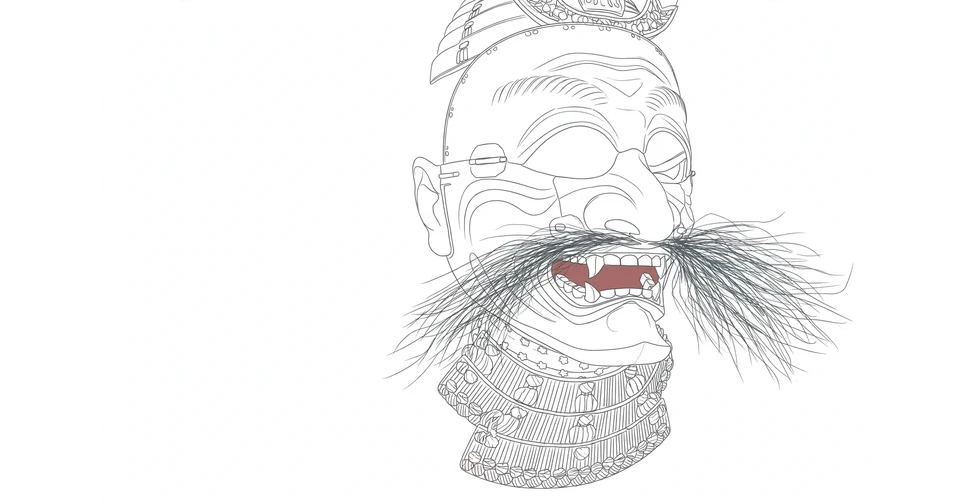
The menpo did not work alone. It was the lower half of a partnership with the helmet above it, and the two pieces were designed to fit together. The kabuto article on this site tells the story of the helmet itself, and it notes the gap the helmet left open. That opening was covered by a separate piece called the menpo, a mask of facial armour that guarded the cheeks, chin, and throat. This article follows that thread and tells the full story of the mask, from its slow beginnings in the age of mounted archers to the museum cases where the finest examples rest today. The kabuto gave the samurai a helmet worthy of his sword, and the menpo gave him the face to go with it.
What a menpo actually is
The menpo is the classic half mask of Japanese armour. It covers the face from the nose down to the chin and leaves the eyes free, so the wearer can see clearly while the most exposed part of his face stays behind iron. Below the chin it usually carries a throat guard of several overlapping rows, known as the yodare-kake or tare, which closes the gap between the mask and the top edge of the cuirass. That throat guard mattered, because a cut to the throat could kill with very little force, and the menpo was built to leave no easy opening.
The wider family of face armour is called men-yoroi, and the menpo is its most common form. Related words appear in books and museum labels, and they are worth sorting out early, because the menpo is often used loosely to mean any samurai mask, while Japanese armour studies draw finer lines. Mengu is another general term for the same family of face armour. The menpo itself is one member of that family, the half mask, and it sits alongside the full mask, the chin guard, and the forehead guard, each covering a different part of the face.
A menpo was made from iron, leather, or a combination of the two. The outside was lacquered or given a dark russet finish, and the inside was usually lacquered red, which protected the metal from rust in the humid Japanese climate and made the surface smoother against the skin. Fine examples carry extra details worked into the iron, such as a moustache, fierce teeth, and a detachable nose piece. The nose piece could be removed or replaced, and that small practical detail tells us something important. The mask was not a single solid shell. It was an assembly of parts, fitted to the wearer and repaired piece by piece, in the same spirit as the helmet above it.
There is one more small feature that shows how seriously the makers took real use. With the exception of the earliest forehead guards, a menpo had a small hole underneath the chin for sweat drainage, known as the ase nagashi no ana. A man fighting in iron under a summer sun would sweat heavily, and without that hole the mask would have filled with perspiration. It is an unglamorous detail, easy to miss in a museum case, and it is exactly the kind of detail that separates a working piece of armour from a costume. The menpo was built by people who knew what a body does inside a mask.
The face guard grew up slowly
Face armour in Japan begins with the happuri, a guard that covered the forehead and cheeks. It appears in paintings of the Heian and Kamakura eras, and it is thought to have appeared during the 10th or 11th centuries. Mounted warriors and foot retainers wore it, sometimes with a helmet and sometimes without one, and it was above all a protection against arrows. In the Heiji Monogatari picture scroll, which depicts the Heiji Rebellion of the late Heian period, mounted warriors appear with their faces covered by a dark object that scholars identify as an early happuri. The exact moment when face armour first appeared is not settled, and the honest answer is that it grew gradually out of the needs of mounted archery, rather than arriving in a single invention.
By the 14th century a new form appears, the hoate, which protected the cheeks, chin, and neck. The change tracks a change in war itself. As battles grew larger and close combat became more intense, the forehead guard was no longer enough, and armour had to cover the jaw and throat. The historian Thomas Conlan has argued that the arrival of the hoate lies behind a fall in facial wound statistics in the 14th century. Other scholars, such as Yamagishi Sumio, are more cautious, and they point out that the hoate restricted the wearer's vision, which may have limited how widely it was used at first. The disagreement is worth keeping, because it shows that every gain in protection came with a cost in sight and comfort, and the samurai spent centuries negotiating that trade.
The menpo itself, the half mask with a detachable nosepiece, and the somen, the full face mask, are believed to have been introduced around the middle to the late 15th century. The hanbo, a smaller guard that covered only the chin and lower cheeks, followed in the second half of the 16th century. That sequence matters. The menpo did not appear at the start of samurai history. It arrived after five centuries of experiment, when warfare had become close, crowded, and brutal enough that a man needed iron over his mouth and jaw as well as over his head. The mask was a late answer to an old problem, and it arrived just as Japan was entering its long age of civil war, when it would be needed most.
I find that slow history reassuring, in a way. The menpo was not a fashion, and it was not a single genius idea. It was the result of generations of men coming home from battle with the same injuries and asking the armourers for a better answer, and the armourers answering a little at a time. A forehead guard became a cheek guard, a cheek guard became a half mask, and the half mask learned to carry a throat guard and a moustache. Each step was small, and the sum of them was a face of iron.
Four shapes, four kinds of coverage
The men-yoroi family is usually described in four main shapes, and the difference between them is simply how much of the face each one covers. Once the shapes are clear, a museum case full of masks stops looking like a jumble of fierce faces and starts reading like a catalogue of choices, each one trading protection against vision, weight, and comfort.
The somen is the full mask. It covers the entire face, including the eye area, with openings to see through. It gave the most complete protection, and it also gave the most complete transformation, since nothing of the wearer's own face remained visible. It was used less often than the half mask, because the restricted vision was a serious disadvantage in a fight, and it is found mainly among high ranking wearers and in ceremonial contexts.
The menpo is the classic half mask, covering the face from the nose down to the chin, with the eyes free. It is by far the most common type, and it is what most people picture when they hear the words samurai mask. It balanced protection and vision better than any other form, which is why it became the standard.
The hanbo, also written hanpo, is a small mask that covers only the lower face, from under the nose to the chin, without enclosing the nose. It was lighter and less restrictive than the menpo, but it also offered considerably less protection, and it suited a man who valued movement and sight over full cover.
The happuri is the narrow forehead and cheek guard, covering neither the chin nor the mouth. It is the oldest of the four, and it was primarily a protection against arrows in the earlier samurai era. Later forms of cheek armour, such as the me no shita men, covered the face from below the eyes to the chin, and they sit somewhere between the hoate and the menpo in the family tree.
| Type | Coverage | Character |
|---|---|---|
| Somen | The entire face, including the eyes | Full protection, restricted vision, often ceremonial |
| Menpo | Nose down to the chin, eyes free | The standard half mask, the best balance of cover and sight |
| Hanbo | Under the nose to the chin only | Light and open, but the least protection |
| Happuri | Forehead and cheeks only | The oldest form, built against arrows |
A useful way to remember the set is to ask what each mask leaves open. The happuri leaves the mouth open. The hanbo leaves the nose open. The menpo leaves only the eyes open. The somen leaves nothing open, and the wearer pays for that completeness with his sight. Every mask in the family is an answer to the same question, and the answers differ because the men who wore them faced different dangers and held different ranks. The fullest overview of the menpo and its family gathers the four types, their history, and their parts in one place, and it is a good companion for a first visit to any collection of Japanese armour.
How a menpo was made
Making a good menpo was a specialised craft, and it belonged to the same workshops that made the rest of the armour. The great armour schools, above all the Myochin lines, along with the Iwai and Haruta schools, produced masks both as individual commissions and as standard elements of complete suits. There were also regions with their own mask traditions. Nara was an important centre, where menpo were made in large numbers and then fitted into suits assembled by other schools. Kaga Province, today Ishikawa Prefecture, developed its own recognisable features, including throat guards of textured leather coated with gold leaf.
The basic material was iron. The smith began with a flat iron plate, hammered it into shape, and gradually bent it to the geometry of the face. High quality masks were assembled from several parts, with the nose, cheeks, and chin as separate elements riveted or screwed together. Some masks were even built with hinges joining four parts, so the fit could be adjusted to the shape of the wearer's face. That detail is easy to admire in the abstract, but it is worth pausing over. A mask that does not fit is a mask that slips, chafes, and blocks the sight, and the best makers treated fit as seriously as they treated strength.
The expressive features were worked into the surface by hammering and embossing, a technique known as uchidashi. Creases around the nose and mouth, the shape of the ears, the contours of the cheek, and the line of the jaw were all raised from the metal with hammers, punches, and chisels. The great Myochin masters of the Ki region were famous for this work, and their masks show exaggerated shapes, a long chin, sharp and deep wrinkles on the cheeks, and a theatrical mouth. A later master, Muneakira, pupil and adopted son of Munesuke, is often credited with carrying the uchidashi technique to its highest level, and his masks are among the most sought after by collectors today.
After the shaping, the inside was coated with lacquer, and the outside was lacquered, russeted, or on rare pieces gilded. The throat guard, the tare, was an integral part of the menpo, made of several rows of small lames held together with dyed cord in lacing styles called sugake odoshi or kebiki odoshi. The colour of the lacing usually matched the lacing of the rest of the suit, because a suit of armour was a matched set, and a mismatched mask would have looked as wrong as a mismatched crest. On the sides of the mask sat small hooks called ori-kugi, or posts called odome, which secured the helmet cord, and these fittings were often decorated in their own right. Some Kaga examples set the hooks on washers engraved with radiating lines, a small flourish in a place almost no one would notice, which is exactly the kind of care that marks a master workshop.
Signatures appear on some menpo, but they are not the rule. Many masks remained unsigned, and others were signed only with a single character or a master's title. When a signature survives, it lets historians attribute a piece to a school or a workshop, and that attribution is often the only record of who made an object that its wearer trusted with his face. I think there is something quietly moving about that. The men who hammered these masks knew their work would be judged in battle, not in a gallery, and most of them never signed it at all.
The fierce face was the point
The most famous feature of the menpo is its expression, and it was not decoration. The masks were made to look fierce on purpose, and the armourers developed a whole typology of faces, each one carrying a meaning that both the wearer and the enemy could read at a glance. A samurai who chose a particular menpo was making a statement about how he saw himself and how he wanted to be seen.
The best known type is the ressei-men, the fierce grim face. It shows an aggressive face, with pronounced creases around the nose and mouth, an open or snarling mouth with visible teeth, bushy eyebrows, and often a moustache of real hair or formed metal. The ressei-men was meant to instil fear in the enemy and at the same time fill the wearer with martial confidence. A famous 18th century example, a white bearded ressei-menpo attributed to the Myochin school, is now held by the Tokyo Fuji Art Museum, and its grin is the image most people carry in their heads when they think of a samurai mask.
The counterpart to the fierce face is the ryubu-men, the mask with a noble expression. It is calm, without creases, with chubby cheeks and soft features, and it communicates dignity, self control, and the Confucian virtue of the cultivated warrior. This type became especially popular in the Edo period, when the samurai increasingly saw themselves as officials and scholars rather than only as fighters, and the face they showed the world softened to match.
The okina-men is the mask of the old man, with the deeply lined face of a veteran, long eyebrows, sunken cheeks, and often a white beard. Wearing one was a signal, a claim to experience rather than to hot tempered youth, and these masks are found more often among older samurai and officers. The tengu-men takes the form of the tengu, the mountain spirit of Japanese folk religion, shown either as a tall monk with an extraordinarily long nose or as a small bird like creature with a beak. Tengu were said to possess outstanding martial skill, and a mask in their likeness borrowed some of that supernatural reputation. Rarer types show demons, Buddhist guardian deities, and other figures from the religious world, each one chosen for the charge it carried.
The moustache deserves a word of its own. Many menpo carry a moustache of horsehair or human hair, fixed above the mouth, and some carry a full beard. The hair gave the iron face something the metal alone could not give, a sense of a living man behind the mask, older, sterner, and harder to frighten than the wearer might have been on his own. The teeth were often gilded or picked out in contrasting metal, and the mouth was set in a snarl or a shout. Together the hair, the teeth, and the creases made a face that did not look like any real face at all, and that was the point. The enemy was not meant to see a man. The enemy was meant to see a demon, a sage, or a god, and to hesitate for the half second that decides a fight.
There is a second audience for the fierce face, and it is the wearer himself. Military writings of the period describe the menpo as part of a larger order of armour, in which each element acted on the wearer as well as on the opponent. Putting on the mask was a small ritual of transformation. The man's own face disappeared, and the face of his clan and his role took its place, and that distance from his individual self made it easier to do what the moment demanded. I find that idea more interesting than the simple story of intimidation, because it treats the menpo as a tool for the wearer's own mind, not only as a weapon against the enemy's. A mask that only frightens others is a prop. A mask that steadies its wearer is a piece of equipment.
How the menpo paired with the kabuto
The menpo and the kabuto were designed as a pair, and neither one worked properly without the other. The helmet is top heavy, and on its own it can slip during fast movement or when struck. The mask solved that problem. The shinobi-no-o, the chin cord of the helmet, was tied under the chin, and small hooks called ori-kugi and posts called odome on the mask gave the cord something firm to anchor to. With the cord fastened to the mask, the whole head assembly sat firmly in place, and the helmet, the mask, and the head moved as one piece.
The order of dressing tells the same story. The menpo went on first, settled against the cheeks and chin, and then the kabuto came down over it, with the cord drawn tight beneath the chin and fastened to the mask's fittings. Taking the helmet off, the act the old expression kabuto wo nugu describes as surrender, also meant taking the face off, because the two pieces came away together as a set. That is why the kabuto article on this site treats the menpo as part of the helmet's story rather than as a separate curiosity. The helmet was the centre of the system, and the mask was the piece that locked it to the man.
The pairing also closed the gaps. The kabuto guards the crown, the sides, and the back of the neck, and its suspended neck guard, the shikoro, hangs down behind the ears. The menpo guards the front, from the nose to the chin, and its throat guard hangs down to meet the cuirass. Between them they leave only the eyes open, a narrow slot between the brim of the helmet and the top edge of the mask. A spear thrust through that slot could still find its mark, and no honest account of the menpo should pretend otherwise. A well aimed thrust was the weakness of the whole arrangement, and the mask reduced the vulnerable area without removing it. That limit is part of what makes the object believable. It was a practical compromise, not a magic shield, and the samurai who wore it knew exactly where its edges were.
Who wore which kind
Not every samurai wore the same menpo, and many foot soldiers wore none at all. High quality signed masks were luxury objects, and they belonged mainly to wealthy daimyo and high ranking samurai who could afford a commission from a master workshop. The finest examples were made to order, fitted to one face, and kept with a named suit of armour for a lifetime. At the other end of the scale, ordinary foot soldiers often wore no mask at all, or only a plain unsigned example, and the museum pieces that survive today come almost entirely from the top of that pyramid, not from everyday life. That is worth remembering when looking at a case of gleaming masks. The beautiful ones survived because they belonged to men whose families kept them, and the plain ones were used hard, repaired, and worn out.
Rank also shaped which type a man chose. The somen, the full mask, appears mainly among high ranking wearers and in ceremonial settings, where the completeness of the transformation mattered more than the restriction of vision. The menpo, the half mask, was the working choice of the fighting samurai, because it protected the jaw while leaving the eyes free. The hanbo suited a man who needed to move fast and see clearly, and who accepted less protection in exchange. The happuri belonged to an earlier age, and by the time the menpo had become standard it survived mostly in the hands of retainers and in ceremonial use.
Armour was not only for men, and the story of the mask belongs to the women who fought as well. The onna-bugeisha held the castle while the men were away, and women warriors who took up arms wore armour of their own, including face protection suited to their rank and role. The menpo was a piece of equipment, not a badge of manhood, and its job was the same whoever wore it, to guard a face and to give its wearer a second one.
The choice of expression also followed the wearer. A young commander might choose a ressei-men to borrow ferocity he had not yet earned. An older officer might choose an okina-men to advertise the experience that was his real weapon. A lord in peacetime might choose a ryubu-men to show that his authority rested on dignity rather than on threats. In each case the mask was a portrait the wearer had chosen of himself, and it told allies as much as enemies who they were following. The mask was personal in a way the rest of the armour was not, because the rest of the armour covered the body, while the mask replaced the face.
Peace turned the menpo into art
The menpo changed its job when the fighting stopped. After the great battles ended in 1615, the Tokugawa peace brought more than two and a half centuries without large scale war, and the samurai became administrators and ceremonial officials rather than battlefield commanders. Armour became a status symbol and an art object, and the menpo changed with it. The Edo period master workshops, above all the Myochin line under masters such as Munesada and later Munekuni, produced masks of extraordinary craftsmanship, with finer and finer detail around the cheeks and mouth, more complex lacquer work, and expressions carved like small sculptures.
In this period the mask was increasingly made for display, in the treasuries of daimyo, in the ceremonial rooms of the Tokugawa rulers, and in the armouries of great clan houses. Menpo were also worn in ceremonial contexts, at parade line ups, in the great processions of alternate attendance, and at formal presentations at the shogun's court. The late Edo masks are often no longer designed for practical combat at all. Some carry gilded details, ivory teeth, beards of real animal hair, and lacquer decoration in several layers, and none of that speaks the language of the battlefield. It speaks the language of the court and the exhibition hall.
The same period sharpened the regional traditions. The smiths of Kaga were known for textured leather on the throat guard, often with applied gold leaf. The smiths of Nara concentrated on a standardised production of mask types, above all the russet half mask known as bamen, which was fitted into the suits of many other schools. The Kyoto masters of the Fujiwara Myochin line produced pieces of the highest precision for the most elite clients. A trained eye can still read the origin of a mask from these details, the washers under the cord hooks, the shape of the moustache, the tone of the lacquer, and the style of the lacing on the throat guard.
The end came with the Meiji Restoration in 1868. The samurai class was dissolved, the sword ban of 1876 made the wearing of swords illegal, and Western military uniforms replaced the old armour. The menpo became obsolete in a single generation, and the surviving examples passed into clan treasuries, museum collections, and the international trade in Japanese art. The kabuto article on this site notes that the last use of samurai armour came in 1877, during the Satsuma Rebellion, and the mask went out of service with the rest of the suit. The irony is gentle and familiar. The menpo reached its greatest beauty only after it stopped being needed, when the makers were free to build faces that no one would ever bleed behind.
Where the menpo survives today
The best place to meet a menpo now is a museum, and the collections that hold them are spread across Japan and beyond. The Tokyo National Museum holds armour from the 15th century onward, and its masks sit alongside the helmets and cuirasses they were made to complete. The Sendai City Museum holds the armour of the Date family, whose crescent moon crest is still the emblem of the city. The Metropolitan Museum of Art in New York is unusual in holding numerous full masks, the somen type, alongside its half masks, and most of its pieces date from the peaceful Edo period, when armourers such as the Myochin clan took pride in making ever more varied masks as a demonstration of their skill.
Outside Japan, the Samurai Museum Berlin holds a broad range of later masterpieces, from signed fierce masks of the Fujiwara Myochin line to calm noble masks and a rare tengu mask by the signed master Fukushima Denbei Kunitaka, and several of its masks are displayed inside complete suits of armour, so a visitor can study the menpo in its original setting, as part of a whole. The museum's account of the menpo as a face mask of the samurai reconstructs the craft, the types, and the meaning of the mask in detail, and it is the best single companion for anyone who wants to go deeper than one article allows.
The craft has not vanished entirely. Reproduction menpo are still made for collectors, for period drama, and for festivals, and a small number of traditional armourers in Japan still build full suits in the old way. The masks also live on in less formal places, in films, in games, and in the popular image of the samurai, where the fierce iron face has become a shorthand for the warrior himself. That afterlife is both a tribute and a small distortion. The film mask is always fierce, always perfect, and always worn by a hero. The real masks were often plain, often unsigned, and often worn by men whose names history never recorded, and that plainness is part of their truth.
Seeing a menpo in person is a different experience from seeing a photograph of one. The masks are smaller than most visitors expect, sized to a human face rather than to a legend, and the iron is thinner and lighter than the fierce expression suggests. Standing close, it is possible to see the hammer marks, the wear on the lacquer where a chin rested, and the small drain hole under the chin that kept a fighting man from drowning in his own sweat. Those details are the ones that stay with a visitor, because they are the details of use, and they turn an art object back into a piece of equipment for a few honest seconds.
Why the menpo still matters
The menpo matters because it is honest about what a face is for in war. A face identifies a man, it betrays his fear, and it gives his enemy something to aim at, and the samurai answered all three problems with a single object that hid the face, guarded it, and replaced it with a chosen one. The mask protected, it steadied the helmet, and it spoke before its wearer did, and it did all three at once, without pretending that any of those jobs was separate from the others.
That is also why it outlived the age that made it. The sword is the symbol of the samurai, but the sword is hidden in its sheath for most of its life, while the mask is always on display. The menpo was the public face of a private code, and it still speaks clearly today, in a museum case, in a festival procession, or in the crest of a city that remembers its founder. A mask that could do all of that was worth far more than the iron it was made from, and the samurai knew it, which is why they never stopped making it beautiful.
There is a quiet lesson in the mask for anyone who has ever had to face something frightening while keeping a steady face. The samurai did not pretend to be fearless. They put on a face that was fearless, and the face did some of the work for them, steadying the wearer as much as it frightened the enemy. The menpo is a reminder that courage is often not a feeling that arrives on its own. It is a practice, a piece of equipment, and sometimes a mask, put on deliberately, one cord at a time, before stepping out to meet whatever is waiting.
More in Culture & Society
- Omiyage and the Japanese Art of Bringing Something Back
- How the Katana Became the Soul of the Samurai
- Kabuto Gave the Samurai a Helmet Worthy of His Sword
- Christmas in Japan and the Fried Chicken Dinner That Started It All
- Kiso Yoshinaka Rode Out of the Mountains and Nearly Took Japan
- Sakayaki Gave the Samurai His Signature Hairline
Latest posts
- Japan Goes Maple Hunting Every Autumn and Calls It Momijigari
- The Archer on the Tower Was Hangaku Gozen
- Koyo Turns Japan Into a Country That Forecasts Leaves
- Inside Japan's 100 Yen Shops, Where Everything Costs a Coin
- Tomoe Gozen Rode Into Battle When Women Were Told to Stay Home
- A Chonmage Is the Knot Every Sumo Wrestler Wears Before the Fan
- Onna-Bugeisha Held the Castle While the Men Were Away
- Momiji-Gari Is Japan's Autumn Answer to Hanami
- Akihabara and How Tokyo's Electric Town Learned to Sell Everything
- The Naginata Gave Japan's Women Warriors a Blade of Their Own
- Momiji Turns Japan Red Every Autumn
- How an Oichomage Turns a Wrestler Into a Sekitori
- Ginkgo and the Gold That Falls on Tokyo Every Autumn
- Japanese Castles and the Samurai Fortresses That Still Stand
- A Kamidana Brings the Shrine Into the Japanese Home