The Archer on the Tower Was Hangaku Gozen
· 15 min read
Hangaku Gozen defended Tossaka Castle from a tower in 1201, shooting down the shogun's soldiers until an arrow in her thigh ended the siege. This is the story of the archer, her capture, and her quiet life after Kamakura.
In the spring of 1201, a woman stood on the tower of a wooden castle in Echigo and held off an army with a bow. Her name was Hangaku Gozen, and the soldiers below her learned quickly that no approach was safe while she could still draw a string. She was not a queen and not a general of a great clan. She was the sister of a rebel, the aunt of a young lord, and the best archer her family had ever produced.
The castle was Tossaka, a wooden fortress near what is now Tainai in Niigata Prefecture. The army outside belonged to the new Kamakura shogunate, and it had come to finish the Jo clan after the failed Kennin Rebellion. Hangaku Gozen directed the defense from the tower, and when the fighting ended it was not because the garrison had been overrun. It ended because a single arrow found the one spot her armor did not cover.
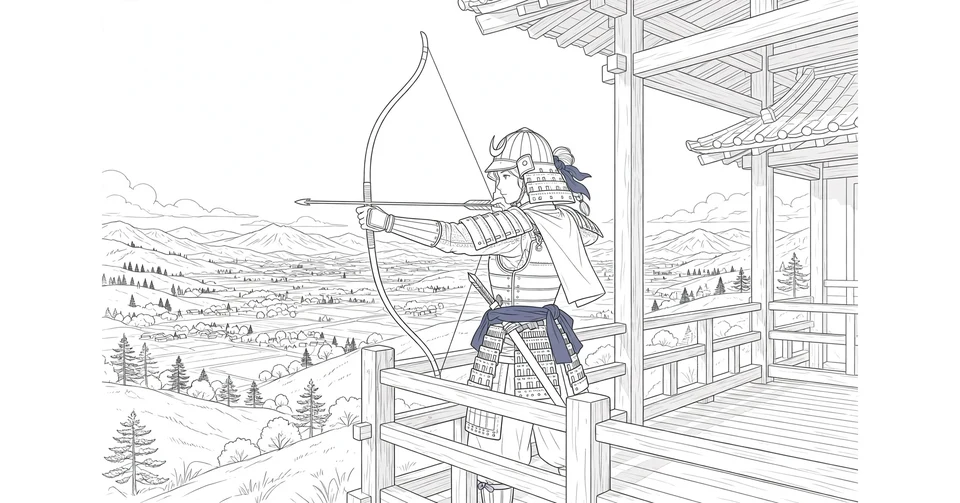
That image, of a lone archer on a tower, is why Hangaku Gozen is still remembered more than eight centuries later. She shares the history books with Tomoe Gozen, the other great woman warrior of the age, but their stories could hardly be more different. Tomoe rode into open battle. Hangaku Gozen stayed in one place and made that place impossible to take. Her victory was measured in weeks survived, not ground taken, and her defeat came down to a single well placed shot from the enemy side.
Hangaku Gozen and the Jo clan of Echigo
Hangaku Gozen was born into the Jo clan, a powerful warrior family of Echigo Province, the old name for the region that is now Niigata Prefecture. The Jo were tied by blood to the Taira clan, the great house that had dominated Japan before the Genpei War of 1180 to 1185. Her father was the warrior Jo Sukekuni, and her brothers were Jo Sukenaga and Jo Nagamochi, who is also recorded under the name Sukemochi. Her nephew, the son of Sukenaga, was Jo Sukemori, and the two grew up close.
The Jo clan's standing had already been shaken before Hangaku Gozen ever picked up a bow in anger. The family sided with the Taira in the Genpei War, and the Taira lost. The victorious Minamoto founded the Kamakura shogunate, and the Jo, who had backed the wrong side, lost much of their power and had to work hard to hold on to what remained in Echigo. This is the background that explains everything that follows. Hangaku Gozen did not fight for glory or for a cause she had chosen in the abstract. She fought because her family's home was under threat, and she was the one best equipped to defend it.
What is known about her early life is thin, and honest history has to admit that. Her birth date is not recorded in any reliable source, as the Wikipedia account of Hangaku Gozen notes, although some modern retellings give the year 1172. Her real given name is also unknown, and Hangaku may be a later name taken from the place where she grew up. The chronicle that preserves her story, the Azuma Kagami, is far more interested in what she did on the tower than in who she was before it.
One detail from that chronicle is worth keeping, because it tells us how her family saw her. The Azuma Kagami says that although she was a woman, her skill with the bow surpassed her father and her older brother. In a warrior household, that was not a compliment about talent alone. It was a statement of rank. The Jo raised their children, daughters included, in the ways of war, and Hangaku Gozen had earned the right to be taken seriously by the men around her. She was trusted with castle business while her father and brothers were away, and she acted as guardian to her nephew Sukemori. That trust is the reason she was on the tower at all.
The Kennin Rebellion of 1201
The rebellion that made Hangaku Gozen famous began with her brother Nagamochi. After the death of the first shogun, Minamoto no Yoritomo, his young son Yoriie took power in Kamakura. Nagamochi had served the Minamoto for a time after the Genpei War, but he had never accepted their rule, and in early 1201 he moved to overthrow the shogunate. He raised an army and marched on the capital at Heian-kyo, hoping for an imperial order that would give his rising legitimacy. He did not get it. The shogunate's forces crushed his army quickly, and Nagamochi was killed in Kyoto.
The defeat in the capital did not end the rebellion. It moved it north to Echigo, where the surviving Jo forces gathered at Tossaka Castle. Nagamochi's nephew Sukemori and his sister Hangaku Gozen prepared for a last stand, gathering their warriors at the family's wooden fortress. The sources disagree on the numbers, with some giving about a thousand defenders and others giving several thousand, so the honest thing to say is that the garrison was heavily outnumbered by the army the shogunate sent against it. That army was led by Sasaki Moritsuna, one of Yoriie's commanders, and its orders were simple: take the castle and finish the Jo clan.
The siege began in the spring of 1201. In April, the garrison repulsed a first attack. The main battle came in May, with Sukemori's troops fighting outside the walls while Hangaku Gozen led the defense of the castle itself. This division of labor matters, because it shows that she was not a figurehead. She commanded the garrison, and the men under her followed her orders because they respected her archery and her judgment.
The defense of Tossaka Castle
The heart of the story is the tower. Dressed in full armor, her hair tied up like a young page, Hangaku Gozen stood on the tower of Tossaka Castle with her bow and shot down the attackers as they came. The Azuma Kagami says that those she shot did not survive, and that many of Sasaki Moritsuna's men were killed by her arrows. She aimed for the chest and the head, the places where a single arrow ended a fight, and she did not waste shots.
There is something important in the way she fought. A rider like Tomoe Gozen won battles by movement, by charging, by being everywhere at once. Hangaku Gozen won her battle by refusing to move. She held one high place and made it deadly. Every attacker had to come to her, up the slope, into her range, and she could see them all coming. That is the advantage of a tower, and it is also its trap. It works until someone finds a way to shoot back.
Her reputation as an archer was already established before the siege, and the defense of Tossaka Castle made it permanent. The men in the garrison fought harder because their commander was visibly fearless, standing in the open on the tower while arrows flew. Leadership in that age was often a matter of being seen, and Hangaku Gozen was seen by everyone on both sides.
The wound that ended the siege
The siege ended the way such sieges often end, not with a grand assault but with one clever move. A samurai named Fujisawa Kiyochika climbed a mountain close to the castle, found a blind spot at the rear of the tower, and shot an arrow at Hangaku Gozen from a place she could not see. The arrow struck her in the thigh, at a spot her armor did not protect. Some accounts say it pierced both her legs. Unable to stand, she collapsed.
With their commander down, the garrison surrendered on 9 May 1201. Hangaku Gozen was taken prisoner. Sukemori fled the field, and his fate is unclear. Some accounts say he hid in Dewa Province, but no reliable record confirms it. The castle fell, the rebellion was over, and the Jo clan was finished as a power in Echigo.
It is worth pausing on the fact that the entire defense turned on a single arrow. Hangaku Gozen had held the tower for weeks against a much larger army, and she lost it to one shot from one man who had taken the time to find her blind spot. That is not a story about luck. It is a story about how even the strongest position has a weakness, and how a patient enemy will eventually find it. The lesson is not that she failed. The lesson is that no defense, however brave, lasts forever without relief from outside.
A prisoner before the shogun
In June 1201, Hangaku Gozen was brought to Kamakura and presented to the young shogun Minamoto no Yoriie. A captured rebel would normally have been ordered to commit ritual suicide or sent into exile in some remote place. Instead, she was presented almost as a curiosity, a woman commander who had humiliated the shogunate's army, and she faced the shogun without fear. The chronicles describe her as fearless as a man and beautiful as a flower, a phrase that has followed her ever since, though later texts give a much harsher description of her appearance. The two versions cannot both be true, and the contradiction is a reminder that the men who wrote about her were describing their own ideas about women warriors as much as they were describing Hangaku Gozen herself.
What happened next is one of the strangest turns in the story. A warrior in Yoriie's retinue, Asari Yoshito of the Kai-Genji, asked the shogun for permission to marry her. When Yoriie asked him to explain himself, Asari argued that a son born to such a woman would be a warrior fit to serve the shogun. Yoriie agreed, and the marriage went ahead. Instead of death or exile, Hangaku Gozen was given a new life in Kai Province, the region that is now Yamanashi Prefecture.
I find this part of the story both generous and unsettling. On one hand, a woman who should have died was allowed to live, marry, and raise a family. On the other hand, the choice was not hers. She was a prisoner, and her future was decided by two men in a room in Kamakura. The chronicles present it as a happy ending, and perhaps it was, but we should not pretend that Hangaku Gozen chose it freely. She survived by becoming useful to the very government she had fought.
What happened after Kamakura
Little is recorded about the rest of Hangaku Gozen's life, and what is recorded is not consistent. The sources agree that she married Asari Yoshito and lived with him in Kai Province, where he held land at Toyotomi Village. A detailed modern retelling of her life says she accompanied him on trips to Akita Prefecture, where he held the Hinai District. Beyond that, the accounts diverge.
The main disagreement is about her child. Some tellings say she had a son, and one tradition even gives the boy's name as Tomoyoshi. Other historians say she had a daughter. There is no document that settles the question, so the honest answer is that she had at least one child, and the child's sex is disputed. Her date of death is also unknown. She is said to have died in Kai, but no grave or record gives a year.
This uncertainty is part of the story, not a flaw in it. Hangaku Gozen appears in the Azuma Kagami for the spring of 1201 and then fades from the record, as most women of her time did once they stopped being a military problem. The men who wrote the chronicles cared about battles, not about the quiet decades that followed. What we know for certain is that she lived, that she married, and that she was remembered. For a woman of the early Kamakura period, that is already a great deal.
Hangaku Gozen and Tomoe Gozen, two kinds of warrior
The comparison with Tomoe Gozen is natural, and the old books make it themselves. The two women were near contemporaries, both fought in the wars that created the Kamakura shogunate, and both are remembered as onna-bugeisha, women of the warrior class who took up arms. But they fought in completely different ways, and the difference tells us something about the range of what women warriors actually did.
Tomoe Gozen, whose story is told in full in our article on Tomoe Gozen, was a rider and a swordswoman. She fought in the open field beside Kiso Yoshinaka, charged into enemy ranks, and was famous for taking heads in close combat. Her war was a war of movement, and her legend is built on speed and daring.
Hangaku Gozen was the opposite. She fought from a fixed position, with a bow, at a distance, and her skill was patience. She did not chase the enemy. She waited for the enemy to come to her and punished them for it. Where Tomoe's story is about what a woman could do on horseback in the middle of a battle, the story of Hangaku Gozen is about what a woman could do when she was given a castle to hold and the authority to hold it.
There is also a difference in how their stories end. Tomoe's fate after the Battle of Awazu is a matter of legend, with some tales saying she became a nun and others saying she married and lived quietly. Hangaku Gozen's later life is better documented, at least in outline, because she was captured alive and her marriage was a matter of shogunal record. One disappeared into story. The other was filed away into the administration of the new government.
Both women matter for the same reason. They show that the women of the warrior class in early medieval Japan were not bystanders to war. They trained, they commanded, and they fought, and the men around them knew it. The full picture of the onna-bugeisha, the women who held castles and led troops, is told in our article on the women who held the castle while the men were away, and Hangaku Gozen is its most famous example.
The legend of one hundred arrows
No part of the story of Hangaku Gozen is repeated more often than the claim that she shot one hundred arrows and killed one hundred men. It appears in later records, and it is easy to see why storytellers loved it. It is a perfect number, and it turns a skilled archer into a figure of myth.
It should be treated as legend, not fact. The phrase comes from the Azuma Kagami's description of her skill, using the expression hyappatsu hyakuchu, which means a hundred shots and a hundred hits. In the chronicle, it is praise for her accuracy, a way of saying that she never missed. Later retellings took the praise literally and turned it into a body count, one hundred arrows and one hundred dead men. No contemporary record counts her kills, and no siege report could have. The truth is simpler and more impressive: she was an archer so accurate that the men who wrote about her reached for the language of perfection to describe her.
The same caution applies to other details that grew around her name over the centuries. Later plays and woodblock prints show Hangaku Gozen wielding a naginata, the long bladed weapon associated with women warriors, and one famous scene has her defending the castle gates with it. But the Azuma Kagami mentions only the bow. The naginata belongs to the centuries of storytelling that followed, not to the siege of Tossaka Castle itself. The prints are beautiful, and they kept her name alive, but they are not evidence of what she carried.
Why her story still matters
Hangaku Gozen is remembered for a few weeks in the spring of 1201, and that is enough. She held a castle with a bow, commanded men who trusted her, and faced her captors without fear. She lost, as the Jo clan lost, and then she lived the rest of her life in a province far from home, married to a man from the winning side. That is not a fairy tale ending. It is a real one, with compromise in it.
What I take from her story is the value of holding a position. Most of us will never command a castle, but we all have places we are responsible for, a home, a family, a piece of work that only we can do. Hangaku Gozen did not win her war, but she made the enemy pay for every step toward her tower, and she did it with skill rather than noise. There is dignity in that, and it does not depend on victory.
Her name also survives in her hometown. In the area around Tainai in Niigata, her story is told in local history, in plays, and in festivals, and visitors still come to the region to walk the ground where Tossaka Castle stood. Eight hundred years after a woman climbed a tower with a bow, people still remember that she was there. That is the real measure of her life. Not the number of arrows, which no one can count, but the fact that the story is still being told.
More in Culture & Society
- Christmas in Japan and the Fried Chicken Dinner That Started It All
- Kiso Yoshinaka Rode Out of the Mountains and Nearly Took Japan
- Sakayaki Gave the Samurai His Signature Hairline
- Tomoe Gozen Rode Into Battle When Women Were Told to Stay Home
- A Chonmage Is the Knot Every Sumo Wrestler Wears Before the Fan
- Onna-Bugeisha Held the Castle While the Men Were Away
Latest posts
- Koyo Turns Japan Into a Country That Forecasts Leaves
- Inside Japan's 100 Yen Shops, Where Everything Costs a Coin
- Momiji-Gari Is Japan's Autumn Answer to Hanami
- Akihabara and How Tokyo's Electric Town Learned to Sell Everything
- The Naginata Gave Japan's Women Warriors a Blade of Their Own
- Momiji Turns Japan Red Every Autumn
- How an Oichomage Turns a Wrestler Into a Sekitori
- Ginkgo and the Gold That Falls on Tokyo Every Autumn
- Japanese Castles and the Samurai Fortresses That Still Stand
- A Kamidana Brings the Shrine Into the Japanese Home
- An Omamori Carries a Shrine's Protection in Your Pocket
- Kongobuji Still Runs the Mountain Kukai Chose
- A Shinai Is a Sword That Refuses to Cut
- Pachinko and the Neon Rooms Where Japan Plays Its Loudest Game
- Kiai Is the Shout That Turns a Strike Into a Commitment