A Kamidana Brings the Shrine Into the Japanese Home
· 18 min read
A kamidana is the small household Shinto altar where a family honours the kami at home, with simple daily offerings of rice, salt, and water placed before the sacred talismans inside it.
Step inside a Japanese home and look up, toward the top of the wall, and you may notice something small and easy to miss. A miniature wooden shrine sits on a high shelf, its tiny roof and doors catching the light above the everyday life of the room. It is not a decoration and it is not a model. A kamidana is the household altar of Shinto, a small shrine kept at home so that the kami, the deities of the tradition, can be honoured every day without a visit to a public shrine.
The idea is simple and, once you see it, quietly moving. The great shrines of Japan stand in forests and on hills, and visiting them is a special occasion. A kamidana brings that same relationship home, into the kitchen and the living room, into the ordinary rhythm of mornings and evenings. It turns a corner of the house into a sacred place, and it does so with almost nothing: a shelf, a few paper talismans, and three small dishes of rice, salt, and water.
This article explains what a kamidana is, what sits inside it, what a family offers there each day, where it belongs in the home, and how it differs from the Buddhist family altar called the butsudan. It is a small object with a long history, and understanding it opens a window onto how Shinto is actually lived, not only at shrines and festivals, but at home.
What a kamidana is
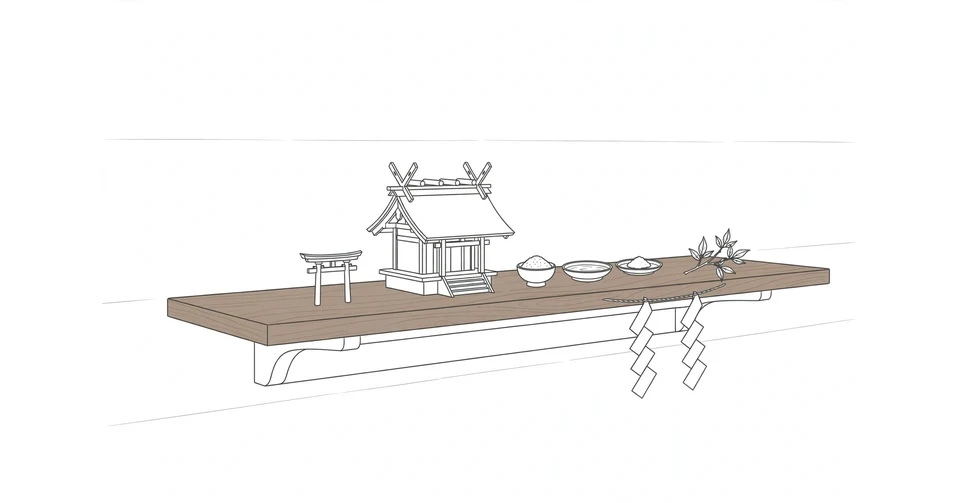
The word kamidana is written in Japanese as 神棚, and it means, quite literally, god shelf. A kamidana is a miniature household altar provided to enshrine a Shinto kami, and it is most commonly found in Japan, the home of kami worship. At its simplest, it is a shelf fixed high on a wall, and on that shelf sits a small wooden structure in the shape of a shrine, often made of unpainted Japanese cypress, hinoki, left in its natural pale colour.
The small shrine on the shelf is called the omiya, and it holds the heart of the whole arrangement. Inside it rest the ofuda, paper or wooden talismans received from Shinto shrines, which represent the presence of the kami. A kamidana without an ofuda is furniture. With an ofuda inside it, the shelf becomes a place of worship, a home for the kami in the most literal sense of the phrase.
The kami honoured on a kamidana are usually the kami of the great shrines and of the local shrine. The most widely kept talisman is the Jingu Taima, the ofuda of Ise Jingu, the Grand Shrine of Ise, which is venerated as the general protecting kami of Japan. Alongside it, a family will usually enshrine the ofuda of its local shrine, its ujigami shrine, and sometimes the ofuda of another shrine to which the family feels a special connection. The kamidana therefore holds a small map of the family's spiritual geography: the nation, the neighbourhood, and the places that matter to them personally.
The ofuda at the heart of the kamidana
Everything on a kamidana exists to serve the ofuda, and the ofuda itself has rules that are worth knowing. An ofuda can only be obtained from a shrine, in exchange for an offering. It cannot be made at home, and it should not be bought as a souvenir from a shop that has no connection to a shrine. The visit to the shrine is part of the meaning. You go, you make your offering, and you bring the kami home with you, in the form of a talisman that the shrine has given you.
The custom, as the priests of Okuni Jinja explain in their guide to home veneration, is to enshrine three kinds of ofuda. The Jingu Taima from Ise Jingu comes first, as the general protecting kami of Japan. Then comes the ofuda of the local ujigami shrine, the shrine that protects the neighbourhood where the family lives. Then come the ofuda of any other shrines to which the family feels a special connection, perhaps the shrine of a family trade or the shrine where a child was blessed. A local shrine can usually provide the Jingu Taima as well as its own ofuda, so one visit can supply the whole set.
There are two standard ways to arrange the ofuda on a kamidana. The first is to line them up front to back in the same space, with the Jingu Taima at the front, so that it is the one you see, and the ujigami ofuda behind it, and any others behind that. The second way is to place three ofuda in a line, in a larger miniature shrine with three spaces. In that case the Jingu Taima goes in the centre, the ujigami ofuda goes to the right as you look at the ofuda, and the others go on the left, lined up one behind another if there is more than one.
An ofuda is not kept forever. It should be venerated for one year, and then returned to the shrine and replaced with a new one, usually around the New Year. Returning it is itself a small rite. If you can bring it in person, you take it to the shrine office and say what you wish to do, and it is appropriate to make an offering when you return it, though there is no fixed amount. If you cannot bring it in person, you may send it to the shrine office by post. The yearly renewal keeps the kamidana fresh in the most literal sense. The kami are honoured with a new talisman each year, and the old one is returned with thanks, not thrown away.
The parts of a kamidana
A kamidana is more than its miniature shrine. Around the ofuda, a family arranges a small set of ritual objects, and each one has a place and a meaning. Together they make the shelf legible at a glance. Even a visitor who knows nothing about Shinto can look at a kamidana and see that this is a sacred place, because the objects are arranged with a care that is different from the care given to ordinary things.
The first thing to notice is the rope. A shimenawa, a sacred rope made of twisted rice straw, is often hung across the top of the kamidana, with the thick end to the right as you look at it. The rope marks the boundary of a sacred area, the same way a larger shimenawa marks the sacred ground of a shrine. Hanging from it are folded strips of white paper called shide, usually four of them, which signal that the space within is set apart. The shimenawa on a kamidana is normally changed every year, at New Year, and in Japan many supermarkets sell them in that season, which tells you how ordinary this sacred object is. It is bought with the weekly shopping, and it is hung with the same hands that cook dinner. The full story of the folded paper streamers that hang from the rope is told in the account of shide as the paper lightning that marks a sacred space.
On either side of the miniature shrine stand two vases holding branches of sakaki, an evergreen broad leaf tree native to Japan. Sakaki is one of the most important sacred plants in Shinto, and its branches are used in ritual at shrines as well as at home. On a kamidana, the sakaki stand like small green guardians, one to the left and one to the right of the ofuda, and they are normally changed every two weeks, at the beginning and the middle of the month, when florists sell fresh bundles for the purpose. Outside Japan, real sakaki is hard to find, and shrines accept artificial sakaki or a local evergreen broad leaf species as a substitute. In northern Japan, where sakaki does not grow naturally, shrines have long used an alternative species, so the substitution is an established part of the practice, not a modern compromise.
In front of the ofuda, some families place a small sacred mirror, the shinkyo, a round disc of polished metal that sits immediately in front of the ofuda or in front of the doors of the miniature shrine. The mirror has a long history in Shinto, where it is one of the three sacred treasures, and on a kamidana it serves as a quiet reminder that the kami are present and that the worshipper, looking toward the altar, is also looking at a reflection of themselves. Below the shrine, on the shelf itself, sit the offering vessels, called shinki. They are usually plain white unglazed ceramic, small and unadorned: a lidded container for water, called a mizutama, and two small flat dishes, called hirazara, one for rice and one for salt. On special days, two small flasks of sake, called heishi, are added. There are no strict rules about the plates and jars, except that they should be small enough to fit on the shelf and should not be used for anything other than offerings to the kami. That separation is part of the respect. The dishes that serve the kami are not the dishes that serve dinner.
The whole structure of the kamidana is described in detail in the JAANUS entry on kamidana, the online dictionary of Japanese architecture and art history, which traces the shelf from its early forms to the familiar miniature shrine of the Edo period. It is the best single reference for the physical history of the object, and it is worth reading alongside this article if you want to see how the shelf itself changed over the centuries.
Daily offerings and the morning bow
The daily life of a kamidana is a life of small offerings, made regularly and without fuss. The basic set is three things: white short grain Japanese rice, washed but uncooked, water, and salt. The rice goes on a plate in the centre, nearest to the ofuda. The salt goes to the right and slightly further from the ofuda, so closer to you. The water goes to the left, lined up with the salt. It is very common to add Japanese sake to the offerings, and when sake is offered, there are normally two small jars, one either side of the rice, with the salt and water furthest out.
There is a hierarchy among the offerings, and it is a useful thing to know if you ever set up a kamidana of your own. Of the standard offerings, the rice is the most important, then the sake if it is being offered, then the salt, and finally the water. Rice is the staple of the Japanese table and the centre of the offering, and its place in the middle, closest to the ofuda, says so without words. The other offerings sit a little further away, in an order that reflects their importance. Non standard offerings, such as seasonal foods or local produce, come after these, and are placed in a lower position than the standard offerings, or offered after the standard ones have been removed. At New Year the shelf changes with the season, and the kagami mochi, the stack of round rice cakes that is the central decoration of the Japanese New Year, is placed on the kamidana as an offering to the kami, a custom explained in the account of why kagami mochi is never cut with a knife.
How often the offerings are changed depends on the household. The fresh water is the offering that people treat as most important to keep fresh, and it is ideally changed every morning. Rice and salt are ideally changed daily too, but replacing them on the first and the fifteenth of the month is a common and accepted compromise, and sakaki branches are normally changed on those same two days. Sake is offered on special days rather than every day, and the shimenawa is changed once a year. The rhythm is forgiving. The tradition asks for regularity, not perfection, and a family that changes the water each morning and the rice on the first and fifteenth is keeping the kamidana well.
The act of worship at a kamidana follows the same etiquette as worship at a shrine, and it takes less than a minute. You take the offerings to the shelf, bow slightly, and place them before the kami. Then you bow deeply twice, clap twice, and bow deeply once more. Then you bow slightly again and remove the offerings. The ideal is to do this twice every day, once in the morning and once in the evening, but it is also common to do it once a day, or only on the first and fifteenth of every month. The offerings should be eaten after you pay your respects, so the simplest habit is to put them on the shelf just before you pray and take them down as soon as you finish. Food offered to the kami is later eaten by the family, and that shared meal is part of the offering. Nothing is wasted, and the kami and the household eat, in a sense, from the same table.
Where a kamidana sits in the home
A kamidana belongs high up, and the height is not a matter of taste. The shelf is fixed to the wall a little above eye level, and there should be nothing above it apart from the ceiling. The kami are honoured by being placed above the everyday life of the house, looking down over the room, and putting anything on top of the kamidana would be disrespectful. In a modern home, it is also possible to enshrine the kami on top of a cabinet or a bookcase, but the same rule applies: the kamidana must be the topmost thing, with nothing above it.
It should stand in a clean, bright place that everyone in the home can easily visit, and it is best for it to face south or east if the layout of the building makes that possible. It should not be placed above a doorway, where people pass beneath it without thinking, and it should not back onto the wall of a lavatory. Many guides also advise that a kamidana should not directly face the Buddhist family altar, the butsudan, so that the two sacred places of the house do not stare at each other across the room. These are guidelines rather than laws, and a family does the best it can with the house it has, but they show how seriously the placement is taken. The kamidana is not put wherever there is a free bit of wall. It is given the best place the house can offer.
How a kamidana differs from a butsudan
Many visitors to Japan confuse the kamidana with the butsudan, and the confusion is understandable, because both are small wooden altars kept in the home, and many houses have both. But they belong to different traditions, honour different beings, and are cared for in different ways, and the difference is one of the clearest windows onto how Japanese religion actually works.
The kamidana is the altar of Shinto, and it honours the kami, the deities of the tradition. Its central object is the ofuda, a talisman from a shrine, and its offerings are rice, salt, water, and sake. The butsudan is the altar of Buddhism, and it honours the ancestors of the family. Its central objects are the ihai, wooden memorial tablets inscribed with the posthumous Buddhist names of the dead, and its offerings include incense, flowers, and food for the ancestors. Where the kamidana looks up and out, toward the kami of the nation and the neighbourhood, the butsudan looks back, toward the generations of the family who came before.
The two altars are also kept differently. A kamidana is usually open, its miniature shrine standing on a high shelf where anyone in the room can see it. A butsudan is usually a cabinet with doors, often large and lacquered, standing on the floor or on a low stand, and its doors are opened for prayer and closed afterwards. The kamidana is placed high, above eye level, with nothing above it. The butsudan stands lower, at a height where a person can kneel before it. The kamidana is tended with water and rice in the morning. The butsudan is tended with incense and the ringing of a small bell. Each has its own rhythm, its own smell, and its own posture of prayer.
The two traditions are not in competition, and that is the part that surprises visitors most. The Japanese often combine the veneration of the kami with the Buddhist veneration of their ancestors, and there is no problem with honouring the kami alongside other religious practices. A family may bow at the kamidana in the morning and light incense at the butsudan in the evening, and no one in the house sees a contradiction. The kami and the ancestors have different jobs, and the house has room for both. The kamidana guards the living household, and the butsudan remembers the dead. Between them, they cover the whole of the family's life, from the daily rice on the table to the names on the memorial tablets.
Living with a kamidana today
The kamidana survives in modern Japan, but it survives in a changed form, and the changes are worth noticing. In a country where most people live in apartments, work long hours, and may not know the name of their local shrine, the kamidana has become smaller, simpler, and sometimes optional. Some families keep one out of habit, tended by a grandparent. Some keep one that is barely more than a shelf with a single ofuda on it. Some have never had one at all, and learn about it from a visit to a shrine or from a friend's house.
There are also new forms. A kamidana can now be bought online, in designs that fit a modern apartment, and some are made to sit on a desk or a bookshelf rather than on a wall. The priests of Okuni Jinja, who publish a detailed guide to home veneration for people living outside Japan as well as inside it, explain that the essential thing is not the shelf but the ofuda, and that a respectful high place will do if a traditional shelf is not possible. The guide, which covers the ofuda, the offerings, the sakaki, the shimenawa, and the daily bow, is one of the clearest introductions to the practice available in English, and it is published in full on the Okuni Jinja guide to home veneration. It is the source for much of the practical detail in this article, and it is worth reading if you are thinking of setting up a kamidana of your own.
The survival of the kamidana in this simplified form raises a question that is worth asking honestly. Is a shelf with a single ofuda and a dish of water still a kamidana, or is it only a reminder of one? I think the answer is that it is still a kamidana, because the kamidana was never defined by its furniture. It was defined by a relationship, a family and a kami, kept alive by a daily act of attention. The shelf, the rope, the sakaki, and the mirror are all helps toward that attention, and they can be simplified or even set aside without losing the thing itself. What cannot be set aside is the act: the water changed, the bow made, the moment taken. As long as that act continues, the kamidana continues, whatever shape it takes.
That is, in the end, the lesson of the kamidana, and it is a lesson that has nothing to do with Shinto alone. We tend to think that sacred things need grand settings, a shrine in a forest, a temple on a mountain, a cathedral in a city square. The kamidana argues that a sacred thing can live on a shelf above the kitchen counter, among the rice and the salt and the drying laundry, and that it can be tended in a minute a day, with water from the tap and rice from the cupboard. It does not ask for a pilgrimage. It asks for attention, given daily, in the place where you already live. And that, quietly and without fuss, is enough. It has been enough for centuries, and if you ever stand in a Japanese home and look up at the small wooden shrine on its high shelf, you may find that it is enough for you too.
More in Culture & Society
- An Omamori Carries a Shrine's Protection in Your Pocket
- A Shinai Is a Sword That Refuses to Cut
- Pachinko and the Neon Rooms Where Japan Plays Its Loudest Game
- Kiai Is the Shout That Turns a Strike Into a Commitment
- Toro Stone Lanterns Light the Way Through Japan's Sacred Places
- An Ofuda Brings the Kami Home on a Slip of Paper
Latest posts
- Japanese Castles and the Samurai Fortresses That Still Stand
- Kongobuji Still Runs the Mountain Kukai Chose
- Kagura Suzu Are the Bells That Let the Kami Hear the Dance
- Japanese Knives From Samurai Swords to Kitchen Counters
- Tenkasu Turns Tempura Scraps Into Japan's Favorite Crunch
- Goshuin Collects Your Shrine Visits One Red Stamp at a Time
- Hamaya Is the Arrow That Breaks Demons at New Year
- Saisen Is the Small Coin You Offer Before You Pray
- Japanese Gardens and the Quiet Art of Borrowed Scenery
- Tanuki Udon Is the Bowl Named After a Raccoon Dog
- A Himorogi Is the Shrine Before Shrines Had Walls
- Wagyu Beef and Why One Small Steak Costs More Than Dinner
- Inari Sushi Turns Fried Tofu Into a Portable Feast
- Sakaki Is the Sacred Tree Shinto Cannot Do Without
- Aburaage Is the Fried Tofu Japan Simmers Sweet