Ginkgo and the Gold That Falls on Tokyo Every Autumn
· 13 min read
The ginkgo turns Tokyo gold every autumn, and the story behind the tree runs from ancient forests to the streets of the modern city.
Every autumn, Tokyo turns gold. Not red like the maples, and not orange like the rowan, but a clear, bright yellow that seems to glow from inside the leaf. The tree behind it is the ginkgo, and for a few weeks each year it turns the busiest city in Japan into something quieter and more generous, a place where strangers slow down and look up.
The ginkgo is not a visitor in Tokyo. It is the official tree of the city, chosen by the people who live there, and its fan shaped leaf is the symbol of Tokyo itself. In late November the most famous ginkgo street in the city, the avenue at Meiji Jingu Gaien, fills with people who have come simply to walk under gold.
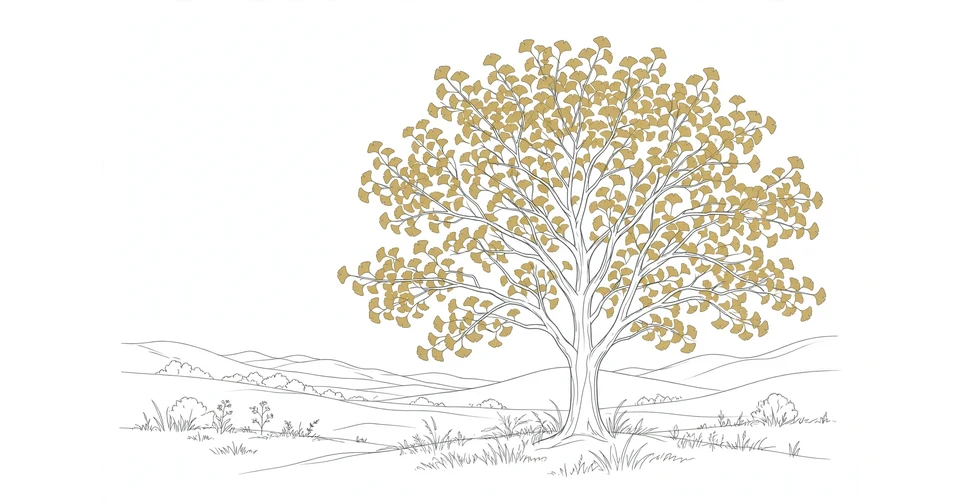
This is a tree with a longer story than almost anything else alive in the city. The ginkgo has been on Earth for hundreds of millions of years, it has survived earthquakes, firebombing, and an atomic bomb, and it still shows up every autumn in the same bright gold. It feeds people, it decorates the city, and it even shapes the hairstyle of a sumo champion. To understand the ginkgo is to understand something about how Japan remembers, endures, and celebrates.
Why the ginkgo became Tokyo's official tree
Tokyo chose the ginkgo on purpose. In 1966 the tree was selected as the official tree of Tokyo by popular vote, and the reasons given were its longevity and its resilience. Those are not the usual reasons a city picks a symbol. Most cities choose something pretty or famous. Tokyo chose something that refuses to die.
The choice makes sense when you spend time in the city. The ginkgo lines streets all over Tokyo, standing through summer heat, winter cold, exhaust fumes, and the crush of crowds. In spring and summer it is a plain green shade tree, easy to walk past without a second look. Then, late in the year, it turns gold all at once, and the whole street changes colour. A tree that works quietly for most of the year and then gives the city its brightest weeks is a fair emblem for a place that works as hard as Tokyo does.
The leaf itself became the symbol of the city. In June 1989 Tokyo adopted a metropolitan symbol made of three arcs that form the letter T in the shape of a vivid green ginkgo leaf. The design stands for future growth, prosperity, charm, and tranquillity. Once you know what to look for, you start seeing the fan shaped leaf everywhere, on the logo of the metropolitan subway system, on buses, and even on the guardrails along the streets. It is a small detail, and it is also a daily reminder that the city has a living emblem.
There is something wise in choosing a tree as a symbol instead of a building or a monument. Buildings are finished and fixed. A tree keeps growing, loses its leaves, and comes back. It asks the people who live with it to be patient, and it rewards that patience every year.
The golden avenue at Meiji Jingu Gaien
The most famous ginkgo sight in Japan is a single straight road in Aoyama. The avenue at Meiji Jingu Gaien, known as Icho Namiki, runs for about 300 metres toward the Meiji Memorial Picture Gallery, lined with 146 ginkgo trees. The avenue was completed in 1923, and it was designed with care. The trees were planted in order of height, and the ground falls gently toward the gallery, so the perspective draws your eye down the whole golden corridor to the domed building at the far end.
Japan's national tourism organisation lists Icho Namiki among the best places in the country to see autumn leaves, and describes how the neatly aligned trees turn a brilliant golden colour as the season deepens. The best time to visit is typically from mid-November to early December, and as the leaves begin to fall the ground becomes blanketed in yellow foliage, forming a scene often described as a golden carpet. You can read the full guide on the Japan National Tourism Organization site.
The avenue is a public road, so walking it costs nothing, and it is only a few minutes on foot from Aoyama-itchome Station. That easy access is part of why it gets so crowded. On a peak weekend in late November the road fills with photographers, families, couples, and visitors from all over Japan and beyond, all standing in the same golden light. Go on a weekday morning if you can, and the avenue feels entirely different, quiet enough to hear the leaves fall.
I think the crowd is part of the point, though. The ginkgo gives Tokyo a shared moment, a few weeks when people who would otherwise hurry past each other stop and look at the same thing. Cities need moments like that. A street full of strangers smiling at trees is not a small thing.
A tree older than the dinosaurs
The ginkgo is often called a living fossil, and the description is fair. The oldest ginkgo fossils date back some 290 million years, which means the lineage of this tree was already old before the first dinosaurs appeared. It is the only surviving species of its order, a single line that kept going while countless other plants vanished. When you stand under a ginkgo in Tokyo, you are standing under a design that nature settled on before flowers existed.
That age is part of why the tree is so tough. The ginkgo tolerates cold, heat, poor soil, and city pollution better than most trees. It has few natural pests, and its deep roots hold it steady in storms. Gardeners plant it along streets precisely because it survives conditions that would kill a more delicate tree. It is not flashy for most of the year, but it is built to last.
Old age has also made the ginkgo a familiar presence at temples and shrines across Japan. Some of the most famous ginkgo trees in Tokyo stand on temple grounds and are far older than the city around them. One tree on the grounds of Zenpukuji temple in Azabu is close to 1,000 years old, and it was badly burned during the American fire bombings of May 1945. Like the city around it, the tree survived and regrew. Another famous tree, the so-called Disaster Ginkgo near the moat of the Imperial Palace, burned during the fires that followed the Great Kanto Earthquake of September 1, 1923, and it survived too. These trees are not just old. They are witnesses, and people in Tokyo treat them with a respect that is closer to reverence than to gardening.
The ginkgo trees that survived Hiroshima
The most moving chapter in the story of the ginkgo belongs to Hiroshima. When the atomic bomb fell on the city on August 6, 1945, it destroyed almost every living thing near the centre of the blast. Among the few living things to survive were six ginkgo trees. The bomb stripped away their bark and destroyed their leaves, but the trunks stood. The next spring, little green buds emerged from the charred wood.
Those trees were soon named hibakujumoku, which means bombed trees, though the word is often translated as survivor trees. They quickly became international symbols of hope and resurrection. The first mayor of Hiroshima after the bombing, Shinzo Hamai, wrote about the powerful emotions stirred by a little sign of life in a place where rumour held that nothing would grow for 75 years. He said that people's expressions brightened and their steps quickened in response to more than the seasonal change.
The seeds of those six trees have since been collected and spread around the world by the organisation Green Legacy Hiroshima, so descendants of the Hiroshima ginkgo now grow in soil from California to Costa Rica. They are honoured as symbols of peace wherever they grow. One survivor of the bombing, Hideko Tamura Snider, planted 51 seeds descended from the six original trees in Oregon in 2017. She told a newspaper that she could not grow her mother or her cousin, but the tree, she could. You can read the full account in this history of the Hiroshima ginkgo trees.
It is hard to write about this without pausing. A tree that survives the worst thing human beings have ever done to a city, and then quietly puts out green shoots the next spring, says something that no speech can say as well. The ginkgo does not argue, and it does not accuse. It simply goes on living, and in doing so it gives the people around it a reason to go on too. That is a kind of wisdom, and it is one of the reasons the tree matters so much in Japan.
Ginnan, the nut you eat a few at a time
The ginkgo is not only something to look at. In autumn it also feeds people, though with a warning attached. The nuts of the tree, called ginnan in Japanese, are in season from September to November, and they are known as a taste of autumn. They are eaten roasted with salt, fried, or boiled, and they appear in chawanmushi, the savoury steamed egg custard, and in takikomi gohan, mixed rice cooked with seasonal ingredients.
The nuts have a chewy texture and a nutty, bittersweet flavour, and a single ginnan sitting in a bowl of chawanmushi is one of the small pleasures of an autumn meal in Japan. But the nuts contain a toxic component called 4-methoxypyridoxine, and even cooking does not fully remove it. The usual guidance is to eat only a small number, about ten nuts a day for an adult and about five for a child, and not to eat them every day. Children are more easily affected than adults, so extra care is needed with them.
The fallen fruit of the female ginkgo also has a strong, unpleasant smell, and the fleshy pulp can irritate the skin, so gloves are sensible when handling the fruit. This is the other side of the tree, and it is worth knowing. The ginkgo is generous, but it is not tame. It asks for respect, in the kitchen as well as on the street.
I like that the nut comes with a limit built in. Modern life trains us to take as much as we can of anything good, and here is a food that quietly says otherwise. A few nuts, once in a while, in season, is enough. It is a small lesson in restraint, delivered by a tree.
How to enjoy the golden weeks
The Japanese tradition of autumn leaf viewing is called momiji-gari, and it has been a pastime since the eighth century. Autumn colours can be seen from late September through to early December depending on the location, and ginkgo trees turn golden yellow while maples turn deep red. The ginkgo is usually among the last trees to change, so it closes the autumn season with gold just as the days grow cold.
If you want to see the ginkgo at its best, plan for late November. At Jingu Gaien that is when the avenue is at full gold, and the fallen leaves cover the road in a yellow carpet. Mornings on weekdays are the calmest time, and the light is softer then too. Bring no plan beyond walking slowly. The avenue takes only twenty to forty minutes to walk end to end and back, longer if you stop for photographs, and stopping is the whole point.
Beyond the famous avenue, the ginkgo rewards anyone who looks around. University campuses in Tokyo, including the University of Tokyo and Aoyama Gakuin University, are well known for their ginkgo lined promenades. Parks, shrine grounds, and ordinary residential streets all have their own golden trees, and some of the best moments come from finding one by accident on a street you walk every day. For more ideas on where autumn colour appears across Japan, see our guide to Japan's autumn leaves and where to find them.
There is no ticket, no booking, and no best seat. The ginkgo asks nothing of you except that you look up. That is a rare kind of generosity in a city where almost everything else has a price and a queue.
A leaf that shows up everywhere
The fan shaped leaf of the ginkgo has become one of the most recognisable motifs in Japan. It appears on the metropolitan symbol of Tokyo, on subway logos, on street guardrails, and on buses. It is a piece of graphic design borrowed directly from nature, and it works because the shape is simple, balanced, and unlike any other leaf. You can draw it in three strokes, and a child in Tokyo would know what it is.
The leaf also appears in a place most visitors would never expect: on the head of a sumo wrestler. A sekitori, a wrestler ranked in the top two divisions, wears his hair dressed in the oichomage, an elaborate topknot fanned out into the shape of a ginkgo leaf. It is a mark of rank, worn with pride, and it connects the wrestler to a tree that stands for endurance and dignity. You can read more about what that rank means in our story about how a wrestler earns the white silk of a sekitori.
The motif works because it carries meaning without needing words. A fan shaped leaf on a guardrail says this is Tokyo. The same shape on a wrestler says this man has earned his place. The same shape turning gold in November says autumn has arrived. One leaf, used three ways, and each use feels natural.
That is the quiet power of the ginkgo in Japanese life. It is not a symbol that was invented in a meeting and pasted onto the city. It grew there, survived there, and earned its place over centuries. The design followed the tree, not the other way around.
A tree that keeps its promises
Every year the ginkgo makes the same promise to Tokyo, and every year it keeps it. The leaves turn gold, the streets fill with people looking up, the nuts appear in the markets, and the city remembers that it has a living emblem. Then the leaves fall, the branches stand bare through the winter, and the cycle begins again.
There is comfort in that rhythm. In a city that rebuilds itself constantly, where whole neighbourhoods can change in a few years, the ginkgo is one of the few things that stays and returns. It was here before the towers, it survived the fires and the bombs, and it will be here when the towers are replaced. That kind of continuity is rare, and it is worth noticing.
If you are in Tokyo in late November, go and stand under a ginkgo. Look at the gold above you, and then look at the carpet of fallen leaves at your feet. You are looking at one of the oldest living things on Earth, doing what it has done for hundreds of millions of years, in the middle of one of the newest cities on Earth. The contrast is the whole story. Old and new, fragile and tough, beautiful and useful, all in a single tree. The gold falls every autumn, and every autumn it is worth stopping for.
More in Culture & Society
- The Naginata Gave Japan's Women Warriors a Blade of Their Own
- How an Oichomage Turns a Wrestler Into a Sekitori
- A Kamidana Brings the Shrine Into the Japanese Home
- An Omamori Carries a Shrine's Protection in Your Pocket
- A Shinai Is a Sword That Refuses to Cut
- Pachinko and the Neon Rooms Where Japan Plays Its Loudest Game
Latest posts
- Momiji Turns Japan Red Every Autumn
- Japanese Castles and the Samurai Fortresses That Still Stand
- Kongobuji Still Runs the Mountain Kukai Chose
- Kiai Is the Shout That Turns a Strike Into a Commitment
- Toro Stone Lanterns Light the Way Through Japan's Sacred Places
- An Ofuda Brings the Kami Home on a Slip of Paper
- Kagura Suzu Are the Bells That Let the Kami Hear the Dance
- Japanese Knives From Samurai Swords to Kitchen Counters
- Tenkasu Turns Tempura Scraps Into Japan's Favorite Crunch
- Goshuin Collects Your Shrine Visits One Red Stamp at a Time
- Hamaya Is the Arrow That Breaks Demons at New Year
- Saisen Is the Small Coin You Offer Before You Pray
- Japanese Gardens and the Quiet Art of Borrowed Scenery
- Tanuki Udon Is the Bowl Named After a Raccoon Dog
- A Himorogi Is the Shrine Before Shrines Had Walls