Mepeed Is the Slow Walk That Carries Bali to the Temple
· 19 min read
Mepeed is the Balinese procession in which women walk in a single ordered line to the temple, each carrying an offering on her head, and the slow walk itself is part of the offering.
On a temple festival morning in Bali, the road fills with colour long before the prayers begin. A line of women in lace kebaya walks slowly toward the temple, each one balancing a tall tower of fruit and flowers on her head, and the line stretches so far down the road that you cannot see where it ends. That slow, ordered walk is a mepeed, and in Bali the walk itself is as much a part of the offering as the fruit the women carry.
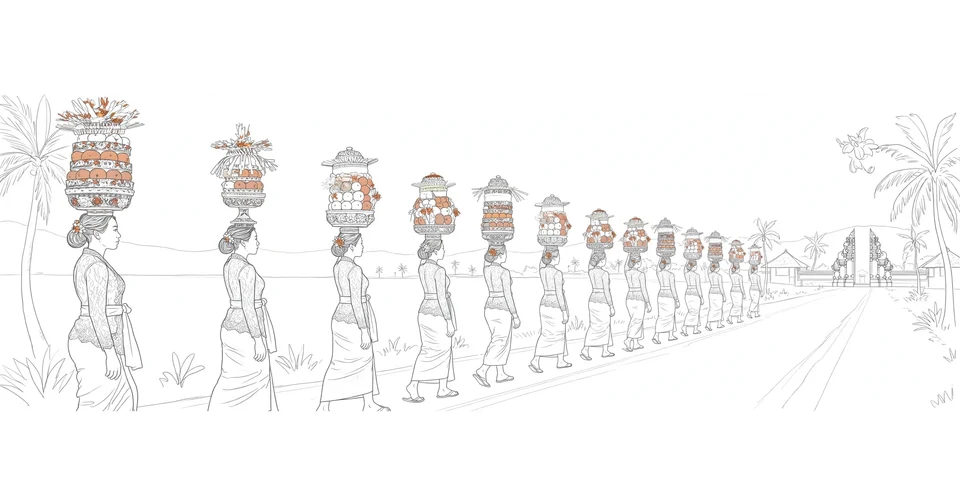
A mepeed is not a parade put on for visitors. It is a religious duty, a form of yadnya, or sacred offering, in which an entire village walks its gratitude to the temple together. The women carry the offerings, the men walk with the banners and the gamelan, and the village guards clear the road ahead, and every person in the line has a place that was decided before the walk began.
To watch a mepeed is to watch Bali at its most patient. Nobody hurries, nobody pushes forward, and nobody overtakes the person in front. The line moves at the pace of its slowest walker, and that is the point. This article explains what mepeed means, when it happens, what the walkers carry, who walks where, and how a visitor should behave when one crosses their path.
What mepeed means
Mepeed comes from the Balinese word peed, which means to walk in line. The word is sometimes spelled mapeed, and both spellings describe the same thing, a procession that walks in a strictly ordered sequence to form one straight line. A mepeed is not a crowd moving in the same direction. It is a line with a shape, a front and a back, and a rule that holds the shape together.
The rule is simple and strict. A participant in a mepeed walks in line and may not try to overtake the participant in front of her. That single rule is the whole philosophy of the walk. In Balinese thought, mepeed is close in meaning to madeeng, the practice of guiding people in an intended direction while those who follow control their steps so that the person ahead is never rushed. The leader sets the direction, the followers set the pace, and the line arrives together.
The custom is old, and its origins are not written down in any surviving manuscript. Balinese belief links mepeed to nyenuk, an old activity in which people came from different directions to offer harvests and livestock to the king or to the temple, and some say a king once decreed that his people should walk in this ordered way whenever they brought holy offerings. Whatever its origin, mepeed has been passed down from generation to generation as part of yadnya, and it survives today in the villages that choose to keep it. Not every village in Bali practices mepeed, and that is worth knowing. The villages that do keep it guard the custom as part of their ancestral heritage, and the villages that do not have their own ways of honouring the temple.
Nobody overtakes, and the slowest carrier sets the pace
The no overtaking rule of mepeed is easy to state and hard to live by, which is exactly why it matters. In ordinary life, the fast overtake the slow without thinking. On the road, in a queue, in a career, the quick move past and the slow are left behind. A mepeed reverses that order. The strongest carrier, the youngest woman, the woman with the lightest tower, all of them walk behind the pace of the slowest person in the line, and the line is only as fast as its oldest or most tired member.
This is not inefficiency. It is the teaching. A mepeed says that a community arrives together or it does not arrive at all, and that no offering is acceptable if it is delivered by leaving someone behind. The line protects the slow in a way that modern life rarely does, and it does so without speeches or slogans. It simply walks at their pace, and everyone in the line agrees to that pace with their feet.
Watch a mepeed for a few minutes and you will see what the rule costs. The women at the front set a slow, steady rhythm, and the women behind match it step for step. A tower of fruit a metre high sways with every step, and the carrier cannot run to catch up or hurry to get ahead. Her hands steady the load, her eyes stay forward, and her feet follow the person in front. The patience is physical, and you can see it in the shoulders of every walker. I find this the most moving part of the tradition, because it turns a value into a bodily habit. Solidarity is not something the village talks about on this day. It is something the village walks.
The pace also changes what the walk feels like for the walkers. A mepeed is not a race to the temple and it is not a performance with a finish line. It is a slow journey, and the slowness gives the walkers time to pray, to sing, and to be together. The gamelan walks with them, the banners move above them, and the road becomes a place of worship long before the temple gate appears. When the line finally reaches the temple, nobody is breathless and nobody has been left behind, and that calm arrival is part of the gift.
When mepeed happens
A mepeed does not happen on a fixed date for the whole island. Each village decides for itself, and the decision is made in a paruman, a meeting of the traditional village council, where the elders settle which neighbourhood groups will take their turn to present their ayahan, or community service, and on which day. The timing follows the temple calendar, and the most common occasion is the odalan, the temple anniversary, which most village temples celebrate every 210 days on the Pawukon calendar.
Because Bali has more than 20,000 temples and every temple keeps its own anniversary, mepeed processions take place somewhere on the island on most days of the year. A traveller who stays in Bali for a week has a fair chance of meeting one on the road, and a traveller who stays a month will almost certainly see one. The island's calendar is crowded with temple birthdays, and each one brings its own line of walkers to the road.
Beyond the temple anniversaries, mepeed lines form in the days between Galungan and Kuningan, the ten-day stretch when families honour their ancestors and the island fills with tall bamboo penjor arches, and on Kuningan itself, ten days after Galungan, when offerings are carried to the temple in great numbers. They also form as part of melasti processions in the days before Nyepi, when sacred heirlooms are carried to the sea or a holy spring to be cleansed, and on full moon days, when temples hold their largest gatherings. A good guide to the temple anniversary cycle, and to the part mepeed plays in it, is this overview of the piodalan festival.
The timing varies from village to village, and so does the form. In Sukawati, in Gianyar Regency, the mepeed runs for four days, with hundreds of participants each day, and the walkers include men, children and elders as well as women. In other villages only the women carry offerings on their heads while the men walk with the banners and instruments. The details change, and the villages are proud of their differences, but the core of the mepeed stays the same everywhere, a line of people walking together to the temple with something to give. For a closer look at how the tradition is described by those who write about Bali, this guide to the mepeed ceremony sets out the 210-day rhythm and the Sukawati variation in plain terms.
What the line carries
The most famous thing a mepeed carries is the gebogan, the tapering tower of fruit, cakes and flowers built on a footed wooden tray called a dulang. A gebogan usually stands between 50 and 100 centimetres high, and it is built at home by the woman who will carry it, from fruit, jaja cakes, flowers and woven palm leaf ornaments. The tower narrows as it climbs, and a small tray of flowers crowns the top, and the whole structure is balanced on the carrier's head without straps or supports. To learn what goes into the tower itself, read about the gebogan, the tower of fruit Bali carries to the temple.
But a gebogan is only one of the things a mepeed carries, and a mepeed that carried nothing but gebogan would be a poor picture of the tradition. The walkers also carry banten, the wide family of offerings that ranges from small trays of flowers and rice made fresh each morning to large ceremonial arrangements, and the simplest walkers carry only flowers and incense for prayer. The banten tradition is worth understanding on its own, because it explains how Bali makes offerings out of almost nothing, and you can read about it in this account of banten, the offerings Bali makes out of almost nothing.
At the most sacred end of the line, the procession carries pratima, the holy effigies and heirloom statues of the temple, which are taken to the sea or a holy spring during melasti to be cleansed with holy water, then carried back to the temple and kept sacred. A pratima may be carried by a man or a woman, and it travels with the greatest honour in the line. The men of the procession carry the other sacred objects, the tall umbul-umbul banners, the tedung ceremonial umbrellas, the pasepan incense burners, and the gamelan instruments, and their role is to lead the line and to guard it.
The weight matters, and it is part of the meaning. A carrier with a heavy tower is allowed to carry only the simplest set of prayer instruments, flowers and incense, because the offering itself is load enough. The village does not ask a woman to carry both a tall tower and a full set of ritual objects. The offering is the burden, and the burden is the offering, and the walk to the temple is the act that joins the two. That is why a mepeed never looks like a parade of porters. It looks like a village carrying its gratitude on its head.
Who walks, and in what order
A mepeed has an order, and the order is decided before anyone takes a step. The village council meets in a paruman, and the elders decide which banjar, or neighbourhood group, will have its turn to present its ayahan on this occasion, and who will walk in the line. The duty then falls to the krama istri, the wives of the banjar members, to the sekaa teruna youth group, and to the children, who commonly walk as the central line, while the krama lanang, the men, take the roles of pecalang guards, musicians, and banner carriers.
On the day itself, the walkers gather at the banjar before the walk begins. They pray together, and the carriers prepare only flowers and incense for prayer, because they already carry a heavy offering. Then the pecalang help the line form, and the gebogan rise above the walkers' heads, and the walk begins. The parade opens with a row of umbul-umbul banners, followed by tedung umbrellas, pasepan incense burners, and the other ceremonial instruments. Children in traditional dress come next, then the krama istri take the middle of the line, and the men and the sekaa gong bring up the rear. The order is the same in most villages, and it is part of what makes a mepeed easy to recognise from a distance.
The destination is usually close, about five kilometres from the banjar, and the route often follows the main road, so pecalang and traffic wardens stand at posts along the way to control the traffic. A mepeed can slow the traffic for a while, especially at a busy hour, and drivers wait while the line passes. Nobody in Bali complains about the delay in the way a visitor might expect, because the line on the road is a familiar sight, and the delay is understood as part of temple day.
The ages in the line run from children to grandparents. Girls walk with their mothers, young women walk with their aunts, and older women walk with the steadiness of decades of practice. A girl who walks her first mepeed beside her mother is learning something no classroom could teach her, how to carry a weight with grace, how to keep a line, and how to belong to a village. The tradition is handed down in the walking itself, and every generation learns it by walking it.
Sukawati shows how much the form can vary. There the mepeed includes men, children and elders, the participants do not carry gebogan on their heads, and the procession stretches for as much as half a kilometre over four days, with hundreds of walkers each day. The Sukawati walk also has its own purpose, collecting tirta, or holy water, from Taman Beji Temple for use through the temple's pujawali anniversary. The differences are real, and the villages are proud of them, but the shared core is the line itself, walking in order to the temple.
The walk is part of the offering
It is easy to think of a mepeed as transport, a way of getting offerings from the village to the temple, but that misses the point. In Balinese Hindu belief, carrying an offering on the head is itself an act of respect, more reverent than carrying it by hand, and the slow walk to the temple is part of the gift. The offering is not only the fruit and the flowers. It is the time, the effort, the balance, and the patience, and the walk is where all of those are given.
When a mepeed reaches the temple, the carriers enter the central courtyard, and a pemangku, or temple priest, sprinkles tirta, holy water, over the offerings. The blessed offerings are then lined up neatly on a bale pavilion in the main temple area, and the prayer procession begins. The gods and ancestors, in Balinese belief, consume only the sari, the invisible essence, scent and devotion of the offering. The physical food remains, and after the ceremony it becomes surudan, blessed food, which families carry home and share with relatives, neighbours and children. Nothing is wasted, and the sharing is the last part of the giving.
After the prayer, some walkers disband and go home on their own, while in other villages the mepeed reforms and walks home in a line, carrying the blessed offerings back to the family compounds. Either way, the walk home is quieter than the walk to the temple, and the towers are lighter for having been blessed. The fruit that was carried to the gods returns as food for the family, and the circle of the offering closes at the family table.
I think this is the part of mepeed that stays with a person who has watched one. The offering is not thrown away and it is not left behind. It is carried there, blessed, and carried back, and the walk frames both journeys. A culture that treats a walk as a prayer is a culture that has decided that how you travel matters as much as where you arrive, and that is a decision worth borrowing. The next time I am in a hurry, I will remember the line of women walking at the pace of their slowest member, and I will ask myself what I am hurrying past.
What mepeed teaches a hurried world
A mepeed is full of values that are easy to name and hard to practise. The line is a picture of gotong royong, mutual cooperation, and of ngayah, the voluntary communal labour that Bali runs on, in which a village gives its time without pay because the temple belongs to everyone. Nobody in the line is paid, nobody is performing for a wage, and nobody is competing for a prize. The walk is service, and the service is shared.
The tradition also refuses competition in a way that is worth noticing. A gebogan may be taller than its neighbour, or more elaborate, or more colourful, but Balinese teaching holds that the offering is not judged by its height or its extravagance. What matters is the intention behind it, a sincere expression of gratitude and humility. The tallest tower in the line is not the winner, because there is no winner, and a small, simple offering carried with a sincere heart is worth as much as the grandest tower. In a world that ranks everything, from school results to social media followers, a mepeed is a reminder that some things are not meant to be ranked at all.
The food a mepeed carries also carries a teaching. What is offered to the gods is what the earth has given, fruit, rice, cakes, flowers, and the offering is a way of saying that the harvest does not belong to the harvester alone. The walkers carry the best of what they have, and they carry it together, and the line makes visible a truth that is easy to forget in a city, that a community is fed by the same land and the same rain. A mepeed is a harvest walk, and it is also a thank you note written with feet.
There is also a quiet lesson about modernity. Bali has changed enormously in a generation, and the roads the lines walk on are busier, louder and faster than they were. Yet the mepeed continues, and the villages that keep it do so not because they are frozen in the past but because the walk still means something to them. A tradition survives when the people who practise it still find it true, and the sight of a line of women in white kebaya crossing the traffic of modern Bali is proof that the old and the new can share the same road, as long as the new is willing to wait a little.
If you meet a mepeed on the road
Most visitors to Bali will meet a mepeed on the road before they ever enter a temple, and the encounter is usually sudden. You are driving or riding along a village road, the traffic slows, a pecalang in a black and white checked sash waves you to the side, and a line of women in matching kebaya walks past with towers on their heads. The right response is simple, and it is the same response a Balinese driver gives, pull over, wait, and watch. Do not try to cut through the line, do not drive between the walkers, and do not sound your horn to hurry them along. The line will pass, and the road will open again, and the few minutes you waited will have cost you nothing.
Photographs are welcome in most cases, but they should be taken from a distance and without blocking the walkers. The women are not performers, and they are not posing for a photograph. They are carrying an offering to the temple, and a camera in their path is a nuisance and a discourtesy. Stand to the side, keep your voice low, and do not step into the road to get a better angle. If you want a closer picture, ask a pecalang first, and accept a refusal gracefully.
If you are invited to enter the temple, dress as the Balinese do, a clean sarong with a waist sash, a shirt or kebaya that covers the shoulders, and for men a folded headcloth called an udeng. Shorts and beachwear will see you turned away at the gate, and rightly so. Do not enter the inner courtyard during the core prayers, do not walk in front of kneeling worshippers, and do not step between a person at prayer and the shrine they face. Visitors are generally not permitted to enter the temple during the most sacred part of the ritual, and that is a rule to respect rather than to test. If you are menstruating, have an open bleeding cut, or are in mourning for a family member, do not enter the temple at all. These rules of spiritual purity are taken seriously, and observing them is the simplest way to show respect.
A small practical note: village temple festivals are community rites, not commercial events, and there are no tickets. Visitors often leave a modest voluntary donation in an offering basket at the entrance to help with temple upkeep, and that gesture is appreciated. But the best thing a visitor can give a mepeed is the one thing the walkers give each other, patience. Wait for the line, let it pass, and let the village reach its temple together.
A mepeed is a slow walk, and slowness is its message. The line teaches that a community is measured by how it treats its slowest member, that an offering is measured by the sincerity behind it rather than its size, and that the journey to the temple is part of the prayer rather than a delay before it. Bali has kept this walk alive through generations of change, and it has done so by walking it, one slow step at a time, together. The next time a mepeed crosses your road, stop and watch it pass. You will be watching a village practise, in public and without fuss, the oldest lesson there is, that we arrive together or we do not arrive at all.
More in Culture & Society
- Gebogan Is the Tower of Fruit Bali Carries to the Temple
- Banten Are the Offerings Bali Makes Out of Almost Nothing
- Tama Nuki Is the Rite That Lets a Sacred Object Rest
- Japanese Noh Theatre and the Slowest Drama on Earth
- Tamashii Ire Invites a Soul Into a Sacred Object
- Kaigen Kuyo Is the Ceremony That Wakes a Sacred Object
Latest posts
- Amado Are the Storm Shutters That Close Japan for the Night
- Ihai Are the Lacquered Tablets That Keep a Name Alive
- A Butsudan Keeps the Dead Close in a Japanese Home
- An Engawa Is Neither Inside nor Outside, and That Is the Point
- Nikko and the Shrines Hidden in the Cedar Forest
- Minka Are the Folk Houses Japan Built Around the Hearth
- Miyadashi Is the Moment the God Leaves Home
- Otabisho Is Where the God Rests on the Way Through Town
- Mikoshi Are the Portable Shrines Japan Carries on Its Shoulders
- Sanja Matsuri Turns Asakusa Into Tokyo's Loudest Weekend
- The Orangutan and the Vanishing Forests of Borneo
- Waraji Straw Sandals Walked Japan for a Thousand Years
- Hozomon Guards the Treasure House Behind Senso-ji's Main Hall
- Nakamise Is the Shopping Street That Has Fed Pilgrims for Centuries
- Kaminarimon Is the Thunder Gate That Opens Asakusa to the World