Tama Nuki Is the Rite That Lets a Sacred Object Rest
· 23 min read
Tama nuki is the Japanese rite that gently removes the soul from a sacred object before it is retired, the quiet farewell that mirrors the ceremony that first woke it.
A family altar stands in the corner of a room that is about to be emptied. The house has been sold, or the last person who tended the altar has died, and the cabinet that was greeted every morning must now go. Nobody in the family wants to throw it away like furniture, and nobody quite knows what to do with it instead. The answer, in Japanese Buddhism, is a rite called tama nuki.
Tama nuki means the extraction of the soul. It is the ceremony that gently removes the soul from a sacred object before the object is dismantled, replaced, or disposed of, and it is the mirror image of the rite that first placed the soul inside.
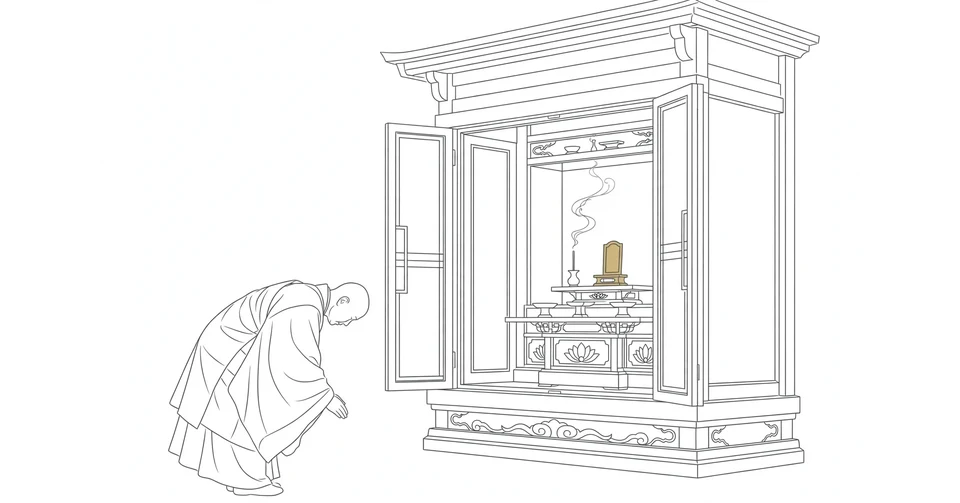
Every sacred object in Japanese Buddhism has two possible ceremonies in its life, one at the beginning and one at the end. The first is the waking, the placing of the soul that turns a crafted thing into a presence. The second is the resting, the removing of the soul that turns the presence back into a thing that can be taken apart without disrespect. Tama nuki is that second ceremony, and it matters because it says that endings deserve the same care as beginnings.
What tama nuki means
The words themselves are plain. Tama means soul or spirit, and nuki means extraction, removal, or taking out. Tama nuki is therefore the extraction of the soul, and it is also written tamashii-nuki, using the fuller word for soul. The name is a direct mirror of tamashii ire, the placing of the soul. One rite puts the soul in, the other takes it out, and the two names say so with the same simplicity.
The rite is called tama nuki, the extraction of the soul, and it is paired with hakken shiki, a sending-away service. That sentence, quoted from the earlier account of the rite that places the soul, is the clearest short description of what happens. The soul is not destroyed and it is not discarded. It is extracted, and then it is sent away, with ceremony, to wherever it belongs next. The object that remains is no longer a dwelling place. It is wood and lacquer and gold leaf again, and it can be dismantled or burned or thrown away without the family feeling that they have thrown away a guest.
It is worth pausing on the word extraction, because it sounds clinical in English, like pulling a tooth. In the Japanese rite it is nothing like that. The extraction is done by chanting and offering, by the same slow language that placed the soul in the first place. The priest does not seize the soul and drag it out. He asks it to leave, politely, and the asking is the rite. Tama nuki is a farewell, and like every good farewell it is built on gratitude, not on force.
The mirror of tamashii ire
To understand tama nuki, it helps to remember its mirror. Tamashii ire is the rite that places the soul in a sacred object, the quiet half of kaigen kuyo, the eye-opening ceremony. A new statue, a new memorial tablet, or a new household altar is not ready to be prayed to when it leaves the workshop. It must first be given its inner life, and tamashii ire is the name for that giving. The full story of that waking is told in the account of the rite that invites a soul into a sacred object, and tama nuki is best read as its second half.
The two rites belong together because they share one belief, that a sacred object is not a thing but a presence. If a statue can hold a soul, then the soul must be placed in it with care, and if the statue must one day be retired, the soul must be taken out with equal care. A religion that performed only the first rite would be a religion of beginnings with no language for endings. Tama nuki supplies that language, and in doing so it completes the logic that tamashii ire begins.
The symmetry runs deeper than the names. Tamashii ire is performed when an object is new, when a family brings home a fresh altar or a temple installs a fresh statue. Tama nuki is performed when an object is old, damaged, or no longer keepable. Tamashii ire is a ceremony of welcome. Tama nuki is a ceremony of goodbye. Both are performed by a priest, both use chanting and offerings, and both treat the object as something that deserves to be addressed rather than handled. The difference is only the direction of the journey, in or out, and the direction is everything.
There is a quiet honesty in having both rites. A tradition that only knew how to wake objects would be a tradition that could never let anything go, and houses would fill with altars nobody could tend and statues nobody could repair. A tradition that only knew how to put objects to rest would be a tradition that never believed in them at all. Japanese Buddhism keeps both, and the keeping of both is what makes the system humane. Things are woken when they are needed, and they are put to rest when their time is done, and neither act is treated as a small thing.
When tama nuki is needed
Tama nuki is needed whenever a sacred object has to stop being sacred, and in ordinary Japanese life that happens more often than an outsider might guess. The most common case is the family altar. A butsudan, the household Buddhist altar, is a large piece of furniture, often taller than a person, and it holds the memorial tablets of the dead. When the house is sold, when the family moves into a small apartment, or when the last person who kept the altar dies, the altar cannot simply be left behind or loaded onto a truck like a wardrobe. Tama nuki is performed first, so that the soul is released and the cabinet can be dismantled.
The second common case is damage. A statue cracks, an altar is eaten by damp, a memorial tablet is broken in an earthquake. The object cannot be repaired, or the repair would cost more than the family can pay, and the question becomes what to do with something that is sacred and broken at the same time. Tama nuki answers that question. The soul is extracted, and the broken object, now an ordinary thing again, can be disposed of without guilt.
The third case is replacement. Temples renew their images, families replace a worn altar with a smaller one, and a new object needs the place of the old. The old object is not thrown away in a fit of tidiness. It is given tama nuki, and only then is it dismantled or burned. The replacement itself then receives tamashii ire, the placing of the soul, so that the household or the temple is never left without a presence. The two rites can follow each other in a single day, the farewell in the morning and the welcome in the afternoon, and the day feels complete because both were performed.
The fourth case is the closing of a grave. When a family grave is permanently closed, a process called haka-jimai, the gravestone is removed and the remains are moved elsewhere. Before the stone is touched, a priest may perform a closing rite called heigan kuyo, the closing of the eyes, which is also known as tamashii-nuki, the same rite under a different name. The grave, like the altar, is treated as a dwelling place, and the dwelling place must be emptied with ceremony before it is dismantled.
Moving house is a borderline case, and it shows how carefully families think about this. A family that moves does not always need tama nuki, because the altar is not being retired, only relocated. In that case the soul is usually invited again in the new home, in a redoing of the soul-placing, rather than extracted. Tama nuki belongs to the true endings, the cases where the object will not be prayed to again, and families and priests draw that line with care. A move is a continuation. A retirement is an ending, and endings get the rite.
How tama nuki is performed
The details of tama nuki vary by Buddhist school and by local custom, and it would be dishonest to pretend there is one fixed script. What the sources agree on is the shape of the rite, and that shape is recognisable across the schools. A priest performs it, usually at the temple or at the home where the object has been kept. The space is tidied and the object is placed before the priest, or the priest comes to the house and the family gathers around the altar one last time.
The ceremony is built from the same elements as its mirror rite, purification, chanting, offering, and the formal act of release. Offerings are prepared, usually incense, candles, flowers, and water, the same simple things that were offered when the soul was placed. The priest chants sutras, and the chanting is understood to ask the soul to depart, just as the chanting of tamashii ire was understood to ask it to arrive. The family may be asked to join their hands, to bow, and to thank the object for the years it served them. The thanks are not decoration. They are the point, because a farewell without thanks is only a removal.
Tama nuki is paired with hakken shiki, the sending-away service, and the pairing is worth understanding. If tama nuki is the extraction, the taking out, then hakken shiki is the dispatch, the sending of what was taken out to its proper place. The two together make a complete farewell, the soul is released and then it is sent, and the object is left empty and at peace. The Courtauld lecture on the lives and afterlives of Buddhist icons describes these as the rituals temples employ today to deactivate objects slated for dismantling, replacement, or disposal, and it names both together, hakken shiki and tama nuki, as the modern answer to the problem of sacred things that must go.
After the rite, the object is handled in a way that would have been unthinkable before it. A dismantled altar can be taken apart by a contractor. A broken statue can be burned, or its wood can be reused. A memorial tablet can be disposed of by the temple. None of this is done lightly, and the family is usually told what will happen, but the rite has changed the standing of the object, and the change is real to the people involved. Before tama nuki, the object was a presence. After tama nuki, it is material, and material can be dealt with.
A rite with almost no medieval past
Here is the most surprising thing about tama nuki. For a rite that feels ancient, it has almost no medieval past at all. The Courtauld lecture on the lives of Buddhist icons, given by Dr Benedetta Lomi, makes this point from the medieval record. It notes that in the medieval period, references to such disempowering ceremonies are strikingly absent from the ritual manuals, despite the abundance of instructions for consecration and installation. The old manuals tell a priest, in great detail, how to wake an object. They say almost nothing about how to put one to sleep.
The reason, the lecture argues, is that the medieval paradigm was reactivation rather than disempowerment. When an old image was repaired, moved, or passed to a new owner, the eye-opening was simply performed again. Restoration, reconsecration, and ritual reuse allowed icons to accrue efficacy through time and lineage, and an old statue that had been repaired and given the rite again was not a diminished thing. It was a thing with more history in it, and the history was part of its power. The medieval answer to an ageing object was to wake it again, not to put it to rest.
That changes how tama nuki should be understood. It is not a rite handed down unchanged from the eighth century, like the eye-opening of the Great Buddha of Todai-ji in 752. It is a newer answer to a newer problem, the problem of what to do with sacred things in a time when families shrink, houses are cleared, and temples hold more old objects than they can keep. The lecture says this plainly, and the plainness is important. Tama nuki is a modern rite wearing old clothes, and knowing that makes it more interesting, not less. It shows a tradition inventing a ceremony for a situation its ancestors rarely faced, and inventing it in the same language, chanting and offering and formal words, that the ancestors used for everything else.
I find that history reassuring rather than disappointing. A tradition that can invent a farewell rite when it needs one is a living tradition, not a museum piece. The medieval priests who kept waking old statues again were solving their own problem, the problem of keeping sacred things alive in a world that valued them. The modern priests who perform tama nuki are solving a different problem, the problem of letting sacred things go in a world that has less room for them. Both groups used the tools their tradition gave them, and both were honest about what they were doing.
The school that does not remove a soul
There is one important exception to tama nuki, and it follows from the exception to tamashii ire. Jodo Shinshu, the True Pure Land school and the largest school of Japanese Buddhism, has no concept of investing the principal image with a soul, and so it has no soul to extract. It does not perform tamashii ire for its honzon, the principal image of worship, and it does not perform tama nuki either. Instead, it holds a service for an auspicious occasion called goishi, or owatamashi, which is a ceremony of transfer, of moving the Buddha to be worshipped into its place.
The reasoning is consistent with the school's teaching. Jodo Shinshu holds that the dead, through the vow of Amida Buddha, are already reborn in the Pure Land, and so they need no tablet to anchor them and no rite to place a soul. The same logic applies to the image. If the Buddha is already present through the vow, the image does not need to be woken, and it does not need to be put to sleep. It needs only to be moved into place, with ceremony and respect, and that is what goishi does. When a Jodo Shinshu family retires an altar, the transfer is undone in the same spirit, a moving away rather than an extraction.
The exception sharpens the meaning of tama nuki for everyone else. Most schools perform tama nuki because they believe a sacred object must be made sacred, and that the making, and the unmaking, are real events. Jodo Shinshu sets both aside because it believes the sacred is already present, and that no making or unmaking is needed. Both positions take the object seriously. They simply disagree about where the sacred comes from, and tama nuki, or its absence, is the visible sign of that disagreement. The full story of the waking side of this divide is told in the account of the ceremony that wakes a sacred object, and the resting side follows the same fault line.
A farewell for dolls
Tama nuki is not the only farewell rite in Japan, and the most familiar one belongs not to altars or statues but to dolls. Ningyo kuyo, the doll memorial service, is held at temples and shrines across Japan for dolls that families can no longer keep. The dolls are brought to the temple, a priest chants over them, and the dolls are then burned or disposed of, having been thanked for their service. The rite has greatly increased in number since the 1990s and now takes place all over Japan, according to the ethnographic study of doll memorials by Fabian Gygi, and the growth tells its own story about how many dolls Japanese households hold and how reluctant families are to throw them away.
The doll services are large, public, and sometimes festive. At Shinmeisha Shrine in Tokorozawa, in Saitama Prefecture, a doll memorial celebration is held on the first Sunday of every June, and the shrine receives about 3,000 dolls a year from across the Kanto region. At Jogan-ji Temple in Matsuyama, a service is held every June 10 to release the spirits of dolls sent from all over Japan, and after the chanting the dolls are burned on a sacred pyre while their owners watch. The dolls are thanked, their spirits are released, and what remains is described as empty husks that can be disposed of without qualm. The language is the language of tama nuki, even when the name is different.
The doll rite matters for understanding tama nuki because it shows the same logic working at a smaller scale and in a more everyday setting. A doll is not a Buddha, and nobody prays to it in the formal sense, but a doll that watched a child grow up is treated as if it had a soul, and the family that throws it away without a word feels that something has been done wrong. Ningyo kuyo gives that feeling a form. It says that the doll served, that the service is remembered, and that the parting is performed rather than merely done. Tama nuki does the same work for the altar and the tablet, at a higher register and with a priest rather than a festival crowd, but the ethic is identical. Gratitude first, disposal second, and never disposal without gratitude.
There is also a practical lesson in the doll services. The study of doll memorials notes that the ritual reanimates stuck dolls by providing a symbolic death, after which disposal becomes possible, and that the rite also enables the repurposing and recycling of dolls or their materials. The farewell is not only spiritual. It is what makes the practical step possible, because it removes the guilt that was blocking it. The same is true of tama nuki. A family that has performed the rite can let the contractor take the altar away, and can do so without the feeling that they have betrayed their ancestors. The rite does not change the physical facts. It changes the family's relationship to the facts, and that change is what allows life to go on.
Tama nuki in a shrinking Japan
Tama nuki is a live problem in Japan today, not a curiosity from a guidebook, because the conditions that call for it are becoming more common every year. Families are smaller, houses are emptied more often, and the objects that filled those houses have to go somewhere. The 2023 survey of empty houses counted 9.0 million vacant homes in Japan, 13.8 percent of all housing, a record, and a large share of those houses contain a family altar, memorial tablets, and religious objects that nobody alive still tends. Every cleared house is a small pile of decisions about sacred things, and tama nuki is the ceremony that makes those decisions bearable.
The scholar Jørn Borup, in a 2026 study of ritual, waste, and disposal in Japanese Buddhism published in the journal Worldwide Waste, examines exactly this territory. His article looks at how used, excess, and exhausted objects and souls are managed in a contemporary Japanese Buddhist context, and it argues that the interplay of ritual practices, affective bonds, and networks of actors expresses and shapes the rules for what counts as disposable waste and what counts as enduring life. The study is set out in Borup's 2026 article on ritualising waste and disposal in Japanese Buddhism, and its central point is simple enough to state plainly. In Japan, disposal is not only a practical question of where things go. It is a ritual question of how things are let go, and the rituals are what decide whether an object is waste or something more.
That framing fits tama nuki exactly. The rite takes an object that is about to become waste, an old altar in an emptied house, a cracked statue in a closing temple, and it gives the object a ritual passage out of the sacred and into the ordinary. Without the rite, the object is stuck, too sacred to throw away and too broken to keep, and families can spend years avoiding the decision. With the rite, the object has a status again, the status of a thing that has been thanked and released, and the decision can be made. The ceremony is, in Borup's terms, a way of managing value, of deciding what endures and what can be let go, and of doing the letting go properly.
The same logic reaches beyond the altar. Japan's temples hold more old objects than they can keep, and the country produces a steady stream of worn amulets, old talismans, and broken ritual items that must be retired with respect. The growth of doll memorial services since the 1990s is one visible sign of this pressure. The demand for tama nuki is another. Both are responses to the same condition, a society with a deep attachment to sacred objects and a shrinking capacity to house them, and both show a religious tradition adapting to that condition rather than pretending it does not exist.
| Object | Rite that wakes it | Rite that lets it rest |
|---|---|---|
| Buddhist statue | Tamashii ire, the placing of the soul | Tama nuki, the extraction of the soul |
| Memorial tablet (ihai) | Tamashii ire at the tablet's consecration | Tama nuki before the tablet is retired |
| Household altar (butsudan) | Tamashii ire when the altar is installed | Tama nuki before the altar is dismantled |
| Family grave | Kaigen kuyo at the grave's opening | Heigan kuyo, also called tamashii-nuki |
| Doll | Ningyo kuyo is a farewell, not a waking | Ningyo kuyo, the doll memorial service |
The table is a simplification, and the schools would argue over its details, but the pattern it shows is real. Every object that is woken has a corresponding rite for resting, and the two rites are equal in dignity. A tradition that honours only the waking would be a tradition of accumulation, and a tradition that honours only the resting would be a tradition of loss. Japanese Buddhism honours both, and the table is the shape of that balance.
Why a farewell matters
It is easy, from the outside, to treat tama nuki as superstition, a quaint ceremony for people who believe that furniture has a soul. That reading misses what the rite actually does, and it misses it in a way that says more about the reader than about the rite. The families who perform tama nuki are not, for the most part, making a claim about physics. They are making a claim about conduct, about how a person ought to behave toward things that have served them. The claim is that some objects deserve a goodbye, and that the goodbye should be performed, out loud, with other people present, rather than carried out silently in a skip.
That claim is worth taking seriously, because the alternative is visible everywhere. Modern life is full of objects that we treat as disposable, and the disposability is not only a practical habit. It is a way of thinking, and it spreads. When everything can be thrown away, nothing has to be cared for, and when nothing has to be cared for, attention itself becomes rare. Tama nuki is a small refusal of that way of thinking, and it is a refusal that costs almost nothing, a priest, an hour, a few offerings, and a bow. In return it gives the family a memory of having done the thing properly, and that memory is itself a kind of care.
There is also a gentler point, and it is the one that stays with me. The rite is performed for the living as much as for the dead, and perhaps more. The soul, if it is anywhere, is not the one that needs comforting. The family is. A daughter clearing her mother's house, a son dismantling the altar his grandfather tended every morning, these are people doing something painful, and the rite gives their pain a shape. It tells them that they are not throwing their mother away, that they are not betraying their grandfather, that the parting has been witnessed and approved by someone whose job it is to witness such things. Tama nuki is, among other things, a piece of pastoral care, and it is good at it precisely because it does not explain itself away. It performs the farewell, and the performance is the comfort.
I think there is a lesson here for people who do not believe any of it, and the lesson is not about souls. It is about endings. Most of us are bad at endings. We leave jobs without saying goodbye, we throw away letters without reading them, we let friendships fade without a word, and we tell ourselves that the silence is kindness, when it is usually only avoidance. Tama nuki is a tradition that refuses that avoidance, at least for sacred objects. It says that an ending should be marked, that the marking should be done with care, and that the care is not wasted even when the thing being ended is only wood and lacquer. A person does not need to believe that a soul leaves a statue to find that refusal attractive. It is enough to notice that the families who perform tama nuki tend their altars every morning, and that the tending is itself a kind of attention, and that attention, practised daily and ended properly, is a good in its own right.
Tama nuki is the quiet farewell that mirrors the ceremony that first woke a sacred object, and it has been performed, from the smallest tablet in a family altar to the statues of a closing temple and the dolls of a shrine festival, for the same reason every time. The soul was invited in with chanting and offering, and it is sent away with chanting and offering, and the object is left at rest. The beginning was marked, the ending is marked, and the keeping in between was the point all along.
More in Culture & Society
- Japanese Noh Theatre and the Slowest Drama on Earth
- Tamashii Ire Invites a Soul Into a Sacred Object
- Kaigen Kuyo Is the Ceremony That Wakes a Sacred Object
- Ihai Are the Lacquered Tablets That Keep a Name Alive
- A Butsudan Keeps the Dead Close in a Japanese Home
- Miyadashi Is the Moment the God Leaves Home
Latest posts
- An Engawa Is Neither Inside nor Outside, and That Is the Point
- Nikko and the Shrines Hidden in the Cedar Forest
- Minka Are the Folk Houses Japan Built Around the Hearth
- Otabisho Is Where the God Rests on the Way Through Town
- Mikoshi Are the Portable Shrines Japan Carries on Its Shoulders
- Sanja Matsuri Turns Asakusa Into Tokyo's Loudest Weekend
- The Orangutan and the Vanishing Forests of Borneo
- Waraji Straw Sandals Walked Japan for a Thousand Years
- Hozomon Guards the Treasure House Behind Senso-ji's Main Hall
- Nakamise Is the Shopping Street That Has Fed Pilgrims for Centuries
- Kaminarimon Is the Thunder Gate That Opens Asakusa to the World
- Sony, the Tokyo Workshop That Taught the World to Listen
- Fujin Carries the Wind That Arrives Before the Thunder
- Raijin Is the Thunder God Behind Japan's Summer Storms
- Tengu Is the Mountain Goblin Japan Still Meets on the Trail