Otabisho Is Where the God Rests on the Way Through Town
· 17 min read
An otabisho is the temporary resting place where a mikoshi pauses during a festival procession, and this is what happens there, from the offerings of sake and food to the journey home.
An otabisho is the place where a god stops to rest on the way through town. During a Japanese shrine festival, the deity leaves its shrine inside a portable shrine called a mikoshi, travels through the streets of its parish, and pauses at an otabisho, a temporary resting place where offerings of sake and food are made and the carriers catch their breath before the journey goes on.
The word itself tells the story. Otabisho joins the honorific prefix o, tabi, meaning journey or travel, and sho, meaning place. It is, quite literally, the trip place, the spot where a travelling god stays for a while. In some festivals the stay lasts an hour. In others, most famously at the Gion Matsuri in Kyoto, the gods stay there for a whole week.
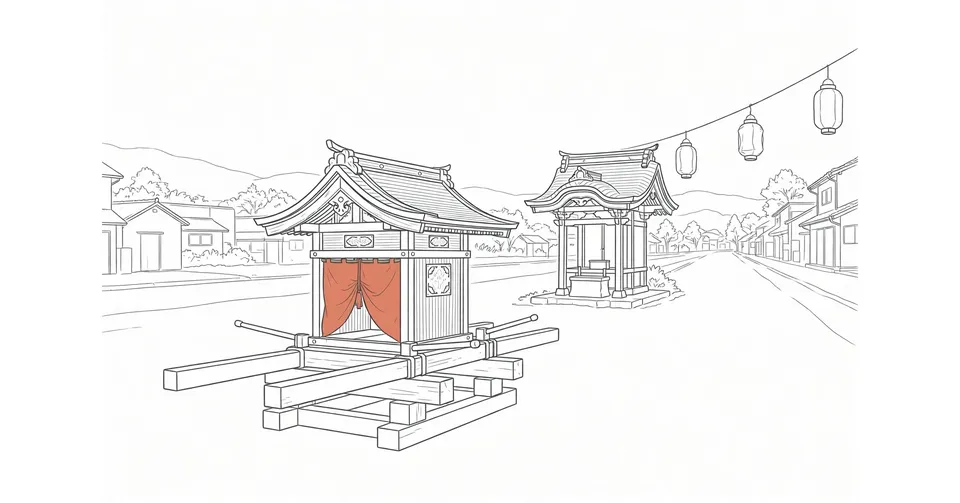
If you have ever watched a mikoshi procession, you have probably seen the moment without knowing its name. The chanting slows, the poles come down, and the lacquered shrine is set gently onto wooden blocks called uma. The crowd steps back. A priest steps forward. For a few minutes the noise of the festival gives way to something quieter, and the god, who has been bouncing on human shoulders through the streets, is allowed to sit still. That quiet pause is the rest stop doing its work.
What an otabisho actually is
An otabisho is a facility that serves as the temporary destination or midway resting point of a kami, more accurately of the mikoshi carrying the kami, in the middle of its ritual procession. That is the plain definition, and it holds the whole idea. The god is on a journey, and a journey needs somewhere to stop. It is that somewhere, a halfway house between the shrine the god left in the morning and the shrine it will return to in the evening.
There is not always just one of them. Some processions have several such rest stops set up along the route, and the mikoshi rests at each in turn. At the arrival of the mikoshi at an otabisho, some rite or small festival is usually observed, so the stop is never only a break for tired shoulders. It is a ceremony in its own right, with its own name, the rest-stop ceremony, and its own place in the order of the day.
The places chosen as an otabisho are never random. They are picked from among places related to the shrine or the enshrined deity, or places important to the shrine parish district. Some have actual shrine buildings of their own. These include original shrines, known as motomiya, auxiliary and branch shrines, and shrines dedicated to consort deities. In other cases the otabisho is a temporary structure set up on previously enshrined land, or even the house of the head of the parishioners, the tonin. The building matters less than the ground it stands on. What makes it is not its roof but its role, a place the god has agreed to visit.
That flexibility is part of what makes the rest stop interesting. A shrine is fixed. It has a gate, a hall, a priest, and a piece of land that has belonged to it for centuries. An otabisho can be grand or plain, permanent or put up for the day, and it is still the same kind of place as long as the god rests there. The Otabisho entry on Wikipedia puts it simply, calling it a facility that serves as the temporary destination or midway resting point of a kami in the middle of its ritual procession, and noting that there may be several along the route.
The pause in the middle of the procession
A festival day has a shape, and the rest stop gives that shape its middle. The mikoshi leaves the shrine in a departure ritual called miyadashi, is carried through the streets of the parish, and often rests for a while at a temporary stopping place called an otabisho, where residents make offerings of sake and food. It may sit there on wooden blocks called uma, which means horse, before being carried on and finally returned to the shrine in the evening. The route is a visit, and the otabisho is where the visit pauses to be properly received.
The uma blocks deserve a closer look. They are simple wooden stands, and the name is a small joke with a serious point. The mikoshi is a vehicle, and like any vehicle it needs somewhere to park. When it rests on the uma, it is not on the ground and it is not in the air. It is held at the height of a horse, ready to be picked up again, and the god inside is never set down in the dirt. The blocks are practical, and they are also respectful. A god does not sit on the pavement.
While the mikoshi rests, the parish gathers. Offerings of sake and food are placed before it, a priest recites a prayer, and the people of the neighbourhood stand close to the god they normally only see from a distance. In some festivals a separate rite is held at each stop, with the priest conducting a short ceremony before the procession moves on. The carriers, meanwhile, get the rest they have earned. A mikoshi can weigh about a tonne, and nobody carries it for long without a break. It is the place where the human part of the festival and the sacred part meet and both are looked after at once.
I think this is the most human moment in the whole tradition. The procession is loud, fast, and physical, all chanting and shaking and sweating shoulders. The rest stop is the opposite. It is still, quiet, and brief, and it exists because the festival understands something simple, that even a god on a journey needs to sit down, and even a crowd that is celebrating needs a moment to breathe. The people who plan these festivals figured that out centuries before anyone talked about pacing an event.
The mikoshi article describes the portable shrine itself, the lacquered box, the poles, the chanting, and the shaking that is meant to please the spirit riding inside. The resting place is the other half of that story. Without the mikoshi there would be no journey, and without it there would be no place for the journey to rest. The two belong together, and you cannot really understand one without the other.
The otabisho of the Gion Matsuri
No otabisho is more famous than the one in Kyoto. The Gion Matsuri, held every July as the midsummer celebration of Yasaka Shrine, is one of the three greatest festivals in Japan, and its otabisho is the centre of the whole month. The festival began as a rite to appease the gods and end a plague. In 869, while Kyoto was still the capital, the country was struck by disease, and Yasaka Shrine erected sixty-six halberds representing the sixty-six provinces of the country and offered them as prayer to the god Gozu Tenno. From the year 970 the rite became an annual event.
The festival runs through the whole month of July, but its sacred heart beats on two evenings. On July 10, in a ritual called mikoshi arai, the portable shrines are purified with sacred water from the Kamo River. Then, on the evening of July 17, after the great float procession of the day, the three sacred carriages are carried from the shrine on the shoulders of men and arrive shortly afterward at the otabisho, their temporary abode located on Shijo street in central Kyoto. This procession is the Shinko-sai, the procession of the sacred carriages, and it is the moment the gods leave home.
Each mikoshi takes a different route to the otabisho, through the neighbourhoods under the protection of the deity it carries, so that the blessing passes through as many streets as possible. Then the gods stay. They reside at the otabisho for a week, between the two float processions, while the city goes about its festival around them. On July 24, in the Kanko-sai, the three sacred carriages are carried from their temporary abode and finally return to their shrine. On the way back, the procession stops at Shinsen-en, the original site of the first rituals in the year 869, the former imperial garden where the festival began.
It is worth pausing on that detail. The gods of Yasaka Shrine spend a full week away from home, living in a temporary dwelling on a shopping street, while their own shrine stands a short walk away in the Gion district. The otabisho is not a poor substitute for the shrine. It is a second home, kept ready all year for one week of use, and the festival treats it with the same respect as the shrine itself. The official Gion Matsuri guide from Kyoto Travel describes the Shinko-sai and the Kanko-sai plainly, the carriages arriving at the otabisho on Shijo street on the 17th and returning to the shrine on the 24th, and the float processions that frame them are presented as the preliminary celebration before the important mikoshi processions.
The scale of the Gion otabisho makes it easy to misunderstand what one normally is. Most of them are small, quiet, and local, and the Gion one is the exception. But the exception shows the rule clearly. However grand the festival, the logic is the same. The god travels, the god rests, and the resting place is prepared with care, because a guest who is a god deserves a proper place to stay.
Not every otabisho looks the same
Travel around Japan during festival season and the otabisho you meet will keep changing shape. In Takayama, in the mountains of Gifu, the otabisho is a small shrine building of its own, solid and permanent, waiting all year for its few days of use. In other towns it is a simple open shelter, a roof on posts with room underneath for the mikoshi and its uma blocks. In some places it is no more than a marked piece of ground where a temporary structure is raised for the day, then taken down when the god has gone home.
The variety comes from history. An otabisho is chosen from places that already matter to the parish, and parishes differ. A neighbourhood whose parish head, the tonin, has a large house may host the god there, and the honour of that hosting becomes part of the family story. A parish with a branch shrine on its edge may use that shrine for the purpose, and the god rests in a building that is already sacred. A parish with an old piece of enshrined land, a spot where a god was once worshipped before any building stood there, may set up a temporary structure on that ground, and the otabisho becomes a reminder of the oldest layer of the shrine history, when only temporary structures, rather than permanent buildings, were erected to host the kami.
At the Sanja Matsuri in Asakusa, Tokyo, the pattern plays out at full scale. About a hundred neighbourhood mikoshi from the 44 parishes of Asakusa are carried to Senso-ji to be blessed on Saturday, and on Sunday the shrine brings out its three great ones, each weighing about a tonne. The whole weekend is a journey of gods through streets, with pauses, blessings, and returns, and the Sanja Matsuri article describes how loud and crowded that journey gets. The otabisho in such a festival is easy to miss in the noise, which is a shame, because it is the place where the noise stops and the festival remembers what it is for.
I find the variety comforting. It suggests that the tradition was never about the building. A faith that can host its god in a grand shrine, a branch shrine, a parish head house, or a temporary shelter on old sacred ground is a faith that understands what a guest needs, which is not luxury but welcome. The otabisho is the welcome made visible, and it takes whatever shape the neighbourhood can offer.
What happens when the god goes home
Every stay at an otabisho ends the same way, with the god going home. At the Gion Matsuri, the return procession has its own name, the Kanko-sai, and its own feeling. The morning departure is joyful and loud, full of anticipation. The return is tired and satisfied, the carriers moving more slowly, the chanting lower, the crowd thinner as the evening comes on. The mikoshi is carried back through the streets it visited in the morning, and finally it is brought into the shrine in the evening return ritual, the miyairi.
The return is not an afterthought. In Shinto practice the procession is a way for the kami to inspect and affirm the boundaries of its parish, and the return completes that inspection. The god has seen its neighbourhood, rested in its otabisho, received its offerings, and blessed the streets it passed. The journey is finished only when the god is back in its shrine, and the parish can settle again knowing the visit has happened.
At the Gion Matsuri the return has one more layer. After the Kanko-sai on July 24, the mikoshi are cleansed again in the Kamo River on July 28, in a second mikoshi arai, and the month closes on July 31 with a purification ritual at the Eki sub-shrine on the Yasaka Shrine grounds, where rice cakes are offered and worshippers pass through a wreath of thatch, giving thanks and praying for protection from sickness and accidents. The festival that began as a prayer against plague ends as a prayer against plague. The otabisho sits in the middle of that long arc, a week of rest between the departure and the return.
There is something quietly generous about the whole arrangement. The god does not have to travel. It could stay in its shrine and let the people come to it, as gods in many traditions do. Instead it goes out, rests in a temporary dwelling, and comes home, and the parish organises its year around that journey. The otabisho is the proof that the journey is taken seriously, because nobody prepares a guest room for a visit they do not mean.
Why a rest stop matters
It is tempting to treat the otabisho as a detail, a footnote to the mikoshi and the festival, but I think it is closer to the point of the whole thing. A shrine festival is a story about a god who visits its people, and every visit needs a place to pause. Without the otabisho, the procession would be a parade, a god carried past the crowd and back again without ever stopping. With the otabisho, it becomes a visit, with a host, an offering, a prayer, and a rest. The pause turns movement into meaning.
The otabisho also does something practical for the community. It gives each neighbourhood a place where the god stops in front of them, not just passes by. The residents who make the offerings, the parish head who opens his house, the neighbours who gather at the small shrine building, they all become hosts rather than spectators. Hosting changes a relationship. A spectator watches a festival. A host is part of it, and the otabisho is the place where that change happens.
There is a lesson in that for anyone who organises anything, religious or not. The loud parts of an event get the attention, the procession, the music, the crowds. But the quiet parts are what people remember, the pause where something real happened. Festivals that last for a thousand years are not the ones with the biggest crowds. They are the ones that give their people a moment to stop, to offer something, and to stand close to what they revere. The otabisho is that moment, built into the route.
Modern life has fewer otabisho in it than it should. We move fast, we pass through places without stopping, and we call the movement itself the achievement. A festival that builds a rest stop into the middle of its most important day is a reminder that the journey is not only about arriving. It is about where you pause, who you pause with, and what you offer while you are there. The god rests, the carriers rest, and the neighbourhood gathers, and for a little while nobody is in a hurry.
Watching the pause as a visitor
If you are lucky enough to be in Japan during a shrine festival, the otabisho is worth seeking out, and the rules for watching it are simple. Stand to the side of the street and keep the route clear. Do not touch the mikoshi, and do not try to join the carriers unless you belong to a parish team or have been clearly invited. When the poles come down and the shrine is set on its uma blocks, step back and give the priest room to work. The ceremony is short, and the best photographs come from arriving early and holding one good spot, not from crowding in.
The pause is also the best time to look closely. With the mikoshi at rest you can see the lacquer, the gold, the carvings, and the phoenix on the roof, details that blur into motion while it is being carried. You can see the offerings, the sake bottles, the food, the small arrangements that the parish prepared that morning. You can see the carriers, finally standing still, wiping their faces and drinking water, and you can understand for the first time how heavy the thing they have been carrying really is.
Do not expect a show. The otabisho ceremony is quiet and brief, and it is not performed for visitors. That is exactly what makes it worth watching. You are seeing the festival at its most honest, a god resting on wooden blocks while its neighbours stand close, and for a few minutes the whole noisy celebration narrows down to a small shrine, a few offerings, and a community that has kept this pause alive for centuries.
A god that goes visiting
An otabisho is, in the end, a simple idea with a long history. A god leaves home, travels through the streets of its parish, and rests at a place prepared for it, where offerings are made and the parish gathers before the journey continues. The place can be a grand building on a Kyoto shopping street or a temporary shelter on old sacred ground. It can host a god for a week or for an hour. What matters is that it exists, and that someone prepared it.
That is why the otabisho has lasted as long as the festivals themselves. It survives because it does something no shrine building can do. It puts the sacred on the street, in the middle of ordinary life, and gives a whole neighbourhood a place to receive a god as a guest. When the last mikoshi of the day returns to its shrine and the poles are set down, the otabisho stands empty again, and the street goes quiet. But the god has been out, the neighbours have hosted it, and the parish has been visited. That is a small thing, and it is the whole festival.
More in Culture & Society
- Miyadashi Is the Moment the God Leaves Home
- Mikoshi Are the Portable Shrines Japan Carries on Its Shoulders
- Sanja Matsuri Turns Asakusa Into Tokyo's Loudest Weekend
- Waraji Straw Sandals Walked Japan for a Thousand Years
- Fujin Carries the Wind That Arrives Before the Thunder
- Raijin Is the Thunder God Behind Japan's Summer Storms
Latest posts
- An Engawa Is Neither Inside nor Outside, and That Is the Point
- Nikko and the Shrines Hidden in the Cedar Forest
- Minka Are the Folk Houses Japan Built Around the Hearth
- The Orangutan and the Vanishing Forests of Borneo
- Hozomon Guards the Treasure House Behind Senso-ji's Main Hall
- Nakamise Is the Shopping Street That Has Fed Pilgrims for Centuries
- Kaminarimon Is the Thunder Gate That Opens Asakusa to the World
- Sony, the Tokyo Workshop That Taught the World to Listen
- Tengu Is the Mountain Goblin Japan Still Meets on the Trail
- Kappa Is the River Imp Japan Still Warns Its Children About
- Calonarang Is the Night Rangda and Barong Finally Meet
- Yamata no Orochi Was Never Just a Monster to Slay
- Kit Kat Japan, the Flavours You Will Not Find Anywhere Else
- How Susanoo Slew the Eight-Headed Serpent and Won a Bride
- How Kusanagi Became Japan's Most Guarded Sword