Mikoshi Are the Portable Shrines Japan Carries on Its Shoulders
· 14 min read
A mikoshi is the portable shrine that carries a Shinto deity through the streets during a Japanese festival, and this is how it works, why it shakes, and who carries it.
A mikoshi is a portable shrine. In the Shinto faith it is the vehicle that carries a deity, a kami, out of its shrine and through the streets of the neighbourhood that worships it, so that the god can visit its people instead of waiting for them to come to it. That single idea explains almost everything about it: why it is built like a miniature shrine, why it is carried on the shoulders of ordinary people, and why it is shaken and rocked as it moves, because the shaking is meant to please the spirit riding inside.
If you have ever stood on a side street in Tokyo in May and heard chanting coming closer before you could see anything, you have probably heard a mikoshi before you saw one. The poles come first, long wooden beams carried on the shoulders of a team in matching happi coats, and then the lacquered box itself rises above the crowd, gold catching the light, a small phoenix on the roof. The people under the poles are the neighbours, and the god on their shoulders belongs to their street.
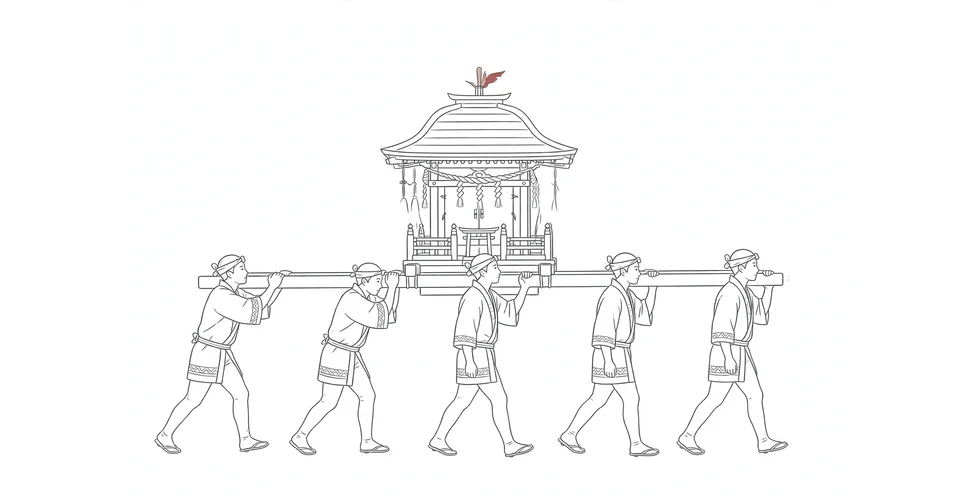
The word itself is simple. Mikoshi joins mi, meaning god, and koshi, meaning palanquin, a covered litter for a person of rank. The shrine travels in style because the passenger matters. A mikoshi is not a float and it is not a parade prop. It is a working piece of religious equipment, and the festival exists around it, not the other way round. Once you understand that, the shouting, the bruised shoulders and the crowds all make sense.
What a mikoshi actually is
A mikoshi is a miniature replica of a shrine, built to hold the spirit of a deity for a journey. Shinto followers believe the kami normally resides in its shrine, and that during a festival the spirit moves into the portable shrine so it can travel. Inside there is usually a sacred object, often a mirror, that serves as the seat of the deity. What the crowd sees is the outside: a small shrine, complete with roof, railings and gold decoration, small enough to be carried and grand enough to be recognised as a home for a god.
The journey has a shape. The mikoshi leaves the shrine in a departure ritual, is carried through the streets of the parish, and often rests for a while at a temporary stopping place called an otabisho, where residents make offerings of sake and food. It may sit there on wooden blocks called uma, which means horse, before being carried on and finally returned to the shrine in the evening. The route is a visit. The deity is calling on its worshippers, the ujiko, the parishioners of the shrine, and the blessing of that visit is meant to cover the neighbourhood for the year to come.
Most mikoshi are rectangular, although hexagonal and octagonal ones exist too. They rest on two long poles, or four, and rarely six, and a typical one is carried by some twenty or thirty people at a time, with teams swapping in and out along the route. Small neighbourhood ones can be carried by a handful of people, and children have their own smaller versions at festivals like the Sanja Matsuri. The great ones, such as the three main mikoshi of Asakusa, weigh about a tonne each. The shape is the same at every scale. It is a shrine that has learned to walk, and it walks on human shoulders.
I find that idea quietly radical. In most religions the worshipper travels to the holy place. Here the holy place travels to the worshipper, and it does so on the backs of the very people it is visiting. There is no distance between the sacred and the everyday in that arrangement. The god passes the corner shop, the school gate and the front doors of the parish, and for a few hours the whole neighbourhood is inside the shrine grounds.
A short history of the mikoshi
The portable shrine is old, but it was not the first way the Japanese carried a god. Before the palanquin appeared, a mirror with a branch of the sacred sakaki tree, or some other object that marked a divine presence, was carried around, sometimes on horseback. The use of a palanquin-like structure began in the 8th century, and the first recorded occurrence was the transfer of the god Hachiman from Usa Shrine in Kyushu to Nara, where the deity was to safeguard the construction of the Great Buddha image at Todai-ji. That journey took place in the year 749, during the Nara period, and Usa Shrine is still described as the birthplace of the portable shrine.
By the 10th century it had become common practice in Kyoto to carry the deity from a shrine through the community in a portable shrine, on the occasion of a festival aimed at pacifying the malevolent spirits believed to cause epidemics. The mikoshi was, in other words, a public health measure as well as a religious one. The god was taken out to meet the trouble where it lived, in the streets, and the procession was the treatment.
The theories about where the mikoshi came from do not fully agree, and the honest version is to say so. One account traces it to harvest festivals of the Jomon and Yayoi periods, when people who lived by hunting and gathering began to worship the deities of their own village and pray for a good harvest or a big catch. Another traces it to the vehicle of Emperor Shomu, whose golden phoenix topped carriage, called a horen, is thought to be a prototype. The phoenix on the roof is the clue that ties these stories together, and it is still there on almost every mikoshi you will see today.
There is also a rougher chapter. In the 12th and 13th centuries the portable shrines of the Hie and Kasuga shrines were sometimes carried into Kyoto by unruly monks from the great temples nearby, in an effort to intimidate the secular authorities into accepting the demands of the clergy. A shrine turned out to be a useful thing to bring to a negotiation, because nobody wanted to be seen standing in the way of a god. That history is worth remembering when you watch a modern procession and wonder why it feels so forceful. It was never only a decoration. It carried authority, and it still does. The Japan Reference guide to the mikoshi sets out this history in full, from the first recorded journey in 749 to the shouldering styles still used today.
What a mikoshi looks like up close
Stand beside one when it rests on its uma blocks and the first thing you notice is the craft. The body is usually lacquered wood, often black, with gold leaf inlay and intricate wooden carvings. The roof is the signature. Many carry a houou, a Chinese phoenix and sacred bird, on the roof, and an onion shaped knob called a giboshi. The phoenix is said to represent all good things and to bring happiness, while the smell of onions is said to ward off evil. It is a small detail with a large job: the roof is both a decoration and a guard.
The designs are not generic. A mikoshi usually replicates the buildings of its own local shrine, so that the kami feels at home on the journey, and different regions have different styles. Building one is a slow craft. Each piece is handcrafted so the structure survives the shaking of the procession, and the techniques have been passed down through generations. A mikoshi that weighs more than a tonne is not only a religious object. It is a piece of engineering, built to be thrown around by a crowd and to come back in one piece.
The gold is not showing off, or at least not only showing off. In the sun a mikoshi is visible from a long way down a crowded street, and that visibility matters, because the procession is a moving landmark. The combination of gold, lacquer and coloured cloth is how a neighbourhood marks its place in a festival that may involve a hundred mikoshi at once, as the Sanja Matsuri in Asakusa does every May.
How a mikoshi moves through a festival day
It is not simply picked up and carried. A mikoshi is first cleansed in a special ritual, and only then do the bearers take their places under the poles. The departure from the shrine has its own name, miyadashi, and the return in the evening is the miyairi. Between the two, it belongs to the streets. It is carried through the parish, rested at the otabisho, and carried on again, and the whole day is paced by the weight on the carriers' shoulders and the chant that keeps their steps together.
Some festivals add a striking variation. At certain shrines the bearers carry it down to the water of a nearby lake, river or ocean and dip it in, a practice called o-hamaori. The god is given a bath, in effect, and the crowd that follows gets soaked too. It is one more reminder that it is not a museum piece. It is handled, shaken, carried into the sea, and expected to take it.
The great festivals show the pattern at full scale. At the Sanja Matsuri, about a hundred neighbourhood mikoshi from the 44 parishes of Asakusa are carried to Senso-ji to be blessed on Saturday, and on Sunday the shrine brings out its three great ones, each weighing about a tonne and each carrying the spirit of one of the three founders of the temple. Smaller festivals work the same way at a smaller scale, and some of them welcome outsiders to join in. A few even welcome foreign visitors under the poles, which is a generous offer, and a heavy one, so it is worth accepting with respect and with a clear sense of how long you can actually carry the weight.
The chanting and the shaking
The sound of a mikoshi is the chant. The most common is wasshoi, shouted in rhythm to keep the carriers stepping together, and the chant changes with the region. In Tokyo, the Edomae style seen at the Sanja Matsuri sways the shrine rapidly up and down, with bearers chanting seiya and sorya as they move. In Shonan, in Kanagawa Prefecture, the dokkoi style moves it up and down more slowly, to a chant of dokkoi dokkoi dokkoi sorya. In Odawara the carriers meet and run, chanting oisah and korasah, and they do not sway the shrine at all. The local variation is part of the identity of each festival, and a listener who knows the chants can tell where a mikoshi comes from before seeing it.
The shaking has a name, mikoshi-furi, and a purpose. The bearers toss and rock the portable shrine to amuse the deity inside, and the wilder the movement the better, because the shaking is believed to spread good fortune over the streets it passes. Some accounts describe the zigzag motion as reflecting the turbulent character of the god within. It is easy to watch this and think it is rowdiness for its own sake, but it is a deliberate part of the rite. The god is not being carried like luggage. The god is being entertained, and the entertainment is physical.
I think the chant is the most underrated part of the whole tradition. A mikoshi weighs about a tonne, and no single person can carry it. The chant is what turns thirty separate pairs of shoulders into one body. The noise is not a side effect of the festival. The noise is the mechanism that makes the carrying possible.
The people under the poles
The carriers are not hired performers. They are the ujiko, the parishioners of the shrine, shopkeepers, office workers, students and retirees from the parish who have waited all year for their turn under the beams. Many of them wear the happi coat of their own neighbourhood, and the coat is a uniform and a badge of belonging at once. The full dress is specific: tabi socks, a happi coat, and a headband called a hachimaki, often marked with kanji. Wearing a happi means you belong to the matsuri, and nowhere is that clearer than under the poles, where the coat tells the crowd exactly which parish is passing.
Carrying is an honour, and it is also hard on the body. Shoulders bruise, voices go hoarse, and the teams take turns under the poles because nobody can carry a tonne for long. That shared effort is the point. It cannot be carried alone, and it cannot be carried by strangers who have not practised together. The weight forces cooperation, and the cooperation is the community.
That tradition is under pressure. Communities struggle with the cost of building and maintaining a mikoshi, which can run to thousands of dollars, and with declining participation as younger generations show less interest. Growing cities also squeeze the procession routes, especially for the larger ones, and some neighbourhoods find it harder to field a full team. But communities are adapting, and some festivals actively welcome newcomers. The Sakura guide to the mikoshi describes these pressures honestly and also describes the ways festivals are finding new carriers, which is the part of the story that matters most. A tradition that can only be carried by the people who were born into it will shrink. A tradition that can welcome a new pair of shoulders has a future.
Watching a mikoshi without getting in the way
The practical rules are simple, and they follow from everything above. Do not touch the mikoshi, and do not try to join the carriers unless you belong to a parish team or have been clearly invited. The people under the beams have trained for this, and a stranger grabbing a pole is a danger, not a bit of fun. Stand on the side of the street, keep the route clear, and let the procession come to you. The best photographs come from arriving early and holding one good spot, not from chasing the shrine down the street.
If you want to see a mikoshi at its grandest, the Sanja Matsuri is the obvious choice, with Saturday the best day for a first visit and Sunday the day for the three great shrines. But the smaller festivals are worth seeking out too. A neighbourhood shrine in a small town, carried by people you can see are neighbours, shows the tradition more clearly than the biggest crowds do. There is no ticket and no fence. You stand on the pavement, the chanting gets louder, and for a minute the whole street belongs to a god on its way to visit the people who live there.
A god that goes visiting
A mikoshi is, in the end, a simple machine for a generous idea: that a god should go out and see its people, rather than waiting behind a gate for them to come. The shrine is built small so it can travel, the poles are built long so many shoulders can share the weight, and the chant is built loud so the team can move as one body. Everything about it serves the journey, and the journey serves the neighbourhood.
That is why it has lasted since the 8th century, through epidemics, politics, war and the slow thinning of the parishes. It survives because it does something no building can do. It puts the sacred on the street, on human shoulders, in the middle of ordinary life, and asks a whole neighbourhood to carry it together. When the last mikoshi of the day returns to its shrine and the poles are set down, the carriers go home with bruised shoulders and hoarse voices, and the street goes quiet again. But the god has been out, the neighbours have carried it, and the parish has been visited. That is a small thing, and it is the whole festival.
More in Culture & Society
- Miyadashi Is the Moment the God Leaves Home
- Otabisho Is Where the God Rests on the Way Through Town
- Sanja Matsuri Turns Asakusa Into Tokyo's Loudest Weekend
- Waraji Straw Sandals Walked Japan for a Thousand Years
- Fujin Carries the Wind That Arrives Before the Thunder
- Raijin Is the Thunder God Behind Japan's Summer Storms
Latest posts
- An Engawa Is Neither Inside nor Outside, and That Is the Point
- Nikko and the Shrines Hidden in the Cedar Forest
- Minka Are the Folk Houses Japan Built Around the Hearth
- The Orangutan and the Vanishing Forests of Borneo
- Hozomon Guards the Treasure House Behind Senso-ji's Main Hall
- Nakamise Is the Shopping Street That Has Fed Pilgrims for Centuries
- Kaminarimon Is the Thunder Gate That Opens Asakusa to the World
- Sony, the Tokyo Workshop That Taught the World to Listen
- Tengu Is the Mountain Goblin Japan Still Meets on the Trail
- Kappa Is the River Imp Japan Still Warns Its Children About
- Calonarang Is the Night Rangda and Barong Finally Meet
- Yamata no Orochi Was Never Just a Monster to Slay
- Kit Kat Japan, the Flavours You Will Not Find Anywhere Else
- How Susanoo Slew the Eight-Headed Serpent and Won a Bride
- How Kusanagi Became Japan's Most Guarded Sword