Banten Are the Offerings Bali Makes Out of Almost Nothing
· 23 min read
Banten are the daily and ceremonial offerings of Bali, woven from palm leaf, flowers, rice and incense, and they carry gratitude, balance and devotion in the smallest possible form.
Walk any street in Bali in the early morning and you will notice them before you notice almost anything else. Small woven trays of flowers sit on doorsteps, on shrine ledges, on shop counters and on the dashboards of parked cars, each one holding a few grains of rice, a pinch of petals and a thin stick of incense. The offerings are called banten, and the small woven trays of flowers, rice and incense that appear on every doorstep and dashboard are canang sari.
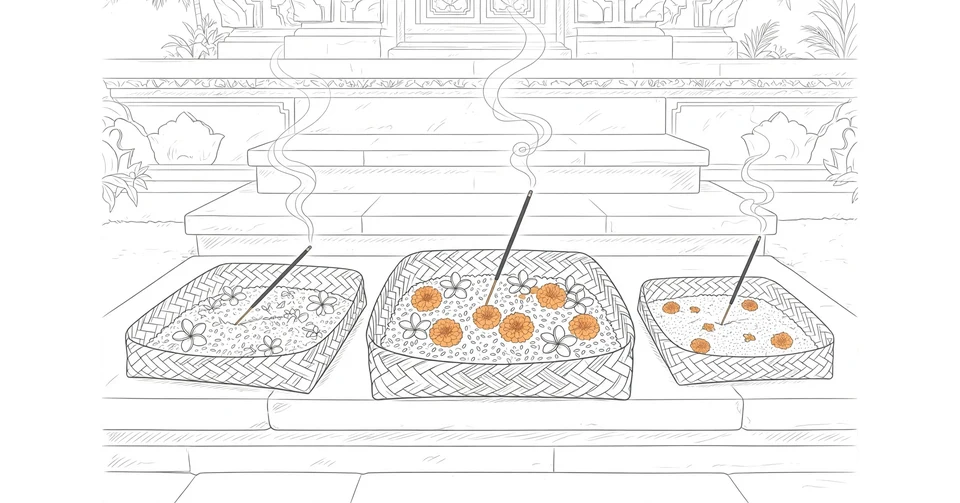
A banten costs almost nothing in money. The tray is folded from a young coconut leaf, the flowers are picked from the garden, the rice comes from the morning pot and the incense is a single stick. What it costs is attention, and it is paid every single day, in thousands of households at once, by people who have done it since they were children. That is the first thing to understand about banten. They are not decorations and they are not souvenirs. They are a daily act of thanks, repeated so often that it becomes part of how the day itself is built.
What banten are
Banten is the Balinese word for offerings, and it covers a whole family of forms rather than a single object. At one end of the scale sits the canang sari, a palm sized tray of flowers that is made fresh every morning. At the other end sit the tall fruit towers carried to the temple on festival days and the elaborate ceremonial banten assembled for weddings, cremations and temple anniversaries. The word stretches to cover all of them, from the smallest scrap of banana leaf holding a spoonful of rice to a construction that takes a team of women a whole day to build.
The common thread is that a banten is a gift given first. Before the family eats, before the shop opens, before the car leaves the driveway, a small part of what the household has is set aside and offered upward, to the gods and the ancestors, and downward, to the spirits of the earth. Nothing about the gift is meant to impress. Its value lies in the fact that it is given at all, and given every day, without fail and without ceremony about the giving.
This is what makes banten easy to misunderstand. A visitor sees hundreds of them and can mistake abundance for carelessness, as if the island were simply littered with pretty trays. The opposite is true. Each banten is made by hand, placed by hand and prayed over, however briefly, by the person who set it down. The scale of the practice is what hides the care inside it. When a whole island does something every morning, the individual act becomes invisible, and only the pattern remains.
The daily canang sari, the banten you meet everywhere
If banten is the wide word, canang sari is the everyday form of it, the one visitors meet within minutes of arriving. It is a small square tray woven from young coconut leaf, filled with flowers and set out fresh each morning. The name is read through Old Javanese as can for beauty, nang for purpose and sari for essence, so the offering is, in its own language, a way of asking for beauty with purpose. A detailed guide to Balinese offerings describes the canang sari as a daily gift of thanks that helps keep the balance between the higher and lower forces, and that balance is the whole point of the exercise.
A canang sari is offered every day to Sang Hyang Widhi Wasa, the supreme God of Balinese Hinduism, as thanks for the peace given to the world. It is the simplest daily household offering, and its philosophy is one of self sacrifice in the plainest sense. The maker takes time and effort to prepare something and then gives it away. There is one exception worth knowing. Canang sari is not offered when there is a death in the community or the family, a pause that says something quiet about how the practice works. The offering belongs to ordinary, living days, and grief has its own observances.
The canang sari is also used on particular days in the Balinese calendar, including Kliwon, Purnama and Tilem. Purnama, the full moon, is one of the days when extra care goes into the offerings, and the full moon and its place in Balinese prayer is a subject of its own. On those days the trays are joined by larger banten and the household shrines fill up, but the daily form does not change. The same small tray, the same flowers, the same incense, only more of them and made with more attention.
What strikes me about this is how little the practice asks of its materials and how much it asks of its people. A religion that demanded gold or rare goods would belong only to the rich. A banten asks for a leaf, a few flowers and a few minutes, which means it belongs to everyone, and that seems to me the most democratic thing about it. The offering does not measure wealth. It measures willingness, and willingness is the one thing nobody in Bali is short of in the morning.
What goes inside a banten
A banten is small, but nothing inside it is random. Every element has a place and a meaning, and the makers learn the arrangement the way a cook learns a recipe, by watching and repeating until the hands know it. The parts of a canang sari are the porosan, the ceper, the raka-raka and the sampian urasari, and each one is named and placed with care. The base is the ceper, a square tray folded from janur, the pale young coconut leaf that Bali folds into almost everything. Janur, the young coconut leaf, is the material the whole offering is built on, pinned into shape with tiny slivers of bamboo. The tray is said to stand for the crescent moon, and it is the vessel that holds everything else.
Under the flowers sits the porosan, a small fold of betel leaf holding lime and areca nut, sometimes with gambier. The porosan is the core of the offering, and its three ingredients stand for the Trimurti, the three great Hindu gods. Lime stands for Shiva, betel nut for Vishnu and gambier for Brahma. It is also read as a reminder that every banten must rest on a sincere heart, which is a stern standard to set for a tray of flowers and a useful one to remember.
On top of the porosan sits a small round of woven leaf called the sampian, and on the sampian the flowers are arranged by colour and direction, each colour facing the god of its quarter. White flowers face east for Iswara, red flowers face south for Brahma, yellow flowers face west for Mahadeva, and blue or green flowers face north for Vishnu. Black flowers would properly stand for the north, but they are uncommon, so blue or purple flowers are used instead. The centre holds shredded pandan leaf, bunga rampai, carrying the fragrance and standing for all the colours together.
A full canang sari also holds food. A slice of sugarcane, a piece of banana, a little cake and a few grains of rice are tucked in, the sugarcane and banana read as the nectar of life and the rice as the soul. A coin, a kepeng or a small paper note, may sit on top, and this is what makes up the sari, the essence of the offering. The banten is finished with a stick of incense, dupa, lit as a witness when the tray is set down, its smoke understood to carry the offering upward. Holy water may be sprinkled over it. The whole construction is small enough to sit in the palm of a hand, yet every element is intentional.
| Part of a banten | What it is | What it means |
|---|---|---|
| Ceper | A square tray folded from young coconut leaf | The crescent moon, and the vessel that holds the offering |
| Porosan | Betel leaf, lime and areca nut | The Trimurti, and a sincere heart underneath everything |
| Sampian | A small round of woven leaf | The base on which the flowers are arranged |
| Flowers | White, red, yellow and blue or green petals | The gods of the four directions, honoured in colour |
| Food | Rice, sugarcane, banana and cake | The nectar of life and the soul of the offering |
| Coin | A kepeng coin or a small note | The essence, the sari, of the gift |
| Incense | A stick of dupa, lit at placement | The witness, carrying the prayer upward |
The table makes the banten look like a formula, and in a sense it is one, but formulas are not the enemy of meaning. The arrangement is fixed so that the maker does not have to decide anything in the morning. She can fold, place and pray without thinking about the order, and that is the point. The meaning is carried by the hands, not debated by the mind, and the fixed form is what lets the practice survive every single day without wearing anyone out.
There is a useful distinction here, recorded in the guidance of the Hindu council PHDI. A tray of flowers alone, used only for prayer, is properly called uras sari rather than canang sari. It is the food elements that make a canang sari complete. The distinction matters because it shows what a banten is for. It is not a decoration that happens to be sacred. It is a meal, in miniature, offered before the household eats its own.
Who makes banten, and when the day begins
Traditionally the women of the household make the banten. Mothers teach daughters, and daughters learn by sitting beside their mothers and folding the trays until their fingers remember the pattern. The skill is passed down through generations of Balinese women, and it is learned the way most household skills are learned, not in a lesson but in company, morning after morning, until the work is part of the body.
The making usually happens early, before the day gets going. A single canang sari takes an experienced maker only a few minutes, and a household may need a dozen or more of them, one for the shrine, one for the gate, one for the kitchen, one for the shop counter, one for the car. The work is folded into the morning the way cooking is folded into the morning, not as a separate event but as part of getting the day ready. Some women make the trays the evening before and fill them in the morning. Some buy ready made canang at the market when the day is too busy, and no one treats that as a failure. The offering is the act, not the authorship.
This is the part of the story that deserves honesty rather than romance. The labour of banten falls mostly on women, and it falls every day, on top of cooking, childcare, work and everything else a household demands. It is easy for a visitor to admire the beauty of the trays and forget the hands that made them before sunrise. I think the right way to look at a banten is to see both things at once, the devotion and the work, and to let the work count as part of the devotion rather than as something separate from it. A practice that asks for daily labour should be described with its labour intact, not edited out for the sake of a prettier picture.
There is also a quieter side to the making that rarely gets mentioned. For many of the women who make them, the canang sari is a few minutes of attention and gratitude before the day begins, a small pocket of stillness that belongs to the maker alone. In a crowded household and a busy island, that stillness is not nothing. The banten gives the morning a shape, and the shape holds even when the rest of the day does not.
Where banten are placed, and why the ground counts too
A banten can go almost anywhere a person lives, works or travels, and the map of where they are placed is itself a statement about the world. Raised offerings go on shrines and high places, given toward the gods and the ancestors. Offerings on the ground go at doorways, thresholds and crossroads, acknowledging the earth spirits so that life stays in order. Neither is forgotten. The aim is balance, with neither side removed, and the placement of the banten is how that balance is drawn on the ground, literally, every day.
You will find banten on household shrines, on the ledge of a family temple, on the gatepost, on the step of a warung, on the counter of a shop, on the dashboard of a car and on the sand of a beach. They sit in rice fields and at the base of trees. They appear wherever Balinese people live, work and move through the world, because the offering follows the person rather than waiting for the temple. A driver places one on the dashboard before a long journey. A shopkeeper places one on the counter before opening. The practice is portable because the need for it is portable. Gratitude does not wait for a holy day.
The smallest offering in the house is not the canang sari at all. It is the saiban, also called yadnya sesa, the offering made after cooking and before the family eats. A few tiny portions of the cooked food are set aside on squares of banana leaf, a little rice, a pinch of salt and a taste of the day's side dishes, and placed at five points around the home. Each point stands for one of the five elements, the Panca Maha Bhuta. Earth at the gate or the house door, water at the well, fire on the stove, air on the rice store, and ether at the house shrine. The logic is plain and rather beautiful. The family offers to God first what it is about to enjoy, then eats what remains, the blessed leftover.
The saiban is easy to confuse with another ground offering, the segehan, since both can sit on the ground on a scrap of leaf. The difference is in the contents. A segehan is a separate offering to the lower forces, with its own set of contents. A saiban is the family's own food, whatever was cooked that morning. Both sit low, and both are there because Balinese Hindu understanding holds that good forces and dark forces share the world, and both must be acknowledged if life is to stay in order.
From a palm sized tray to a tower
The daily banten is the base of the practice, but Balinese ritual life builds far beyond it. Banten is the wider word for ceremonial offerings, and they range from modest daily trays up to elaborate constructions for temple days, weddings and rites of passage. The bigger the occasion, the more involved the banten, and the scale of the offering is how a household shows the scale of the day.
The grandest offering a household makes is the gebogan, also called pajegan, a tapering tower of fruit, cakes and flowers built on a footed wooden tray called a dulang. Fruit, jaja cakes, flowers and woven palm leaf ornaments called sampian are pushed onto a core of small banana trunk so that nothing falls on the walk to the temple, and a canang sari crowns the arrangement. The tapering shape is likened to a mountain, and the word gebogan itself is said to mean sum, for the many colours and foods gathered into one offering.
Mothers and daughters build the gebogan at home, usually before a temple's festival, and the skill is in the balance as much as in the arrangement. A tower that looks effortless on a woman's head has been built to stay upright on a walk through the village. On festival days the gebogan arrive in procession, in a mepeed, the women of a village walking side by side in a long line, each carrying her tower on her head, in lace kebaya, to the temple or around the temple grounds. It is the whole community's offering made visible at once.
At the temple the gebogan are placed before the shrines, prayed over and blessed with holy water. When the ceremony ends, families carry them home. In Balinese Hindu understanding the offering has been spiritually received by the deities, and the fruit and cakes, now blessed, are shared and eaten by the family. Nothing is wasted, and that is worth pausing on. The largest and most elaborate banten ends the same way the smallest one does, as food shared by the people who made it, which is a reminder that the offering was never really about the object. It was about the giving, and the giving ends in a meal.
Temple offerings appear in greater abundance during a temple's anniversary, the odalan, which comes round often given how many temples there are, and in the days between Galungan and Kuningan, when temples across Bali fill with offerings and penjor poles line the roads. If your visit lines up with a ceremony, you are seeing the same impulse as the daily canang, scaled up into something communal and grand. The daily banten is the rehearsal, and the festival is the performance, but the rehearsal is the practice that matters most, because it is the one that happens when nobody is watching.
There is a warning in the gebogan worth hearing, and it comes from the people of Lovina who describe it best. The worth of a gebogan is measured by the sincerity of the giver. A modest tower made with a full heart counts for as much as a grand one, and no ranking is read into the height. That is a useful rule for the whole subject. A banten is not a competition, and the island has no interest in turning it into one.
What banten cost in time and in money
It is worth asking, plainly, what banten cost, because the answer explains why the practice has lasted. In money, a daily banten costs very little. The leaves come from the garden or the market, the flowers are picked or bought cheaply, the rice is a pinch from the pot, and the incense is a single stick. The coin on top is small. A household that makes its own banten spends almost nothing on materials, and even a household that buys ready made trays at the market is spending a small sum for a daily need.
In time, the cost is larger, and it is the real price of the practice. A dozen trays at a few minutes each is the better part of an hour, every morning, before the day has properly begun, and the festival banten take far longer. A gebogan can absorb a whole day of building, and the ceremonial banten for a wedding or a temple anniversary can take a team of women days of preparation, folding, arranging and cooking. That labour is real, and it is worth naming rather than waving away with praise for the beauty of the result.
The economics of banten are also, quietly, an economy of their own. Women make canang to sell at the local markets, and households that cannot make their own buy from them, so the practice supports a small daily trade in leaves, flowers and finished trays. The money stays local and the skill stays local, and the market stall selling canang in the morning is as much a part of the practice as the shrine. Nobody gets rich from banten, which is perhaps why the trade has stayed honest. It pays for a morning's work and not much more, and that seems about right for something made of leaves and given away by noon.
There is a lesson in this for anyone who likes to measure value in money. A banten is worth almost nothing and is treated as priceless, and both of those statements are true at the same time. The materials are free because the island provides them. The value is in the time and the attention, and time and attention are the two things a person cannot buy more of. That is why the offering works as a gift. It costs the giver something real, and the realness of the cost is what makes it sincere.
The philosophy folded into a banten
Behind the banten sits a philosophy that is simple to state and hard to live by. It is called Tri Hita Karana, the three causes of wellbeing, and it frames a good life as harmony in three relationships, between humans and God, between humans and each other, and between humans and nature. The daily offering is one of the simplest and most constant expressions of that harmony. The tray holds nature in the form of leaves and flowers, it holds the divine in the form of prayer, and it holds other people in the form of the household that made it together and will eat together after. One small object, three relationships, renewed every morning.
The placement of banten adds a second idea, called Rwa Bhineda, the balance of opposites. Good forces and dark forces share the world, and the offering acknowledges both, the raised tray for the gods above and the ground offering for the spirits below. Neither side is removed or defeated. The aim is balance, and the banten is the daily maintenance of that balance, repeated by thousands of households at the same time each morning. It is a philosophy that does not promise a world without difficulty. It promises a way of living inside difficulty without being ruled by it, and that is a more honest promise.
The offering is also one of the five sacred duties known as the Panca Yadnya, the duties that structure Balinese Hindu life. That sounds grand, and it is meant to, but the daily form of the duty is deliberately small. A tray of flowers, a pinch of rice, a stick of incense, and the day can begin. The scale is the teaching. A sacred duty does not have to be large to be real. It has to be repeated, and repetition is what the banten provides, a small act done so often that it stops being an act and becomes a habit, and a habit that shapes the person who keeps it.
I find something steadying in that idea, and it is not only about Bali. Most of us wait for a grand occasion to be grateful, and the grand occasions are rare. The banten does the opposite. It makes gratitude ordinary, daily and small, and by making it small it makes it possible. A person who gives thanks once a year is performing. A person who gives thanks every morning before breakfast is practicing, and practice is what changes a life rather than decorating it.
How to behave around banten when you visit Bali
A visitor needs only one real habit around banten, and it is simple. Walk around offerings on the ground and do not step on them. They are set at doorways, on steps and along pavements, so a little attention to your feet goes a long way, and it is noticed and appreciated. Never kick an offering out of your way. Step over it or around it, and do not pick one up or move it, even to tidy it. The tray has been placed with intention, and moving it undoes the intention.
If you brush one by accident, do not panic. Offerings on busy paths get walked over through the day, and accidental contact is generally understood. It matters only that you were not careless or dismissive about it. Ask before photographing someone making or placing a banten, and do not frame an offering in a mocking way. Do not interrupt a woman mid offering or someone praying at a small shrine. Bring the attention and respect you would bring to any living act of worship, without anxiety.
There are a few more courtesies worth carrying with you. Dress modestly near temples and ceremonies, and follow the lead of those around you. If you would like to attend a ceremony, ask your host or a local guide first, and do not turn up uninvited. If a resort or a homestay offers a canang making session, take it seriously rather than treating it as a craft activity. The guide will place each colour by its compass point, and you will learn more in an hour of folding leaves than in a day of reading about them. The point of the session is not the tray you take home. It is the understanding that the tray was never the point.
The deeper rule, underneath all of these, is to remember that a banten is not a spectacle staged for visitors. It is the daily maintenance of balance, repeated by thousands of households every morning and through the day, and you are walking through someone else's morning prayer. Treat it the way you would want your own quiet practices treated, with attention and without commentary, and you will have understood more about Bali than most visitors manage.
A banten is, in the end, a small thing made of almost nothing, and that is exactly why it matters. A leaf, a few flowers, a pinch of rice and a stick of incense add up to a daily decision to be grateful, to keep balance and to give before taking. The island has been making that decision every morning for longer than anyone can count, one tray at a time, and the trays are still there on the doorsteps when the sun comes up. The offering is small because the gesture is large, and the gesture is large because it is repeated. That is the whole teaching, folded into a palm sized tray, and it is waiting on the doorstep.
More in Culture & Society
- Tama Nuki Is the Rite That Lets a Sacred Object Rest
- Japanese Noh Theatre and the Slowest Drama on Earth
- Tamashii Ire Invites a Soul Into a Sacred Object
- Kaigen Kuyo Is the Ceremony That Wakes a Sacred Object
- Ihai Are the Lacquered Tablets That Keep a Name Alive
- A Butsudan Keeps the Dead Close in a Japanese Home
Latest posts
- Amado Are the Storm Shutters That Close Japan for the Night
- An Engawa Is Neither Inside nor Outside, and That Is the Point
- Nikko and the Shrines Hidden in the Cedar Forest
- Minka Are the Folk Houses Japan Built Around the Hearth
- Miyadashi Is the Moment the God Leaves Home
- Otabisho Is Where the God Rests on the Way Through Town
- Mikoshi Are the Portable Shrines Japan Carries on Its Shoulders
- Sanja Matsuri Turns Asakusa Into Tokyo's Loudest Weekend
- The Orangutan and the Vanishing Forests of Borneo
- Waraji Straw Sandals Walked Japan for a Thousand Years
- Hozomon Guards the Treasure House Behind Senso-ji's Main Hall
- Nakamise Is the Shopping Street That Has Fed Pilgrims for Centuries
- Kaminarimon Is the Thunder Gate That Opens Asakusa to the World
- Sony, the Tokyo Workshop That Taught the World to Listen
- Fujin Carries the Wind That Arrives Before the Thunder