Sanja Matsuri Turns Asakusa Into Tokyo's Loudest Weekend
· 12 min read
Sanja Matsuri is the three day festival of Asakusa Shrine in Tokyo, when three great mikoshi are carried through the streets and about 1.8 million people come to watch.
For three days every May, the old streets of Asakusa stop behaving like a tourist district and start behaving like a neighbourhood that has waited all year for its turn to be loud. The Sanja Matsuri is the festival of Asakusa Shrine, the small Shinto shrine that stands beside the great Buddhist temple of Senso-ji, and it is one of the biggest street festivals in Tokyo. Drums, chanting and the creak of wooden beams fill the lanes from Friday afternoon until Sunday night, and the whole district seems to move to the same rhythm.
The heart of the festival is the mikoshi, the portable shrine. Teams of carriers in matching happi coats shoulder these lacquered and gilded boxes and rock them as they walk, because the shaking is said to please the spirit inside. Around a hundred neighbourhood mikoshi take part in the Sanja Matsuri across the weekend, and on Sunday the shrine brings out its three great ones, each weighing about a tonne. It is a religious procession, a community reunion and a street party at the same time, and that mixture is exactly why it draws a crowd of about 1.8 million people over three days, a figure the shrine itself reports, although some guides round it up to two million.
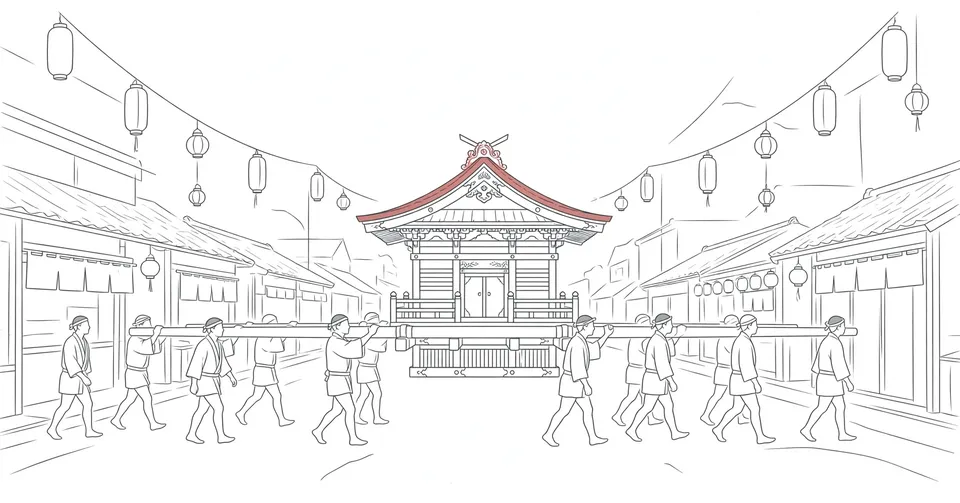
If you have ever visited Asakusa on a quiet weekday, the change is hard to believe. The same lanes that are calm enough for a slow walk past souvenir stalls become a river of people, and the same temple grounds that feel spacious in the morning become a stage. The Sanja Matsuri does not hide behind fences or tickets. It is free, it is open, and it happens right in the middle of everyday Asakusa, which is part of its charm and part of its challenge.
Three men and a statue in the river
The Sanja Matsuri honours three men who are remembered as the founders of Asakusa. According to the legend told by Asakusa Shrine, about 1,300 years ago two fishermen brothers, Hinokuma Hamanari and Hinokuma Takenari, found a small statue of Kannon, the goddess of mercy, caught in a fishing net in the Sumida River. The date is given as March 18, which is May 18 by the solar calendar. A wealthy local landlord named Hajino Matsuchi heard about the discovery, spoke to the brothers about the Buddha, and the brothers were so moved that they converted to Buddhism.
The statue was enshrined in a small temple by the landlord and the brothers, who then devoted their lives to teaching Buddhism in the area. That small temple grew into Senso-ji, the great temple that now anchors Asakusa, and the three men came to be revered as deities. In the Kamakura period, about 800 years ago, a shrine was built beside the temple to honour them, and the townsfolk began holding a festival for the three devoted men. That festival, the Sanja Matsuri, is the origin of Asakusa Shrine, which is also known as Sanja-sama, and the name Sanja itself means three shrines, a reference to the three men enshrined there.
What I find most striking about this story is how ordinary it is at the start. There is no emperor and no grand battle, only two fishermen pulling up a net and a neighbour who took the time to talk to them. The festival that grew from that small moment now fills one of the largest cities on earth, and that contrast is worth keeping in mind when the drums start. The Sanja Matsuri is not a show put on for visitors. It began as a neighbourhood giving thanks, and in its heart it still is.
What happens on each day of Sanja Matsuri
The festival runs from Friday to Sunday on the third weekend of May, and each day has its own character. Friday afternoon opens the weekend with the Daigyoretsu, a grand procession in which priests, geisha, musicians, dancers and people in Edo period costume walk through the streets of Asakusa. The Binzasara dance, a traditional performance with wooden clappers, is also performed at the shrine on Friday. It is the calmest day of the Sanja Matsuri and the most photogenic, a good day for anyone who wants to see the costumes and the ceremony without fighting the biggest crowds.
Saturday belongs to the neighbourhoods. From around noon, about a hundred mikoshi from the 44 parishes of Asakusa are carried to Senso-ji to be blessed, then paraded through the streets. Each parish has its own mikoshi, its own happi coats and its own chant, so the afternoon feels like dozens of small festivals happening at once and slowly joining together. Children take part too, with a children's mikoshi procession in the afternoon, which gives Saturday a family feeling that Sunday does not have. If you can only come to the Sanja Matsuri for one day and you want to see the most mikoshi, Saturday is the day to choose.
Sunday is the climax of the Sanja Matsuri, and it belongs to the shrine itself. In the early morning the three main mikoshi leave Asakusa Shrine in a ritual called miyadashi, the departure from the shrine, and they are carried through the parishes for the whole day before returning in the evening in the miyairi, the return to the shrine. The courtyard is packed at dawn, the shouting is at its loudest, and the three great shrines are rocked and heaved through the gates in a scrum that can look chaotic from the outside. The shrine publishes the exact timetable each spring, and the hours shift slightly from year to year, so the details are worth checking on the official Asakusa Shrine website before you plan a trip around them.
The three mikoshi that carry the weekend
The three main mikoshi have names of their own: ichi-no-miya, the first shrine, ni-no-miya, the second shrine, and san-no-miya, the third shrine. Each one carries the spirit of one of the three founders, so the Sunday procession of the Sanja Matsuri is, in a real sense, the three men being carried through the streets of the district they founded. Each mikoshi weighs about a tonne, and each is borne on long wooden beams by dozens of carriers who take turns under the weight, shouting in rhythm to keep their steps together.
The rocking is deliberate. The carriers bounce and sway the mikoshi as they walk, and the wilder the movement the better, because the shaking is believed to please the deity inside and to spread good fortune over the streets it passes. Watching it up close, you understand why the festival has a reputation for roughness. Shoulders bruise, voices go hoarse, and the crowd pushes in from every side. The shrine has tightened the rules around the procession over the years, and the Sunday procession was suspended entirely in 2008 after an incident the year before, which shows that the energy of the festival is real and not staged for cameras.
There is something honest about a festival that refuses to be tamed. Tokyo is a city that usually runs on order, on queues and timetables and quiet trains, and for one weekend a year Asakusa is allowed to be the opposite. I think that is a large part of why people keep coming back. The noise is not a side effect of the festival. The noise is the point, and the neighbourhood owns it.
Why the gates of Asakusa open wide
One of the most telling details of the festival is what happens to the gates. The great red lantern of Kaminarimon, the thunder gate that opens Asakusa to the world, is folded up and raised so that the tall mikoshi can pass through the gate on their way to the temple. The lanterns of Hozomon, the treasure house gate behind the main hall, are removed for the weekend for the same reason, so that the portable shrines can pass through without obstruction.
This is not a small adjustment. The Kaminarimon lantern is one of the most photographed objects in Tokyo, and folding it away means the most famous view in Asakusa looks different for three days a year. The Sanja Matsuri literally rearranges the district to make room for itself, and the district accepts that, because the mikoshi come first. It is a useful reminder that Senso-ji and its gates are not a museum. They are working parts of a living neighbourhood, and once a year the neighbourhood reminds everyone of that fact.
The route itself runs through the heart of Asakusa, from the shrine past the main hall of Senso-ji, down the Nakamise shopping street and out into the surrounding lanes. The Nakamise is about 250 metres long and lined with more than 50 shops, and during the festival it becomes both a procession route and a crowded market at the same time. Food stalls fill the side streets, the smell of grilled food mixes with incense from the temple, and the boundary between watching the festival and being inside it disappears almost immediately.
A neighbourhood festival that belongs to its people
The Sanja Matsuri is organised by the ujiko, the parishioners of Asakusa Shrine, the people who live in the 44 neighbourhoods around it. The shrine itself describes the parade of the portable shrines as being held first for the mutual friendship of the ujiko and the prosperity of the community, and only then for everyone else who comes to watch. That order matters. The visitors are welcome, and there are millions of them, but they are guests at someone else's festival.
You can feel the difference in the way the weekend is run. The carriers are not hired performers. They are shopkeepers, office workers, students and retirees from the parish, people who have waited all year for their turn under the beams. Many of them wear the happi coat of their own neighbourhood, and the pride in that coat is visible from a long way off. The Sanja Matsuri is also one of the Three Great Festivals of Edo, the old name for Tokyo, alongside the Kanda Matsuri and the Sanno Matsuri, which places it in a tradition that goes back to the Edo period, when the present form of the festival was established.
I think there is a lesson in that for anyone who travels to see a festival. The best ones are not performed for you. They are performed by a community for itself, and you are lucky to be allowed to stand nearby and watch. The Sanja Matsuri is generous with that permission, but it does not ask for approval, and it does not soften its edges for visitors. That stubbornness is what keeps it alive, and it is what makes the weekend feel real instead of rehearsed.
How to watch without getting in the way
The practical side of the Sanja Matsuri is simple, but it rewards a little planning. The festival is free to attend, with no tickets, and Asakusa is served by the Ginza subway line, the Asakusa subway line, the Tobu Skytree line and the Tsukuba Express, all of which stop at Asakusa Station. The trains are crowded all weekend, so allow extra time, and expect to walk the last part of the way through streets that are closed to cars.
Saturday is the best day for a first visit. The neighbourhood mikoshi gather from around noon, the atmosphere is festive rather than frantic, and you can see a large number of mikoshi in a short walk. Sunday is the day for the three main mikoshi, and the miyadashi at dawn is the most intense moment of the whole weekend, but it is also the most crowded, and entry to the shrine grounds is restricted in the evening for the return. Friday afternoon is the quietest option, with the Daigyoretsu procession and the Binzasara dance offering ceremony and colour without the crush.
A few rules of respect are worth remembering. Do not touch the mikoshi, and do not try to join the carriers unless you belong to a parish team. The people under the beams have trained for this and they are carrying about a tonne of lacquered wood over their heads, so a stranger grabbing a beam is a danger, not a bit of fun. Stand on the side of the street, keep the procession route clear, and watch from the Nakamise or the shrine courtyard, where the Japan Guide page on Asakusa also suggests starting a walk through the district. If you want the best photographs, arrive early and find a spot before the crowds do, then stay there and let the festival come to you.
The weekend Asakusa remembers all year
Long after the last mikoshi has returned to the shrine and the lanterns have been hung back in their places, the weekend stays with the people who were there. The carriers go back to their shops and offices with bruised shoulders and hoarse voices, the streets are swept clean, and Asakusa returns to its usual calm. But the festival is not really over. It lives in the stories the neighbourhood tells for the rest of the year, in the photographs on shop walls, and in the quiet pride of having carried a tonne of history through your own streets.
The Sanja Matsuri is loud, crowded, rough around the edges and entirely itself. Tokyo has many festivals, but few of them hand a whole district back to its people so completely for three days. If you ever get the chance to stand on a side street in Asakusa in May and hear the chanting coming closer, you will not forget the sound, and you will understand, in a way no description can quite give you, why a small shrine beside a great temple can stop a whole city for a weekend.
More in Culture & Society
- Miyadashi Is the Moment the God Leaves Home
- Otabisho Is Where the God Rests on the Way Through Town
- Mikoshi Are the Portable Shrines Japan Carries on Its Shoulders
- Waraji Straw Sandals Walked Japan for a Thousand Years
- Fujin Carries the Wind That Arrives Before the Thunder
- Raijin Is the Thunder God Behind Japan's Summer Storms
Latest posts
- An Engawa Is Neither Inside nor Outside, and That Is the Point
- Nikko and the Shrines Hidden in the Cedar Forest
- Minka Are the Folk Houses Japan Built Around the Hearth
- The Orangutan and the Vanishing Forests of Borneo
- Hozomon Guards the Treasure House Behind Senso-ji's Main Hall
- Nakamise Is the Shopping Street That Has Fed Pilgrims for Centuries
- Kaminarimon Is the Thunder Gate That Opens Asakusa to the World
- Sony, the Tokyo Workshop That Taught the World to Listen
- Tengu Is the Mountain Goblin Japan Still Meets on the Trail
- Kappa Is the River Imp Japan Still Warns Its Children About
- Calonarang Is the Night Rangda and Barong Finally Meet
- Yamata no Orochi Was Never Just a Monster to Slay
- Kit Kat Japan, the Flavours You Will Not Find Anywhere Else
- How Susanoo Slew the Eight-Headed Serpent and Won a Bride
- How Kusanagi Became Japan's Most Guarded Sword