Nakamise Is the Shopping Street That Has Fed Pilgrims for Centuries
· 14 min read
Nakamise is the 250 meter shopping street that runs from the Kaminarimon gate to Senso-ji in Asakusa, and it has fed and supplied temple pilgrims since the Edo period.
Nakamise is the short street that turns a walk to a temple into a meal. It runs about 250 meters from the Kaminarimon gate to the grounds of Senso-ji in Asakusa, and nearly every step of it sells something to eat, to carry home, or to remember the visit by.
The street is not a modern mall dressed up in old clothes. Nakamise began as a row of stalls serving people who came to pray at Senso-ji, and it still does that job today. The goods have changed with the centuries, but the purpose has not.
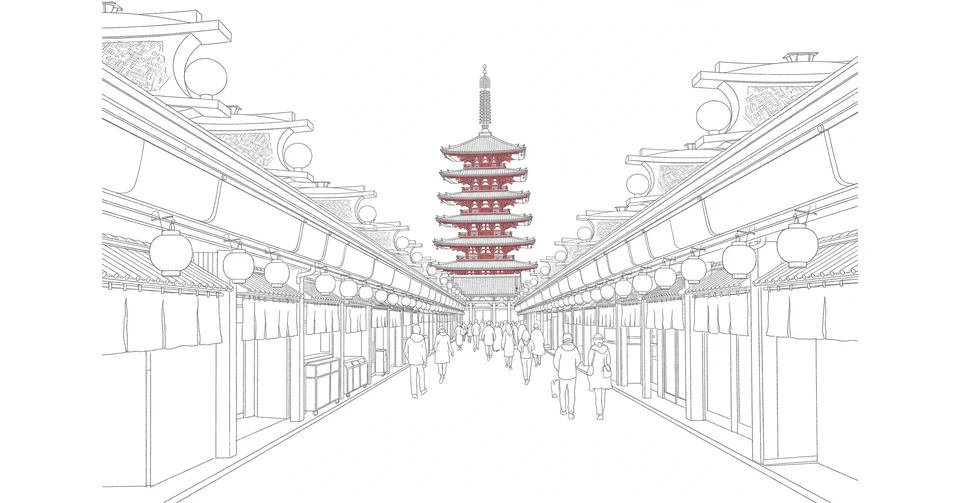
About 90 small shops line the lane, packed shoulder to shoulder on both sides. Sources differ slightly on the exact count, with the street association giving 87 and other guides giving 89, so the honest figure is roughly 90. What matters more than the number is the density. In the space of a five minute walk, a visitor passes sponge cakes baked in molds, rice crackers toasted over charcoal, folded fans, cotton cloths, wooden toys, and umbrellas.
Senso-ji itself is the reason the street exists. The temple is the oldest in Tokyo, founded in the seventh century, and its official site says it draws about 30 million visitors every year. A crowd that large needs feeding, and for centuries Nakamise has been the place where the feeding happens.
How Nakamise began as a row of stalls for pilgrims
The story of Nakamise starts with permission, not with a plan. According to the shopping street association, local people who served visitors at Senso-ji were given the right to open shops along the temple approach between about 1688 and 1735. Taito City, the ward that governs Asakusa, places the origin a little earlier, around 1685. The two accounts disagree on the exact year, but they agree on the logic. The stalls appeared because pilgrims were already there, and someone had to feed them.
Those early stalls were humble. The ward records speak of about 20 tea stalls that also sold toys, candies, and souvenirs. In the Edo period the tea houses were known as Yakudana, while shops near the Kaminarimon gate were called Hiramise. The names have faded, but the pairing of a hot drink, a sweet snack, and a small keepsake has survived for more than three hundred years.
Nakamise has been rebuilt more than once, and each rebuilding tells something about the Tokyo of its time. In 1885 the city government cleared the old stalls and replaced them with Western style brick shops, a sign of a Japan that was remaking itself in a hurry. The Great Kanto Earthquake destroyed those brick shops in 1923. Two years later, in 1925, the street rose again in reinforced concrete, its fronts painted vermilion in a style borrowed from the Momoyama period. The interiors burned in the air raids of 1945 and were restored soon after.
That history is worth knowing before you go, because it changes how the street looks. Nakamise is old in its purpose and its trade, but its buildings are not ancient. They are a twentieth century reconstruction of an Edo period idea, and they work because the idea was sound. A temple draws people, people get hungry and curious, and small shops answer both needs at once.
There is a lesson in that durability. Many shopping streets in Tokyo have been rebuilt, rebranded, or replaced by malls. Nakamise survived because it never tried to be anything other than the approach to a temple. Its shops do not compete with department stores. They sell what a pilgrim or a visitor wants in the moment, and they have done so long enough that the trade itself has become part of the attraction.
What to eat on the walk to the temple
Food is the first thing Nakamise offers, and it is the best reason to walk slowly. Most stalls cook in front of you, so the smell reaches you before the sign does. The classics are small, cheap, and meant to be eaten on the spot.
Ningyo-yaki is the most famous of them. These are small sponge cakes baked in molds shaped like dolls, pagodas, or lanterns, usually filled with sweet red bean paste. The name means doll cake, and the molds are part of the charm. A fresh one, still warm from the iron, tastes of egg and sugar and nothing more complicated than that.
Kaminari-okoshi is the snack most tied to this exact place. It is a crisp bar of puffed rice bound with sugar syrup, sold near the Kaminarimon gate, and its name plays on the thunder gate itself. It keeps well, so it has long been the souvenir of choice for visitors who want to carry a taste of Asakusa home. A bag of it in a suitcase is a small, honest gift.
Senbei, the grilled rice cracker brushed with soy sauce, is the salty answer to the sweet stalls. Some shops toast the crackers over charcoal while you watch, and the smell of soy and smoke is one of the defining scents of the street. Age-manju, deep fried buns with a sweet filling, and kibi dango, soft millet dumplings rolled in roasted soybean flour, round out the old menu.
| Snack | What it is | Why it fits the street |
|---|---|---|
| Ningyo-yaki | Sponge cake baked in molds, often filled with red bean paste | Baked fresh at the stall, easy to eat while standing |
| Kaminari-okoshi | Crisp puffed rice bars bound with syrup | Keeps well, the classic edible souvenir of Asakusa |
| Senbei | Rice crackers grilled and brushed with soy sauce | The salty counterpoint to the sweet stalls |
| Age-manju | Deep fried buns with a sweet filling | Warm, filling, and sold in small numbers |
| Kibi dango | Soft millet dumplings in roasted soybean flour | An old sweet with a plain, gentle taste |
Newer stalls have joined the old ones, selling matcha soft serve, melon bread, and croquettes. They are popular, and there is nothing wrong with enjoying them, but they are not the reason Nakamise matters. Nakamise absorbs them without losing its character, because the old stalls still set the tone. The old snacks matter because they were shaped by the street itself. They are food that can be made in a tiny shop, sold through a small window, eaten with no cutlery, and finished before the next stall. That is a design born of a crowded lane, and it has lasted because it works.
The custom on Nakamise is to eat where you bought the food, stepping to the side of the shop rather than walking and eating. The lane is narrow and the crowds are thick, especially on weekends, and a person eating while walking becomes an obstacle. Standing at the counter for a minute costs nothing and respects the flow of people behind you. It also tastes better. Food eaten slowly, even for one minute, is a different experience from food eaten on the move.
My own view is simple. A street that has fed pilgrims for centuries deserves to be eaten in, not rushed through. Buy one thing, finish it, then buy the next. The street rewards that pace. The shops are small enough that a second visit to the same stall is noticed, and the sellers remember a face that stops rather than one that passes.
What to buy beyond the snacks
Once the hunger is settled, Nakamise turns into a row of small craft shops, and the goods here follow the same logic as the food. They are small, portable, and tied to Japanese tradition.
Folding fans are among the best buys. They are light, they pack flat, and a good one is both useful and beautiful. Tenugui, the thin cotton cloths printed with patterns, are another classic. They serve as hand towels, head coverings, wrapping cloths, and souvenirs, and their patterns often carry seasonal or Asakusa motifs. Kimono accessories, hair ornaments, and small bags sit alongside them.
Edo style wooden toys, masks, and festival goods fill other shops, and umbrellas, both plain and decorated, hang in rows. Some shops specialize in props for traditional dance or in the tools of festival life. The range is wide, but the scale is always small. Nothing on Nakamise is large, because a pilgrim could only carry so much home.
That smallness is worth respecting. Prices on the street are aimed at visitors, and the shops are a good place for small gifts rather than serious craft collecting. A fan bought here is a fine gift. A serious collector of Japanese crafts would look elsewhere. Knowing that in advance protects both the visitor and the seller from disappointment.
The family character of the shops is part of the story. Japan's national tourism organization notes that most shops on Nakamise have been run by the same families for several generations. That continuity shows in the way the street feels. The sellers are not tenants of a mall. They are inheritors of a pitch their grandparents worked, and their knowledge of the goods runs deep. Ask a question about a fan or a sweet, and the answer usually comes with a small piece of history attached.
If you buy one thing to keep, make it something made to be used rather than displayed. A fan gets opened on hot days. A tenugui gets carried in a pocket. A bag of kaminari-okoshi gets eaten. The best souvenirs from Nakamise are the ones that keep working after the trip, because that is how the street itself works. It sells useful things to people on a journey, and it has done so for centuries.
The painted shutters and the street after dark
Nakamise changes character in the evening. Most shops close in the late afternoon, around 5 p.m., and the lane empties. What remains is worth seeing. The steel shutters of the shops are painted with scenes of old Asakusa, a series known as Asakusa Emaki, created under the guidance of artists from Tokyo University of the Arts. The paintings show festivals, street scenes, and the yearly life of the district.
Walking the closed street is a different experience from walking it at noon. The noise is gone, the smell of grilling crackers fades, and the painted shutters turn the lane into a quiet gallery. It is the best time to look at the architecture, the vermilion fronts, and the proportions of the street without a crowd pressing behind you.
The evening walk also reveals how small the street really is. In the daytime crush, 250 meters feels long. After closing, the same distance takes a few unhurried minutes, and the scale of the place becomes clear. This was never a grand boulevard. It was a lane between two gates, and its charm is the charm of a lane, not a plaza.
Festivals return the street to its loudest self. The Sanja Matsuri, the festival of Asakusa Shrine beside the temple, is held every year on a weekend in mid May, and it is one of Tokyo's most famous festivals. The Hagoita Market, held near the halls and gates of Senso-ji in mid December, fills the area with decorated battledore paddles. Both events pour crowds into Nakamise, and the street handles them the way it always has, by selling food and small goods to people who came for something else. If you visit during a festival, expect crowds and enjoy them, but do not expect a quiet walk.
The contrast between the crowded day and the painted evening is the truest picture of Nakamise. It is a working street in the morning and a painted one at night, and both versions are honest. A place that only exists for tourists would not bother painting its shutters. A place that only exists for pilgrims would not sell soft serve. Nakamise does both, and the balance is the point.
How to walk Nakamise without ruining it for others
Nakamise is old and crowded, and like any old and crowded street it has manners, and they are simple enough to learn in a minute. The first is the eating rule already mentioned. Eat at the stall, not while walking. The second is to keep moving in the flow of people. Stopping in the middle of the lane to take a photograph blocks everyone behind you, so step to the side of a shop front first.
The third is to remember that the shops are small family businesses, not a theme park. Photography inside a shop should wait for a nod from the seller. Bargaining is not the custom here. Prices are what they are, and the margin on a small sweet or a cloth is thin.
Cash is still useful on Nakamise. Many small stalls take cards now, but some do not, and a pocket of coins makes every small purchase easier. A thousand yen note goes a long way on this street, which is part of its appeal. Few places in Tokyo offer so much for so little.
Getting there is easy. The street starts at the Kaminarimon gate, a short walk from Asakusa Station, and the temple's own site lists the nearby stations at about five minutes on foot. Japan Guide's Asakusa page notes that the street has provided temple visitors with traditional snacks and souvenirs for centuries, and the walk from the station is itself part of the visit, because Asakusa's older streets set the tone before the gate appears.
One more practical note. Go early if you can. The street is at its best in the late morning, when the stalls are fully open and the crowds are still thin. By mid afternoon on a weekend, the lane can be slow moving. An early start also leaves the afternoon free for the temple itself, for the shrine beside it, and for the side streets of Asakusa, which reward wandering.
Why a shopping street can be a sacred place
It is tempting to draw a hard line between the sacred and the commercial, to say the temple is holy and the shops are not. Nakamise makes that line hard to hold. The shops exist because the temple exists. The pilgrims needed food, drink, and a small offering or keepsake, and the street grew to meet those needs. Commerce here is not an intrusion on the sacred. It is the infrastructure of pilgrimage.
That is a useful thing to remember beyond Asakusa. Pilgrimage has always had a practical side. People who travel to a holy place need to eat, to rest, and to carry something home. The streets that serve them are not a corruption of the journey. They are part of it. The test is whether the trade serves the journey or replaces it, and on Nakamise the trade still serves the journey. The temple stands at the end of the lane, visible from the first step, and everything on the street points toward it.
I think that is why the street has lasted. It never forgot what it was for. Shops have come and gone, buildings have burned and been rebuilt, and tastes have changed, but the arrangement has held. A gate, a lane of small shops, and a temple at the end. Walk Nakamise slowly, eat one thing at a time, buy something you will use, and leave the street a little better than you found it. That is the whole lesson of Nakamise, and it fits in 250 meters.
More in Food & Travel
- Nikko and the Shrines Hidden in the Cedar Forest
- The Orangutan and the Vanishing Forests of Borneo
- Hozomon Guards the Treasure House Behind Senso-ji's Main Hall
- Kaminarimon Is the Thunder Gate That Opens Asakusa to the World
- Kit Kat Japan, the Flavours You Will Not Find Anywhere Else
- Yakiniku, Japan's Do-It-Yourself Barbecue
Latest posts
- An Engawa Is Neither Inside nor Outside, and That Is the Point
- Minka Are the Folk Houses Japan Built Around the Hearth
- Miyadashi Is the Moment the God Leaves Home
- Otabisho Is Where the God Rests on the Way Through Town
- Mikoshi Are the Portable Shrines Japan Carries on Its Shoulders
- Sanja Matsuri Turns Asakusa Into Tokyo's Loudest Weekend
- Waraji Straw Sandals Walked Japan for a Thousand Years
- Sony, the Tokyo Workshop That Taught the World to Listen
- Fujin Carries the Wind That Arrives Before the Thunder
- Raijin Is the Thunder God Behind Japan's Summer Storms
- Tengu Is the Mountain Goblin Japan Still Meets on the Trail
- Kappa Is the River Imp Japan Still Warns Its Children About
- Calonarang Is the Night Rangda and Barong Finally Meet
- Yamata no Orochi Was Never Just a Monster to Slay
- How Susanoo Slew the Eight-Headed Serpent and Won a Bride