Kaigen Kuyo Is the Ceremony That Wakes a Sacred Object
· 17 min read
Kaigen kuyo is the Japanese Buddhist eye-opening ceremony that consecrates a new statue, tablet, or altar, turning a crafted object into a place where the sacred is understood to dwell.
A new Buddhist statue arrives at a temple or a home, and it looks complete. The carving is finished, the lacquer is dry, the gold leaf catches the light. Yet in Japanese Buddhism the statue is not yet ready to be prayed to. It is still, in the plainest sense, a piece of wood or bronze. Something has to happen before it can be treated as sacred, and that something is kaigen kuyo.
Kaigen kuyo is the eye-opening ceremony, the rite that consecrates a newly made object of worship. The name itself says what the ceremony does. Kaigen means opening the eyes, and kuyo means a memorial rite or offering service. Through it, a statue, a painted image, a memorial tablet, or a whole household altar is understood to wake up and become a place where the sacred dwells.
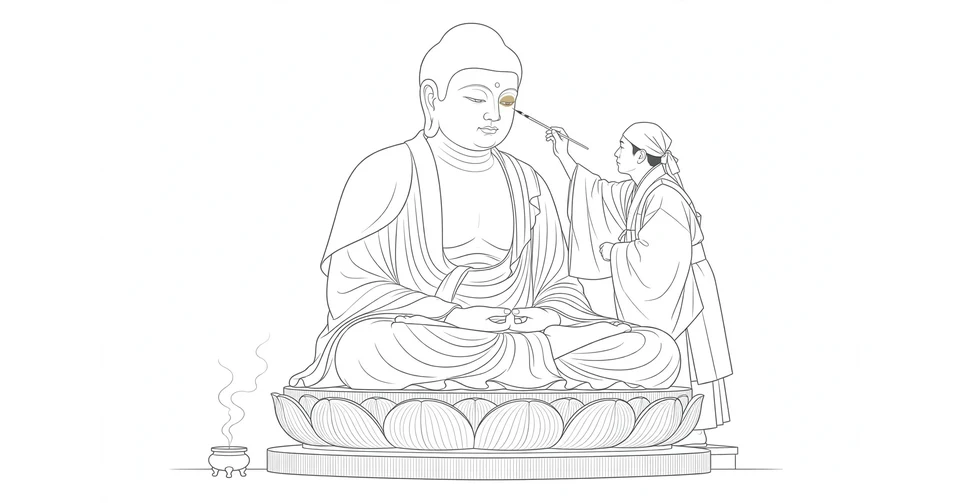
This article explains what kaigen kuyo is, how the eyes of a statue are painted, what tamashii ire means, when the ceremony is performed, and how it differs from an ordinary blessing.
What kaigen kuyo actually does
The simplest definition of kaigen kuyo comes from the Dictionary of Buddhism kept by the Nichiren Buddhism Library, which describes kaigen kuyo as a ceremony to open the eyes of, or consecrate, newly created statues or painted images of a Buddha. It is performed in the belief that the image can thereby be endowed with spiritual properties, and through it the image is believed to become equal to the living Buddha. That definition of kaigen kuyo is worth reading slowly, because it makes a bold claim in calm language. The statue does not change its shape. It changes its standing.
The idea behind the rite is that a sacred object is not sacred by nature. It becomes sacred by ceremony. A carver can shape the wood and a painter can gild it, but neither of them can give it the quality that makes people bow before it. That quality is given by a priest, in a rite, in front of witnesses, and from that day the object is treated differently. It is placed higher, handled more carefully, greeted each morning, and never treated as decoration again. I find this distinction honest rather than mystical. It says that holiness is not a property hidden inside a material. It is a relationship, agreed upon by a community, and the ceremony is the moment the agreement is made.
Kaigen kuyo is also known by other names, and the names tell the same story from different angles. It is sometimes called kaigen hoyo, using the word for a Buddhist service rather than an offering rite. It is also called nyukon shiki or tamaire, both of which point to the same act: putting a soul, or a spirit, into the object. The Japanese Wiki Corpus entry on the rite lists all three names together and treats them as one ceremony, which they are. The eye-opening and the soul-entering are two ways of describing a single change.
The eyes are painted last
The most striking moment of kaigen kuyo is also the oldest part of it. When a Buddhist statue is made, the eyes are inserted at the very end of the process. The Japanese word for this is tensei, the inserting of the eyes, and it was regarded as so important that it grew into the ceremony itself. The statue is finished, in the religious sense, only when its eyes are open.
There is a practical reason for this order. A carver works on the face last in many traditions, because the face is where the work is judged. But there is also a deeper reason, and it is the one the ceremony preserves. The eyes are the part of a statue that looks back at the worshipper. A statue with closed or unfinished eyes is a statue that does not yet see, and a statue that does not see cannot receive a prayer. Painting the eyes is the moment the statue begins to meet the gaze of the people who will pray before it. I think that is why the rite has survived for more than a thousand years. It takes a small, visible act, a brush touching a face, and makes it carry the whole weight of the change.
In the great kaigen kuyo ceremonies of the past, the painting of the eyes was done with a large brush, and ropes were attached to it so that the people gathered could hold them and share in the blessing. The ropes were often five colours, and the crowd that held them was understood to receive the merit of the rite through touch. The act was public, not private. The statue was not woken in secret. It was woken in front of the people who would worship it, and their hands on the rope made them part of it.
Tamashii ire, inviting the soul in
The second half of kaigen kuyo is harder to see but just as important. It is called tamashii ire, the placing of the soul, or the inviting of the spirit in. Where the painting of the eyes is a visible act, tamashii ire is an invisible one, and it is the part of the ceremony that gives the object its inner life.
Tamashii ire is best understood through the objects that receive it. A new memorial tablet, an ihai, is not yet an object of worship when it arrives from the maker, however beautiful its lacquer and gold lettering may be. It becomes one through a ceremony called kaigen kuyo, sometimes also called the ceremony of placing the soul, tamashii ire. A priest performs the rite, and by it the tablet is understood to become a place where the soul of the dead resides. That is how the ceremony is described in the account of the lacquered tablets that keep a name alive, and it shows the logic of the rite clearly. The tablet carries a name, but the name alone is not enough. The soul has to be invited to dwell with the name, and the invitation is the ceremony.
The same kind of ceremony is performed for a new butsudan, the household Buddhist altar, and for a new Buddhist statue. In each case the pattern is the same. A crafted object arrives, a priest performs the rite, and from that day the object is treated as a dwelling place rather than a piece of furniture. The soul is not forced into the object. It is invited, and the invitation is made with chanting, offerings, and the formal language of the sect.
I find the word inviting important here. It suggests that the sacred is a guest, not a possession. A family does not own the spirit in its altar the way it owns the cabinet. It hosts it, and hosting carries duties. The cabinet is opened each morning and closed each night, water and rice are offered, and the bell is rung. The ceremony does not only wake the object. It also wakes the family to the responsibility of keeping it.
When kaigen kuyo is performed
Kaigen kuyo is performed whenever a new object of worship is completed, and the list of occasions is wider than most people expect. The Japanese Wiki Corpus entry describes it as a Buddhist service held at the completion of a Buddhist statue, painting, altar, or tomb. That covers most of the cases, and each one follows the same logic. Whenever something new is made to be prayed to, it needs the rite before prayer begins.
A new statue in a temple is the clearest case for kaigen kuyo, and it is also the oldest. A new painted image, a hanging scroll of a Buddha or a bodhisattva, receives the same rite, because a painted face is understood to need its eyes opened just as a carved one does. A new ihai receives it, so that the tablet becomes a dwelling for the soul of the dead. A new butsudan receives it, so that the cabinet becomes a home altar rather than a handsome cupboard. The full story of that cabinet, and how it came into Japanese homes, is told in the account of a butsudan keeping the dead close in a Japanese home, and the ceremony is the moment the cabinet stops being furniture and starts being a shrine.
Kaigen kuyo is also performed again in some circumstances, not only for new objects. A statue that has been repaired, moved to a new temple, or passed to a new owner may receive the ceremony a second time, so that its standing is renewed in its new place. A lecture at the Courtauld Institute on the lives of Buddhist icons notes that in the medieval period the kaigen kuyo rite was repeated after repairs, relocations, or changes in ownership, which suggests that reactivation, rather than disposal, was the normal way of caring for an old image. I like that detail, because it shows the ceremony as a beginning that can be repeated. An object does not get one waking and then age in silence. It can be woken again, whenever its life changes.
The most famous kaigen kuyo in Japan
One kaigen kuyo is more famous than all the others, and it is the one that fixed the ceremony in Japanese history. It was the eye-opening of the Great Buddha of Todai-ji Temple in Nara, the giant bronze statue of the Buddha Vairocana, held on May 30, 752. The ceremony was held by Emperor Shomu, and the priest Bodhisena, known in Japanese as Bodai Senna, who had come to Japan from India by way of Tang China, painted the eyes.
The scale of the occasion matched the scale of the statue. Five-colour ropes were attached to the writing brush used to paint the eyes, and the ropes were handed to the people gathered so that they could receive a blessing by holding them. The crowd did not only watch the statue wake. It took part in the waking, through its hands on the rope. That detail has survived for more than twelve centuries, and it is still the most vivid image of what kaigen kuyo feels like: a whole community, holding a rope, watching a brush touch a face.
The date matters because it shows how old the rite is in Japan. By the year 752, the ceremony already had a settled form, a great temple, an emperor, a foreign priest, and a crowd. It was not a new invention then. It was already the way a great statue was finished, and it has remained so ever since. When a small statue in a family home receives the same rite today, it is the same ceremony, shrunk to the size of a living room, and the family holding no rope at all still stands in the same tradition as the crowd at Todai-ji.
How the ceremony unfolds
The details of kaigen kuyo vary by Buddhist school and by local custom, and it would be dishonest to pretend there is one fixed script. What the sources agree on is the shape of the rite, and that shape is recognisable across the schools. A priest performs it, usually at the temple or at the home where the object will be kept. The space is tidied and the object is placed on the altar before the priest arrives, or it is brought to the temple carefully wrapped.
The ceremony itself is built from four elements that appear again and again: purification, chanting, offering, and the formal act of opening. Offerings are prepared, usually incense, candles, flowers, water, and sometimes fruit or simple sweets. The priest chants sutras, mantras, or dharani, and the chanting is understood to place the object within the Buddha's teaching, so that it is not treated as an isolated thing but as part of a living practice. In esoteric traditions the rite may also include mudras, the hand gestures of the tradition, and a more elaborate arrangement of the altar.
The eye-opening itself, the painting or touching of the eyes, comes as the formal act of kaigen kuyo within this frame. It is not a trick performed on its own. It is the centre of a service that also includes prayer, chanting, and offerings, and it is the service as a whole, not the single brushstroke, that makes the change. This is worth saying plainly, because the ceremony is sometimes described as if the brush alone did the work. It does not. The brush is the visible sign of a rite that is mostly made of words and attention.
Families without a temple connection sometimes skip the ceremony, and makers of memorial tablets say this is acceptable, advising the family to welcome the tablet with joined hands and gratitude when it first arrives. That advice is not a dismissal of the rite. It is an honest recognition that a ceremony performed by a priest is one way to mark a beginning, and a quiet moment of gratitude at home is another. Kaigen kuyo is the full form. The welcome is the simple form. Both of them understand the same thing: that an object becomes sacred when someone treats it as sacred, and says so.
Kaigen kuyo is not an ordinary blessing
It is easy to mistake kaigen kuyo for a blessing, and the two do share a surface resemblance. Both involve a priest, chanting, and offerings, and both leave the people present feeling that something good has happened. But they are different in kind, and the difference is the point of the ceremony.
A blessing asks for protection or good fortune for something that already exists. A new house is blessed so that the people in it will be safe. A new car is blessed so that its driver will travel safely. The house and the car do not change their nature. They remain a house and a car, now under a good wish. Kaigen kuyo does something else. It changes what the object is. Before the rite, the statue is a carved image. After it, the statue is an object of worship, understood to be equal to the living Buddha. Before the rite, the tablet is a piece of lacquered wood with a name on it. After it, the tablet is a dwelling place for a soul. The change is not a wish laid over the object. It is a new status given to it.
There is a second difference, and it is a practical one. A blessing can be repeated casually, whenever someone wants one, and it carries no duties with it. Kaigen kuyo carries duties. Once an object has received the rite, it must be treated as sacred from then on. It is placed properly, kept clean, greeted daily, and never used as decoration or thrown away casually. The ceremony is a promise, made by the people who receive the object, to treat it in a certain way for as long as they keep it. A blessing asks nothing in return. Kaigen kuyo asks for a lifetime of care.
The sect that does it differently
There is one important exception to kaigen kuyo, and it is worth stating plainly, because it shows that the rite is a choice and not a habit. Jodo Shinshu, the True Pure Land school and the largest school of Japanese Buddhism, has no concept of investing the principal image with a soul. It does not perform kaigen kuyo for its honzon, the principal image of worship. Instead, it holds a service for an auspicious occasion called goishi, or owatamashi, which is a ceremony of transfer, of moving the Buddha to be worshipped into its place.
The reasoning behind the exception is consistent with the school's teaching. Jodo Shinshu holds that the dead, through the vow of Amida Buddha, are already reborn in the Pure Land, and so they need no tablet to anchor them and no rite to place a soul. The same logic applies to the image. If the Buddha is already present through the vow, the image does not need to be woken. It needs only to be moved into place, with ceremony and respect, and that is what goishi does.
I respect the exception, because it sharpens the meaning of the rite for everyone else. Most schools perform kaigen kuyo because they believe a sacred object must be made sacred, and that the making is a real event. Jodo Shinshu sets it aside because it believes the sacred is already present, and that no making is needed. Both positions take the object seriously. They simply disagree about where the sacred comes from, and the ceremony, or its absence, is the visible sign of that disagreement.
Why the ceremony still matters
Kaigen kuyo matters because it draws a line that modern life keeps blurring. A statue can be bought online, delivered in a box, and placed on a shelf next to a vase. Nothing in the transaction marks it as different from the vase. Kaigen kuyo is the mark. It says that this object is not like the others, that it was made to be prayed to, and that the people who keep it have agreed to treat it that way.
The line matters for the people who keep the object, not only for the object itself. A family that has held a rite for its altar tends to its altar differently from a family that has not. It opens the cabinet in the morning, offers water and rice, rings the bell, and closes the doors at night. The rite does not create the daily care. The daily care creates the rite, and the rite gives the care a beginning, a day that can be remembered. Without a beginning, care drifts. With one, it has a date, a priest, and a moment when everyone present agreed to it.
There is also something quietly hopeful in the idea that a thing made by human hands can be woken. It says that making is not the end of a story. A carver finishes a statue, and the story is not over. A family buys a tablet, and the story is not over. The object still waits for its eyes to be opened, and the opening is done by people, in a room, with words and a brush. The sacred, in this view, is not something that falls from the sky. It is something that people make together, and then agree to honour. That is a modest claim, and it is a strong one. It means the ceremony is not only about statues and tablets. It is about the way a community decides what is sacred, and then keeps its word.
Kaigen kuyo is the ceremony that wakes a sacred object, and it has been waking them, from the Great Buddha of Todai-ji to the smallest tablet in a family altar, for more than twelve centuries. The brush touches the eyes, the soul is invited in, and from that day the object is no longer a thing. It is a presence, and the people who keep it are its keepers.
More in Culture & Society
- Tamashii Ire Invites a Soul Into a Sacred Object
- Ihai Are the Lacquered Tablets That Keep a Name Alive
- A Butsudan Keeps the Dead Close in a Japanese Home
- Miyadashi Is the Moment the God Leaves Home
- Otabisho Is Where the God Rests on the Way Through Town
- Mikoshi Are the Portable Shrines Japan Carries on Its Shoulders
Latest posts
- An Engawa Is Neither Inside nor Outside, and That Is the Point
- Nikko and the Shrines Hidden in the Cedar Forest
- Minka Are the Folk Houses Japan Built Around the Hearth
- Sanja Matsuri Turns Asakusa Into Tokyo's Loudest Weekend
- The Orangutan and the Vanishing Forests of Borneo
- Waraji Straw Sandals Walked Japan for a Thousand Years
- Hozomon Guards the Treasure House Behind Senso-ji's Main Hall
- Nakamise Is the Shopping Street That Has Fed Pilgrims for Centuries
- Kaminarimon Is the Thunder Gate That Opens Asakusa to the World
- Sony, the Tokyo Workshop That Taught the World to Listen
- Fujin Carries the Wind That Arrives Before the Thunder
- Raijin Is the Thunder God Behind Japan's Summer Storms
- Tengu Is the Mountain Goblin Japan Still Meets on the Trail
- Kappa Is the River Imp Japan Still Warns Its Children About
- Calonarang Is the Night Rangda and Barong Finally Meet