Kaminarimon Is the Thunder Gate That Opens Asakusa to the World
· 13 min read
Kaminarimon, the Thunder Gate of Asakusa, has guarded the entrance to Senso-ji temple for more than a thousand years, and its great red lantern, its wind and thunder gods, and its long history of fire and rebuilding make it the best introduction to old Tokyo.
There is a gate in Tokyo that almost every visitor photographs and almost nobody reads. It stands at the end of a busy street in Asakusa, a great tiled roof held up by red pillars, with a giant red lantern hanging under its center. The lantern is so famous that it has become the symbol of the whole district, and the gate behind it is easy to miss. Its name is Kaminarimon, and it means Thunder Gate, and it has guarded the entrance to Senso-ji temple for centuries.
The Kaminarimon is not a decoration. It is the outer gate of the oldest temple in Tokyo, and it marks the line where the ordinary street ends and the temple grounds begin. Walk through it and the noise of Asakusa softens into the smell of incense and the chatter of the Nakamise shopping street. Walk past it without stopping and you have missed the best introduction Tokyo offers to its own past, because the Kaminarimon carries its history in plain sight, in its statues, its lantern, and the name carved above it.
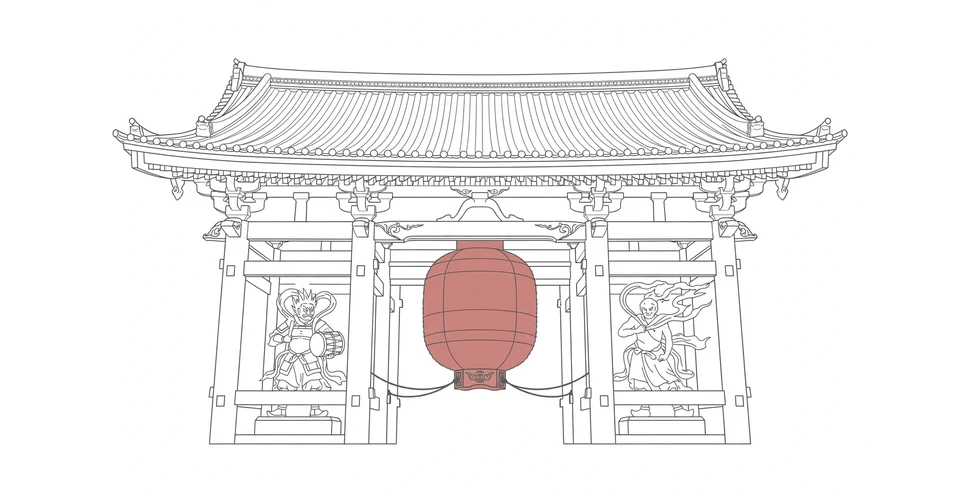
This article follows the Kaminarimon from its first stones in the tenth century to the concrete Kaminarimon that stands there today. The gate rewards a slow look. Its two gods, its two dragons, and its great lantern each tell a different part of the same story, and once you know what to look for, the Thunder Gate stops being a backdrop for photographs and becomes a place worth standing under for a while.
What the name Kaminarimon really means
Kaminarimon is the popular name, and it is the name written on the front of the great lantern. Kaminari means thunder, mon means gate, and the two words together give the Thunder Gate. The official name is longer and more precise. Painted on the back of the lantern are the characters for Furaijinmon, the Gate of the Wind and Thunder Gods, and that name explains what the gate actually is. It is not named for the weather. It is named for the two gods who stand guard in its front alcoves.
Above the lantern hangs a wooden tablet with four characters that read Kinryu-zan, the formal name of Senso-ji itself, the mountain of the golden dragon. The characters read from right to left, in the old style, and most visitors walk under them without noticing. In daily speech, the short name has won. Nobody in Asakusa says Furaijinmon when they give directions. They say the Kaminarimon, and everyone knows exactly where to go.
I like that the gate keeps both names, one for the front and one for the back. A place photographed millions of times a year could easily become a simple postcard, but the Kaminarimon refuses to be simple. Its front is famous and its back is formal, and the difference between the two is the difference between a landmark and a temple gate.
The two gods in front and the two dragons behind
Four statues live in the Kaminarimon, two in the front alcoves and two on the other side, and they divide the Kaminarimon into two different kinds of protection. On the front, facing the street and the city beyond it, stand Fujin, the god of wind, on the east side, and Raijin, the god of thunder, on the west side. They face outward, toward whatever comes from the world, and their job is to guard the temple from storms, floods, and disasters.
Fujin stands with his great bag of winds slung over his shoulders, the same bag that has made him one of the most recognizable gods in Japan. His full story runs from the oldest Japanese chronicle to the gold folding screens of Kyoto, and it is told in Fujin Carries the Wind That Arrives Before the Thunder, which follows the wind god from his strange birth to this very gate. Beside him, his brother Raijin carries his ring of drums, and the pair has stood together at temple gates for centuries, wind first and thunder second, exactly as a summer storm arrives.
Raijin deserves his own look, because the god of thunder is more than the noise that follows the wind. His drums, his fierce face, and his long history are told in Raijin Is the Thunder God Behind Japan's Summer Storms, which explains how a demon born in the land of the dead became a guardian of the temple. Together the two brothers turn the front of the Kaminarimon into a warning and a welcome at once, fierce to look at, yet standing there to protect the people who walk between them.
Turn around and walk back through the gate, and the Kaminarimon shows its second face. On the reverse stand Tenryu, the Buddhist god of the heavenly dragon, on the east side, and Kinryu, the goddess of the golden dragon, on the west side. They face inward, toward the temple, and they guard the grounds from the inside, as if the gate needed one pair of guardians for the world outside and another for the sacred space within. The two dragon deities were donated in 1978 to mark the 1,350th anniversary of the first appearance of the bodhisattva Kannon at Asakusa, and they were carved by the master sculptor Hirakushi Denchu, who was 106 years old at the time.
The statues in front are not the originals. The first sculptures were badly damaged in the fire of 1865, and only their heads were saved. The statues were restored for the rebuilding of the Kaminarimon in 1960, using those surviving heads, so the gods you see today carry faces more than a century and a half old on bodies made in the twentieth century. Almost nothing at the gate is original, and yet the Kaminarimon itself has never really gone away.
A gate that burned down and waited 95 years
The Kaminarimon was first built in the early 940s by the military commander Taira no Kinmasa, the same man who built the first five-storied pagoda of Senso-ji. The temple's own history gives the year as 942, while some other sources say 941, and the honest answer is that the gate is more than a thousand years old and the exact year has blurred with time. It first stood near Komagata, and it was moved to its present place in 1635, when the statues of the wind and thunder gods are believed to have been set in the gate for the first time.
Fire has been the Kaminarimon's oldest enemy. Four years after the move, in 1639, the gate burned down. The third shogun, Tokugawa Iemitsu, had it rebuilt in 1649, along with several other great buildings of the temple, and that rebuilding gave the Kaminarimon the form it kept for the next two centuries. It burned again in 1757, was rebuilt, and then burned to the ground in a great fire that spread from the neighboring district of Tawaramachi in December 1865. That fire took the statues with it, all but their heads, and it took the gate itself.
What happened next is the strangest part of the story. For 95 years, there was no gate at all. Visitors to Senso-ji walked in through an empty space where the great Thunder Gate had stood, and the district grew used to its absence. The gate was finally rebuilt in 1960, and the money came from one man, Konosuke Matsushita, the founder of Matsushita Electric, the company now known as Panasonic. His donation paid for the new Kaminarimon, which was dedicated in December 1960, and the base of the great lantern still carries a small name plate that reads Matsushita Denki, the old name of his company, as a quiet thank you that most visitors never see.
The present Kaminarimon is therefore younger than many visitors guess. It is a concrete structure, not a wooden one, built to survive the fires that destroyed its predecessors, and it has now stood for more than sixty years without burning. The Kaminarimon that looks ancient is, in its bones, a modern building, and that is part of its charm. It carries a thousand years of history in a body made in 1960.
The gate stands 11.7 meters tall and 11.4 meters wide, covering about 69.3 square meters. Those numbers sound modest until you stand under the roof and look up, because the Kaminarimon is built to be walked through, not admired from a distance, and its height is felt in the neck rather than measured in the eye. It is large enough to make a person feel small, and small enough that the street never disappears behind it.
The lantern that weighs as much as a small car
The most famous part of the Kaminarimon is not the gate at all. It is the giant red lantern, the chochin, that hangs under the center of the roof. It is 3.9 meters tall and 3.3 meters wide, and it weighs about 700 kilograms, roughly as much as a small car, hung from a wooden beam above the heads of everyone who passes. Its front carries the gate's name in bold black characters, and its back carries the formal name, Furaijinmon. Underneath, carved into the metal base, is a dragon, a small work of art that rewards anyone who stops and looks up.
The lantern is not permanent. Paper and bamboo do not last forever, especially outdoors, so the great lantern is remade roughly every ten years by Takahashi Chochin, a Kyoto workshop that has made the lantern for generations. The current lantern is the sixth of its line, and each new one is built to the same measurements as the last, so the Kaminarimon never changes even as its most famous part is renewed. There is something reassuring about that. The lantern is rebuilt on purpose, before it fails, and the Kaminarimon goes on looking exactly as it always has.
| Part | Fact |
|---|---|
| Gate | 11.7 meters tall, 11.4 meters wide |
| Lantern | 3.9 meters tall, 3.3 meters wide, about 700 kilograms |
| First built | Early 940s, by Taira no Kinmasa |
| Current gate | Dedicated in December 1960 |
| Back statues | Donated in 1978, carved by Hirakushi Denchu |
Numbers alone do not explain why the lantern matters, but they help. A lantern of that size is not a decoration. It is a piece of street furniture on the scale of a building, and it turns the gate into a meeting point. People say meet me at the lantern, not meet me at the gate, because the lantern is the part you can see from down the street, glowing red against the roof tiles, and it is the part every photograph includes.
Once a year, the lantern does something surprising. During the Sanja Matsuri, the great festival of Asakusa, the lantern is folded up and raised so that the tall portable shrines, the mikoshi, can pass through the gate. For a few days the Kaminarimon stands without its most famous feature, and the gate looks strangely bare. Then the festival ends, the lantern comes down again, and the gate is itself once more. I find that detail touching. Even the most photographed object in Asakusa steps aside when the festival needs the road, and the gate proves that it is still a working gate, not a museum piece.
Walking through the Kaminarimon into old Tokyo
The best way to see the Kaminarimon is to arrive on foot, the way most visitors have arrived for centuries. The gate stands a short walk from Asakusa Station, and the street that leads to it is already full of the district, small shops, food stalls, and the smell of freshly cooked senbei rice crackers. The Kaminarimon appears at the end of the street all at once, red and huge, and the first sight of it is the moment Asakusa begins. The temple's official guide describes Senso-ji as the oldest temple in Tokyo, drawing 30 million visitors a year, and the gate is the door all of them walk through.
Step through the Kaminarimon and you are on Nakamise, one of the oldest shopping streets in Japan, a covered lane of about 250 meters that runs from the Kaminarimon to the second gate, the Hozomon. The street sells traditional toys, cakes, souvenirs, and snacks, and it has been a market street for centuries, because pilgrims have always needed food, charms, and gifts on their way to the temple. The Hozomon, the inner gate, is the second of the two great gates, and beyond it lies the main hall, where the statue of Kannon, found in the Sumida River in the year 628, is kept hidden from view.
The walk from the Kaminarimon to the main hall takes only a few minutes, but it crosses more than a thousand years. The gate you enter through was first built in the tenth century. The street you walk down has sold souvenirs since the Edo period. The hall at the end holds a statue that fishermen pulled from a river in 628. Few places in Tokyo compress that much time into such a short walk, and that is why the approach matters as much as the temple itself. The Kaminarimon is not the destination. It is the beginning of the visit, and it sets the pace for everything after it.
My advice is simple, and it costs nothing. Go early, before the crowds arrive, or go late, when the lantern is lit and the street is quiet. Stand under the lantern and look up at the dragon on its base. Then turn around and look at the two dragons on the back of the Kaminarimon, the ones most visitors never see. The gate rewards the visitor who looks twice, once going in and once coming back, and the second look is always better than the first.
Why the Kaminarimon still works as a gate
Tokyo rebuilds itself constantly, and most of its famous places are younger than they look. The Kaminarimon is honest about that. It does not pretend to be a thousand years old in its timbers. It admits, through its concrete frame and its 1960 dedication, that it was rebuilt by a businessman who loved the temple, and it carries that modern story as proudly as its ancient one. A gate that has burned four times and waited 95 years to return has earned the right to be a little modern.
There is also a lesson in the gate's patience. For nearly a century, Asakusa managed without its most famous landmark, and when the Kaminarimon finally returned, the district welcomed it back as if it had never left. Places can disappear and come back. Memory is longer than timber, and a community that remembers its Kaminarimon can rebuild it. The gate stood missing for longer than most people live, and it still came home, which is a hopeful thought for any place that has lost something it loves.
So the next time you are in Asakusa, do not rush through the Thunder Gate on your way to the temple. Stop under the lantern, read the two names it carries, and notice the gods in front and the dragons behind. The Kaminarimon has stood at the edge of the temple for more than a thousand years, in one form or another, and it will still be there when you leave, watching the street it guards. Gates are meant to be passed through, but the good ones are also meant to be noticed, and this one has been waiting a long time to be noticed properly.
More in Food & Travel
- Nikko and the Shrines Hidden in the Cedar Forest
- The Orangutan and the Vanishing Forests of Borneo
- Hozomon Guards the Treasure House Behind Senso-ji's Main Hall
- Nakamise Is the Shopping Street That Has Fed Pilgrims for Centuries
- Kit Kat Japan, the Flavours You Will Not Find Anywhere Else
- Yakiniku, Japan's Do-It-Yourself Barbecue
Latest posts
- An Engawa Is Neither Inside nor Outside, and That Is the Point
- Minka Are the Folk Houses Japan Built Around the Hearth
- Miyadashi Is the Moment the God Leaves Home
- Otabisho Is Where the God Rests on the Way Through Town
- Mikoshi Are the Portable Shrines Japan Carries on Its Shoulders
- Sanja Matsuri Turns Asakusa Into Tokyo's Loudest Weekend
- Waraji Straw Sandals Walked Japan for a Thousand Years
- Sony, the Tokyo Workshop That Taught the World to Listen
- Fujin Carries the Wind That Arrives Before the Thunder
- Raijin Is the Thunder God Behind Japan's Summer Storms
- Tengu Is the Mountain Goblin Japan Still Meets on the Trail
- Kappa Is the River Imp Japan Still Warns Its Children About
- Calonarang Is the Night Rangda and Barong Finally Meet
- Yamata no Orochi Was Never Just a Monster to Slay
- How Susanoo Slew the Eight-Headed Serpent and Won a Bride