A Butsudan Keeps the Dead Close in a Japanese Home
· 13 min read
A butsudan is the Buddhist family altar kept in a Japanese home, a cabinet where a family honours the Buddha and remembers its dead with daily offerings of rice, water, flowers, and incense.
Step into a Japanese home and, somewhere in the living room, you may find a cabinet that looks like a piece of furniture until its doors open. Behind them is a small gilded world, a Buddha image or scroll at the top, dark lacquered tablets bearing the names of the dead, a small bell, and dishes for rice and water. A butsudan is the Buddhist family altar, the place where a household keeps its dead close and its faith within reach.
The idea is easy to miss and hard to forget once you understand it. Temples are grand and distant, and visiting one is an occasion. The cabinet brings the temple home, into the room where the family eats and talks and sleeps, and it asks for only a minute or two each morning and evening. Open the doors, light a candle, offer rice and water, ring the bell, and the dead are present again, not as a memory in a photograph album but as names on tablets that are greeted every day.
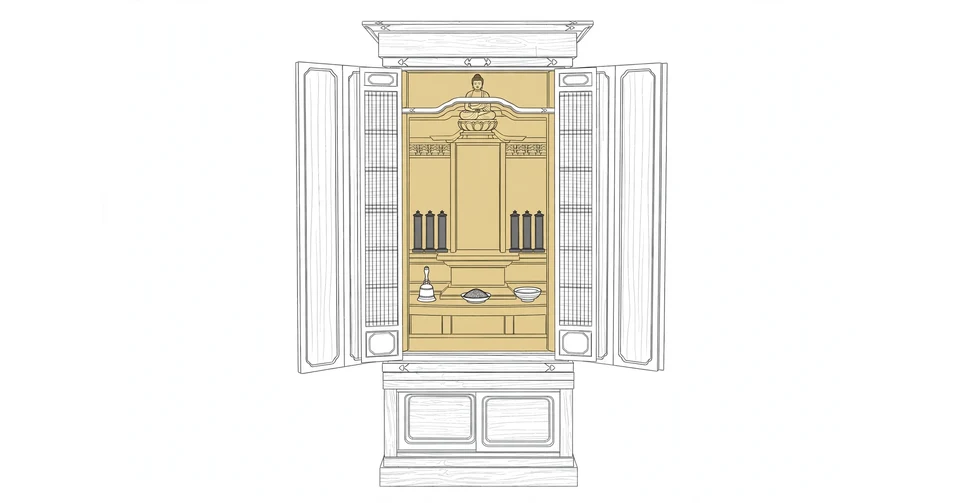
This article explains what a butsudan is, where it came from, what sits inside it, and how a family tends it each day.
What a butsudan is
The word butsudan means, quite literally, Buddhist altar. A butsudan is a small household Buddhist shrine, and its exterior often resembles a simple cabinet with two outward opening doors, though it can also take more elaborate and elegant forms. Inside it houses a religious icon, a Buddhist statue or image, and the name tablets of the family's ancestors, arranged alongside a set of religious items called butsugu.
It is also, in an important sense, unique to Japan. No other Buddhist country keeps home altars in quite this way. In most of Asia, Buddhism is practised at temples. In Japan, the temple came home as well, and the butsudan is the form it took: a small room of its own, opened every day.
A grave is a place you visit. A butsudan is a place that lives with you, honouring not only the recently departed but the generations of the family.
The two stories behind the butsudan
Nobody knows exactly how the butsudan began. There are two theories, and the first is regarded as more likely, but the second has survived because it captures a feeling the first misses.
The first theory begins with the nobility. Some wealthy families had their own jibutsudo, a private Buddha hall, a small building outside the house where a Buddha statue and ancestor tablets were kept. In the Nara period this was a separate structure, and it only began to be placed inside the house during the Heian period. According to the historian Takeda Choshu, the jibutsudo was eventually made smaller, into a butsuma, a room for the Buddha, and then reduced again into what we now know as the butsudan, a cabinet that could be put indoors.
The second theory begins not with the nobility but with the festival of the dead. A tamadana, literally a soul shelf, is an altar set up to greet the spirits of ancestors and the recently deceased during Obon. The folklorist Yanagida Kunio claimed that the tamadana gave birth to the modern butsudan, moving from temporary use during the Bon festival to a place of permanent installation. I find the second theory moving even if it is probably not the true origin. A tamadana is built for a visit, for the days when the dead are believed to return. The cabinet keeps that welcome open all year. The cabinet is, in this telling, a soul shelf that never gets taken down.
An emperor, an edict, and a long wait
On March 27, 685, Emperor Tenmu is said to have issued an edict stating that each family in every province must make a Buddhist altar holding a statue of Buddha and the Buddhist scriptures, and conduct prayer and memorial services before it. The full account of the edict and the two origin theories is told in the Tofugu guide to the butsudan.
But the current cabinet is not directly descended from that edict. The edict is better understood as the beginning of the idea, the claim that a Buddhist altar belongs in the home, rather than the birth of the cabinet itself.
How the butsudan reached ordinary homes
For a long time the cabinet belonged to the wealthy and the devout, and ordinary families did not have one. The change came through the Jodo Shinshu sect, the largest school of Japanese Buddhism, in the Muromachi period, the eighth head of Honganji temple was Rennyo, and he restored the Jodo Shinshu sect and gave his followers scrolls bearing the words namuamidabutsu, an homage to the Buddha of infinite light and life. He encouraged them to enshrine the scrolls at home, and families imitated the head temple by making their altars out of gold. This paved the way for the kin butsudan, the golden butsudan, which remains the most recognisable style today.
The decisive step, though, was political. In the Edo period, from 1603 to 1868, the shogunate created the terauke system, a temple registration system in which Buddhist temples certified people as members of their temple. Under it, each household had to choose a specific temple and install a household altar for morning and evening worship. The practice spread among commoners until the cabinet became an integral part of Japanese family life.
What sits inside a butsudan
Open the cabinet and the first thing you notice is the order. The arrangement and the types of items inside vary by sect and by the size of the cabinet, but the logic is the same everywhere: the most important thing sits highest, and everything else is placed in relation to it. The highest step is called the shumidan, and it is reserved for the most important item in the cabinet, a Buddha statue.
At the heart of every cabinet sits the honzon, the central object of reverence, and it changes with the family's sect. For Pure Land families it is Amida Buddha, for Nichiren families a calligraphic mandala, and for Zen families Shakyamuni, the historical Buddha. In Jodo Shinshu, the honzon is usually not a statue at all but a scroll bearing the words namuamidabutsu, received from the head temple.
Around them are arranged the butsugu, the ritual implements of the altar: an incense burner, candle stands, flower vases, a bell called a rin with its striker, and small vessels for offerings of rice, water, and tea. Below the honzon, or beside it on the lower tiers, stand the ihai, the lacquered memorial tablets that bear the posthumous names of the family dead.
There is one important exception. In Jodo Shinshu, families generally do not place ihai in the altar, because the teaching of the school holds that the dead are already reborn in the Pure Land and need no tablet to anchor them. What stays the same is the intention: the dead are named, and the names are kept daily.
A day with the butsudan
The daily life of the cabinet is a life of small acts, done regularly and without fuss. In a traditional family the cabinet is opened in the morning and closed at night, and the doors are the rhythm of the day. In the morning the family lights the candles and the incense, offers fresh water, tea, or rice, and rings the bell.
The offerings are simple, and their simplicity is the point. The altar does not ask for wealth. It asks for attention, given daily, in the place where the family already lives. A dish of rice placed before the tablets is later eaten by the family, so nothing is wasted. The offering is a sharing, a portion of the family's own meal set aside for those who no longer eat at the table.
The candles matter more than a visitor might guess, and their flame is part of the offering rather than a way to see. Japanese candles burn in Buddhist temples and on the butsudan, the cabinet-like home altar where families remember their dead, and they are lit for Obon and for memorial services. The full story of how those candles are still rolled by hand is told in the account of Japanese candles that are still rolled by hand in Japan, and it is worth reading to understand why the small flame on the altar is made the way it is.
I think the morning routine is the most important thing about the cabinet, more important than its history or its gold leaf. A religion that lives only in temples and festivals is a religion you visit. A religion that opens a cabinet door every morning is a religion you live with.
Golden, dark wood, and furniture styles
Not all cabinets look alike, and the differences are worth knowing if you ever see one in a shop or a home. Specialists usually distinguish four groups: the golden kin butsudan, the dark-wood karaki butsudan, the Kanto style butsudan, and the modern furniture-style butsudan that looks like an ordinary cabinet. Small models for apartments are only 30 to 40 centimetres wide, and they are made to fit a life lived in a single room. The Suki Desu guide to the butsudan describes all four styles in detail.
Its interior is covered in gold leaf, its carving is elaborate, and it glows when the doors open, even in a dim room. The karaki butsudan is its opposite in mood: dark wood, lacquered and restrained, with the beauty in the grain and the finish rather than in gold.
Making a butsudan is a craft with many steps, from woodworking and lacquer to gold leaf and carving. Production peaked in the 1980s and has declined significantly since then, as fewer families buy large altars and more choose small or furniture-style models. A new cabinet is consecrated in its own ceremony, the kaigen kuyo, the moment the cabinet stops being furniture and becomes an altar.
A butsudan and a kamidana under one roof
Many visitors to Japan confuse the cabinet with the kamidana, and the confusion is understandable, because both are small wooden altars kept in the home, and many houses have both. But they belong to different traditions, honour different beings, and are cared for in different ways. The butsudan is Buddhist, while the kamidana is the Shinto home altar. The kamidana usually stands high on a wall and holds objects for the kami, the Shinto deities. The cabinet, by contrast, is associated with the Buddha, the bodhisattvas, and deceased relatives.
The differences are practical as well as theological. A kamidana is usually open, its miniature shrine standing on a high shelf where anyone in the room can see it. The butsudan is usually a cabinet with doors, often large and lacquered, standing on the floor or on a low stand, and its doors are opened for prayer and closed afterwards. The kamidana is tended with water and rice in the morning. The cabinet is tended with incense and the ringing of a small bell.
There is one rule about placement that shows how seriously the two altars are taken. A household may keep both, but they are not placed facing each other, so that the two sacred places of the house do not stare at each other across the room. The kami and the ancestors have different jobs, and the house has room for both. The full story of the Shinto altar is told in the account of how a kamidana brings the shrine into the Japanese home, and it is worth reading alongside this article to see both sides of the same house.
Obon and the return of the dead
If there is one season when the cabinet matters most, it is Obon, the festival when the dead are believed to return. During Obon in summer, the altar has a special meaning, because the return of the ancestors is celebrated, and the home altar plays a central role in the rites of the season. The doors are opened wide, the offerings are fuller than usual, the candles burn longer, and the family gathers.
The cabinet is central to welcoming them because it is where the welcome has been rehearsed all year. A family that opens the cabinet every morning does not need to learn how to greet the dead in Obon. It already knows. The festival only makes sense because the daily practice exists. Obon without a cabinet tended all year would be a performance. With it, Obon is a homecoming.
Living with a butsudan today
The cabinet survives in modern Japan, but it survives in a changed form, and the changes are worth noticing honestly. In big cities apartments are smaller, and not every family sets up a large altar. The share of households with an altar is higher in rural areas than in cities, and the number is falling, especially in cities, because of living space and because of the question of who takes care of the altar and pays for it.
The survival of the butsudan in this smaller form raises a question worth asking honestly. Is a cabinet the size of a bookshelf, with a single scroll and a dish of water, still a butsudan, or is it only a reminder of one? I think the answer is the same as it is for any sacred object that has been simplified by modern life. It is still a butsudan, because the cabinet was never defined by its size or its gold leaf. It was defined by a relationship, a family and its dead, kept alive by a daily act of attention. What cannot be set aside is the act itself. As long as it continues, the cabinet continues, whatever shape it takes.
That is, in the end, the lesson of the cabinet, and it is a lesson that has nothing to do with Buddhism alone. The butsudan argues that remembering can live in a cabinet in the living room, among the rice and the tea and the drying laundry, and that it can be tended in a minute a day, with water from the tap and incense from a drawer. It does not ask for a pilgrimage. It asks for attention, given daily, in the place where you already live. And that, quietly and without fuss, is enough.
More in Culture & Society
- Miyadashi Is the Moment the God Leaves Home
- Otabisho Is Where the God Rests on the Way Through Town
- Mikoshi Are the Portable Shrines Japan Carries on Its Shoulders
- Sanja Matsuri Turns Asakusa Into Tokyo's Loudest Weekend
- Waraji Straw Sandals Walked Japan for a Thousand Years
- Fujin Carries the Wind That Arrives Before the Thunder
Latest posts
- An Engawa Is Neither Inside nor Outside, and That Is the Point
- Nikko and the Shrines Hidden in the Cedar Forest
- Minka Are the Folk Houses Japan Built Around the Hearth
- The Orangutan and the Vanishing Forests of Borneo
- Hozomon Guards the Treasure House Behind Senso-ji's Main Hall
- Nakamise Is the Shopping Street That Has Fed Pilgrims for Centuries
- Kaminarimon Is the Thunder Gate That Opens Asakusa to the World
- Sony, the Tokyo Workshop That Taught the World to Listen
- Raijin Is the Thunder God Behind Japan's Summer Storms
- Tengu Is the Mountain Goblin Japan Still Meets on the Trail
- Kappa Is the River Imp Japan Still Warns Its Children About
- Calonarang Is the Night Rangda and Barong Finally Meet
- Yamata no Orochi Was Never Just a Monster to Slay
- Kit Kat Japan, the Flavours You Will Not Find Anywhere Else
- How Susanoo Slew the Eight-Headed Serpent and Won a Bride