Hozomon Guards the Treasure House Behind Senso-ji's Main Hall
· 14 min read
Hozomon is the inner gate of Senso-ji in Asakusa, a two story gate that guards the main hall, houses temple treasures upstairs, and carries two Nio statues and a pair of giant straw sandals.
Most visitors walk straight through the Hozomon without knowing they have passed through a treasure house. They come up the Nakamise shopping street, they pass under a great red lantern, and they step into the open ground in front of the main hall of Senso-ji. The gate behind them was the last threshold, and it was also the most interesting one. Hozomon is the inner gate of Senso-ji in Asakusa, Tokyo, and it does three jobs at once. It guards the approach to the main hall, it stores some of the temple's most precious treasures on its upper floor, and it carries two guardian statues and a pair of giant straw sandals that most visitors never see.
The gate is easy to miss because its famous neighbour steals the attention. The Kaminarimon, the thunder gate at the street end of Nakamise, is the symbol of Asakusa, and almost every visitor photographs it. Hozomon stands at the other end of the street, quieter and plainer, and it rewards the people who slow down.
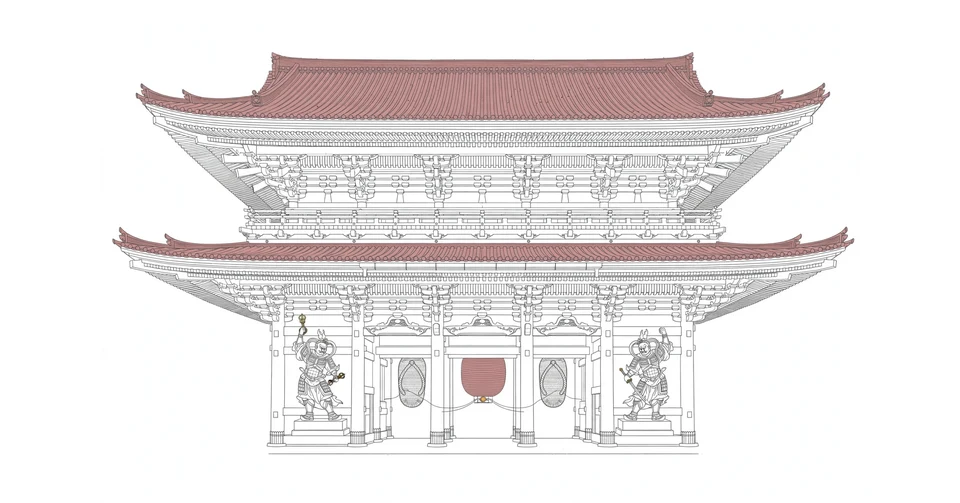
That is the right way to meet the Hozomon, not as a photo stop but as a place with a purpose. The name itself tells you the purpose. Hozomon means treasure house gate, and the upper story of the gate really is a storehouse. The treasures are not on display, and the upper floor is not open to visitors, but knowing they are there changes the way the gate feels. You are walking under a vault, not just a roof.
What the name Hozomon means
The name Hozomon comes from the Japanese words for treasure and storehouse, and it describes exactly what the gate became. The gate was not always called that. For most of its life it was known as the Niomon, the gate of the Nio, after the two fierce guardian statues that stand on its south face. The name changed only when the gate took on a new job during its most recent rebuilding. When the present gate was built in 1964, its upper story was made into a fire resistant storehouse for the temple's sutras and treasures, and the gate earned its new name.
The change of name is a small detail, but it says something about how Japanese temples think about their buildings. A gate is not only a doorway. It can also be a safe, a library, and a piece of the temple's memory. The Hozomon keeps its treasures out of sight, in a room no visitor will ever enter, and that quiet storage is part of the point. The most valuable things in a temple are often the ones nobody sees, and a name learned before you go turns a passage into a place.
A gate first built in 942 and rebuilt after fire
The Hozomon has a history almost as old as the temple it guards. According to the temple's own account, the first gate on this spot was built in 942 by the military commander Taira no Kinmasa, the same commander who is credited with building the first Kaminarimon. Senso-ji itself is older still. Its story begins in 628, when two fishermen are said to have pulled a statue of the bodhisattva Kannon from the Sumida River, and the temple that grew around that statue is the oldest in Tokyo.
Fire has shaped the gate's history more than any other force. The original gate burned in the 17th century and was rebuilt under Tokugawa Iemitsu, the third Tokugawa shogun, who was also rebuilding much of the temple complex. The temple's official history dates that Iemitsu era gate to 1649, while one other history gives 1636 for the same rebuilding, so the exact year is uncertain, but the shape of the story is clear. The gate burned, a shogun rebuilt it, and it stood for three hundred years.
Then came the night of March 10, 1945, when the great Tokyo air raid destroyed the main hall, the five storied pagoda, and the Hozomon itself. The main hall was rebuilt in 1958 with donations from followers across Japan, and the Hozomon followed in 1964. The money for the new gate came from Yonetaro Otani, the founder of Otani Heavy Industries and the Hotel New Otani, and his wife. The new gate was built in steel and reinforced concrete, a deliberate choice after fire had taken the old wooden gate twice. It looks traditional, but its bones are modern, and that is why it can safely hold the treasures upstairs.
I find that history moving in a way that a single beautiful building is not. The Hozomon is not an ancient survivor. It is a 1964 rebuilding of a 1649 gate that replaced a 942 gate, and each version carried the same job forward. The temple did not give up on the gate after the fire. It rebuilt the gate, and then it trusted the new gate with its most precious books.
The two Nio guardians on the south face
The reason the gate was once called the Niomon is still standing on its south face, the side that faces the Nakamise and the crowds coming up the street. Two Nio statues, also called Kongo Rikishi, stand in niches on either side of the passage. They are the guardian deities of the Buddha, fierce muscled figures whose job is to protect the sacred ground from evil and to frighten away anything that would harm it.
The statues are about five metres tall, and sources differ slightly on the exact height, with one giving 5.45 metres and another giving figures closer to four and a half and five metres for the two figures. Stand beside the base and the scale becomes real. These are not decorations. They are presences, carved from Kiso cypress, and they have watched every visitor to the temple for decades.
The two figures are a pair, and they work as a pair. One is Agyo, with his mouth open, and the other is Ungyo, with his mouth closed. The open mouth speaks the first sound of the Sanskrit alphabet, and the closed mouth speaks the last, so together they hold the beginning and the end of all things. It is a quiet piece of theology built into two loud statues, and it is worth knowing before you look at them, because otherwise they are only two angry giants. With the story in mind, they become a sentence, and the gate becomes a place where a visitor passes between the first sound and the last.
Look at their faces rather than only their size. The carving is detailed, the muscles are taut, the expressions are fierce but not cruel. They are not threatening the visitor. They are threatening whatever would follow the visitor in with bad intent. That distinction matters, because it is the whole idea of a temple guardian. The gate does not keep people out. It keeps harm out, and it lets people through.## The giant straw sandals on the back of the gate
Here is the part most visitors miss, and it is the best reason to slow down at the Hozomon. Walk through the gate, then turn around. On the north face, the side that faces the main hall, hang two enormous straw sandals, waraji, each about 4.5 metres long and 1.5 metres wide. They are hand woven from rice straw, and sources give their weight as somewhere between 400 and 500 kilograms each, so the honest figure is several hundred kilograms per sandal. They are far too large for any human foot, and that is exactly the point.
The sandals are an offering, donated by people from Murayama City in Yamagata Prefecture, far to the north of Tokyo, and they are replaced roughly once a decade. The current pair was dedicated in October 2018. They are made from about 2,500 kilograms of rice straw, woven by volunteers, and they are a sign of the Nio guardians' strength. The idea is simple and charming. If a demon sees footwear this size hanging on the gate, it will assume that the guardians who wear such sandals are far too large to fight, and it will think better of approaching the temple.
The practical advice follows from that. Most people walk through the Hozomon facing forward, toward the main hall, and they never see the sandals at all. The sandals are behind you the moment you pass through. So the rule for the Hozomon is simple. Walk through, stop on the far side, and turn around. The gate has two faces, and the back face is the more surprising one.
The lanterns that light the passage
The Hozomon is also a gate of lanterns, and the lanterns are part of its character. The largest is a red chochin paper lantern that hangs under the centre of the gate's opening, above the heads of the people passing through. It is 3.75 metres tall and 2.7 metres wide, and it weighs about 400 kilograms. It carries the name of Kobunacho, a town in the old merchant district of Tokyo, whose people donated it. The current lantern dates from 2003, when the people of Kobunacho gave money to mark the 400th anniversary of the start of the Edo period.
On either side of the great red lantern hang two copper toro lanterns, each about 2.75 metres tall and weighing roughly 1,000 kilograms. The three lanterns together make the passage feel like a room rather than a tunnel, and on a grey day the red lantern is the warmest colour in the whole temple ground.
One practical detail is worth knowing. All three lanterns are removed during festivals such as the Sanja Matsuri, the great festival of the neighbouring Asakusa Shrine, so that the portable shrines can pass through the gate. If you visit during a festival weekend in mid May, the gate will look strangely bare, and the lanterns will be gone. That is not damage. It is the gate making way for the festival, which is its oldest job of all.
The treasures stored upstairs
The upper story of the Hozomon is the reason for its name, and it is also the part of the gate that no visitor will ever see. The second story is a storehouse, and it holds some of the most precious objects at Senso-ji. Among them is a copy of the Lotus Sutra that is designated a Japanese National Treasure, and the Issai-kyo, a complete collection of Buddhist scriptures that is designated an Important Cultural Property. The temple also keeps other statues and scriptures there, including figures of Shakyamuni and the Four Heavenly Kings.
The upper floor is not open to the public, and it never has been. That is not a disappointment to be worked around. It is the design. The treasures are kept in a fire resistant room in a concrete gate precisely so that they will survive, and the temple's judgment is that their survival matters more than their display. The Lotus Sutra copy upstairs is one of the most valued objects in Japanese Buddhism, and it sits in silence above the heads of thirty million visitors a year, which is the number the temple gives for its annual crowd. It takes confidence to keep the best thing hidden and to trust that the building itself is enough.
Hozomon and Kaminarimon, two gates with two jobs
The Hozomon makes most sense when it is set against its partner at the other end of the Nakamise. The Kaminarimon is the outer gate, the thunder gate, the symbol of Asakusa and the first thing a visitor meets. Its guardians are Fujin and Raijin, the gods of wind and thunder, and its great red lantern is one of the most photographed objects in Japan. It was first built more than a thousand years ago, it burned in a fire in 1865, and the present gate was rebuilt in 1960 with a donation from Konosuke Matsushita, the founder of Panasonic.
The Hozomon is the inner gate, the treasure house gate, the last thing a visitor passes before the main hall. Its guardians are the Nio, its lantern is smaller, and its treasure is hidden upstairs. Where the Kaminarimon welcomes, the Hozomon guards. Where the Kaminarimon is a symbol, the Hozomon is a storehouse. The two gates divide the work of the temple between them, and the Nakamise runs between them, which is why the old description of the street still works. The Nakamise street runs from the Kaminarimon to the second gate, the Hozomon, and that short walk is a journey from welcome to protection.
The difference is also a difference in mood. The Kaminarimon is loud, crowded, and joyful, a place for photographs and first impressions. The Hozomon is quieter, and the crowd thins a little as people pass under it toward the hall. A temple needs both, a door that says come in and a door that says this ground is sacred. Asakusa has both, and the walk between them, past ninety small shops, is the space where a visitor changes from a shopper into a pilgrim.
How to walk through the Hozomon well
The practical advice for the Hozomon is short, because the gate asks for very little. Come up the Nakamise slowly, and remember that the street itself is part of the temple approach, not a detour from it. The Nakamise has fed pilgrims for centuries, and the snacks and souvenirs along its 250 metres are the reason the street exists. Eat one thing at a stall, finish it, and then walk on. By the time you reach the Hozomon, the noise of the street will have faded a little, and the gate will feel like a change of air.
Stop before the gate and look up at the Nio statues. They are on the south face, the side you approach from, and they are easy to see once you look for them. Then walk through the passage under the red lantern, and stop again on the far side. Turn around and look at the giant straw sandals on the back of the gate. That turn is the whole visit, and it takes less than a minute, but it is the difference between passing through the Hozomon and actually seeing it.
Go early if you can. The temple grounds are at their best in the late morning, when the shops of the Nakamise are fully open and the crowds are still thin, and the official Senso-ji site gives the temple's history and its yearly festivals for planning a visit. Japan Guide's Asakusa page is a useful companion for the wider district, from the shrine beside the temple to the streets beyond it. If you visit in mid May, expect the Sanja Matsuri, one of Tokyo's great festivals, and expect the lanterns of the Hozomon to be gone for the weekend, removed so the portable shrines can pass.
Photographs are welcome, and the gate photographs well from the south side, with the Nio statues framing the passage. But the best photograph of the Hozomon is the one taken from the far side, looking back at the sandals, because that is the view most people never take. Step to the side before you stop, so you do not block the flow of people, and remember that the people around you are not only tourists. Many of them are worshippers on their way to the main hall, and the gate is their threshold too.## Why a gate that stores books matters
The Hozomon matters because it is a reminder that a temple is not only a place to look at. It is a place that keeps things, and the things it keeps are the reason it exists. The gate stores a copy of the Lotus Sutra and a complete collection of Buddhist scriptures, and it does so in silence, above the heads of a crowd that mostly does not know they are there. The Nio guard the door, the sandals warn off evil, the lantern lights the way, and upstairs, out of sight, the books wait.
That arrangement has survived fire, war, and rebuilding, and it has survived because the temple understood what the gate was for. The Kaminarimon welcomes the world in. The Hozomon guards what the world came to find. Walk in, buy something small, pass under the lantern, turn around to see the sandals, and then step into the ground before the main hall. The Hozomon will have done its work, and you will have done yours, which is simply to notice it.
More in Food & Travel
- Nikko and the Shrines Hidden in the Cedar Forest
- The Orangutan and the Vanishing Forests of Borneo
- Nakamise Is the Shopping Street That Has Fed Pilgrims for Centuries
- Kaminarimon Is the Thunder Gate That Opens Asakusa to the World
- Kit Kat Japan, the Flavours You Will Not Find Anywhere Else
- Yakiniku, Japan's Do-It-Yourself Barbecue
Latest posts
- An Engawa Is Neither Inside nor Outside, and That Is the Point
- Minka Are the Folk Houses Japan Built Around the Hearth
- Miyadashi Is the Moment the God Leaves Home
- Otabisho Is Where the God Rests on the Way Through Town
- Mikoshi Are the Portable Shrines Japan Carries on Its Shoulders
- Sanja Matsuri Turns Asakusa Into Tokyo's Loudest Weekend
- Waraji Straw Sandals Walked Japan for a Thousand Years
- Sony, the Tokyo Workshop That Taught the World to Listen
- Fujin Carries the Wind That Arrives Before the Thunder
- Raijin Is the Thunder God Behind Japan's Summer Storms
- Tengu Is the Mountain Goblin Japan Still Meets on the Trail
- Kappa Is the River Imp Japan Still Warns Its Children About
- Calonarang Is the Night Rangda and Barong Finally Meet
- Yamata no Orochi Was Never Just a Monster to Slay
- How Susanoo Slew the Eight-Headed Serpent and Won a Bride