The Orangutan and the Vanishing Forests of Borneo
· 14 min read
The orangutan shares about 97 percent of our DNA and spends almost its whole life in the trees, yet all three species are now critically endangered as the forests of Borneo and Sumatra shrink.
The name says it all. In Malay, orang means person and hutan means forest, so an orangutan is a person of the forest. Spend an afternoon watching one move through the canopy and the name stops sounding like poetry. The long arms, the thoughtful face, the way it studies a branch before trusting it with its weight, all of it looks familiar in a way that is hard to shake. Humans and the orangutan share about 97 percent of their DNA, and the resemblance is not only skin deep.
Yet the animal that feels so close to us is slipping away. All three species are now listed as critically endangered, the highest warning level on the IUCN Red List. Their home is shrinking, cut into smaller and smaller patches by logging, fire, and plantations. The story of this ape is therefore two stories at once. One is about a remarkable ape that lives almost entirely in the trees. The other is about what happens when the trees go.
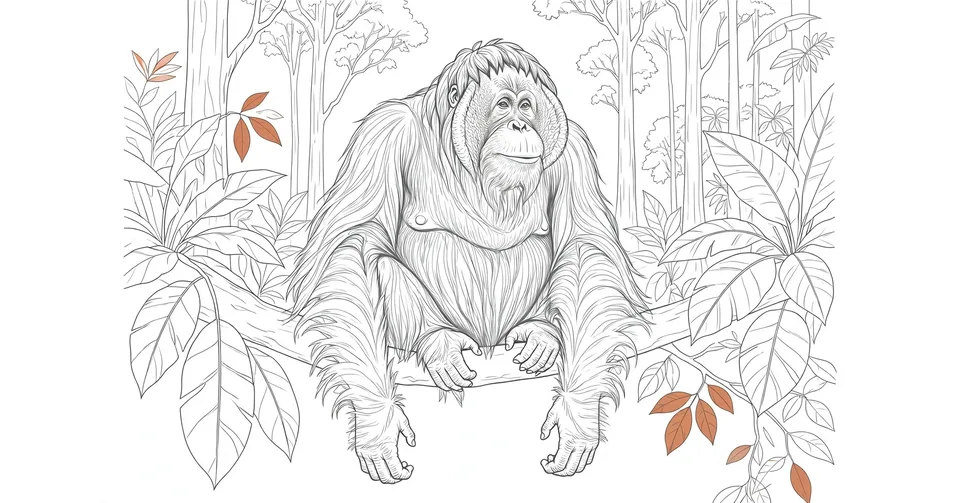
The good news is that it is not gone, and the places that protect it are some of the most extraordinary corners of Southeast Asia. In Central Kalimantan, visitors drift up black rivers on wooden houseboats to watch wild orangutans at feeding stations deep in the forest. In Sumatra, a village at the edge of a national park has built a whole economy around showing travellers the apes without disturbing them. Seeing one in the wild takes effort, patience, and a willingness to travel far from the usual tourist trail, but that is exactly what makes it worth doing.
The person of the forest
The orangutan is a great ape, not a monkey. Apes have no tail, larger brains for their body size, and a more upright posture, and it belongs to the same family as gorillas, chimpanzees, and humans. It is the only great ape native to Asia, and it is by far the most tree dwelling of the group. Gorillas live mostly on the ground and chimpanzees split their time, but an orangutan rarely comes down at all, especially in Sumatra, where tigers roam the forest floor.
The body is built for the canopy. An adult male Bornean orangutan weighs between 50 and 100 kilograms and stands up to about 1.4 metres tall, while females weigh roughly 30 to 50 kilograms. The arms are the striking part. They can span more than two metres, and the shoulder and hip joints are so flexible that each limb can move easily in almost any direction. The hands and feet are nearly identical, with long curved fingers and short thumbs that hook over branches. A male can weigh as much as a person and still move through the treetops with a grace that looks unhurried, almost lazy, until you notice how carefully every movement is planned.
Fully grown males develop the feature that makes them unmistakable. Wide cheek pads, called flanges, grow out from the face, and a large throat sac hangs below the chin. The throat sac lets the male produce a deep, booming long call that carries through the forest for a kilometre or more. The call announces his presence to females and warns other males to keep their distance. It is one of the loudest sounds in the rainforest, and hearing it for the first time is the kind of moment travellers remember for years.
They are also famously intelligent. They use tools, they learn by watching, and different populations have distinct habits that are passed on through social learning, a trait once thought to belong only to humans. In captivity they have learned to use symbols, solve puzzles, and wash their own dishes. In the wild, they choose the right stick to extract honey or seeds, and they fold leaves into a glove before handling spiny fruit. Watch one open a durian, the spikiest fruit in Southeast Asia, and you will understand why durian is one of their favourite foods.
Three species, one shrinking home
There are three species of orangutan, and each lives in a different corner of the same two islands. The Bornean orangutan, Pongo pygmaeus, is the most numerous and lives only on Borneo. The Sumatran orangutan, Pongo abelii, lives only in the far north of Sumatra, mostly in Aceh and North Sumatra. The Tapanuli orangutan, Pongo tapanuliensis, was only described as a separate species in 2017. It lives in the Batang Toru forest south of Lake Toba, in an area of about 1,000 square kilometres, and fewer than 800 remain, making it the rarest great ape on Earth.
| Species | Where it lives | How many are left |
|---|---|---|
| Bornean | Borneo | Roughly 45,000 to just over 100,000, depending on the survey |
| Sumatran | Northern Sumatra | Fewer than 14,000 |
| Tapanuli | Batang Toru, Sumatra | Fewer than 800 |
Borneo itself is the third largest island in the world, at 743,330 square kilometres, and it is divided among three countries. Most of it is Indonesian Kalimantan, with the Malaysian states of Sabah and Sarawak in the north and the small nation of Brunei on the coast. The ape needs tall, fruit rich forest, and that is exactly the forest that has been disappearing fastest. Lowland rainforest is the easiest to log, the easiest to burn, and the easiest to turn into plantations, so the animal that depends on it has been squeezed into the fragments that remain.
The IUCN reclassified the Bornean orangutan as critically endangered in 2016, and the Sumatran and Tapanuli species carry the same status. The main threats are the same across both islands. Forest is cleared for palm oil plantations, logged illegally, and lost to fires that spread through drained peat swamps. Hunting still takes a toll, and orphaned babies sometimes end up in the illegal pet trade. The numbers tell the story plainly enough, but the real loss is harder to count. Every patch of forest that disappears takes with it the fruit trees an orangutan knows, the nest sites it returns to, and the routes it has travelled for years.
A life spent in the trees
An orangutan spends almost its entire life above the ground. It eats, sleeps, travels, and raises its young in the canopy, and it comes down only when it must. The diet is dominated by fruit, and wild figs and durians are favourites, supplemented with leaves, bark, flowers, insects, honey, and the occasional bird egg. Because fruit ripens in different trees at different times, it must know its forest intimately, remembering which trees fruit in which season and how far apart they stand. A female may range over several square kilometres, and she passes that knowledge to her young over years of close company.
Every night, it builds a fresh nest of branches high in the canopy. It bends and weaves a platform, sometimes adding a roof of leaves or a pillow of soft twigs, sleeps in it once, and abandons it in the morning. A single animal may build more than 10,000 nests in a lifetime, which makes it one of the most prolific builders in the animal kingdom, even though almost nobody ever sees the work. In the wild, they live about 35 to 40 years, and in captivity some reach 60. That long life is part of the problem for conservation. They reproduce slowly, a mother raises one baby at a time for many years, so a population that loses adults cannot bounce back quickly.
The slow pace of life is also what makes watching them so absorbing. Nothing about the animal is hurried. It moves deliberately, tests each branch, pauses to eat, and looks around with an attention that feels almost human. People who have watched one for an hour often say the same thing afterwards. It did not feel like watching an animal. It felt like being watched back.
Where to see an orangutan in the wild
The best known place to see a wild orangutan is Tanjung Puting National Park in Central Kalimantan. The park covers 415,040 hectares of lowland forest and peat swamp between Kumai Bay and the Seruyan River. It was first set aside as a game reserve in 1936, became a national park in 1984, and was recognised as a UNESCO Biosphere Reserve in 1977. It holds the largest wild population of Bornean orangutans on the planet, and it is also the site of Camp Leakey, the research and rehabilitation centre founded in 1971 by primatologist Birute Galdikas. Visitors travel up the blackwater rivers aboard klotok, traditional wooden houseboats, sleeping on deck under mosquito nets and waking to the sound of the forest.
The other great stronghold is Sebangau National Park, also in Central Kalimantan. Created as a national park in 2004, it covers about 568,700 hectares of peat swamp forest and is home to between 6,000 and 9,000 of them, one of the largest populations anywhere. It is less visited than Tanjung Puting, and the trips there feel rougher and more remote, but the reward is the same, wild orangutans in a forest that still stretches to the horizon.
In Sumatra, the usual gateway is Bukit Lawang, a village on the edge of Gunung Leuser National Park. Guides lead small groups into the forest to look for the Sumatran species, which is slimmer and paler than its Bornean cousin, with a longer beard and flatter cheek pads. Across the strait in Malaysian Borneo, the Sepilok Rehabilitation Centre in Sabah and the Semenggoh Wildlife Centre in Sarawak care for orphaned and injured apes and return them to the forest. Both centres let visitors watch feeding times from a platform, which is the closest most people will ever get to a wild one without a multi day trek. The best known places to see orangutans in the wild include these centres along with Gunung Leuser in Sumatra and the Kinabatangan River in Sabah.
Wherever you go, the rules are the same, and they matter. Keep a distance of several metres, never feed the animals, never call out to them, and follow the guide. They share so much of our biology that they can catch our diseases, and a cold that is a nuisance to a tourist can kill an ape. The distance is not just politeness. It is protection, and it runs both ways. A wild male is enormously strong, and the guides who keep you at a safe distance are keeping you safe too.
Why the forest is vanishing
The ape is losing its home for reasons that have little to do with the animal itself. Palm oil is the main driver. The oil palm grows well in exactly the lowland climate the orangutan needs, and plantations have replaced vast areas of forest in both Borneo and Sumatra. Logging, both legal and illegal, removes the big fruit trees first, the same trees the orangutan depends on. Peat swamps are drained for farming, which dries them out and turns them into tinder, and in dry years fires burn for months, filling the air with smoke and destroying forest that took centuries to grow.
The scale of the loss is difficult to grasp from a single statistic, but one figure gives a sense of it. Borneo has lost about half of its forest cover in recent decades, and the lowland forest it needs has been hit hardest of all. What remains is fragmented, broken into islands of green separated by roads, fields, and plantations. It can cross a gap in the canopy by swinging from branch to branch, but it cannot cross a plantation or a highway. Fragmentation isolates populations, and isolated populations shrink, because animals cannot find mates, cannot reach new food sources, and cannot escape fire or disease.
It would be easy to tell this part of the story as a simple tragedy, and it would be easy to blame the people who live near the forest, but that would miss the point. The palm oil that replaces the forest ends up in products used all over the world, in food, cosmetics, and fuel. The demand is global, which means the responsibility is global too. The farmers who plant oil palm are often smallholders trying to earn a living from land that was already cleared. The companies that clear forest on an industrial scale are a different matter, and they are the ones conservation groups are trying to hold to account.
What saving the orangutan actually takes
Protecting the orangutan is not really about the ape alone. Conservationists call it an umbrella species, which means that if its home range is protected, many other species are automatically protected along with it. The same forest that shelters it also shelters clouded leopards, sun bears, hornbills, proboscis monkeys, and thousands of plants found nowhere else on Earth. Save the canopy and you save all of them at once. Lose the canopy and you lose them together, which is what makes the stakes so high.
The work that is already happening shows what success looks like. Large national parks like Tanjung Puting and Sebangau keep the core habitat intact, and patrols inside them fight logging and fire. Rehabilitation centres rescue orphans, teach them to climb and forage, and release them back into protected forest. Local communities run patrols, fight fires, and earn a living from tourism instead of clearing. In Bukit Lawang, the village that once lived off logging now lives off guiding, and that change happened because visitors kept coming and paying to see the forest standing.
There is also a quieter, less visible kind of progress. Certification schemes for sustainable palm oil now cover a meaningful share of production, and buyers who insist on certified oil give plantations a reason to stop clearing new forest. It is imperfect, and critics are right to point out the gaps, but it is better than the alternative, which is no standard at all. The honest answer is that no single measure will save the orangutan. Parks, patrols, rehabilitation, certification, and tourism all have to work together, and they all have to keep working for decades, because the forest grows back slowly and the ape reproduces slowly too.
I think the orangutan deserves that patience. It is easy to care about an animal that looks back at you with recognition, and the orangutan does exactly that. But the deeper reason is simpler. The forest that the orangutan needs is the same forest that stores carbon, steadies the climate, and holds a share of the living world that exists nowhere else. When a species that shares 97 percent of our DNA is pushed to the edge of extinction by the way we use land, the question is not really about the ape. It is about what kind of neighbours we intend to be.
A forest worth the journey
The orangutan will not wait for us to decide. Every year, more forest is cleared and more habitat is broken apart, and every year the remaining populations grow a little more isolated. But the places that protect it are still there, still wild, and still reachable, and the people who work in them are still working. A trip to Tanjung Puting or Bukit Lawang is not a safari in the usual sense. It is slow, quiet, humid, and sometimes uncomfortable, and it asks the visitor to be patient. That is the point. The orangutan lives at the pace of the forest, and the only way to meet it is to slow down to that pace.
If you go, go with a reputable operator, keep your distance, and remember that you are a guest in the only home this animal has ever known. The orangutan has survived for millions of years in the rainforests of Borneo and Sumatra. Whether it survives the next hundred years depends less on the ape than on us, and on whether we are willing to leave enough forest standing for a person of the forest to live in.
More in Food & Travel
- Nikko and the Shrines Hidden in the Cedar Forest
- Hozomon Guards the Treasure House Behind Senso-ji's Main Hall
- Nakamise Is the Shopping Street That Has Fed Pilgrims for Centuries
- Kaminarimon Is the Thunder Gate That Opens Asakusa to the World
- Kit Kat Japan, the Flavours You Will Not Find Anywhere Else
- Yakiniku, Japan's Do-It-Yourself Barbecue
Latest posts
- An Engawa Is Neither Inside nor Outside, and That Is the Point
- Minka Are the Folk Houses Japan Built Around the Hearth
- Miyadashi Is the Moment the God Leaves Home
- Otabisho Is Where the God Rests on the Way Through Town
- Mikoshi Are the Portable Shrines Japan Carries on Its Shoulders
- Sanja Matsuri Turns Asakusa Into Tokyo's Loudest Weekend
- Waraji Straw Sandals Walked Japan for a Thousand Years
- Sony, the Tokyo Workshop That Taught the World to Listen
- Fujin Carries the Wind That Arrives Before the Thunder
- Raijin Is the Thunder God Behind Japan's Summer Storms
- Tengu Is the Mountain Goblin Japan Still Meets on the Trail
- Kappa Is the River Imp Japan Still Warns Its Children About
- Calonarang Is the Night Rangda and Barong Finally Meet
- Yamata no Orochi Was Never Just a Monster to Slay
- How Susanoo Slew the Eight-Headed Serpent and Won a Bride