Japanese Noh Theatre and the Slowest Drama on Earth
· 14 min read
Japanese Noh theatre is a masked dance drama that has been performed for more than 600 years. This guide explains its history, its five kinds of play, its masks, and how to watch your first performance.
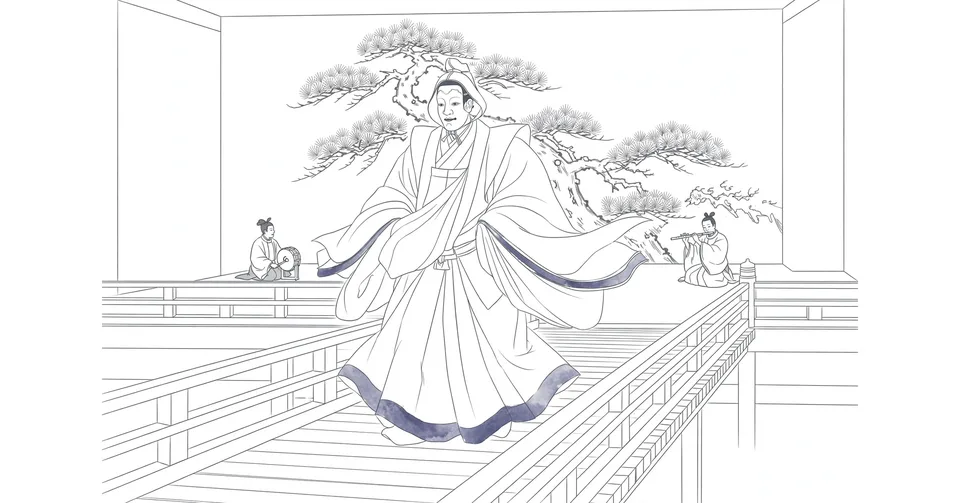
A single actor crosses a wooden bridge so slowly that you can hear the flute before you see him. He wears a carved mask, a silk robe heavy with gold thread, and he moves as if time itself has agreed to wait. That is Japanese Noh theatre, Japan's oldest surviving stage art, and it has been performed in almost the same form for more than 600 years.
Japanese Noh theatre is not a play in the way most visitors expect a play to be. There is no scenery to speak of, no quick dialogue, and no plot twist waiting in the second act. Instead there is a ghost, a god, or a grieving woman, a chorus that sings what the actor cannot say, and a silence so deliberate it feels like part of the music. Once you understand what you are watching, the slowness stops feeling strange and starts feeling like the point.
What Japanese Noh theatre is
The word Noh means skill or talent, and the art is a dance drama that combines chant, music, dance, and masks. Its plots usually come from classical literature and old tales. In most plays, a supernatural being takes human form and tells its story to a living person, often a travelling priest who listens and asks questions. The ghost might be a warrior who died in battle centuries ago, a woman who cannot let go of a lost love, or a god who has come to bless a place.
Japanese Noh theatre grew out of older entertainments. Its roots reach back to sangaku, a form of acrobatics and comic performance that came from China in the 8th century, and to sarugaku, the popular comic theatre of the Kamakura period. By the 14th century, sarugaku troupes were performing a more serious kind of drama, and that drama became what we now call Japanese Noh theatre. With kyogen, the comic theatre that shares its stage, it forms nogaku, the paired tradition that UNESCO inscribed on its Representative List of the Intangible Cultural Heritage of Humanity in 2008. UNESCO had already proclaimed it a Masterpiece of the Oral and Intangible Heritage of Humanity in 2001, and in 1957 Japan designated nogaku an Important Intangible Cultural Property.
About 240 plays remain in the current repertoire of Japanese Noh theatre, out of roughly 2,000 that are known to have been written. That small surviving list was shaped less by popular taste than by the taste of the Tokugawa aristocracy, who kept Noh as their ceremonial art through the Edo period. The result is a repertoire that feels like a museum and a living theatre at the same time.
Kan'ami and Zeami, the father and son who made it
Japanese Noh theatre as we know it was largely shaped by two men: Kan'ami, who lived from 1333 to 1384, and his son Zeami Motokiyo, who lived from about 1363 to 1443. Kan'ami led a sarugaku troupe in Yamato, and he brought a popular song and dance called kusemai into his performances, giving them a rhythmic drive they had not had before. His troupe, the Yuzaki company, later became the Kanze school, still the largest of the five schools of Noh today.
Zeami was the greater artist of the two. He performed before the shogun Ashikaga Yoshimitsu in 1374, when he was only eleven years old, and he stayed in the shogun's favour for the rest of Yoshimitsu's life. After his father's death in 1384, Zeami took over the Kanze school and wrote many of the plays still performed today, including most of the best known ones. Britannica credits him with about 90 of the roughly 230 plays in the present repertoire.
Zeami was also the first great theorist of the form. His treatise Fushikaden, written between 1400 and 1418 as a manual for his pupils, set out the ideas that still define Japanese Noh theatre: yugen, a subtle and mysterious beauty, and hana, the flower, the fresh quality that holds an audience's attention. He also described jo-ha-kyu, the rhythm of a slow opening, a development, and a fast climax, a pattern that governs a single gesture, a whole play, and a full day's programme alike. Zeami fell out of favour under a later shogun and was banished to Sado Island late in life, but his plays and his writing outlived his exile.
Japanese Noh theatre flourished under samurai patronage, declined early in the Meiji period when that patronage vanished, and has since revived. Today Japanese Noh theatre is kept alive by five schools of principal actors, Kanze, Hosho, Komparu, Kongo, and Kita, each preserving its own interpretations of the same plays.
The five kinds of play
Every Noh play belongs to one of five categories, and a formal programme once took one play from each category in order, so that the day would follow the rhythm of jo-ha-kyu from a slow beginning to a fast finish. The categories are still the simplest way to understand what you are about to see.
God plays, or kami-mono, open a programme. A god appears, often in disguise, and blesses the place or the occasion. They are celebratory and stately, and the most famous example is Okina, a ritual piece so old and sacred that it is treated almost as a ceremony rather than a play.
Warrior plays, or shura-mono, are about the ghosts of dead warriors. A samurai who died in battle returns to describe his suffering and to ask for prayers. Atsumori is the best known, the story of a young warrior killed in the Genpei War whose ghost meets the man who killed him.
Woman plays, or kazura-mono, are the most graceful and full of yugen. They are usually about a woman, living or dead, whose beauty and sorrow drive the play. Matsukaze, about two sisters who wait forever for a lover who will never return, is the classic example.
Miscellaneous plays, or zatsu-mono, cover everything else: madness, longing, and living people in extraordinary situations. Sumidagawa, about a mother searching for her lost child, belongs here, and it is one of the most moving plays in the whole repertoire.
Demon plays, or kiri-no, close the programme with speed and spectacle. Demons, monsters, and supernatural beings appear in full force, and the ending is fast and dramatic. Rashomon and Tsuchigumo are good examples, and they are also among the best first plays for a newcomer, because the visual drama carries you even before you understand the words.
Modern programmes of Japanese Noh theatre are usually shorter, often two plays with a kyogen comedy between them, but the five categories still shape what gets chosen and in what order.
The masked actor and the empty stage
The stage of Japanese Noh theatre is one of the most recognisable spaces in Japanese culture, and it is almost empty. It is a square platform of polished cypress wood, roofed even indoors, a reminder that Noh began as an outdoor performance at shrines. Behind the stage hangs a painting of an old pine tree, the only scenery the form has ever needed. A narrow bridgeway, the hashigakari, runs from the stage to a curtained entrance, and the principal actor makes his entrance by walking slowly down that bridge, so the audience watches him arrive long before he speaks.
Four pillars mark the corners of the stage, and the actors use them as landmarks, which matters because the principal actor can barely see. The Noh mask, the omote, is carved from hinoki cypress, coated with white gofun made from crushed shell, and painted. Its eyeholes are tiny, so the shite, the principal actor, sees only small slivers of the stage and steers by the pillars. Before a performance, the shite puts on the mask in the mirror room, the kagami-no-ma, and looks at his own reflection until he has taken on the character.
There are about 60 types of mask, and each shows a type rather than an individual: ko-omote for a young woman, hannya for a woman turned into a demon by jealousy, okina for a sacred old man, chujo for a noble warrior. A mask has no moving parts, yet a slight tilt of the head changes its expression. Tilted down, it seems to weep. Tilted up, it seems to smile. That small trick is one of the quiet marvels of Japanese Noh theatre.
Usually only the shite wears a mask. The waki, the counterpart, is almost always a living person, a travelling priest, an official, or a warrior, and he appears unmasked. He stands in for the audience, asking the questions that lead the ghost to tell its story. Companions are called tsure. The chorus, the jiutai, sits at the side of the stage, six to eight singers who chant the thoughts and narration the actors do not speak. The hayashi ensemble plays flute, shoulder drum, hip drum, and sometimes a stick drum. Stage assistants, the koken, move in plain view, handing the actors props and adjusting costumes, and the audience is expected to ignore them, which is easier than it sounds.
The most versatile prop in Japanese Noh theatre is the folding fan, the chukei. In the hands of a skilled actor it becomes a sword, a sake cup, a letter, a bow, or the moon. That economy runs through the whole form. Japanese Noh theatre does almost nothing with scenery, and everything with suggestion.
Yugen, the beauty you cannot quite name
If there is one idea at the centre of Japanese Noh theatre, it is yugen. Zeami used the word for a beauty that is subtle, mysterious, and only half seen, the feeling you get from moonlight through mist or from a song you can barely hear. It is not the beauty of something bright and obvious. It is the beauty of what is suggested and left unfinished.
That idea explains why the form moves so slowly. A gesture in Japanese Noh theatre is reduced to what is essential, so a single turn of the head can carry a scene. A play lasting 90 minutes may depict only a few minutes of story time. The slowness is not a lack of action. It is a decision to let the audience feel what the words only point toward.
It also explains why Japanese Noh theatre has survived while faster entertainments have come and gone. There is a pleasure in watching something that refuses to hurry, and in a loud century that pleasure has not gone away. I find that reassuring. An art form that asks you to sit still and pay attention for two hours is, in its own way, a small act of resistance against the idea that everything must be quick to matter.
Japanese Noh theatre and kabuki, cousins not twins
Visitors often confuse Japanese Noh theatre with kabuki, and the confusion is understandable. Both are classical Japanese theatre, both use elaborate costumes and stylised movement, and both are protected as intangible cultural heritage. But they are very different experiences, and knowing the difference helps you choose which to see first.
Kabuki, which I wrote about in Japanese Kabuki and the Theatre That Paints Its Actors, is loud, colourful, and full of spectacle. Its actors wear heavy makeup, its plots are full of romance and revenge, and its most famous moments are dramatic poses held for applause. Noh is the opposite in almost every way: quiet, restrained, and slow, with masks instead of makeup and ghosts instead of heroes. Kabuki was born in the pleasure quarters of Edo for a paying public. Noh was born under the patronage of shoguns and kept as a ceremonial art. One shouts. The other whispers.
The two forms share a stage in one sense only: kyogen, the comic theatre performed between Noh plays, is the ancestor of some of kabuki's comic business. But if you want colour and noise, go to kabuki. If you want stillness and suggestion, go to Noh.
The aesthetics of Japanese Noh theatre also reach beyond the stage. The same taste for restraint and suggestion shapes the Japanese tea ceremony, where a single bowl of tea is prepared with total attention, and Japanese gardens, where a few stones and a raked patch of gravel are meant to suggest a whole landscape. Noh, tea, and gardens are different arts, but they share one idea: less can say more.
How to watch your first play
The easiest place to see Japanese Noh theatre is the National Noh Theatre in Sendagaya, Tokyo. It opened in 1983 to protect and promote nogaku, it seats 627 people, and its own productions run on four or five days a month. The building stands between the Meiji Jingu forest and Shinjuku Gyoen National Garden, about five minutes on foot from JR Sendagaya Station. Its lobby holds a small exhibition room where real masks and costumes are displayed, free to enter on performance days.
Tickets for the theatre's own programmes cost about 2,800 to 5,800 yen for the December 2026 and January 2027 programmes, which makes Noh one of the cheapest classical performances in Tokyo. Some performances at other venues cost more, from about 3,000 yen for an introductory programme to 12,500 yen or more for a prestigious school's performance, but the National Noh Theatre is the best place to start.
Three things make a first visit much easier. First, read the synopsis before the lights go down. The programme gives you the story, and knowing it in advance lets you watch the performance instead of struggling to follow the plot. Second, use the English subtitles. The National Noh Theatre provides subtitles on a screen at every seat for its own productions, and other venues increasingly offer them too. Third, let the slowness happen. A first timer who waits for something to happen will be frustrated. A first timer who watches the hands, the tilt of the mask, and the space between the drumbeats will usually find the rhythm by the second play.
Good first plays are Hagoromo, the elegant woman play about a celestial maiden and her feathered robe, and Funa Benkei, which shifts from a quiet scene on a boat to a spectacular supernatural climax. Demon plays like Rashomon and Tsuchigumo are also good starters, because the visual drama is strong. Very long god plays and complex warrior plays are better saved for a second visit.
A full programme of Japanese Noh theatre usually runs two to three hours, including an interval and a kyogen comedy between the plays. Arrive early, visit the exhibition room, and do not worry about falling asleep. Even regulars will tell you that Noh works on you partly through a kind of waking dream, and that is not a failure of attention. It is the form doing what it was designed to do.
Why slowness still works
Japanese Noh theatre has survived for more than 600 years, through the loss of its patrons, the arrival of cinema and television, and every prediction that young audiences would abandon it. It survives because it offers something almost nothing else does: a room where nothing is hurried, where a ghost can take an hour to tell you why it cannot rest, and where a mask that never moves can still make you feel sorrow.
Japanese Noh theatre does not try to be modern. It does not add video screens or shorten its plays for short attention spans. It trusts that an audience willing to slow down will find something worth the wait, and for six centuries, enough people have agreed. That trust is the real subject of the plays, I think. The ghosts in Noh are always waiting for someone to listen properly. The theatre asks the same thing of us, and when we do, it answers with a beauty that is hard to name and harder to forget.
More in Culture & Society
- Tama Nuki Is the Rite That Lets a Sacred Object Rest
- Tamashii Ire Invites a Soul Into a Sacred Object
- Kaigen Kuyo Is the Ceremony That Wakes a Sacred Object
- Ihai Are the Lacquered Tablets That Keep a Name Alive
- A Butsudan Keeps the Dead Close in a Japanese Home
- Miyadashi Is the Moment the God Leaves Home
Latest posts
- An Engawa Is Neither Inside nor Outside, and That Is the Point
- Nikko and the Shrines Hidden in the Cedar Forest
- Minka Are the Folk Houses Japan Built Around the Hearth
- Otabisho Is Where the God Rests on the Way Through Town
- Mikoshi Are the Portable Shrines Japan Carries on Its Shoulders
- Sanja Matsuri Turns Asakusa Into Tokyo's Loudest Weekend
- The Orangutan and the Vanishing Forests of Borneo
- Waraji Straw Sandals Walked Japan for a Thousand Years
- Hozomon Guards the Treasure House Behind Senso-ji's Main Hall
- Nakamise Is the Shopping Street That Has Fed Pilgrims for Centuries
- Kaminarimon Is the Thunder Gate That Opens Asakusa to the World
- Sony, the Tokyo Workshop That Taught the World to Listen
- Fujin Carries the Wind That Arrives Before the Thunder
- Raijin Is the Thunder God Behind Japan's Summer Storms
- Tengu Is the Mountain Goblin Japan Still Meets on the Trail