Miyadashi Is the Moment the God Leaves Home
· 16 min read
Miyadashi is the departure ritual in which a mikoshi leaves its shrine at the start of a festival, and this is what happens in that charged moment, from the transfer of the god to the first steps into the street.
Miyadashi is the moment a Japanese festival truly begins. Before the chanting fills the streets, before the sake is offered at the rest stops, before the crowds press in, a mikoshi is carried out of its shrine and into the open air. That departure has a name, and the name matters, because the whole day is built around it.
The word joins miya, meaning shrine, and dashi, meaning to take out or bring forth. Miyadashi is the carrying out of the shrine. It is the instant when the god stops being a resident and becomes a traveller, when the doors of the shrine open and the deity, riding inside its portable shrine, crosses the threshold into the town it protects.
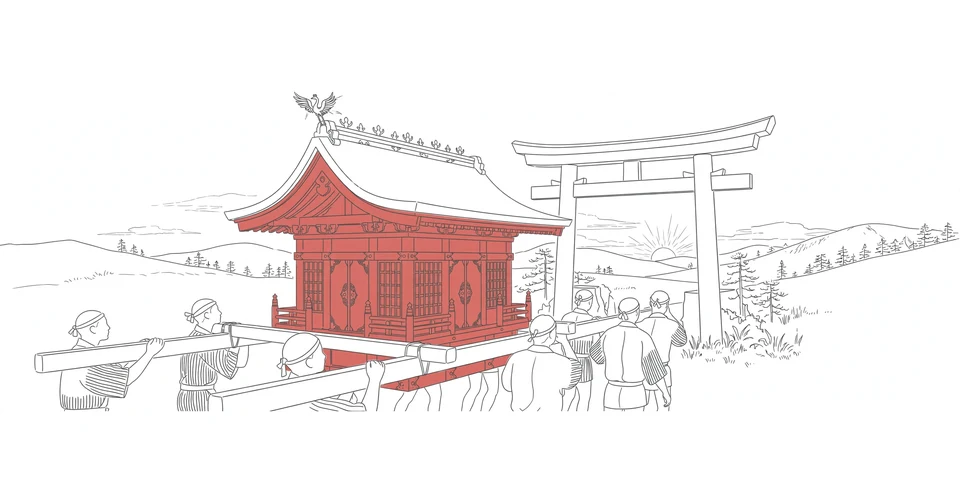
If you have ever stood in a shrine courtyard on a festival morning, you will know the feeling of that moment even if you did not know its name. The courtyard is packed, the carriers are already under the poles, and the air is tight with waiting. Then the mikoshi moves. It sways, it rocks, it comes through the gate, and the crowd roars as if something has been released. In a sense, something has. The god is out, and the town is about to be visited.
What miyadashi means
In Japanese, the definition is plain and exact. Miyadashi is the act of taking a mikoshi out of the shrine grounds so that it can tour the parish, and its counterpart, miyairi, is the act of bringing it back inside when the tour is done. The Japanese Wikipedia entry on the divine procession puts it in one clean sentence, that carrying the mikoshi out of the precincts for the procession is called miyadashi, and the return of the mikoshi to the precincts after the procession is called miyairi. The same words are also used when festival floats, or the offerings carried by children and parishioners, leave and re-enter the shrine.
That precision is worth noticing. Japanese festival language names every stage of the day, and miyadashi names only the departure. It is not the whole procession, and it is not the festival itself. It is the crossing, the few minutes in which the god goes from inside to outside, and everything after it depends on that crossing having happened properly.
The departure is part of a larger ritual called shinko-sai, the divine procession, in which the spirit of the kami is transferred from the shrine into the mikoshi and carried through the streets. The Shinko-shiki entry on Wikipedia describes it as the procession of a kami's sacred object, transferred from the main shrine into a portable shrine, and notes that the procession is regarded as a way for the kami to inspect and affirm the boundaries of its parish. Miyadashi is the opening move of that inspection. Until the mikoshi leaves, the god has not yet seen its town. After it leaves, the whole parish is under its gaze.
I find that idea quietly moving. A god that stays inside its shrine can only be visited by those who come to it. A god that leaves can visit everyone, including the old, the busy, and the ones who would never make the trip themselves. Miyadashi is the moment that decision is made real, the moment the shrine stops waiting for the town and goes out to meet it.
The five steps of the god's day out
A shinko-sai follows a set order, and miyadashi sits near the start of it. The Japanese account of the rite lays out the flow in five steps, and it is worth following them, because they show how much of the day is preparation for a single crossing. First, the spirit of the kami is transferred into the mikoshi in a quiet rite inside the shrine. Second, the mikoshi is carried out of the shrine and through the parish, which is the miyadashi and the procession that follows it. Third, rites and offerings are held at the otabisho, the temporary resting place. Fourth, the mikoshi returns from the otabisho toward the shrine. Fifth, the spirit is transferred back into the shrine, and the god is home again.
The whole sequence can take a single day, or it can stretch across several days, and the mikoshi often tours the parish districts on the way out and on the way back, so that the blessing passes through as many streets as possible. But the shape is always the same. Something sacred is moved, it travels, it rests, it returns, and it is put back. Miyadashi is the second step, the one where the plan becomes visible, and everything before it is invisible work.
There is a practical side to this order that is easy to miss. The transfer of the spirit happens behind closed doors, out of public sight, and so does the transfer back. The public never sees the god move from the shrine into the mikoshi. What the public sees is the mikoshi itself, and the first public sight of it is the departure. That is why miyadashi carries so much weight. It is the first moment the festival can be watched, and the first moment the carriers can be seen doing their work, and the first moment the crowd can answer with its voice.
The mikoshi article describes the portable shrine itself, the lacquered box, the poles, the chanting, and the shaking that is meant to please the spirit riding inside. That shaking starts at the departure. The carriers do not walk the mikoshi smoothly out of the gate. They heave it, rock it, and bounce it, and the god inside is woken up and pleased by the motion. A quiet, careful exit would miss the point. The god is not being moved like furniture. It is being celebrated out of its house.
The loud departure at the Sanja Matsuri
No miyadashi in Japan is louder than the one at the Sanja Matsuri in Asakusa, Tokyo. The festival honours the three men who founded Senso-ji, the temple next door to Asakusa Shrine, and on the Sunday morning of the festival weekend the shrine brings out its three great mikoshi, each weighing about a tonne, in front of a crowd that has been waiting since before dawn.
The Yomiuri Shimbun, reporting on the 2024 festival, called the carrying out of the shrines an important phase of the festival known as miyadashi, and described the three portable shrines being carried through the town by worshippers in hanten coats, calling out "Oisa" and "Soiya" as they went. The miyadashi is over in minutes, but it is the moment the whole weekend is built around, and the crowd knows it. Hundreds of people pack the courtyard competing for a place under the beams, the shrine rocks violently as it comes through the gate, and everybody roars.
It is worth asking why the departure is so chaotic when the rite it belongs to is so formal. The priests have done their quiet work inside. The spirit has been transferred. The order of the day is set. And then the doors open and all that formality gives way to shouting, pushing, and a tonne of lacquered wood swaying over the heads of the crowd. I think the chaos is the point. The formality belongs to the shrine. The noise belongs to the town. Miyadashi is where the two meet, and the meeting is not polite, because a god coming out to visit its people is not a polite occasion. It is a joyful one, and joy at that scale is loud.
The Sanja Matsuri also shows what the departure gives to the people who are not carrying. The parishioners who line the route do not get to touch the mikoshi, and most of them will never carry it. But they are there at the gate when it comes out, and they see the god leave, and that sight is theirs. The otabisho article describes the resting place where the mikoshi pauses later in the day, and the rest stop only exists because the departure happened first. The journey has a middle because it has a beginning, and the beginning is the loudest part of the day.
The quiet departure at the Gion Matsuri
At the other end of Japan's festival spectrum, the same ritual can be almost solemn. The Gion Matsuri in Kyoto is one of the three greatest festivals in the country, and its miyadashi happens on the evening of July 17, after the great float procession of the day. In a rite called the Shinko-sai, the three sacred mikoshi of Yasaka Shrine are carried out of the shrine and through the streets to the otabisho on Shijo street, where the gods will stay for a week.
The contrast with Asakusa is striking. The Gion miyadashi is not a scramble for the beams. It is a procession, ordered and deliberate, with each mikoshi taking a different route through the neighbourhoods under the protection of the deity it carries, so that the blessing passes through as many streets as possible. The gods arrive at the otabisho shortly after leaving, and they stay there for a week, between the two float processions, while the city goes about its festival around them. On July 24, in the Kanko-sai, the three mikoshi are carried back to the shrine.
Wikipedia's Shinko-shiki entry notes that the character of these processions varies widely by region, with Tokyo's tending to be lively and focused on revelry, while the one in Yuzawa is subdued and formal. The Gion Matsuri sits on the formal end of that scale, and its miyadashi shows it. But the meaning is the same in both places. Whether the god leaves to shouting or to measured steps, it leaves, and the town is visited.
I think this variety is the most interesting thing about the ritual. A single word, miyadashi, covers a dawn scramble in Asakusa and an evening procession in Kyoto, and both are the same act. The tradition does not prescribe a mood for the departure. It prescribes only the crossing, and each town fills that crossing with its own character. That is how a ritual survives for centuries. It holds its shape and lets the people inside it be themselves.
The threshold is the whole point
There is a detail in the definition of miyadashi that deserves more attention than it usually gets. The departure is not from the shrine building. It is from the shrine grounds, the precincts, the whole enclosed space of the shrine. The god does not simply step out of a door. It leaves a territory, crosses a boundary, and enters a different kind of space, the streets where ordinary life happens.
You can see that boundary most clearly where the ground itself makes it dramatic. At the Taketsu Shrine Gion Festival in Komoro, Nagano Prefecture, the highlight of the day is the mikoshi's departure from the shrine as it races down the stone steps of Taketsu Shrine. The mikoshi is hexagonal, made entirely of zelkova wood, carrying the deity Susanoo-no-Mikoto, and it comes down those steps in a rush, with the carriers holding on and the crowd watching from below. The festival, designated an Important Intangible Folk Cultural Property by Komoro City, has been celebrated on a grand scale since the Edo period, and the mikoshi took its present hexagonal form in 1675. The steps are the threshold made visible, a slope of stone between the sacred ground above and the castle town below, and the departure is a descent in every sense.
That image stays with me, because it makes the theology physical. The god is up high, on holy ground, behind a gate. The people are down below, in the town, on ordinary streets. Miyadashi is the moment the distance between those two places is closed, and the closing is not gentle. It is a run down stone steps with a heavy shrine on human shoulders, and it is dangerous, and it is thrilling, and it is exactly as serious as it looks. A god that descends like that is not making a courtesy call. It is coming down to where its people live.
Every shrine has its own version of that slope. Sometimes it is a long flight of steps, sometimes a short slope, sometimes only a gate and a flat stretch of ground. But the shape of the miyadashi is the same everywhere. Inside is quiet, ordered, and still. Outside is noise, weather, and crowd. Miyadashi is the second in which the god passes from one to the other, and the festival holds its breath for that second, because everything that follows depends on it going well.
Miyadashi and miyairi, the pair that frames the day
A departure only means something if there is a return, and Japanese festival language keeps the two together as a pair. Miyadashi is the leaving, miyairi is the entering, and the day is the space between them. The Japanese account of the divine procession defines them side by side, in a single sentence, as if they were two halves of one word, and in a way they are. You cannot have one without the other, and you cannot understand one without the other.
The return has its own feeling, and it is different from the departure in a way that tells you what the day was for. The morning departure is joyful and loud, full of anticipation. The return is tired and satisfied, the carriers moving more slowly, the chanting lower, the crowd thinner as the evening comes on. The god has seen its neighbourhood, rested at its otabisho, received its offerings, and blessed the streets it passed. The journey is finished only when the god is back in its shrine, and the parish can settle again knowing the visit has happened.
That symmetry is part of why the departure matters so much. A god that left and never returned would be a god that had abandoned its shrine. A god that never left would be a god that had abandoned its people. Miyadashi and miyairi together say something simple and complete. The god belongs to the shrine, and the god belongs to the town, and the festival is the day when both of those belongings are true at once. The leaving proves the god cares for the town. The return proves the god still has a home.
I think there is a lesson in that pairing for anyone who has ever had to leave a place they love. Leaving is not the opposite of belonging. It is one of the ways belonging is shown. The god leaves because the town is its parish, not in spite of it, and it comes back because the shrine is its home, not in spite of the town. The festival holds both truths without choosing between them, and the day is built to prove that both can be true.
Watching the departure as a visitor
If you are in Japan during a shrine festival, the departure is the moment to plan your morning around, and the rules for watching it are simple. Find out the time of the miyadashi in advance, because it is often early, and arrive well before it starts. The courtyard fills fast, and the best view is from the side of the route, near the gate, where you can see the mikoshi come out without blocking the carriers.
Stand to the side and keep the route clear. Do not touch the mikoshi, and do not try to join the carriers unless you belong to a parish team or have been clearly invited. When the mikoshi comes through the gate, step back and give the carriers room to work. The miyadashi is fast, loud, and crowded, and the people carrying a tonne of lacquered wood down stone steps have no attention to spare for a visitor in their path.
The best photographs come from arriving early and holding one good spot, not from crowding in. With the mikoshi at rest before the departure you can see the lacquer, the gold, the carvings, and the phoenix on the roof, details that blur into motion once it is moving. But once it starts moving, put the camera down for a moment and watch. The departure is over in minutes, and it is the kind of moment that is better remembered than recorded, a god leaving home while its town roars it on its way.
Do not expect a show. The departure is not performed for visitors. It is performed for the parish, and the parish has been waiting all year for it. That is exactly what makes it worth watching. You are seeing a festival at its most honest, a community carrying its god out of its house and into the streets, and for a few minutes the whole noisy celebration narrows down to a gate, a heavy shrine, and a crowd that has kept this leaving alive for centuries.
The god leaves so the town can be visited
Miyadashi is, in the end, a simple idea with a long history. A god leaves its shrine, travels through the streets of its parish, rests at a place prepared for it, and comes home again in the evening. The miyadashi is the moment that sets all of it in motion, and the festival treats it with the seriousness it deserves, naming it, timing it, and building the whole day around it.
That is why the ritual has lasted as long as the festivals themselves. It survives because it does something no shrine building can do. It puts the sacred on the street, in the middle of ordinary life, and gives a whole town a chance to receive a god as a guest. When the last mikoshi of the day returns to its shrine and the poles are set down, the gate closes again, and the street goes quiet. But the god has been out, the neighbours have hosted it, and the parish has been visited. That is a small thing, and it is the whole festival.
More in Culture & Society
- Otabisho Is Where the God Rests on the Way Through Town
- Mikoshi Are the Portable Shrines Japan Carries on Its Shoulders
- Sanja Matsuri Turns Asakusa Into Tokyo's Loudest Weekend
- Waraji Straw Sandals Walked Japan for a Thousand Years
- Fujin Carries the Wind That Arrives Before the Thunder
- Raijin Is the Thunder God Behind Japan's Summer Storms
Latest posts
- An Engawa Is Neither Inside nor Outside, and That Is the Point
- Nikko and the Shrines Hidden in the Cedar Forest
- Minka Are the Folk Houses Japan Built Around the Hearth
- The Orangutan and the Vanishing Forests of Borneo
- Hozomon Guards the Treasure House Behind Senso-ji's Main Hall
- Nakamise Is the Shopping Street That Has Fed Pilgrims for Centuries
- Kaminarimon Is the Thunder Gate That Opens Asakusa to the World
- Sony, the Tokyo Workshop That Taught the World to Listen
- Tengu Is the Mountain Goblin Japan Still Meets on the Trail
- Kappa Is the River Imp Japan Still Warns Its Children About
- Calonarang Is the Night Rangda and Barong Finally Meet
- Yamata no Orochi Was Never Just a Monster to Slay
- Kit Kat Japan, the Flavours You Will Not Find Anywhere Else
- How Susanoo Slew the Eight-Headed Serpent and Won a Bride
- How Kusanagi Became Japan's Most Guarded Sword