Nikko and the Shrines Hidden in the Cedar Forest
· 11 min read
Nikko packs a UNESCO shrine, a 97-metre waterfall and a mountain lake into one day trip from Tokyo. Here is how to see it well.
Two hours north of Tokyo, the train climbs out of the flat Kanto plain and into cedar forest so thick that the light turns green. At the top of the climb sits Nikko, a small mountain town that holds one of the grandest shrines in Japan, a 97-metre waterfall and a lake so high that it feels like a different season. It is the easiest great day trip from Tokyo, and it is also the one most people rush.
Nikko rewards slowness. The shrine complex alone deserves two or three unhurried hours, and the road up to the lake adds a whole second landscape of hairpin bends, marshland and cold, clear water. Come with a full day, or better, stay the night, and the town shows you what a day trip never can: cedar scent in the morning, empty paths at dusk, and a mountain that has been sacred for more than twelve centuries.
Most visitors come to Nikko for one building, and the building earns the attention. But the town works best as a pair of worlds, the gilded shrines in the forest below and the quiet highland of lake and waterfall above, joined by a road with 48 bends. This guide covers both, with the prices and times that were current in November 2026.
The shrine that gold built
Nikko Toshogu is the mausoleum and shrine of Tokugawa Ieyasu, the warlord who ended a century of civil war and founded the Tokugawa shogunate that ruled Japan for 268 years. Ieyasu was enshrined here in 1617, a year after his death, and the buildings you see today were rebuilt in 1636 by his grandson, the third shogun Iemitsu. The work took one year and five months, and the result is the most richly decorated religious site in Japan.
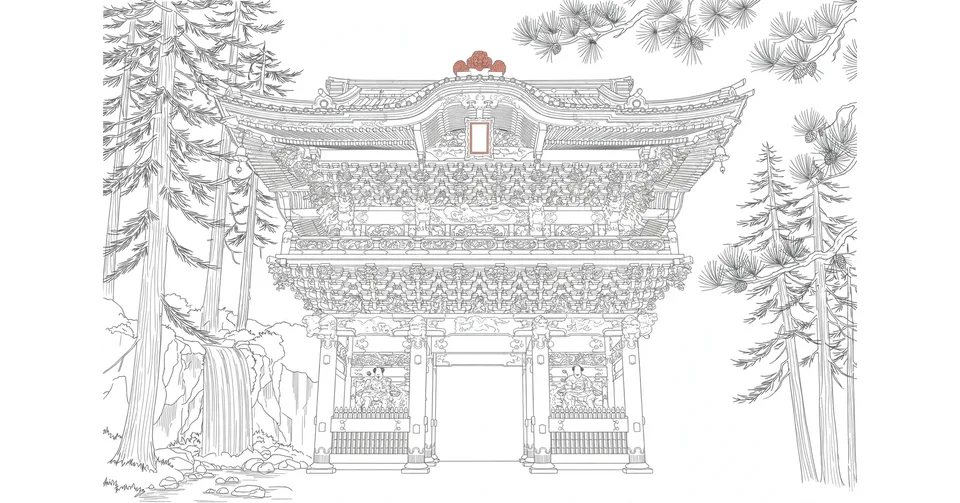
Most Shinto shrines favour plain wood and restraint. Toshogu breaks that rule on purpose. Gold leaf, vermilion lacquer and carving cover almost every surface, and the message was political as much as religious: regional lords travelling to Nikko were meant to feel the weight of central power before they went home. The centrepiece is the Yomeimon Gate, a two-storey gate so ornate that it is said a person could look at it all day and never tire of it. It carries 508 carvings, and eight of the buildings at Toshogu are National Treasures.
Two small carvings here are more famous than the gate itself. The Three Wise Monkeys, see no evil, hear no evil, speak no evil, sit on the wall of the Sacred Stable, and the Sleeping Cat, carved by the sculptor Hidari Jingoro, guards the gate that leads up 207 stone steps to Ieyasu's tomb at the Okusha inner shrine. The tomb itself is deliberately plain, a quiet bronze urn in the forest, which makes the climb feel like the point of the whole visit.
Toshogu is one of three sites that make up the UNESCO World Heritage property called Shrines and Temples of Nikko, inscribed in 1999. The property covers 103 buildings across Toshogu, Futarasan Shrine and Rinno-ji Temple, on 50.8 hectares of cedar forest. Admission to Toshogu is 1,600 yen for adults and high school students and 550 yen for younger students, and a combined ticket with the Treasure Museum costs 2,400 yen. The shrine opens at 9:00 and closes at 17:00 from April to October, and at 16:00 from November to March, with the ticket desk closing 30 minutes before. Plan on two to three hours, and arrive close to opening if you want the gate without a crowd. A detailed Toshogu guide keeps the current hours and fees in one place if you want to double-check before you go.
The bridge and the other two shrines
Before you reach the shrine, you cross the Shinkyo Bridge, a vermilion arch over the Daiya River that marks the entrance to the sacred area. The current bridge dates to 1636, and it counts as one of the three most famous bridges in Japan. You cannot walk across the original, though a small fee buys a crossing of the bridge itself for photographs, and the view from the riverbank is free and just as good.
The other two parts of the World Heritage site sit within a short walk of Toshogu, and skipping them is the most common mistake visitors make in Nikko. Rinno-ji Temple was founded in 766 by the monk Shodo Shonin, who first brought Buddhism to these mountains, and its Treasure House holds statues that have watched over the town for more than a thousand years. Next to it stands the Taiyu-in Mausoleum, the resting place of the third shogun Iemitsu, which is smaller and darker than Toshogu and, to many visitors, more beautiful for it.
Futarasan Shrine, founded in 767, is dedicated to Mount Nantai, the volcano that towers over the lake above the town. It is the oldest of the three sites and the quietest, a place of plain wood and stone lanterns that shows what Nikko looked like before gold arrived. Walk all three and you see the full story: a mountain faith, a Buddhist temple and a shogun's mausoleum sharing one forest.
The mountain, the lake and the waterfall
The second half of Nikko begins when the bus leaves town and climbs the Irohazaka, a mountain road with 48 hairpin bends, each named after a character of the old Japanese iroha syllabary. The road climbs about 440 metres in a short distance, and in autumn the maples along it turn the whole slope red. Traffic can gridlock on autumn weekends, so go early or go on a weekday.
At the top sits Lake Chuzenji, at 1,269 metres above sea level, the highest natural lake in Japan. It was formed about 20,000 years ago when an eruption of Mount Nantai blocked the Daiya River, and it covers 11.62 square kilometres, measures 25 kilometres around and reaches 163 metres deep. In the Meiji era, foreign diplomats posted to Tokyo built summer villas along its shore to escape the capital's heat, and the lake still feels like a retreat: cool air, pine forest and a horizon of mountains, with the 2,486-metre cone of Mount Nantai rising over the far shore.
The lake drains over Kegon Falls, a single drop of 97 metres into a narrow gorge, and one of the three most beautiful waterfalls in Japan. You can watch it from the free viewpoint at the top, but the better view is from below, reached by a one-minute elevator ride that costs 600 yen return and runs from 8:00 to 17:00. From the base, the falls fill the whole frame, and the spray reaches you on a warm day. A practical guide to Kegon Falls and Lake Chuzenji covers the viewpoints, the elevator and the bus times in detail.
Beyond the lake, the road continues into Oku-Nikko, the deep Nikko highland, where the Senjogahara marshland spreads across a plateau at about 1,400 metres. A flat boardwalk trail crosses it in about an hour, with wildflowers in summer and golden grass in autumn, and it is the easiest walk in the area for anyone who wants mountain air without a climb. If you have a second day, the Yumoto Onsen hot spring village at the far end of the road is worth the bus ride, and the onsen etiquette that applies everywhere in Japan applies here too.
When to go to Nikko
Autumn is the famous season, and it earns the fame. The leaves around the lake turn first, from late October to mid-November, and the town below follows a week or two later, so a well timed visit catches both. The price is crowds: the Irohazaka can take hours on a November weekend, and the buses fill early. If you come in autumn, stay overnight and start at the shrine before 9:00.
Spring brings cherry blossom to the town in April and fresh green to the cedars in May, while summer is the quiet surprise. When Tokyo sits at 35 degrees, the lake shore is ten degrees cooler, which is why the diplomats built their villas there. Winter is the hardest season and the most beautiful in its own way: snow on the shrine roofs, frozen spray at Kegon Falls, and far fewer people. One warning for 2026 and 2027: the Akechidaira Ropeway, the cable car with the classic view over the Irohazaka and the falls, is suspended from 16 January 2026 to 31 August 2027 for renewal work, so do not plan a trip around it.
Getting there and what it costs
Nikko is about 140 kilometres north of Tokyo, and the journey is part of the pleasure. The Tobu limited express Kegon runs from Asakusa and takes about one hour and 50 minutes, while the JR limited express Nikko runs from Shinjuku in about two hours. Both arrive at stations a short bus ride from the shrine, and the World Heritage loop bus covers the shrine area for 600 yen a day. The bus from the stations up the Irohazaka to Lake Chuzenji takes 40 to 50 minutes.
| Item | Price |
|---|---|
| Toshogu Shrine, adult | 1,600 yen |
| Toshogu Shrine plus Treasure Museum, adult | 2,400 yen |
| Kegon Falls elevator, return | 600 yen |
| World Heritage loop bus pass, one day | 600 yen |
| NIKKO PASS World Heritage Area | 3,000 yen |
The NIKKO PASS World Heritage Area covers Tobu transport around the shrine area, but it does not cover the bus to Lake Chuzenji. For the lake, buy the All Area version instead. If you plan to use the trains from Tokyo as well, check the pass that bundles the round trip, since it is usually cheaper than buying each leg separately. A similar kind of careful planning pays off at Mount Fuji, where the climbing season and the fees change every year, and at Hakone, where the loop of train, cable car and boat rewards the same kind of advance ticket.
One practical note: Nikko is a town of steep lanes and stone steps, and the shrine complex alone involves a good deal of walking uphill. Wear shoes you can climb in, not the ones you would wear to a city museum. Cash is useful for the smaller temples and food stalls, though the shrine ticket office takes cards.
A few honest notes
Nikko is not a hidden place, and pretending otherwise would be dishonest. On a fine autumn day, the shrine is crowded, the buses are full, and the queue for the elevator at Kegon Falls moves slowly. The trick is not to find a secret Nikko but to give the famous one enough time. The visitors who leave disappointed are almost always the ones who tried to see the shrine, the lake and the waterfall in four hours and spent two of them in transit.
Staying overnight changes the trip completely. The town empties after the last day trippers leave, the cedar forest goes quiet, and the morning light on the Yomeimon Gate belongs to the few people who slept there. The local food helps too: yuba, the delicate skin that forms on heated soy milk, is the town's speciality, served in soups, rolls and set meals in the small restaurants near the shrine, and it is worth a slow lunch after the climb to the tomb.
Nikko also pairs well with the other old capitals within reach of Tokyo. Kamakura offers the same mix of temples and sea air on a smaller scale, and the Japanese Alps give the mountain half of the Nikko experience at a grander scale. But neither has the particular combination that makes this town special: a shogun's golden shrine and a silent mountain lake, joined by a road of 48 bends, all inside a single day from Tokyo.
Come for the gate, stay for the lake, and leave time for the forest in between. That is the whole secret of Nikko, and it has been working for more than a thousand years.
More in Food & Travel
- The Orangutan and the Vanishing Forests of Borneo
- Hozomon Guards the Treasure House Behind Senso-ji's Main Hall
- Nakamise Is the Shopping Street That Has Fed Pilgrims for Centuries
- Kaminarimon Is the Thunder Gate That Opens Asakusa to the World
- Kit Kat Japan, the Flavours You Will Not Find Anywhere Else
- Yakiniku, Japan's Do-It-Yourself Barbecue
Latest posts
- An Engawa Is Neither Inside nor Outside, and That Is the Point
- Minka Are the Folk Houses Japan Built Around the Hearth
- Miyadashi Is the Moment the God Leaves Home
- Otabisho Is Where the God Rests on the Way Through Town
- Mikoshi Are the Portable Shrines Japan Carries on Its Shoulders
- Sanja Matsuri Turns Asakusa Into Tokyo's Loudest Weekend
- Waraji Straw Sandals Walked Japan for a Thousand Years
- Sony, the Tokyo Workshop That Taught the World to Listen
- Fujin Carries the Wind That Arrives Before the Thunder
- Raijin Is the Thunder God Behind Japan's Summer Storms
- Tengu Is the Mountain Goblin Japan Still Meets on the Trail
- Kappa Is the River Imp Japan Still Warns Its Children About
- Calonarang Is the Night Rangda and Barong Finally Meet
- Yamata no Orochi Was Never Just a Monster to Slay
- How Susanoo Slew the Eight-Headed Serpent and Won a Bride