Gebogan Is the Tower of Fruit Bali Carries to the Temple
· 21 min read
A gebogan is Bali's tallest offering, a tapering tower of fruit, cakes and flowers carried on a woman's head to the temple, and its height matters less than the sincerity of the person who built it.
On a temple festival day in Bali, the road fills with colour before the ceremony itself begins. Women walk in a long line in lace kebaya, each one balancing a tall tower of fruit and flowers on her head, and the towers sway gently with every step but never fall. The tower is a gebogan, and it is the grandest offering a Balinese household makes.
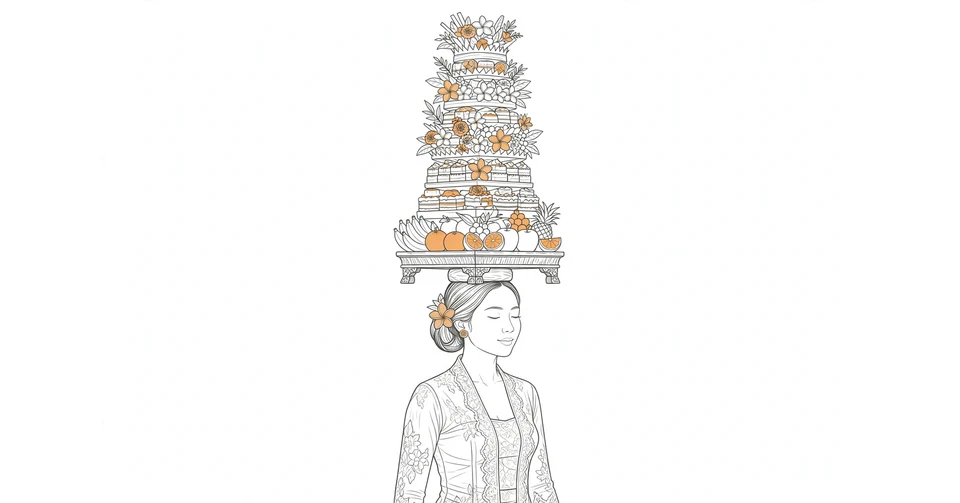
A gebogan is not a decoration and it is not a display piece made for visitors. It is a gift of food, built by hand at home, carried to the temple on a woman's head, prayed over and blessed, and then carried home again to be shared and eaten by the family. Everything about it, the height, the colour, the balance, the long walk, is part of the giving. To understand a gebogan is to understand how Bali turns gratitude into something you can carry.
What a gebogan is
A gebogan, also called pajegan, is a tapering tower of fruit, jaja cakes and flowers built on a footed wooden tray called a dulang. Fruit, cakes, flowers and woven palm leaf ornaments called sampian are pushed onto a core of small banana trunk so that nothing falls on the walk to the temple, and a canang sari crowns the arrangement. The tower narrows as it climbs, which gives the gebogan its unmistakable shape, a cone of colour rising from a round wooden base.
The gebogan belongs to the wider family of banten, the offerings Bali makes out of almost nothing. Banten is the wide word for offerings, and it stretches from the smallest palm sized tray of flowers made fresh every morning to the tallest tower carried to the temple on a festival day. The gebogan sits at the far end of that scale. It is the offering a household puts the most into, and it appears when the occasion is large enough to deserve it, a temple festival, a temple anniversary, a wedding, or one of the great days of the Balinese calendar.
The word gebogan itself is said to mean sum, for the many colours and foods gathered into one offering. One Bali guide traces it to the word gebog, meaning combination, pile, or amount, which fits what the eye sees. A gebogan is a sum in the plainest sense, a whole market stall of fruit and cakes and flowers added up into a single tower and offered as one thing. The name tells you how to read it. Do not look for one meaning in one fruit. Look at the whole pile, gathered and given together.
A gebogan is usually built for a particular temple on a particular day, and it is built by the household that will carry it. Mothers and daughters build it at home, usually before a temple festival, and the skill is in the balance as much as in the arrangement. A tower that looks effortless on a woman's head has been built to stay upright on a walk through the village, over uneven ground, in the heat, in a crowd, and sometimes in the rain. The beauty of a gebogan is real, but the beauty is the outside of something practical. It has to travel.
The dulang and the core that holds it up
Every gebogan starts with the dulang, a round wooden tray on a single foot. The dulang is the foundation of the whole tower, and its job is humble and essential. It holds the weight, it gives the carrier something firm to balance on her head, and it sets the width from which the tower narrows upward. Without a solid dulang, there is no gebogan, only a pile of fruit.
Into the centre of the dulang goes the core, a piece of small banana trunk, sometimes with a small bamboo pole, that runs up through the middle of the tower like a spine. The fruit, the cakes, the flowers and the sampian are pushed onto this core, and small bamboo sticks or palm leaf ribs are used as supports so that each piece stands firm. The core is the secret of the gebogan. From the outside you see colour and symmetry. From the inside, the tower is engineering, a trunk and a set of pins holding a metre of food upright on a moving head.
The base layer is usually fruit, arranged in a circle on the dulang, and bananas are almost always part of it because their size and sturdiness support the fruit above. Oranges, apples, mangosteen, snake fruit, mango and jackfruit are among the local fruits commonly used, chosen for colour as well as for taste, and the choice of fruit follows the season and the market as much as it follows any rule. Above the fruit come the cakes and the flowers, then the sampian, the finely cut young coconut leaf ornaments that give the tower its lace like crown, and finally the canang sari that sits at the very top.
There is a discipline to this that is easy to miss. Each layer has to be tight enough not to shift, light enough not to topple the tower, and beautiful enough to be worthy of the temple. The maker is solving three problems at once, and she solves them with her hands, without a diagram, because she has watched her mother do it and her grandmother before that. I think that is worth saying plainly. We are quick to call such work tradition and slow to call it skill, but a gebogan that survives the walk to the temple is a piece of craft, and the craft deserves the name.
What goes into a gebogan
Nothing in a gebogan is random, and each part has a place and a purpose. The parts below are the ones you will find in most towers, though the exact fruit and the exact cakes change with the household, the season and the occasion.
| Part of a gebogan | What it is | What it does |
|---|---|---|
| Dulang | A round wooden tray on a single foot | The foundation that holds the tower and balances on the carrier's head |
| Banana trunk core | A piece of small banana trunk, sometimes with bamboo | The spine the fruit and flowers are pushed onto so nothing falls |
| Fruit | Bananas, oranges, apples, mangosteen, snake fruit, mango, jackfruit | The body of the tower, arranged in circles from the base upward |
| Jaja cakes | Balinese cakes and sweets such as jajan uli, begina and dodol | Colour and texture between the fruit, and food for the sharing afterwards |
| Sampian | Woven and cut palm leaf ornaments | The lace like decoration that crowns the tower and frames the flowers |
| Flowers | Marigold, frangipani, balsam and roses | Fresh colour at the top, facing the sky |
| Canang sari | A small palm leaf offering tray | The crown of the gebogan, placed at the very peak |
The table makes a gebogan look like a recipe, and in a sense it is one, but the recipe leaves out the judgement. How much fruit is enough, how high the tower can safely go, which colours sit well together, how tight each piece must be pushed onto the core, none of that is written down. It is learned by doing, and the doing is the point. A gebogan built from a written list would look right and fall apart on the road. A gebogan built by hands that know the work looks right and arrives whole.
The fruit matters twice over. It is the offering, and it is also the meal that follows the offering. The cakes and the fruit that are blessed at the temple are the same cakes and fruit the family eats at home afterwards, which means the maker is choosing food her family will actually enjoy. The gebogan is not a model of food. It is food, arranged beautifully and given away first, and that is a different and more serious thing.
The mountain in miniature
The shape of a gebogan is its meaning. The tower narrows as it climbs, and the tapering shape is likened to a mountain. In Hindu belief the mountain is Mahameru, the sacred mountain held to be the dwelling place of the gods, and a gebogan built in the shape of a mountain is a small mountain offered back to the mountain of the gods. The fruit of the earth is arranged in the shape of the earth at its highest, and the offering becomes a picture of where it is going.
The shape is also read as a journey upward. The wide base holds the fruits and foods of the earth, the middle holds the sampian and the decoration, and the top holds the flowers and the canang sari, facing the sky. One account of the gebogan describes the arrangement as a movement from the many below to the One above, and that is a good way to see it. Many fruits, many colours, many small gifts, gathered into one tower that points at one place. The sum becomes a single gesture.
The layers of a gebogan follow a set order, and the order carries the symbolism with it. The base layer is usually fruit and vegetables arranged in a circle, the layer above is flowers arranged for colour and harmony, and the crown is the sampian and the canang sari. A guide to the towered offering of Bali describes the base as fruit and the second layer as flowers such as frangipani, jasmine and marigolds, and notes that the women who build the gebogan choose each item for its colour, shape and symbolic meaning. The cultural writer Jean Couteau, quoted in the same guide, reads the conical shape as an echo of the cosmic mountain and notes that each component, fruit, cake, flowers and even meat in some forms, relates to gods and cosmic functions, while the sampian on top stands for the Balinese rose of the wind and the small canang above it carries the Trimurti in its heart.
That is a dense reading for a tower of fruit, and it is worth taking seriously rather than treating it as decoration for a tourist article. The gebogan does not hide its meaning behind its beauty. The meaning is the beauty, arranged so that anyone who looks at the tower can see the mountain in it, and anyone who carries it can feel the weight of what the mountain stands for. I find that honest in a way that a plainer offering would not be. A gebogan does not pretend that gratitude is a small feeling. It builds the feeling to the size of a mountain and carries it in public.
Who builds a gebogan, and what it costs in time
Traditionally the women of the household build the gebogan. Mothers teach daughters, and daughters learn by sitting beside their mothers and arranging the fruit until their hands know the pattern. The skill is passed down the way most household skills are passed down, not in a lesson but in company, season after season, until the work is part of the body.
A gebogan can absorb a whole day of building, and the ceremonial banten for a wedding or a temple anniversary can take a team of women days of preparation, folding, arranging and cooking. That time is the real price of the offering. The fruit costs money, and the cakes cost money, but the day is what the maker gives that cannot be bought back. A household that builds a gebogan has given a day of a woman's life to the temple, and the tower is the visible shape of that day.
The towers themselves vary in size. One Bali guide puts the height of a gebogan at around half a metre for a modest tower to more than a metre for a grand one, and the same guide puts the weight of a carried gebogan at roughly five to fifteen kilograms, which is a serious load to balance on the head while walking. That weight explains why the balance matters so much, and why the core and the tight packing matter so much. A tower of fifteen kilograms that shifts on the walk is not a small problem. It is a day of work sliding off a woman's head in front of her village, and every maker knows it. The guide that records the height and weight of a gebogan also notes that women in Bali train this balance from childhood, which is the only way such a skill is ever learned.
This is the part of the story that deserves honesty rather than romance. The labour of the gebogan falls mostly on women, and it falls on top of cooking, childcare, work and everything else a household demands. It is easy for a visitor to admire the towers and forget the hands that built them before sunrise and the necks that carried them to the temple. I think the right way to look at a gebogan is to see both things at once, the devotion and the work, and to let the work count as part of the devotion rather than as something separate from it. A practice that asks for a day of labour should be described with its labour intact, not edited out for the sake of a prettier picture.
There is also a quieter side to the building that rarely gets mentioned. For many of the women who make them, the hours of arranging fruit and cutting palm leaf are a pocket of attention before the festival, a slow task done in company with mothers and daughters and neighbours. In a busy household, that slow work is not nothing. The gebogan gives the day before the festival a shape, and the shape holds even when the rest of the week does not.
Mepeed, the walk to the temple
On festival days the gebogan do not arrive one by one. They arrive in a mepeed, a procession in which the women of a village walk side by side in a long line, each carrying her tower on her head, in lace kebaya, to the temple or around the temple grounds. The line is the point. One tower is a household's offering. A hundred towers walking together is the whole community's offering made visible at once.
Mepeed means walking in a strictly ordered line, and the order matters. The women walk together, nobody overtakes the woman in front, and the procession moves at the pace of the slowest carrier. That is a discipline of its own, and it is part of the ceremony rather than a way of getting to it. The walk is the offering too. The village shows its gratitude by moving together, in step, carrying the same kind of gift, and the sight of it is what visitors remember longest about a Balinese festival.
The gebogan appear at temple anniversaries, the odalan, and in the days between Galungan and Kuningan, when temples across Bali fill with offerings and penjor poles line the roads. They are also part of the melasti cleansing rituals that take place before Nyepi, when groups travel from the village temple to the sea or a river in long processions, carrying holy effigies to be cleansed, and the gebogan travel with them, adding colour to an already vivid scene. The full moon is another day when extra care goes into the offerings, and the full moon and its place in Balinese prayer is a subject of its own. If your visit lines up with a ceremony, you are seeing the same impulse as the daily offering, scaled up into something communal and grand.
What strikes me about the mepeed is that it turns a private act into a public one without turning it into a performance. Each woman built her tower at home, in her own kitchen, for her own household, and then she carries it in a line where everyone can see it. The offering stays personal and becomes communal at the same time, and the line holds both of those truths without resolving them. That is a rarer thing than it sounds. Most public ceremonies ask people to give up the personal part. The mepeed keeps it, and carries it on its head.
At the temple, and the meal afterwards
At the temple the gebogan are placed before the shrines, prayed over and blessed with holy water. The towers stand in rows in the temple courtyard, and for a little while the temple looks like a market that has been arranged by colour, fruit and flowers rising in cones on every side. Then the ceremony ends, and the families carry their towers home.
In Balinese Hindu understanding the offering has been spiritually received by the deities, and the fruit and cakes, now blessed, are shared and eaten by the family. Nothing is wasted, and that is worth pausing on. The largest and most elaborate banten ends the same way the smallest one does, as food shared by the people who made it, which is a reminder that the offering was never really about the object. It was about the giving, and the giving ends in a meal.
There is something quietly radical in that ending. A tower that took a whole day to build is taken apart and eaten in an evening, and nobody treats that as a loss. The gebogan is not kept, photographed and preserved. It is consumed, and the consumption is the completion. The gift is given, the gift is received, and then the gift feeds the givers, which closes the circle the offering opened in the morning. I think many of us build things to last and forget that some things are meant to be used up. A gebogan is built to be used up, and its beauty is not diminished by that. It is completed by it.
The sharing matters in another way too. The blessed fruit and cakes go to the family, to children and grandparents and neighbours who helped build the tower, and the meal becomes a second ceremony, smaller and quieter than the one at the temple. The temple blessing is public. The eating is private. The gebogan belongs to both, and it needs both to be finished.
The Lovina rule, sincerity over height
There is a warning in the gebogan worth hearing, and it comes from the people of Lovina, in the north of Bali, who describe it best. The worth of a gebogan is measured by the sincerity of the giver. A modest tower made with a full heart counts for as much as a grand one, and no ranking is read into the height. That is a useful rule for the whole subject. A gebogan is not a competition, and the island has no interest in turning it into one.
The rule matters because the temptation is real. A tower is visible, and visible things invite comparison. A taller gebogan, a brighter gebogan, a more expensive gebogan, the eye reads all of that before the heart reads anything, and the maker knows her tower will be seen in a line with a hundred others. The Lovina rule answers that temptation directly. Height is not holiness. Cost is not devotion. The measure is the heart of the giver, and the heart is not visible from the road, which is exactly why the rule has to be said out loud.
Bali's own guides repeat the warning in plainer language. Elders remind makers that a gebogan should not be made excessive to the point of encouraging wasteful display, and that a simple gebogan made with full sincerity holds the same spiritual value as a grand and luxurious one. The principle behind the warning is an old one, that an offering must be beautiful, made with honest intention, and offered for the common good, and the beauty is only one part of the three. A tower that is beautiful but built to impress has missed the point, however tall it stands.
I find the Lovina rule the most useful idea in this whole subject, and it is not only about Bali. Most of us live in places where generosity is measured in public, where the size of the gift is read as the size of the feeling, and where a modest gift can feel like an embarrassment. The gebogan says the opposite, and it says it in a tradition that builds towers a metre high. Even here, where the gift is designed to be seen, the teaching is that the seeing is not the point. The giving is the point, and the giving is measured where nobody can see it.
Gebogan today, between tradition and display
The gebogan has not stood still. At cultural festivals and banten arranging competitions, towers are now designed with very detailed colour combinations, gradients of red snake fruit, green oranges and yellow bananas, and makers experiment with new forms while keeping the core meaning intact. The tradition continues to evolve, and the evolution is not a betrayal of it. A living practice changes, and a gebogan built today looks different from a gebogan built a generation ago, just as the fruit in the market looks different.
The change brings a real tension with it. A gebogan is photogenic, and festivals now draw visitors who come to photograph the towers, which is understandable and also risky. The tower was built to be carried to the temple, not to be photographed, and the camera can turn a religious procession into a backdrop without anyone intending it. The elders' warning about excess applies here too, not only to the size of the tower but to the way it is watched. Attention is part of the ceremony, and careless attention is a kind of excess.
If you see a gebogan on a festival day, a few courtesies carry you a long way. Ask before photographing someone building or carrying a tower, and do not step into the line of a mepeed to get a better picture. Do not touch a tower or move one that has been placed at a shrine, and dress modestly near the temple, following the lead of those around you. If a homestay or a guide offers a gebogan making session, take it seriously rather than treating it as a craft activity. You will learn more in an hour of pushing fruit onto a banana trunk core than in a day of reading about it, and the point of the session is not the tower you take home. It is the understanding that the tower was never the point.
The deeper rule, underneath all of these, is to remember that a gebogan is not a spectacle staged for visitors. It is the grandest offering a household makes, built with a day of labour and carried in public for a sacred reason, and you are walking through someone else's festival. Treat it the way you would want your own quiet practices treated, with attention and without commentary, and you will have understood more about Bali than most visitors manage.
A gebogan is, in the end, a tower of fruit that a woman carries on her head to the temple, and that is exactly why it matters. Fruit, cakes, flowers and palm leaf add up to a daily decision to be grateful, to give before taking, and to carry the gift in public without turning it into a contest. The island has been making that decision on festival days for longer than anyone can count, one tower at a time, and the towers are still there on the road to the temple when the festival comes round. The offering is tall because the gratitude is large, and the gratitude is large because it is shared, and the sharing ends, as it should, in a meal at home.
More in Culture & Society
- Mepeed Is the Slow Walk That Carries Bali to the Temple
- Banten Are the Offerings Bali Makes Out of Almost Nothing
- Tama Nuki Is the Rite That Lets a Sacred Object Rest
- Japanese Noh Theatre and the Slowest Drama on Earth
- Tamashii Ire Invites a Soul Into a Sacred Object
- Kaigen Kuyo Is the Ceremony That Wakes a Sacred Object
Latest posts
- Amado Are the Storm Shutters That Close Japan for the Night
- Ihai Are the Lacquered Tablets That Keep a Name Alive
- A Butsudan Keeps the Dead Close in a Japanese Home
- An Engawa Is Neither Inside nor Outside, and That Is the Point
- Nikko and the Shrines Hidden in the Cedar Forest
- Minka Are the Folk Houses Japan Built Around the Hearth
- Miyadashi Is the Moment the God Leaves Home
- Otabisho Is Where the God Rests on the Way Through Town
- Mikoshi Are the Portable Shrines Japan Carries on Its Shoulders
- Sanja Matsuri Turns Asakusa Into Tokyo's Loudest Weekend
- The Orangutan and the Vanishing Forests of Borneo
- Waraji Straw Sandals Walked Japan for a Thousand Years
- Hozomon Guards the Treasure House Behind Senso-ji's Main Hall
- Nakamise Is the Shopping Street That Has Fed Pilgrims for Centuries
- Kaminarimon Is the Thunder Gate That Opens Asakusa to the World