Tamashii Ire Invites a Soul Into a Sacred Object
· 16 min read
Tamashii ire is the Japanese Buddhist rite of placing a soul in a sacred object, the quiet half of the eye-opening ceremony that turns a crafted statue, tablet, or altar into a dwelling place for the sacred.
A new memorial tablet arrives from the maker, lacquered black and lettered in gold, and it looks finished. A new statue stands on its base, painted and gilded, and it looks finished too. Yet in Japanese Buddhism neither object is ready to be prayed to. Something has to happen before they can be treated as sacred, and the heart of that something is tamashii ire.
Tamashii ire means the placing of the soul, or the inviting of the spirit in. It is the quiet half of kaigen kuyo, the eye-opening ceremony, and it is the part that gives a sacred object its inner life. Where the painting of the eyes can be seen, tamashii ire cannot. A priest chants, offerings are made, and by the end of the rite the object is understood to have changed in a way that no eye can check.
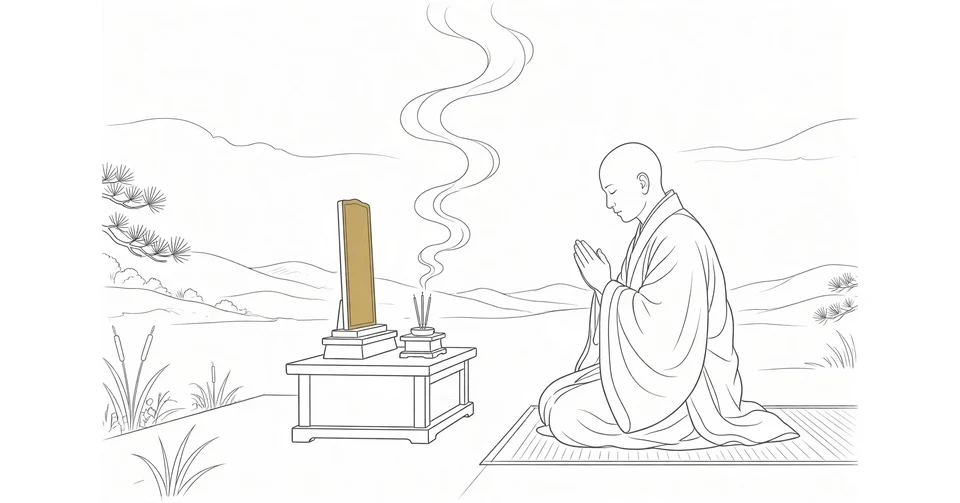
The full story of the ceremony that contains tamashii ire is told in the account of the ceremony that wakes a sacred object. Tamashii ire is not a blessing, and it is not a decoration of the rite. It is the moment the object stops being a product of the workshop and starts being a presence in the room, and everything that follows, the daily care, the morning greetings, the reluctance to throw the object away, follows from that moment.
What tamashii ire means
The words themselves are plain. Tamashii means soul or spirit, and ire means putting in, or placing within. Tamashii ire is therefore the placing of the soul, and it is also known by two other names that say the same thing in different words. It is called nyukon shiki, the ceremony of entering the soul, and it is called tamaire, the soul-entering, and the Japanese Wiki Corpus entry on the rite lists all three names together as one ceremony. The names matter because they show that the rite has always been understood as an act of placing, not an act of making. The priest does not create the soul. He places it, or invites it, into a home that has been prepared for it.
That distinction is the whole meaning of tamashii ire. A statue is carved, a tablet is lacquered, an altar is joined and polished, and all of that is human work. Tamashii ire is the moment when human work stops and something else is asked to arrive. The priest chants sutras, and the chanting is understood to call the sacred into the object, so that from that day the object is treated as a dwelling place rather than a piece of furniture. The object does not change its shape. It changes its standing, and the people around it change how they behave toward it.
The rite also rests on a bold piece of Buddhist teaching. The Dictionary of Buddhism kept by the Nichiren Buddhism Library describes the eye-opening ceremony as a rite performed in the belief that the image can be endowed with spiritual properties, and that through it the image is believed to become equal to the living Buddha. That claim connects tamashii ire to an old doctrine, the attainment of Buddhahood by insentient beings, the idea that even things without minds can awaken. Whether or not a reader accepts the doctrine, the logic is consistent. If a statue can become equal to the living Buddha, then something real must be placed in it, and tamashii ire is the name for that placing.
The eyes and the soul are two different acts
Kaigen kuyo is often described as one ceremony, and in practice it is performed as one service, but it contains two different acts, and confusing them is the most common mistake people make about it. The first act is kaigen itself, the opening of the eyes. The second act is tamashii ire, the placing of the soul. They happen together, and they mean different things.
The opening of the eyes is the visible act. When a Buddhist statue is made, the eyes are inserted at the very end of the process. The Japanese word for this is tensei, the inserting of the eyes, and it was regarded as so important that it grew into the ceremony itself. The statue is finished, in the religious sense, only when its eyes are open, because the eyes are the part of the statue that looks back at the worshipper. A statue with closed or unfinished eyes is a statue that does not yet see, and a statue that does not see cannot receive a prayer.
Tamashii ire is the invisible act, and it is the one that gives the statue its inner life. The eyes say the statue can see. Tamashii ire says there is someone, or something, inside doing the seeing. One act opens the surface, and the other fills the interior, and both are needed before the statue can be prayed to. A statue with open eyes and no soul placed within it would be a watchful shell. A statue with a soul placed within it but eyes still closed would be a presence that cannot meet a gaze. The ceremony joins the two, and the joining is the point.
The Japanese Wiki Corpus entry makes this connection explicit. It says that when a statue is made, tensei is performed at the end of the process to consecrate a man-made statue, and that since the statue is completed by investing it with soul, tensei in particular was regarded as important and later became a ceremony. Read carefully, that sentence puts tamashii ire at the centre of the whole rite. The eyes are inserted because the soul is being invested. The visible act exists to serve the invisible one, and the ceremony is remembered as an eye-opening only because the eyes are the part of it that can be photographed.
Which objects receive tamashii ire
Tamashii ire is performed for every kind of object that Japanese Buddhism treats as a dwelling place for the sacred, and the list is wider than statues alone. The Japanese Wiki Corpus entry describes kaigen-hoyo as a service held at the completion of a Buddhist statue, painting, altar, or tomb, and tamashii ire belongs to each of those cases in the same way. Whenever something new is made to be prayed to, it needs the soul placed in it before prayer begins.
The memorial tablet is the most personal case. A new ihai is not yet an object of worship when it arrives from the maker, however beautiful its lacquer and gold lettering may be. It becomes one through a ceremony called kaigen kuyo, the consecration, sometimes also called the ceremony of placing the soul, tamashii ire. A priest performs the rite, and by it the tablet is understood to become a place where the soul of the dead resides. That is how the ceremony is described in the account of the lacquered tablets that keep a name alive, and it shows the logic of tamashii ire at its clearest. The tablet carries a name, but the name alone is not enough. The soul has to be invited to dwell with the name, and the invitation is the ceremony.
The household altar is the second case, and it is the one most families meet first. A new butsudan, the household Buddhist altar, receives tamashii ire so that the cabinet becomes a home altar rather than a handsome cupboard. The cabinet is opened each morning and closed each night, water and rice are offered, and the bell is rung, and none of that daily care would make sense if the cabinet were only furniture. Tamashii ire is the moment the cabinet stops being furniture and starts being a shrine, and the family that keeps it knows the date, because it was the day the priest came to the house.
Statues and painted images are the third case, and the oldest. A new statue in a temple receives tamashii ire, and so does a new painted image, a hanging scroll of a Buddha or a bodhisattva, because a painted face is understood to need its soul placed within it just as a carved one does. The most famous example is the Great Buddha of Todai-ji Temple in Nara, whose eye-opening was held on May 30, 752, by Emperor Shomu, with the priest Bodhisena, who had come to Japan from India by way of Tang China, painting the eyes.
How the rite is performed
The details of tamashii ire vary by Buddhist school and by local custom, and it would be dishonest to pretend there is one fixed script. What the sources agree on is the shape of the rite, and that shape is recognisable across the schools. A priest performs it, usually at the temple or at the home where the object will be kept. The space is tidied and the object is placed on the altar before the priest arrives, or it is brought to the temple carefully wrapped.
The ceremony is built from four elements that appear again and again: purification, chanting, offering, and the formal act of placing. Offerings are prepared, usually incense, candles, flowers, water, and sometimes fruit or simple sweets. The priest chants sutras, mantras, or dharani, and the chanting is understood to place the object within the Buddha's teaching, so that it is not treated as an isolated thing but as part of a living practice. In esoteric traditions the rite may also include mudras, the hand gestures of the tradition, and a more elaborate arrangement of the altar.
The school that does not place a soul
There is one important exception to tamashii ire, and it is worth stating plainly, because it shows that the rite is a choice and not a habit. Jodo Shinshu, the True Pure Land school and the largest school of Japanese Buddhism, has no concept of investing the principal image with a soul. It does not perform tamashii ire for its honzon, the principal image of worship. Instead, it holds a service for an auspicious occasion called goishi, or owatamashi, which is a ceremony of transfer, of moving the Buddha to be worshipped into its place.
The reasoning behind the exception is consistent with the school's teaching. Jodo Shinshu holds that the dead, through the vow of Amida Buddha, are already reborn in the Pure Land, and so they need no tablet to anchor them and no rite to place a soul. The same logic applies to the image. If the Buddha is already present through the vow, the image does not need to be woken. It needs only to be moved into place, with ceremony and respect, and that is what goishi does. The kanji used in goishi mean to move or transfer, and when the service is called owatamashi, it is an honorific expression for the transfer of a noble person, referring to the Buddha to be worshipped.
I respect the exception, because it sharpens the meaning of tamashii ire for everyone else. Most schools perform tamashii ire because they believe a sacred object must be made sacred, and that the making is a real event. Jodo Shinshu sets it aside because it believes the sacred is already present, and that no making is needed. Both positions take the object seriously. They simply disagree about where the sacred comes from, and tamashii ire, or its absence, is the visible sign of that disagreement.
When an object is repaired, moved, or retired
A sacred object does not stay new. Statues are repaired, altars are moved to a new house, tablets pass to a new generation, and the question arises of what happens to the soul that was placed inside. The answer, in Japanese Buddhism, is that tamashii ire can be performed again, and that reactivation, rather than disposal, has long been the normal way of caring for an old image.
A lecture at the Courtauld Institute on the lives of Buddhist icons, given by Dr Benedetta Lomi, makes this point from the medieval record. She argues that while the eye-opening was generally performed to activate newly created images, it was also repeated after repairs, relocations, or changes in ownership, suggesting that reactivation rather than disempowerment was the dominant paradigm. The same lecture notes that restoration, reconsecration, and ritual reuse allowed icons to accrue efficacy through time and lineage. An old statue that had been repaired and given the rite again was not a diminished thing. It was a thing with more history in it, and the history was part of its power. The full argument is set out in the Courtauld lecture on the lives and afterlives of Buddhist icons.
The same care applies to moving. A family that moves house does not carry its altar like furniture. The soul in the altar is understood to need a rite for the move, and the rite of tamashii ire is performed again in the new home, so that the altar is a dwelling place there too. The practice even has its own everyday name in modern Japan, o-tamashii ire-naoshi, the redoing of the soul-placing, and families speak of it as a normal part of moving. The old home is left behind, but the presence in the altar travels, because someone took the trouble to invite it again.
Retirement is the harder case, and it has its own rite. When an object is too damaged to repair, or a family can no longer keep an altar, the soul must be taken out before the object can be dismantled or disposed of. The rite is called tama nuki, the extraction of the soul, and it is paired with hakken shiki, a sending-away service. The Courtauld lecture describes these as the rituals temples employ today to deactivate objects slated for dismantling, replacement, or disposal, and notes that in the medieval period references to such disempowering ceremonies are strikingly absent from the ritual manuals. The old way, it seems, was to keep waking objects again rather than to put them to sleep, and the modern rite of removal is a newer answer to a newer problem, the problem of what to do with sacred things in a time when families shrink and houses are cleared.
A soul breathed into a puppet
Tamashii ire is not confined to Buddhist altars and statues. The same idea, the same words, appear in the Japanese theatre, and the appearance there shows how deeply the idea runs in Japanese culture. Bunraku puppets, the large wooden puppets of the traditional puppet theatre, are given a ceremony of tamashii ire before they are performed with, a rite in which a soul is breathed into the puppet so that it can move as a living thing on the stage.
In January 2017, the Musee des arts de la Marionette in Tournai, Belgium, celebrated two new Bunraku puppets, the first to be exhibited in public in Belgium, and the museum organised a special opening with a tamashii ire ceremony, performed by the puppeteer Hidehito Matsuura and his team, who had been invited from Japan for the occasion. The Embassy of Japan in Belgium, which reported the event, described it plainly as a traditional ceremony where a soul is breathed into the puppets.
The puppet case is worth pausing over, because a puppet is not worshipped, and nobody prays to it. Yet the people who work with it still perform tamashii ire, and still speak of breathing a soul into it. That tells us something about what the rite really is. It is not only a Buddhist doctrine. It is a Japanese way of marking the moment when a made thing stops being a thing and starts being a presence, and that moment matters whether the presence will be prayed to in a temple or moved across a stage in a theatre.
Why inviting matters more than forcing
The word inviting has been doing quiet work throughout this article, and it deserves to be said out loud. Tamashii ire is an invitation, not a capture. The soul is not forced into the object. It is invited, and the invitation is made with chanting, offerings, and the formal language of the sect. The difference between inviting and forcing is the difference between a guest and a prisoner, and everything about the rite follows from that difference.
A guest is treated with care, and a guest can leave. The daily offerings at a family altar, the water, the rice, the incense, the ringing of the bell, make sense as hospitality, as the things a host does for a guest. The reluctance to throw a sacred object away makes sense too. You do not throw a guest out with the rubbish. You perform tama nuki, and you ask the guest to leave with respect. Tamashii ire is built on the idea that the sacred comes when it is asked, and the asking is the rite.
I think there is a lesson in this for people who do not believe any of it. Modern life is full of objects that we treat as disposable, and the disposability is not only a practical habit. It is a way of thinking, and it spreads. When everything can be thrown away, nothing has to be cared for, and when nothing has to be cared for, attention itself becomes rare. Tamashii ire is a small refusal of that way of thinking. It says that at least some objects, the ones we have chosen to live with, deserve a beginning that is marked, a daily care that is kept, and an ending that is performed with respect. A person does not need to believe that a soul enters a statue to find that refusal attractive. It is enough to notice that the families who perform tamashii ire tend their altars every morning, and that the tending is itself a kind of attention, and that attention, practised daily, is a good in its own right.
Tamashii ire is the quiet half of the ceremony that wakes a sacred object, and it has been waking them, from the Great Buddha of Todai-ji to the smallest tablet in a family altar and the puppets on a stage in Belgium, for more than twelve centuries. The brush touches the eyes, the soul is invited in, and from that day the object is no longer a thing. It is a presence, and the people who keep it are its keepers, and the keeping is the point.
More in Culture & Society
- Kaigen Kuyo Is the Ceremony That Wakes a Sacred Object
- Ihai Are the Lacquered Tablets That Keep a Name Alive
- A Butsudan Keeps the Dead Close in a Japanese Home
- Miyadashi Is the Moment the God Leaves Home
- Otabisho Is Where the God Rests on the Way Through Town
- Mikoshi Are the Portable Shrines Japan Carries on Its Shoulders
Latest posts
- An Engawa Is Neither Inside nor Outside, and That Is the Point
- Nikko and the Shrines Hidden in the Cedar Forest
- Minka Are the Folk Houses Japan Built Around the Hearth
- Sanja Matsuri Turns Asakusa Into Tokyo's Loudest Weekend
- The Orangutan and the Vanishing Forests of Borneo
- Waraji Straw Sandals Walked Japan for a Thousand Years
- Hozomon Guards the Treasure House Behind Senso-ji's Main Hall
- Nakamise Is the Shopping Street That Has Fed Pilgrims for Centuries
- Kaminarimon Is the Thunder Gate That Opens Asakusa to the World
- Sony, the Tokyo Workshop That Taught the World to Listen
- Fujin Carries the Wind That Arrives Before the Thunder
- Raijin Is the Thunder God Behind Japan's Summer Storms
- Tengu Is the Mountain Goblin Japan Still Meets on the Trail
- Kappa Is the River Imp Japan Still Warns Its Children About
- Calonarang Is the Night Rangda and Barong Finally Meet