Waraji Straw Sandals Walked Japan for a Thousand Years
· 13 min read
Waraji Straw Sandals were the everyday footwear of Japan for a thousand years, woven from rice straw and tied on with straw cords. This is the story of the humble sandal that carried farmers, monks and travellers across Japan, and of the giant pair that still hangs on the gate of Senso-ji in Asakusa.
For a thousand years, most of Japan walked on straw. Long before rubber soles and factory shoes, the Waraji Straw Sandals tied onto a farmer's feet each morning were the most common footwear in the country, and they were woven from the same rice straw that was left in the fields after every harvest. They were light, cheap, and easy to make at home, and when they wore out, which they did quickly, the wearer simply tied on another pair and kept walking.
That short life is the whole story of the Waraji Straw Sandals in one sentence. They were not beautiful objects, and they were never meant to last. They were a tool for walking, built from a material that every rice farming village had in abundance, and they carried Japan's common people, its monks, its soldiers and its travellers for more than a thousand years.
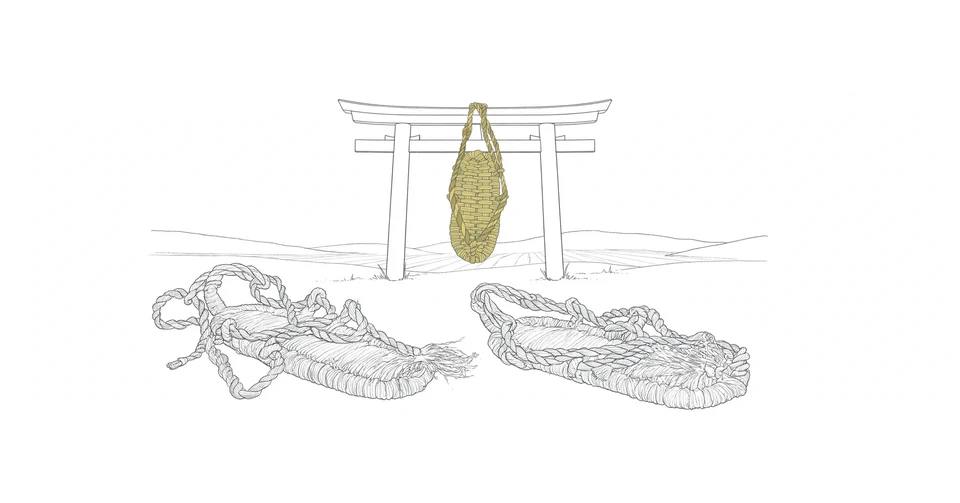
The sandal has almost vanished from daily life, but it has not vanished from Japan. You can still see Waraji Straw Sandals on the feet of Buddhist monks, in festivals, and on the backs of pilgrims climbing mountain trails. And in Tokyo, on the back of the great Hozomon gate at Senso-ji, hangs a pair of them so large that a single sandal is longer than a car, a joke in straw that carries a serious meaning.
What Waraji Straw Sandals are
A waraji is a light sandal woven from rope made of rice straw, called wara in Japanese. The sole is a flat plait of straw rope, and the Waraji Straw Sandals are held to the foot by cords that pass between the first and second toes, loop through the sides, and tie over the instep and around the ankle. There was never one standard way of tying them, and different regions and different jobs produced different knots, but the idea was always the same: a sole that could be tied on tightly and would stay put on a long walk.
The fit was close and practical. Waraji Straw Sandals were usually worn over tabi, the split toe socks of Japan, and they were woven so that the wearer's toes stuck out slightly past the front edge of the sole. That small overhang gave the toes grip and feeling on rough ground, which mattered on mountain paths and muddy fields. The sandal was shorter than a modern shoe, and it was meant to move with the foot rather than to enclose it.
It is worth saying plainly what waraji were not. They were the simplest form of outdoor footwear, and they were never worn indoors, since sandals of any kind stayed outside the house. They were also informal. A person would not wear waraji with a formal kimono, and that simple rule of dress tells you where the sandal stood in Japanese life. It belonged to work, to travel, and to the road, not to ceremony.
A thousand years on the road
There are records of waraji in the Heian period, which ran from 794 to 1185, and they may have existed even earlier. For the common people of Japan, Waraji Straw Sandals were the standard footwear for centuries, and they stayed that way through the long Edo period, from 1603 to 1867. In the cities of Edo, people wore geta, the wooden clogs that clicked on paved streets, but anyone setting out on a long journey put on waraji instead.
The reason was grip and weight. Waraji Straw Sandals were light, and their woven straw sole gripped dirt, mud and stone better than smooth wood. Soldiers wore them on the march, farmers wore them in the fields, and labourers wore them for hard and prolonged work. The sandal was the footwear of people who walked for a living, and in a country of mountains and unpaved roads, that was most people.
They were still being made at home in the early 20th century. A photograph from September 1914 shows a man weaving waraji in his own house, holding the twine warp between his hands and toes while he worked the loose straw weft into the sole. It was a household skill, learned in childhood, and it needed no workshop, no tools beyond a pair of hands, and no material beyond the straw that the harvest had already provided.
How Waraji Straw Sandals are made
Making Waraji Straw Sandals began with the straw itself. Long rice straw, left unbroken by threshing, was sprayed with water to make it pliable, then beaten with a wooden mallet to soften the fibres and shake out the loose pieces. The softened straw was twisted into rope, and the rope was plaited into a flat sole with loops at the sides and at the heel for the tying cords. A workshop in Fujino, in the hills west of Tokyo, still teaches visitors to make straw footwear this way, starting with wetting and beating the straw and ending with a sandal that can be walked in the same day.
The work was slow, but it was never special. Waraji Straw Sandals were homemade from cheap materials, and a family could make them in the evening after the day's work in the fields. The straw was a byproduct of the rice harvest, so the sandal cost almost nothing but time, and time was something a farming household could spend in winter, when the fields were quiet and the straw was dry and stored.
There is something quietly radical about a shoe made from the waste of the harvest. Nothing was bought, nothing was shipped, and nothing was thrown away that the earth had not already given. Modern shoes travel thousands of kilometres before they reach a foot, and they are made from materials that will sit in a landfill for centuries. The straw sandal was the opposite: it was local, it was simple, and when it was finished, it went back to the earth without a fuss.
Why travellers carried spares
A pair of Waraji Straw Sandals did not last long. In constant use, a rice straw pair wore through in three or four days, or roughly 24 hours of active walking, and a person who wore them every day would need about a hundred pairs a year. That sounds absurd until you remember how cheap and quick they were to make, and travellers simply planned for it. They carried a supply of fresh pairs in their packs, and when a pair wore out on the road, they threw it away and tied on a new one.
The practice shaped the way people travelled. A long journey in old Japan was measured not only in distance but in sandals. A traveller leaving Edo for Kyoto would set out with a bundle of straw sandals, and the worn out pairs left along the roadside were a normal sight, not litter in the modern sense but straw returning to the fields it came from. The road itself kept a record of the feet that had passed.
It is a strange thought for a modern traveller, who expects one pair of shoes to last a year or more. But there is a kind of honesty in the Waraji Straw Sandals that our durable shoes lack. They never pretended to be permanent. They were built to be used up, and their short life was the price of their lightness, their cheapness and their grip. A sandal that lasts three days and costs nothing is not a bad sandal. It is a different answer to the question of what a shoe is for.
Waraji, zori and geta, three sandals for three jobs
Waraji Straw Sandals are often confused with zori and geta, the two other famous sandals of Japan, but the three had different jobs. Zori are flat slip on sandals held by a thong between the toes, and they began as a form of waraji meant to be worn with more formal clothing such as kimono. Over time they were made from cloth, lacquered wood, leather and other finer materials, and the zori that Japan still wears to formal occasions today grew directly out of that idea.
Geta are different again. They are wooden clogs that lift the foot above mud and puddles, and in the Edo period they were the footwear of the city, worn on paved streets where their wooden teeth clicked with every step. Waraji Straw Sandals, by contrast, were tied on, not slipped on, and their woven sole gripped the dirt roads and mountain paths where geta would have slipped. If zori were the sandal for ceremony and geta were the sandal for the town, waraji were the sandal for the road.
The three sandals together tell a small history of Japan itself. A society that walked everywhere needed different shoes for different ground, and it made them all from what was close at hand: straw from the fields, wood from the forests, cloth from the loom. None of them needed a factory, and all of them could be repaired or replaced by the person wearing them.
The giant Waraji Straw Sandals of Senso-ji
The most famous Waraji Straw Sandals in Japan are the ones nobody can wear. On the north face of the Hozomon, the inner gate of Senso-ji in Asakusa, the side that faces the main hall, hang two enormous straw sandals, waraji, each about 4.5 metres long and 1.5 metres wide. Most visitors walk through the gate facing forward, toward the main hall, and never see them at all. The sandals are behind you the moment you pass through, and the only way to see them is to stop on the far side and turn around.
The giant Waraji Straw Sandals are real sandals, not sculptures, woven by hand in the traditional way and scaled up until the method nearly breaks. Each one weighs almost 500 kilograms, and the pair was made from about 2,500 kilograms of rice straw, according to the Tokyo Free Walking Tour report on the new o-waraji. Some 1,100 people took part in the work, and special rice seedlings were planted more than a year in advance and cultivated just for the weaving.
They are an offering from the people of Murayama City in Yamagata Prefecture, far to the north of Tokyo, and they have been renewed roughly once a decade for generations. The first pair was donated in 1941, and it burned with the temple in the air raids of 1945. A second pair was donated in 1964, when the gate was rebuilt, and the current pair, the eighth, was dedicated in October 2018. The Hozomon that carries them is itself a treasure house gate, guarding the main hall with its Nio statues on one face and these giant sandals on the other.
The meaning of the giant Waraji Straw Sandals is simple and charming. They are a sign of the strength of the Nio, the fierce guardian deities whose statues stand on the other face of the gate. The idea is that a demon seeing footwear of this size will assume the guardians who wear such sandals are far too large to fight, and will think better of approaching the temple. In older times, people also brought ordinary straw sandals to temples as offerings, hoping for healthy feet and protection on their journeys, and the giant pair at Senso-ji carries that old custom to its grandest scale.
Visitors today still reach up to touch the giant Waraji Straw Sandals, hoping to borrow a little of their power for their own walking, and the bottoms of the sandals have grown worn and discoloured from so many hands. It is a small, human detail, and it says something about why the sandals survive. They are not only a charm against evil. They are a wish, made in straw, that our feet will carry us as far as we need to go.
Where Waraji Straw Sandals still walk today
In modern Japan, Waraji Straw Sandals are still worn by Buddhist monks, and by pilgrims on mountain trails, including the monks who perform the kaihogyo, lacing waraji over their tabi before they set out on their long mountain rounds. They appear in festivals too, carried into the sea at waraji festivals and worn by participants in historical processions, where their straw soles are part of the costume and part of the meaning.
They also survive in the hands of makers. Workshops in the satoyama, the rural landscape of fields and woodland around Japan's farming villages, teach visitors to beat the straw, twist it into rope, and weave a sandal they can walk in the same afternoon. The Japan Tourism Agency's satoyama experience page describes one such workshop in Fujino, where the straw is prepared step by step and the finished sandal is tested on a walk through the hills, and it is a good place to start for anyone who wants to understand how a handful of straw becomes a shoe.
What strikes me about this survival is that the Waraji Straw Sandals never tried to become fashionable. They did not adapt, they did not rebrand, and they did not pretend to be something else. They simply stayed useful in the few places where usefulness still matters more than appearance: on a monk's feet, on a mountain path, and in a workshop where a visitor learns that a shoe can be made by hand in an afternoon.
What a straw sandal teaches
A thousand years of Waraji Straw Sandals add up to a simple lesson, and it is not about nostalgia. The sandal worked because it asked for so little: straw from the harvest, hands that knew the weave, and a traveller willing to carry spares. It did not promise to last, and it did not need to. It promised to be light, to grip the road, and to be replaced without fuss when its work was done.
That is a good way to think about the things we still make by hand. The Waraji Straw Sandals of old Japan were not precious, and that was their strength. A precious shoe is kept in a box. A straw sandal was worn until it fell apart, and then another was made, and the road went on. The giant pair on the Hozomon gate will never walk anywhere, but they remind every visitor who turns around that the humblest things, made well and offered freely, can outlast the grandest buildings. The gate burned and was rebuilt. The sandals burned and were rewoven. The feet that wore them are long gone, but the road is still there, and the straw is still waiting in the fields.
More in Culture & Society
- Miyadashi Is the Moment the God Leaves Home
- Otabisho Is Where the God Rests on the Way Through Town
- Mikoshi Are the Portable Shrines Japan Carries on Its Shoulders
- Sanja Matsuri Turns Asakusa Into Tokyo's Loudest Weekend
- Fujin Carries the Wind That Arrives Before the Thunder
- Raijin Is the Thunder God Behind Japan's Summer Storms
Latest posts
- An Engawa Is Neither Inside nor Outside, and That Is the Point
- Nikko and the Shrines Hidden in the Cedar Forest
- Minka Are the Folk Houses Japan Built Around the Hearth
- The Orangutan and the Vanishing Forests of Borneo
- Hozomon Guards the Treasure House Behind Senso-ji's Main Hall
- Nakamise Is the Shopping Street That Has Fed Pilgrims for Centuries
- Kaminarimon Is the Thunder Gate That Opens Asakusa to the World
- Sony, the Tokyo Workshop That Taught the World to Listen
- Tengu Is the Mountain Goblin Japan Still Meets on the Trail
- Kappa Is the River Imp Japan Still Warns Its Children About
- Calonarang Is the Night Rangda and Barong Finally Meet
- Yamata no Orochi Was Never Just a Monster to Slay
- Kit Kat Japan, the Flavours You Will Not Find Anywhere Else
- How Susanoo Slew the Eight-Headed Serpent and Won a Bride
- How Kusanagi Became Japan's Most Guarded Sword