Odalan Is the Birthday Bali Gives Every Temple
· 25 min read
An odalan is the Balinese temple anniversary, a festival held every 210 days on the Pawukon calendar, when a village invites its gods home for three days of prayer, procession, and shared food.
Every village in Bali has a date it never forgets, and it is not written on any wall calendar you can buy in a shop. It is the birthday of the village temple, and when that day comes the whole village stops its ordinary work, puts on its best clothes, and throws a party for the gods. That party is an odalan, and it is the most common festival in Bali, which is saying a great deal on an island where festivals are part of everyday life.
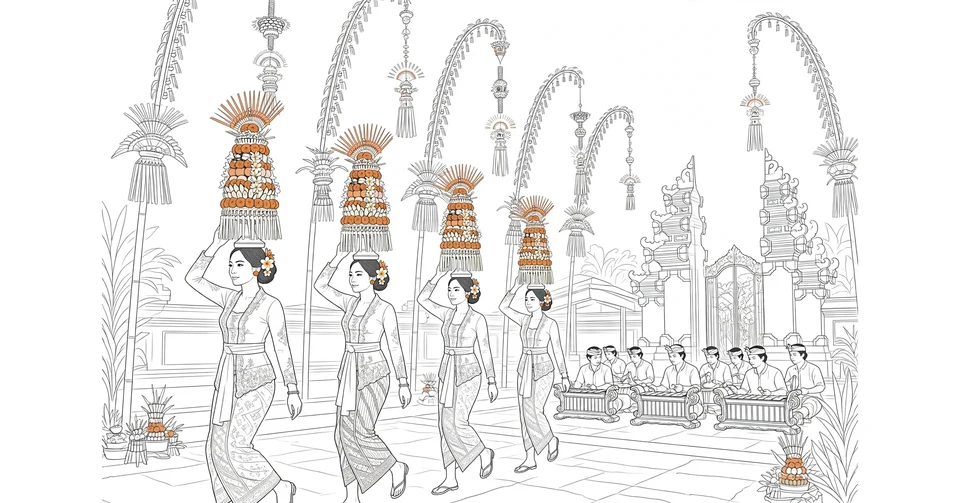
An odalan is a temple anniversary. Every temple in Bali, from the smallest family shrine to the great mother temple at Besakih, was founded on a particular day, and the odalan marks that founding day, the day the temple was consecrated and the gods were first invited to dwell there. The word itself comes from the Balinese root wedal, which means birth, or appearance, or to emerge into the world, so an odalan is literally the day a temple was born. It is also called piodalan, and the two words describe the same celebration.
Because Bali has more than 20,000 temples, and every village has at least three, an odalan is happening somewhere on the island on almost every day of the year. A traveller who stays in Bali for a week has a fair chance of meeting one, and a traveller who stays a month will almost certainly see one, whether as a line of women carrying fruit towers down a village road or as the sound of gamelan drifting over a rice field after dark. This article explains what an odalan is, how its date is set, what happens across its days, and how a visitor should behave when one crosses their path.
What an odalan is
An odalan is a Balinese village temple festival, an occasion when the Hindu village community comes together, invites the gods to visit for three or more days, and performs religious services together, offering refreshments and entertainment. That short description, from the encyclopedia entry on odalan, holds the whole idea in a single sentence. The gods are the guests of honour, the village is the host, and the festival is the hosting.
The theology behind it is worth understanding, because it explains everything that follows. In Balinese Hindu belief, the tiered stone pagodas and wooden shrines of a temple, the meru and the pelinggih, are not permanent homes for the deities. They are sanctified vehicles, or landing stations. On the sacred days of the odalan, the supreme divinity, the ancestral spirits, and the protective deities descend from their heavenly abodes to dwell temporarily within the sanctified courtyard. For three to eleven consecutive days, the local community serves as divine host, showering its heavenly guests with feasts, music, theatrical entertainment, and heartfelt devotion.
That is why an odalan is not a performance put on for an audience. It is an act of hospitality. The village cleans the temple, decorates it, cooks for days, and rehearses its dances, all for guests who cannot be seen but whose presence is felt in every part of the celebration. The rituals of the festival are called Dewa Yadnya, sacred offerings to the gods, and they include processions, the decoration of the village temple, entertainment, and dancing in the temple courtyard. The whole village pools its resources and observes the festival together, and that pooling is as much a part of the religion as the prayers.
I find this idea of hosting the gods quietly radical. Most religions ask people to go to the gods, to climb a mountain or to travel to a holy city. An odalan brings the gods home instead, into the courtyard at the centre of the village, and asks ordinary people to be good hosts. It turns the temple into a house with guests, and the village into a family receiving them, and that changes the feeling of the whole festival. It is not solemn in the way a visitor might expect. It is warm, busy, noisy, and generous, because that is what good hosting looks like.
Why every temple has a birthday
Every temple in Bali has its own odalan because every temple has its own founding day. When a temple is built, it is consecrated in a ceremony called pemlaspas, and the date of that consecration becomes the temple's birthday. The odalan marks the exact anniversary of that day, and it returns on the same point of the Balinese calendar, again and again, for as long as the temple stands.
This is why there are so many of them. A village in Bali typically has three community temples, the Pura Kahyangan Tiga, the three temples of the village, and each one keeps its own anniversary. Add the family temples, the clan temples, the temples of the rice fields, and the temples of the mountains and the sea, and the island's calendar fills up. The result is that the odalan is not a single festival with a single date, like a national holiday. It is thousands of small birthdays, scattered across the year, each one belonging to one temple and one community.
The birthday framing also explains the mood of the festival. A birthday is a day for remembering how something began and for celebrating that it is still here. An odalan does both. It remembers the founding of the temple, and it celebrates that the temple, and the village around it, have survived another cycle. The gods are invited back to the place where they were first welcomed, and the village renews the welcome, as a family renews a birthday greeting every year.
There is a practical side to this, too. A temple is a building, and buildings need repair. The odalan is the occasion when the community gathers the money, the labour, and the attention to maintain the temple, to repaint the shrines, to replace the thatch, and to keep the courtyards clean. The festival is the temple's maintenance schedule as much as its birthday, and the two purposes fit together naturally. You look after the house when the guests are coming, and the guests keep coming because the house is looked after.
How the 210-day Pawukon calendar sets the date
Most village temples set their odalan by the Pawukon calendar, the 210-day Balinese calendar, and understanding that calendar is the key to understanding why an odalan falls when it does. The Pawukon cycle is 210 days long, made up of thirty weeks of seven days, and a temple's anniversary is fixed to a specific intersection of its cycles. A temple might celebrate its odalan every Buda Cemeng Klawu, a Wednesday in the week of Klawu, and that combination recurs exactly every 210 days.
The date is fixed to an intersection of three cycles at once: the seven-day week called Saptawara, the five-day week called Pancawara, and the seven-day cycle called Wuku. It is the combination of the three that names the day, and because the cycles turn together, the same combination comes around again after 210 days. A temple's birthday is therefore not a date on a wall calendar. It is a position in a turning wheel, and the wheel brings it around roughly twice in a Gregorian year.
That rhythm shapes the whole island. Because every temple has its own position on the wheel, and the wheel has 210 positions, the birthdays are spread out across the year, and several odalan fall on any given day. The island never has a season without temple birthdays, and no village has to wait long for its own. The calendar is crowded by design, and the crowding is the point. The gods are always being welcomed somewhere, and the island is always celebrating something.
I think there is something quietly wise about a 210-day year. A Gregorian year is tied to the sun, and it repeats the same seasons in the same order. The Pawukon cycle is tied to nothing in the sky that a visitor can see, and it moves against the solar year, so a temple's birthday drifts through the seasons over the years. That drifting means an odalan is never owned by one season. It belongs to the temple, not to the weather, and the village celebrates it in the heat and in the rain alike. A birthday that never settles into a season is a reminder that the temple's life runs on its own time.
Not every odalan follows the same calendar
Most village temples follow the Pawukon cycle, but the great temples do not, and the difference is worth knowing. The major regional sanctuaries and supreme mountain mother temples, such as Pura Besakih, Pura Ulun Danu Beratan, and Pura Ulun Danu Batur, frequently celebrate their grand festivals according to the Saka lunar calendar. Their ceremonies coincide with auspicious full moon days, most notably Purnama Kadasa, the tenth full moon, which usually falls in March or April, or Purnama Kalima, the fifth full moon.
The Saka calendar is lunar, so its dates move against the solar year in a different way from the Pawukon cycle, and the grand odalan of a great temple is a rarer and larger event than a village odalan. A village odalan is a community affair, organised by one banjar, or neighbourhood group, and attended by the families of that village. A great temple's odalan draws pilgrims from across the island, and the preparations stretch for weeks.
This split between the two calendars is a useful reminder that Bali is not one uniform culture. It is a network of villages, each with its own temple and its own calendar, gathered under a handful of great temples that keep a different rhythm. The odalan of a small village temple and the odalan of Besakih are the same kind of celebration, a temple's birthday, but they are celebrated on different clocks, at different scales, and for different communities. The word is the same, and the feeling is the same, but the size of the party is very different.
The distinction also matters for a visitor. A village odalan is easy to stumble into, because there are so many of them, and a visitor who is respectful will usually be welcomed to watch. A grand odalan at a great temple is a major event that a visitor can plan around, and it will be crowded, with pilgrims arriving from all over the island. Both are worth seeing, but they are different experiences, and knowing which calendar a temple follows tells you which kind of celebration to expect.
The weeks before an odalan: ngayah and the village prepares
An odalan is not organised by a committee or a company. It is organised by the village itself, through ngayah, the voluntary communal labour that Bali runs on, in which people give their time without pay because the temple belongs to everyone. Days before the festival begins, the local neighbourhood collective, the banjar, gathers in the temple to work, and the work is joyful rather than grim, because the work is part of the festival.
The men harvest tall curved bamboo poles to craft soaring penjor arches, erect palm-thatch shade pavilions, and prepare roast suckling pigs. The women spend dozens of hours weaving intricate coconut-leaf decorations called jejaitan and preparing mountains of offerings. The temple is cleaned, the shrines are repainted, the courtyards are swept, and the whole village is put in order for its guests. Nobody is paid, nobody is performing for a wage, and nobody is competing for a prize. The work is service, and the service is shared.
The preparation is also when the village decides who will do what. The traditional village council meets in a paruman, and the elders settle which neighbourhood groups will take their turn to present their ayahan, or community service, and on which day. The duty then falls to the families of the banjar, and every household knows its part. Some cook, some weave, some carry, some play music, and some guard the road, and the festival only works because all of those parts are filled.
I have always thought that the preparation is the most honest part of an odalan. Anyone can attend a festival, but the people who built it are the ones who own it, and the ngayah is what makes the odalan belong to the village rather than to the temple alone. A festival that is bought is a show. A festival that is built by hand, by the people who will celebrate it, is a homecoming, and you can feel the difference in the way the village walks through its own temple on the day itself, with the ease of people who swept the courtyard themselves.
The opening day: mepeed and the walk to the temple
On the opening day of an odalan, the village performs melasti or mendak batara, marching the sacred heirloom statues, the pratima, to the nearest holy spring, river, or ocean to be ritually cleansed with holy water. The procession that carries them is known as mepeed, and it is one of the great sights of Bali. Hundreds of village women walk in single file, each bearing a gebogan fruit offering stacked two to four feet high on her head, with effortless posture, and the line stretches down the road as far as the eye can see. To understand the walk itself, read about the mepeed, the slow walk that carries Bali to the temple.
The mepeed is the odalan arriving at the temple, and it is also the odalan in miniature. The line is ordered, nobody overtakes the person in front, and the slowest walker sets the pace, so the whole village arrives together. The women carry the offerings, the men walk with the banners and the gamelan, and the village guards clear the road ahead, and every person in the line has a place that was decided before the walk began. The road becomes a place of worship long before the temple gate appears.
When the line reaches the temple, the carriers enter the central courtyard, and a pemangku, or temple priest, sprinkles tirta, holy water, over the offerings. The blessed offerings are then lined up neatly on a bale pavilion in the main temple area, and the prayer procession begins. The walk is over, but the festival has only just begun, and the temple, which has been cleaned and decorated for days, is finally full of its guests, both the gods and the village.
The opening day also sets the tone for the days that follow. An odalan is not a single moment of prayer. It is a stretch of days in which the temple stays open, the gods stay in residence, and the village keeps coming back, morning and evening, to pray, to eat, to watch the dances, and to be together. The first day is the arrival, and the days after it are the visit, and the whole festival is shaped like a good house guest's stay, with a welcome, a long visit, and a farewell.
Inside the courtyard: prayers, dances, and the gods as guests
Inside the inner sanctum, the jeroan, the officiating high priests ring brass prayer bells called genta, chant Sanskrit verses, and sprinkle blessed water over the offerings and the worshippers. The prayers are the heart of the odalan, and they are also the part a visitor is least likely to see, because the inner courtyard is reserved for the community and its priests during the core rituals. The sacredness is not a show, and it is not hidden out of secrecy. It is simply the private part of a family occasion, and a visitor respects it by staying at the edge.
Outside the inner sanctum, in the middle and outer courtyards, the festival is public, and it is there that the odalan becomes the theatrical event that scholars have written about. Sacred ceremonial dances are staged in the courtyard to entertain the gods, and the dances are as much a part of the offering as the food. Rejang Dewa is an ethereal, hypnotic line dance performed by young, unmarried village maidens dressed in white and gold, guiding ancestral spirits down from the heavens. Baris Gede is an ancient warrior dance performed by village men brandishing spears and shields, standing as protective guardians against negative energies. Topeng Sidhakarya is a masked theatrical performance featuring a fierce, white-faced priest with protruding fangs, whose final comic blessing ensures the ritual is valid, auspicious, and complete.
The music runs through all of it. Gamelan orchestras play in the courtyards, sometimes in competition with each other, and the sound carries across the village long after dark. The most enchanting atmosphere comes after sunset, between seven in the evening and midnight, when thousands of oil lamps illuminate the courtyards, the gamelan plays, and sacred drama troupes perform under the stars. An odalan is not a daytime event that ends at dusk. It is a festival that comes alive at night, when the lamps are lit and the gods, in Balinese belief, are most present among their hosts.
The dancing and the music are also a reminder that the odalan has shaped Balinese art for centuries. The encyclopedia account notes that the celebrations have historically contributed to the rich tradition of theatre and Balinese dance forms, and that is no exaggeration. The dances of the odalan are not decorations on a religious festival. They are the festival, the entertainment the village offers its divine guests, and they are also the school in which each generation of dancers learns its art. A child who watches Rejang Dewa at her village odalan is watching her own future, if she chooses it, and the temple courtyard is her classroom.
The food the gods leave behind
Visitors often marvel at the mountains of tropical fruit, woven rice cakes, duck roasts, and sweet meats stacked inside the temple pavilions during an odalan, and they wonder if the food goes to waste. The answer is an emphatic no, and the reason is one of the most beautiful ideas in Balinese Hindu belief.
In Balinese belief, the gods and ancestors consume only the sari, the invisible spiritual essence, scent, and devotion of the offering. Once the priests have consecrated the offerings with holy water and the ceremonies conclude, the physical food becomes surudan, divinely blessed food. Families carry their towering gebogan fruit pyramids back to their home compounds, where the fruit is shared among relatives, neighbours, and children during joyous post-festival meals. Nothing is wasted, and the sharing is the last part of the giving. To learn what goes into the tower itself, read about the gebogan, the tower of fruit Bali carries to the temple.
The tower that the women carry is itself a work of art. A gebogan is a tapering tower of fruit, cakes, and flowers built on a footed wooden tray called a dulang, usually between 50 and 100 centimetres high, built at home by the woman who will carry it. The tower narrows as it climbs, a small tray of flowers crowns the top, and the whole structure is balanced on the carrier's head without straps or supports. To carry one in a mepeed, in the heat, in a line that does not hurry, is itself an act of devotion, and the tower is the visible sign of it.
The sharing of the surudan is also the moment when the odalan stops being a temple event and becomes a village event again. The blessed food goes home, the families eat together, the children get the sweetest pieces, and the neighbours who could not come to the temple still taste the festival. The gods have eaten the essence, and the village eats the rest, and the circle of the offering closes at the family table. I think this is the part of the odalan that stays with a person who has watched one. The offering is not thrown away, and it is not left behind. It is carried there, blessed, and carried home, and the sharing is what makes the whole long preparation worthwhile.
The biggest odalan of all: Besakih
The odalan at a few large temples has major cultural importance beyond its location, and none more so than Pura Besakih, the biggest Hindu temple in Bali. Besakih is the mother temple, the island's supreme sanctuary on the slopes of Mount Agung, and its odalan is an island-wide event, celebrated with major preparations once every hundred Balinese years.
That scale is hard to picture, and it is worth pausing on. A village odalan is organised by one banjar and attended by the families of one village. The odalan of Besakih draws pilgrims from across the whole island, and the preparations stretch for weeks, with offerings, dances, and rituals on a scale that no village could attempt. The temple's courtyards fill with people who have travelled for hours to be there, and the festival lasts far longer than the three days of a village temple, running for eleven days or more.
Besakih's odalan is also a reminder of how the temple network fits together. Every village temple has its own birthday, and every village celebrates it, but the great temples belong to everyone, and their birthdays belong to the whole island. The village odalan is a family birthday, and the Besakih odalan is a national holiday, and both are the same kind of celebration, a temple's birthday, kept on a different scale. A good guide to the temple anniversary cycle, and to the part the procession plays in it, is this overview of the piodalan festival.
The other great temples keep their own grand rhythms. Pura Ulun Danu Beratan on Lake Bratan and Pura Ulun Danu Batur on Lake Batur celebrate their grand festivals on the Saka lunar calendar, on full moon days that draw pilgrims from their regions. A smaller neighbourhood family shrine or village temple festival typically lasts for three consecutive days, while the grand festivals of the great temples can last for eleven days or even an entire lunar month, a period known as nyelem, during which pilgrims visit daily. The range is enormous, from three days in a village to a month at a mother temple, and the word odalan covers all of it.
How long an odalan lasts, and how often it comes
A village odalan typically lasts for three consecutive days, and that is the length most visitors will meet. Three days is long enough for the gods to be welcomed, entertained, and farewelled, and short enough for a working village to sustain. The first day brings the procession and the arrival, the middle days hold the prayers and the dances, and the last day brings the farewell, when the gods are thanked and the temple returns to its quiet routine.
The grand odalan of a great temple lasts longer, eleven days to an entire lunar month, and the difference is a matter of scale rather than kind. More pilgrims, more offerings, more dances, and more days are needed to host a larger community of guests, and the great temples have the resources and the reputation to sustain a longer festival. The rhythm is the same, a welcome, a visit, and a farewell, stretched out over more days.
And the odalan always comes back. A village temple's birthday returns every 210 days on the Pawukon calendar, roughly twice in a Gregorian year, so no village waits long for its next celebration. The cycle is short enough that a child grows up with the festival as a regular part of life, and long enough that each one feels like an occasion. The temple is born again, every 210 days, and the village is born again with it, and that repetition is the point. An odalan is not a once-in-a-lifetime event. It is a habit, kept for centuries, and the habit is what keeps the temple alive.
That repetition is also what makes the odalan easy to miss and easy to find. Easy to miss, because there is no single date to circle on a calendar, and no island-wide announcement. Easy to find, because there are so many of them, and a visitor who stays in Bali for more than a few days will hear the gamelan before they see the temple, and will follow the sound to a courtyard full of lamplight and dancers. The festival does not advertise itself. It simply happens, again and again, as it has for generations.
If you are invited to an odalan
Balinese communities are exceptionally hospitable, and they welcome respectful foreign travellers to observe an odalan. The rules for doing so are simple, and they are the same rules that govern any visit to a Balinese temple, but they matter more on a festival day, when the temple is full and the rituals are at their most sacred.
Dress as the Balinese do. Wear a clean sarong with a waist sash, a shirt or kebaya that covers the shoulders, and for men a folded headcloth called an udeng. Shorts and beachwear will see you turned away at the gate, and rightly so. Do not enter the inner courtyard during the core prayers, do not walk in front of kneeling worshippers, and do not step between a person at prayer and the shrine they face. Sit or stand quietly along the periphery of the courtyard, and let the ceremony come to you.
Observe the rules of spiritual purity, which are taken seriously. Do not enter the temple if you are menstruating, if you have an open bleeding cut, or if you are in mourning for a family member. These rules are not a judgement on the visitor. They are a condition of the temple's sanctity, and observing them is the simplest way to show respect.
Photographs are welcome in most cases, but they should be taken from a distance and without blocking the walkers or the worshippers. The women carrying gebogan are not performers, and they are not posing for a photograph. They are carrying an offering to the temple, and a camera in their path is a nuisance and a discourtesy. Stand to the side, keep your voice low, and do not step into the road to get a better angle.
A village odalan is a community rite, not a commercial event, and there are no tickets. Visitors often leave a modest voluntary donation in an offering basket at the entrance to help with temple upkeep, typically twenty thousand to fifty thousand rupiah, and that gesture is appreciated. But the best thing a visitor can give an odalan is the one thing the villagers give each other, patience. Wait for the line, let it pass, and let the village reach its temple together.
If you meet the procession on the road, the right response is simple, and it is the same response a Balinese driver gives. Pull over, wait, and watch. Do not try to cut through the line, do not drive between the walkers, and do not sound your horn to hurry them along. The line will pass, and the road will open again, and the few minutes you waited will have cost you nothing.
What an odalan teaches about belonging
An odalan is a birthday, and like any birthday it is a reminder that something has lasted. A temple lasts because a village keeps it, and a village keeps it because the temple gives the village a reason to gather, to work together, to cook together, and to welcome the gods together. The festival is the mechanism by which a community renews itself, every 210 days, without speeches or slogans, simply by doing the work and sharing the food.
The lesson is not a complicated one, and that is why it has survived. A community is not an idea. It is a set of practices, repeated on a schedule, that give people a reason to be in the same place at the same time, doing the same work for the same purpose. The odalan gives Bali that reason, more often than any other festival on the island, and it does so without fanfare, in thousands of small courtyards, on thousands of small birthdays.
I think the rest of us could borrow the shape of it, even if we do not share the belief behind it. A birthday for a place, kept on a fixed cycle, with work done together beforehand and food shared afterwards, is a way of saying that the place matters and the people around it matter, and that neither survives without the other. Bali has kept that habit for centuries, one temple at a time, and the island is more itself for it.
The next time you hear gamelan drifting over a rice field after dark, follow the sound. You will find a temple courtyard full of lamplight, a village in its best clothes, and a birthday being celebrated for a building that cannot eat, cannot speak, and cannot thank its guests. The village celebrates it anyway, because the celebration is the point, and because a temple that is loved for centuries is never just a building. It is a home, and an odalan is the day the family comes home to it.
More in Culture & Society
- Japanese Mythology and the Gods Who Shaped an Island Nation
- Mepeed Is the Slow Walk That Carries Bali to the Temple
- Gebogan Is the Tower of Fruit Bali Carries to the Temple
- Banten Are the Offerings Bali Makes Out of Almost Nothing
- Tama Nuki Is the Rite That Lets a Sacred Object Rest
- Japanese Noh Theatre and the Slowest Drama on Earth
Latest posts
- Amado Are the Storm Shutters That Close Japan for the Night
- Tamashii Ire Invites a Soul Into a Sacred Object
- Kaigen Kuyo Is the Ceremony That Wakes a Sacred Object
- Ihai Are the Lacquered Tablets That Keep a Name Alive
- A Butsudan Keeps the Dead Close in a Japanese Home
- An Engawa Is Neither Inside nor Outside, and That Is the Point
- Nikko and the Shrines Hidden in the Cedar Forest
- Minka Are the Folk Houses Japan Built Around the Hearth
- Miyadashi Is the Moment the God Leaves Home
- Otabisho Is Where the God Rests on the Way Through Town
- Mikoshi Are the Portable Shrines Japan Carries on Its Shoulders
- Sanja Matsuri Turns Asakusa Into Tokyo's Loudest Weekend
- The Orangutan and the Vanishing Forests of Borneo
- Waraji Straw Sandals Walked Japan for a Thousand Years
- Hozomon Guards the Treasure House Behind Senso-ji's Main Hall