Japanese Mythology and the Gods Who Shaped an Island Nation
· 15 min read
Japanese mythology begins with two gods stirring the sea with a spear and ends with an emperor who claims descent from the sun. This guide follows the creation stories, the sun goddess, the storm god, and the seven lucky gods.
Japan's oldest books do not open with kings or battles. They open with a formless sea, a jewelled spear, and two gods standing on a bridge in heaven, stirring the water until the first drops fall and harden into land. That is where Japanese mythology begins, and in a sense it never really ends, because the same stories still decide where shrines stand, what festivals celebrate, and why the emperor of Japan still traces his family line back to the sun.
Japanese mythology is the collection of stories recorded in the Kojiki, compiled in 712, and the Nihon Shoki, compiled in 720. The two books are the oldest surviving works written in Japan, and together they form the literary foundation of Shinto, the native religion of the islands. They were written down in the eighth century, but the stories themselves are older, carried for generations by storytellers and court reciters before anyone set them in ink. Reading Japanese mythology today feels less like reading history and more like listening to a family explain itself: who we are, where our land came from, and why our rulers are who they are.
The first thing to understand is that Japanese mythology is not one story but a family of them, tied together by bloodlines. Gods marry, quarrel, give birth, and die, and their children become the next chapter. The word for these beings is kami, often translated as god or spirit, but the translation is too small. A kami can be a mountain, a river, a storm, an ancestor, or a force of nature with a personality. Tradition speaks of yaoyorozu no kami, eight million kami, which is a poetic way of saying there are too many to count, and that the sacred is not locked in a temple but scattered through the landscape. That is the first rule of Japanese mythology: the sacred is local before it is grand.
How Japanese mythology begins, with a spear and the first island
In the beginning, according to the Kojiki, heaven and earth were not yet separated. Light rose, heavy matter sank, and a handful of gods appeared on their own, without parents, and then hid themselves away. The last divine couple to appear were Izanagi, He Who Invites, and his sister-wife Izanami, She Who Invites. The elder gods handed them a spear decorated with jewels, called Ame-no-Nuboko, and ordered them to make solid land out of the drifting sea.
The couple stood on the Floating Bridge of Heaven and stirred the ocean with the spear. When they lifted it, the brine dripping from the tip clotted and formed Onogoro, the first island, which hardened under their feet. They descended to it, built a home, and began to have children. Their first children were failures, born deformed and set adrift, because the couple had circled the marriage pillar in the wrong order. They tried again, properly, and this time Izanami gave birth to the eight great islands of Japan, the Oyashima, one after another, and then to the gods of wind, sea, mountains, rivers, and trees.
The story turns dark with the birth of the fire god Kagutsuchi. His flames burned Izanami so badly that she died, and Izanagi, raging with grief, cut his own son down with his sword. From the fire god's blood and body, more gods were born, including the god of thunder. Death enters Japanese mythology early, and it never really leaves. Then Izanagi followed his wife down to Yomi, the land of the dead, and begged her to return. She agreed, on one condition: he must not look at her. He looked. What he saw was a rotting corpse crawling with maggots, and he fled in horror while she chased him to the border of the living world, promising to kill a thousand people a day. He answered that he would father fifteen hundred a day, and so the myth explains why people are born and die. It is a strange, sad bargain, and it is the first time Japanese mythology explains something ordinary, the fact of death, with a story about gods.
The sun, the moon, and the storm, born from one washing
After escaping Yomi, Izanagi washed himself in a river to clean off the pollution of the dead. This ritual washing, called misogi, is still practised at shrines today. As the water fell from his body, three of the most important gods in Japanese mythology were born. From his left eye came Amaterasu Omikami, the sun goddess. From his right eye came Tsukuyomi, the god of the moon. From his nose came Susanoo, the storm god, a restless trickster who would spend the rest of the stories causing trouble.
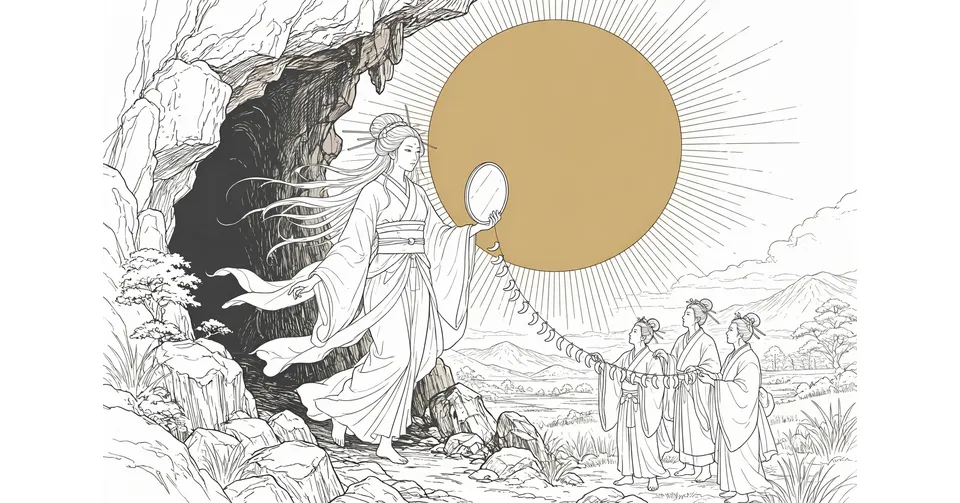
Amaterasu became the supreme deity of the pantheon and the ancestor of the imperial family, which is why her story matters beyond religion. The three siblings dominate Japanese mythology the way a family dominates a small town: they quarrel, they reconcile, and everything else happens around them. Izanagi gave her a jewelled necklace and told her to rule the High Plain of Heaven. He gave the night to Tsukuyomi and the sea to Susanoo, but Susanoo was not satisfied. He wept and howled for his dead mother until the mountains withered and the rivers dried, and his father banished him from heaven. Before leaving, Susanoo went to say goodbye to his sister, and the visit went badly.
The two gods held a contest to prove their good faith, chewing each other's possessions and breathing out new gods from them. Amaterasu bore three male gods from Susanoo's sword, and Susanoo bore five goddesses from Amaterasu's jewels. Susanoo declared himself the winner and celebrated by wrecking his sister's halls, breaking down the walls of her weaving rooms, and throwing a flayed horse through her roof. One of Amaterasu's weavers died of fright, and the sun goddess, in grief and fury, shut herself inside a cave and sealed it with a rock. The world went dark.
The cave where the sun hid
The story of the cave, called Ama-no-Iwato, is the most famous episode in Japanese mythology, and it is also the most human. Eight hundred gods gathered outside the rock and tried everything to lure Amaterasu out. They hung a great mirror and a string of curved jewels on a tree outside the cave, they sang, and they played music. Then the goddess Ame-no-Uzume, the goddess of dawn and revelry, climbed onto an overturned tub and danced so wildly, baring herself and laughing, that the gods roared with laughter. Amaterasu, curious about the noise, pushed the rock aside a little and asked what they were celebrating. They told her there was a goddess more splendid than her, and pointed at the mirror. When she leaned out to look at her own reflection, the gods pulled her from the cave, and light returned to the world. The mirror and the jewels from that day became two of the Three Sacred Treasures of Japan, and Ame-no-Uzume's dance is remembered as the origin of kagura, the sacred dance still performed at shrines, a tradition explored in the article about kagura.
It is worth pausing on this story, because it says something quietly wise about the way Japanese mythology treats its gods. Amaterasu is not lured out by force or by argument. She is lured out by laughter, music, and curiosity, by the sight of her own face. The gods do not command the sun to shine. They remind it why shining is worth doing. That is why the cave episode is the heart of Japanese mythology for many readers, and I think it is a gentler idea of divinity than most mythologies offer. It helps explain why Shinto has always felt closer to daily life than to doctrine.
Susanoo and the eight-headed serpent
Banished to earth, Susanoo eventually found a use for his strength. In the province of Izumo he met an old couple weeping over their daughter Kushinada, the last of eight sisters. The other seven had been eaten, one each year, by Yamata no Orochi, an eight-headed serpent so large its body stretched across eight valleys. Susanoo offered to kill the serpent in exchange for the girl's hand, and the family agreed. He had eight vats of strong sake set out, one for each head, and when the serpent drank itself to sleep, he cut it to pieces. Inside the tail he found a sword, which he named Ame-no-Murakumo, the Heavenly Cloud-Gathering Sword, and presented it to Amaterasu as an apology. The sword was later renamed Kusanagi, the Grass-Cutter, and became the third of the Three Sacred Treasures. The full tale of the serpent is told in the story of Susanoo and the serpent.
The serpent story matters because it marks a shift in Japanese mythology. The Yamato cycle, centred on Amaterasu and the imperial court, gives way to the Izumo cycle, centred on Susanoo and his descendants. Izumo is the older, earthier tradition, full of quarrels, bargains, and cunning. Its hero is Okuninushi, a descendant of Susanoo, a god of medicine, magic, and nation-building who won the land through kindness and trickery, including the famous episode of the Hare of Inaba, a white hare he rescued from a shark. In the end Okuninushi agreed to hand the land over to the descendants of Amaterasu, an event called the transfer of the land, and withdrew to his great shrine at Izumo Taisha, which still stands today as one of the oldest and most revered shrines in Japan. The two cycles together, court and countryside, heaven and earth, are what make Japanese mythology feel complete rather than one-sided.
The three sacred treasures and the first emperor
Amaterasu's grandson Ninigi was sent down from heaven to rule the earthly islands, and his grandmother gave him three gifts to prove his authority: the mirror Yata no Kagami, the sword Kusanagi, and the jewel Yasakani no Magatama. Each treasure stands for a virtue. The mirror stands for wisdom, because it shows things as they are. The sword stands for valour. The jewel stands for benevolence. The three objects became the Imperial Regalia of Japan, the most political objects in Japanese mythology, and they have been presented at every enthronement ceremony since at least the year 690, most recently at the enthronement of Emperor Naruhito in 2019. The mirror is enshrined at the Grand Shrine of Ise, the sword at Atsuta Shrine in Nagoya, and the jewel is kept with the emperor himself. Almost no one alive has seen the originals, which is part of their power: they are symbols of authority precisely because they are hidden.
Ninigi's great-grandson was Jimmu, traditionally the first emperor of Japan, said to have ascended the throne in 660 BCE after leading a military campaign from Kyushu to the Yamato region, in what is now Nara Prefecture. The date of 660 BCE is not historically verifiable, and historians treat Jimmu as a legendary figure rather than a documented ruler, but the story itself was never meant as a history lesson. Its purpose, like the whole of the Kojiki and the Nihon Shoki, was to trace the imperial line back to the sun goddess and give the court a divine origin. The current emperor is the 126th in the traditional count, and whether or not one believes the genealogy, it is the longest unbroken hereditary line claimed by any monarchy on earth.
Inari, Ebisu, and the seven lucky gods
Not all of Japanese mythology lives in the old chronicles. Some of its most beloved figures grew up later, in the daily religion of ordinary people. Inari, the kami of rice, agriculture, and prosperity, is the most widely worshipped of all. Foxes serve as the messengers of Inari, which is why stone foxes guard the entrances of Inari shrines, and more than 30,000 shrines across Japan carry the name. The head shrine, Fushimi Inari Taisha in Kyoto, founded in 711, is famous for its tunnels of ten thousand vermilion torii gates climbing the mountain, and it is one of the most visited shrines in the country.
Then there are the Seven Lucky Gods, the Shichifukujin, a cheerful group who sail together on a treasure ship, the Takarabune, and arrive at New Year to bring good fortune. Only one of them, Ebisu, the laughing god of fishermen and merchants, is originally Japanese. The others came from elsewhere and were adopted: Daikokuten from the Hindu god Mahakala, Bishamonten from the guardian king Vaisravana, Benzaiten from the goddess Saraswati, Hotei from the Chinese monk Budai, and Fukurokuju and Jurojin from Taoist sages of longevity. That mixture is typical of Japanese mythology as a whole. It absorbs what arrives from outside, gives it a Japanese name and a Japanese face, and keeps it. The same pattern runs through the strange spirits of Japanese folklore, where imported demons and local ghosts live side by side.
Where Japanese mythology still lives today
The myths did not retire when Japan modernised. Japanese mythology did not become a museum subject; it stayed a calendar, a map, and a set of habits. There are about 80,000 Shinto shrines in Japan, and the most important of them still perform the rituals the myths describe. At the Grand Shrine of Ise, the holiest site in Shinto, the shrine buildings are torn down and rebuilt in identical form every twenty years, a practice called shikinen sengu. The last rebuilding was in 2013, and the next is due in 2033. The point is not to preserve old wood. It is to keep the act of building alive, so that the shrine is never a museum piece but a thing remade by living hands, the way the myths themselves are remade each time they are told.
Festivals carry the stories into the streets. Japanese mythology is not a subject for school textbooks here; it is a calendar. At New Year, families place pictures of the treasure ship under their pillows for lucky dreams. At Setsubun, the bean-throwing festival in February, people scatter roasted soybeans and shout for demons to leave and fortune to enter, a ritual that descends directly from the old fear of the spirits of the dark. Kagura dancers still perform the dance of Ame-no-Uzume at shrine festivals, and Noh theatre, Japan's oldest surviving stage art, still stages plays about gods and ghosts from the chronicles. The slow, masked drama of Noh is in many ways the myths' second home, and Japanese Noh theatre keeps their plots alive for audiences who may never open the Kojiki.
Popular culture took the myths further than any priest could. Hayao Miyazaki filled Princess Mononoke with forest gods and Spirited Away with a bathhouse full of kami and spirits, and both films introduced Japanese mythology to audiences who had never heard of Amaterasu. Video games, manga, and anime borrow the gods freely: Susanoo's sword, Amaterasu's mirror, and the eight-headed serpent appear in stories far from any shrine. Some purists complain that this cheapens the myths, but I think it does the opposite. A story that can survive being retold as a cartoon has proved it is still alive, and the films of Studio Ghibli have done more to carry these gods abroad than a century of textbooks.
| God | Domain | Where to meet them |
|---|---|---|
| Amaterasu | The sun, ancestor of the imperial family | Ise Grand Shrine, Mie |
| Susanoo | Storms, the sea, trickery | Izumo Taisha, Shimane |
| Inari | Rice, prosperity, foxes | Fushimi Inari Taisha, Kyoto |
| Okuninushi | Medicine, nation-building, matchmaking | Izumo Taisha, Shimane |
| Ebisu | Fishermen, merchants, luck | Ebisu shrines nationwide |
The table above is only a starting point. A visitor who wants to understand Japanese mythology does not need to memorise every name. It is enough to visit one shrine, watch one kagura dance, or stand under the torii gates of Fushimi Inari at dawn and feel what the stories were trying to describe: that the world is full of presences, that the land itself has a memory, and that the boundary between the human and the divine was never drawn as firmly in Japan as it was elsewhere.
Japanese mythology endures because it never asked to be believed in the way a creed asks to be believed. It asked to be remembered, retold, and walked through, and after thirteen centuries people still do all three. The spear is gone, the cave is empty, and the serpent is dead, but the sun still rises over the same islands the myths describe, and every morning it does the work Amaterasu was said to do. That, in the end, is why these stories last. They are not about a world that used to be. They are about the world that is still outside the window.
More in Culture & Society
- Odalan Is the Birthday Bali Gives Every Temple
- Mepeed Is the Slow Walk That Carries Bali to the Temple
- Gebogan Is the Tower of Fruit Bali Carries to the Temple
- Banten Are the Offerings Bali Makes Out of Almost Nothing
- Tama Nuki Is the Rite That Lets a Sacred Object Rest
- Japanese Noh Theatre and the Slowest Drama on Earth
Latest posts
- Amado Are the Storm Shutters That Close Japan for the Night
- Tamashii Ire Invites a Soul Into a Sacred Object
- Kaigen Kuyo Is the Ceremony That Wakes a Sacred Object
- Ihai Are the Lacquered Tablets That Keep a Name Alive
- A Butsudan Keeps the Dead Close in a Japanese Home
- An Engawa Is Neither Inside nor Outside, and That Is the Point
- Nikko and the Shrines Hidden in the Cedar Forest
- Minka Are the Folk Houses Japan Built Around the Hearth
- Miyadashi Is the Moment the God Leaves Home
- Otabisho Is Where the God Rests on the Way Through Town
- Mikoshi Are the Portable Shrines Japan Carries on Its Shoulders
- Sanja Matsuri Turns Asakusa Into Tokyo's Loudest Weekend
- The Orangutan and the Vanishing Forests of Borneo
- Waraji Straw Sandals Walked Japan for a Thousand Years
- Hozomon Guards the Treasure House Behind Senso-ji's Main Hall