Tatami Still Sets the Measure of a Japanese Room
· 16 min read
Tatami is the woven rush floor that still measures Japanese rooms in mats, and this article looks at how it is made, how its sizes differ by region, and why it has lasted so long.
Ask how big a room is in Japan and the answer may come back in mats, not metres. A six mat room, a four and a half mat room, an eight mat room. The floor itself is the unit of measure, and the unit is tatami, the woven rush floor that has covered Japanese rooms for centuries.
That is the simplest way to understand it. Tatami is not a rug laid over a floor. It is the floor, built to a fixed size, in a fixed ratio, with a surface of woven grass over a firm core. Once you know that, the rest of the room starts to make sense, from the low table to the sliding screens to the futon that is rolled out at night and put away in the morning.
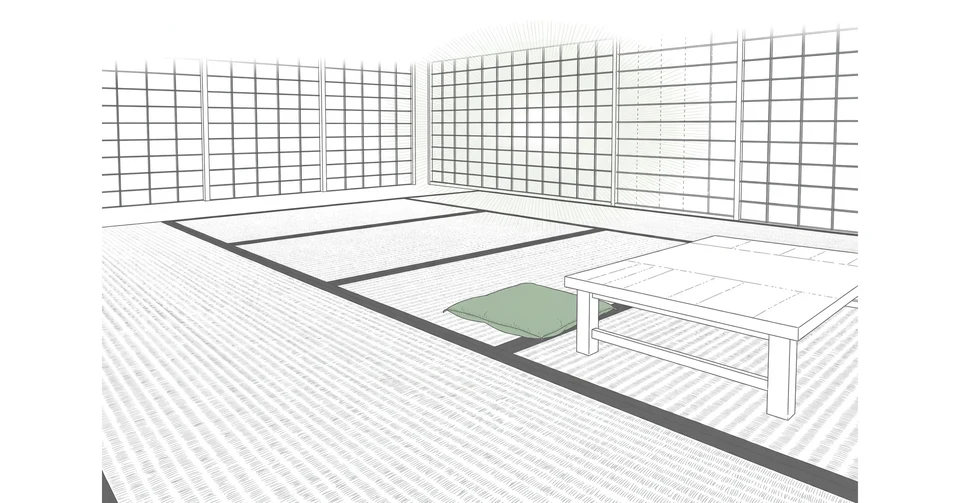
I first slept on a tatami floor in a small inn, and I remember the smell more than the sight, a faint green scent like cut grass, and the slight give of the surface under my knees. Nothing in the room asked to be admired. The floor simply did its work, cool in summer, quiet underfoot, and firm enough to sit on for a long meal. It felt old without feeling like a museum, and that is the point of it. The best Japanese rooms do not show off their history. They let you live inside it.
Why tatami still measures the room
In Japan, the size of a room is usually given in relation to the number of mats it holds, counted in jo. A standard Nagoya size tatami covers about 1.653 square metres, so a six mat room is roughly 3.64 metres by 2.73 metres, and an eight mat room is roughly 3.64 metres square. A four and a half mat room, the classic size for a tea room, is about 2.73 metres square. These figures explain why a listing that says six mats tells a Japanese reader almost everything. It gives the shape as well as the area, because tatami only fits together in certain patterns.
Two mats make a square called a tsubo, about 3.306 square metres, and that square is still used to describe the floor area of a whole house. The system is practical, not poetic. A builder who knows the mat knows the room, and a tenant who knows the room knows what furniture will fit and what will not. I find something reassuring in that honesty. Modern listings in many countries give a number of square metres and leave you to guess the shape, but a count in tatami tells you the room was designed around a human body lying down, sitting, or kneeling, not around a round number on a plan.
The measure has survived the arrival of concrete apartments, fitted kitchens, and wall to wall carpet. Many new homes have only one traditional room, called a washitsu or nihonma, and that one room is often where guests sleep, where the family gathers for New Year, or where an elderly parent prefers to sit. The rest of the house may follow Western habits, with chairs and beds and hard floors, but the tatami room keeps its own rules. It is worth keeping, I think, because a home that measures everything in the same unit loses the sense that different rooms can have different manners.
A mat that began as a seat, not a floor
The word tatami comes from the verb tatamu, meaning to fold or to pile, which suggests that the earliest mats were thin enough to fold away or stack in layers. The word already appears in the Kojiki, compiled in 712, so the object is older than most of the architecture around it. For a long time, though, it was not a floor covering at all. It was a seat, and a mark of rank.
During the Heian period, aristocratic residences in the shinden-zukuri style still had wooden floors, and tatami was used as seating only for the highest aristocrats. The lower classes had mat covered earthen floors, and commoners slept on straw mats or loose straw. The mat was a status object before it was furniture, something placed on a bare floor when an important person sat down, then taken away again.
The change came slowly. In the Kamakura period, the shoin-zukuri style of residence spread among samurai and priests who had gained power, and it reached its peak in the Muromachi period, when tatami gradually came to cover whole rooms, beginning with small rooms. A room fully laid with mats came to be called a zashiki, and rules about seating and etiquette began to decide how the mats were arranged. Before the middle of the 16th century, the ruling nobility and samurai still slept on tatami or on woven mats called goza, while commoners used straw. The floor reached ordinary houses only toward the end of the 17th century, which is a useful reminder that what now looks timeless was once a luxury, and that luxury took centuries to become ordinary.
I like that slow history, because it explains the respect the floor still receives. A thing that began as a privilege and became a common comfort tends to be treated with care, and the care is visible in the rules that surround it. You do not walk on tatami in shoes, you do not drag furniture across it, and you do not treat it as just another surface. The history is not written on the wall. It is under your knees.
What tatami is made of
A traditional tatami mat has three parts, and each one has its own name. The core is the doko, traditionally made of sewn together rice straw. The surface is the omote, a weft faced weave of soft rush called igusa, worked on a warp of hemp or weaker cotton. The long sides are edged with cloth called heri, usually brocade or plain cloth, although some modern mats have no edging at all. A fresh omote has a grassy scent that fades as the weave turns from green toward gold, and that slow change of colour is part of the pleasure of living with the floor. It ages in front of you, and the ageing is not treated as damage.
The core is not always rice straw today. Contemporary tatami sometimes has compressed wood chip boards or extruded polystyrene foam in its core instead, or as well, and the surface is sometimes paper or synthetic fibre rather than igusa. These versions are lighter, cheaper, and easier to keep dry, and they make sense in a damp apartment or a rented room. Yet the classic combination of straw and rush is still the standard against which the others are judged, because it breathes. Straw holds humidity, which is a comfort in a dry winter and a risk in a wet summer, and that trade is part of what tatami asks of its owner. It asks for ventilation, for dry air, and for attention.
The rush itself is a wetland grass, grown in flooded paddy fields, and the best known growing region is Kumamoto Prefecture, where the city of Yatsushiro has long been the centre of the trade. Each blade is harvested, dried, and woven, and the work is still done by specialist workshops, some by machine and some by hand. It is easy to forget, standing on a finished tatami floor, that the surface under your feet was once a field of grass. I think that forgetting is a small loss. A floor made of a crop connects a room to a season and a place, in a way that a factory floor never will.
With ordinary care the woven surface of tatami often lasts around five or six years before it needs replacing, while the core can last longer if it stays dry. That is a modest lifespan for a floor, and it is honest about it. The surface is not meant to last forever. It is meant to be renewed, and the renewal is part of the rhythm of the house, like re-papering a screen or re-thatching a roof. A home that expects its floors to be replaced now and then is a home that expects to be looked after.
Three sizes, one rectangle
Every tatami mat is a long rectangle, twice as long as it is wide, and that ratio never changes. What changes is the exact size, because Japan has three regional standards, and each one comes from a different building tradition. The full set of sizes is laid out on the Tatami page on Wikipedia, and the names are worth learning, because they tell you where you are.
| Standard | Where it is common | Approximate size |
|---|---|---|
| Kyoma | Kyoto and western Japan | 191 by 95.5 cm, about 5.5 cm thick |
| Chukyoma | Nagoya and central Japan | 182 by 91 cm |
| Edoma | Tokyo, Kanto, and farther north | 176 by 88 cm, about 6 cm thick |
The Kyoto size is the largest and the oldest, and it comes from the architecture of the old imperial court. The Nagoya size sits in the middle, and it is the size used for the familiar room measurements quoted above. The Tokyo size is the smallest, shaped by the dense city plots of Edo, where land was expensive and rooms were built tighter. Apartment blocks sometimes use an even smaller danchima size, around 170 by 85 cm. Export listings often quote a round 90 by 180 cm, which is a convenient approximation rather than any one regional standard, and the honest thing to say is that there is no single national tatami size, only a single ratio.
That ratio is what makes the floor work as a measuring system. Two tatami mats make a square, four mats make a larger square, and half mats fill the gaps that a whole number of full mats cannot. A half mat is called a hanjo, and a three quarter length mat called a daimedatami is used in tea ceremony rooms. The square mats from the Ryukyu Islands, called Ryukyu tatami, break the pattern in a different way, because they have no border and can be laid in any direction, which is why they have become popular in modern rooms that want the look without the strict layout.
The regional difference has a practical consequence for anyone renting or buying in Japan. A six mat room in Kyoto is noticeably larger than a six mat room in Tokyo, roughly 10.9 square metres against roughly 9.3 square metres on the older standards, so the count alone does not settle the size. The wise move is to ask which standard the building uses, or simply to check the dimensions in metres as well. The old measure is beautiful, but it was never meant to hide the truth. It was meant to make the truth easy to carry in your head.
The layout has manners of its own
There are rules about how tatami is laid, and they are older than most of the houses they govern. In the usual auspicious layout, called shugijiki, the junctions of the mats form a T shape. In the inauspicious layout, called fushugijiki, the mats sit in a grid, and the junctions form a plus shape. The plus layout was once used for funerals, and it is now widely avoided because it is associated with bad luck. An auspicious tiling often requires the use of half mats, because a whole number of full mats will not always tile a room in T junctions, and that small complication is part of the craft.
These rules sound superstitious until you live with them for a while, and then they start to look like design sense. A T junction spreads the seams so that no four corners meet at one point, which keeps the floor stronger and the pattern calmer to look at. The plus grid, by contrast, makes the floor look like a checkerboard, and the eye keeps finding the crossings. The old language of luck may simply be the way a building culture remembers a good detail. I have come to think that many rules of this kind work the same way. They dress a practical choice in a story, so that the choice survives after the reason is forgotten.
The layout also decides where people sit. In a formal tatami room, the place of honour is the seat nearest the tokonoma alcove, with its hanging scroll and flower arrangement, and the mats are laid so that nobody has to step across the cloth edging to reach it. The tokonoma itself is a small recess that holds nothing useful, only a scroll and a flower, and that emptiness is the point. A room that leaves space for one beautiful thing is a room that knows what matters, and the floor is laid to protect that space.
Walking through such a room teaches the same lesson as the genkan, the small entryway where outdoor shoes come off before anyone steps inside. Both places ask you to slow down and notice where you are. The genkan does it with a step up and a change of floor, and the tatami room does it with a surface that is soft enough to sit on and firm enough to remind you that you are sitting on something made by hand.
Living on tatami, gently
The etiquette of a tatami room is simple, and most of it follows from the material. Do not step on tatami with outdoor shoes, and not with hallway slippers either. Do not step on the cloth edging, the heri, because it frays. Do not step on the tracks of the sliding doors, the shikii, because it is rude and it damages the rail. Lift bags instead of rolling wheels across the floor, and keep luggage out of the tokonoma alcove. Sleep on a futon laid on the mats, and choose low furniture that spreads its weight, such as a kotatsu, the low heated table that warms the legs in winter. The Suki Desu guide to tatami mats sets out the same care rules in detail, from cleaning along the grain to keeping the room dry.
Cleaning follows the same logic. Vacuum or wipe with a barely damp cloth, always along the grain of the igusa, never against it, and blot spills rather than rubbing them. Straw cores hold humidity, so they attract dust mites if they stay damp, and mould if a room is left wet and closed. The advice sounds fussy, but it is really a single idea repeated in different forms. Treat tatami as a living material, not as a hard surface, and it will repay the attention.
There is a pleasure in that kind of care that is hard to explain to someone who has only lived with hard floors. A hard floor asks nothing of you, and it gives nothing back. A tatami floor asks you to take your shoes off, to sit down, to move slowly, and in return it gives you a room that smells faintly of grass in its first year, stays cool in summer, and softens the sound of every step. I do not think this is nostalgia. It is a trade, and it is a fair one.
Modern life has found ways to keep the trade without rebuilding the whole house. Unit mats, called yunitto tatami or oki tatami, sit like rugs on an existing floor, so a Western style room can have one quiet corner of woven rush without a full renovation. They are not the same as a full tatami floor, and nobody who sells them honestly claims they are, but they are a sensible compromise, and they have brought the material to people who would otherwise never touch it. The dojo version is a different object again, a thicker foam floor that borrows the look and the name for martial arts training, and it should not be confused with the house floor. The house floor is for sitting and sleeping. The gym floor is for falling safely.
The light in such a room is part of the experience, and it is shaped by the shoji, the paper screen on a wooden lattice that turns harsh daylight into a soft glow. A tatami room with paper screens and a low table is a room built from soft materials, grass, paper, wood, and cloth, and the softness is the point. Nothing in it is hard enough to hurt you, and nothing is loud enough to shout. It is a room that asks you to lower your voice, and most people do, without being told.
What the floor teaches
A room measured in tatami is a room measured in bodies. Six mats is not an abstract area. It is space for six people to sit, or for a family to sleep side by side, or for one person to live simply with a low table, a futon, and a shelf of books. The measure survives because it is human, and the human scale is the hardest thing for a modern home to keep. Square metres are easy to compare and easy to sell, but they say nothing about how a room feels at seven in the morning, when the light comes through the paper screens and the floor is cool under bare feet.
I think tatami also teaches patience. It changes colour, it wears where people sit, it needs its surface replaced every few years, and it asks its owner to notice these things. A home that is maintained in small acts, a wiped floor, a replaced surface, a ventilated room, is a home that is lived in with attention, and attention is the cheapest form of care there is. The mat does not demand much, only that you take your shoes off and pay attention to where you step, and in return it gives you a room that feels calm without trying to be calm.
The measure will probably keep shrinking. New homes have fewer tatami rooms, and some have none at all, and the young people who grow up in those homes may never learn to count a room in mats. That would be a loss, but not a disaster, because the floor is not going away. It is still there in inns and temples, in tea rooms and old houses, and in the one quiet room of many modern flats, waiting for the next person who wants a floor that is also a measure, a seat, and a small piece of a field. The mats are still there, and the rooms they measure are still worth sitting in.
More in Culture & Society
- A Kakejiku Turns a Blank Wall Into a Conversation
- A Shoji Lets the Daylight In While Keeping the World Out
- A Tokonoma Turns One Corner of a Japanese Room Into a Shrine
- Fusuma Turn a Room Into Whatever Japan Needs Next
- Wearing a Happi Means You Belong to the Matsuri
- Washi Paper and the Thousand-Year Craft Behind Japan's Toughest Sheets
Latest posts
- Chawanmushi Hides a Whole Meal Inside a Teacup
- Japanese Video Games and How a Small Island Rewired Play
- A Sudare Turns Harsh Sunlight Into a Cool Breeze
- Himeji Castle, Japan's White Heron That Survived War and Fire
- A Genkan Is Where Japan Leaves the Outside World at the Door
- A Ranma Lets a Japanese Room Breathe Over the Top of Its Walls
- Japanese Breakfast and the Morning Meal That Starts with Rice and Soup
- A Yuzamashi Cools the Water Before the Tea Begins
- Tencha Is the Shade-Grown Leaf Matcha Is Made From
- Taiko Drums and the Thunder That Shook Japanese Festivals
- A Kyusu Is the Small Teapot Behind Every Good Cup of Sencha
- Shincha Is the First Flush Japan Waits All Winter For
- Gyokuro Earns Its Price One Shade-Grown Leaf at a Time
- Sencha Is the Green Tea Japan Drinks Every Single Day
- Mugicha Is the Barley Tea Japan Pours All Summer Long