Chawanmushi Hides a Whole Meal Inside a Teacup
· 14 min read
Chawanmushi is a savory Japanese steamed egg custard that hides chicken, shrimp, mushrooms, and ginkgo nuts inside a small lidded cup, and this guide explains its history, its ratio, and how to make it at home.
Chawanmushi is a savory steamed egg custard served in a small lidded cup, and it is one of the quietest dishes in Japanese cooking. Lift the lid and you find a pale, trembling surface that looks almost plain. Break through it with a spoon and the cup turns out to hold chicken, shrimp, mushrooms, and sometimes a ginkgo nut, all suspended in a warm custard scented with dashi. It is soup and main course at once, and it asks for nothing more than a small spoon and a little patience.
The name tells you exactly what it is. Chawan means teacup or rice bowl, and mushi means steamed, so chawanmushi is simply something steamed in a tea bowl. That plain name hides a dish with more than 300 years of history behind it, a dish that traveled from Chinese traders in Nagasaki into the formal banquets of Edo period Japan and then into home kitchens across the country.
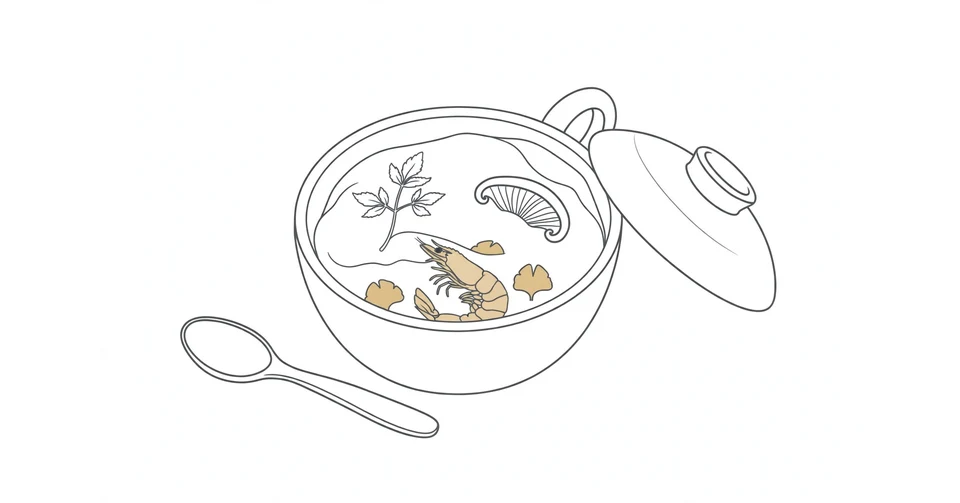
What makes chawanmushi worth knowing is not its rarity. You can find it in kaiseki restaurants, in department store basements, in family restaurants, and in home kitchens. What makes it worth knowing is the discipline inside it. The custard is mostly seasoned stock, the egg is there to hold it together, and the fillings are hidden so that every spoonful is a small surprise. A good cup tastes gentle, almost quiet, and that quietness is the point.
What chawanmushi actually is
A chawanmushi is not a dessert custard, and that is the first thing to get straight. It is savory through and through. Beaten egg is mixed with dashi, a little soy sauce, a little mirin, and a pinch of salt, then poured over fillings arranged at the bottom of a cup. The cup is covered and steamed gently until the mixture sets into a soft, trembling custard that barely holds its shape on the spoon.
The dashi does most of the work here. It gives the custard its delicate savory flavor, and it makes up roughly three quarters of the liquid by weight, which is why the texture is so light. A cook who rushes the stock or reaches for a stale packet will taste the shortcut at once, because there is nowhere for a weak dashi to hide in a dish this plain. If you want to understand why the stock matters so much, read how dashi quietly carries almost everything Japan cooks, and you will see the same logic at work in a bowl of soup, a simmered dish, and this little cup.
Chawanmushi is usually served hot, with its lid on, and eaten with a small spoon. In a kaiseki meal it often arrives early, as a warm appetizer that wakes up the palate without filling it. At home it plays a humbler role, a side dish next to rice and something grilled or simmered. Either way, it is a dish that rewards slowness. There is no dramatic flavor, no heat, no crunch to chase. The pleasure is in the silkiness, the warmth, and the small discoveries waiting under the surface.
A Nagasaki dish with Chinese roots
Chawanmushi traces its roots to shippoku banquet cuisine in Nagasaki, a style that blended Japanese, Chinese, and European influenced cooking during the Edo period, which ran from 1603 to 1868. Nagasaki was the one port where trade with China continued while the rest of the country stayed closed, and Chinese traders living there introduced a steamed egg dish of their own. Japanese cooks took that idea, seasoned it with dashi and local ingredients, and slowly turned it into something of their own. The history of the dish is a reminder that some of the most Japanese foods began as borrowings, and that borrowing well is a skill of its own.
The story is tied to a specific place and a specific year. In 1689 the shogunate built the Tojin Yashiki, a walled compound in Nagasaki where Chinese residents were housed, and it was in that world of traders and banquets that the dish took shape. A feudal lord named Nobutake Yoshida is said to have tasted it in Nagasaki and loved it so much that he opened a shop to serve it. That shop, Yossou, still operates in Nagasaki today and traces its start to 1866, which makes it one of the oldest restaurants of its kind in Japan. The full account of the dish and its Nagasaki shops is told well by Food in Japan, which walks through the history, the recipe, and the restaurants that still serve it.
The early version was simpler than the one we know now. At first it was little more than egg, steamed plain. Over time the amount of soup stock grew, the fillings multiplied, and the custard became softer and more delicate. That slow change tells you something about Japanese cooking in general. A dish is rarely invented in one stroke. It is adjusted a little at a time, across generations, until it settles into the form that feels inevitable. Chawanmushi settled into a form that hides its richness, and that restraint is exactly what makes it feel refined.
What hides inside the cup
Part of the fun of chawanmushi is that you never quite know what you will find until the spoon goes in. The classic fillings are small and few, usually about a third of the cup by volume, and each one is chosen for a different reason. Some add savor, some add color, some add a texture that breaks up the smoothness of the custard.
| Filling | What it brings to the cup |
|---|---|
| Chicken | Savory depth and a little richness from its fat |
| Shrimp | Sweetness, a pink flash of color, and a firm bite |
| Kamaboko fish cake | A gentle fish flavor and a pale pink or white slice on top |
| Shiitake or shimeji mushrooms | Earthy aroma and a soft, meaty texture |
| Ginkgo nut | A pale green surprise with a sticky, mild flavor |
| Mitsuba | A fresh herbal note and a green garnish |
The ginkgo nut deserves a note, because it divides people. It is mild, slightly sticky when heated, and easy to miss if you are not looking for it. Some cooks leave it out, and some diners fish it out and set it aside. I think it earns its place. A dish this smooth needs one thing that is slightly strange, one small reminder that the cook made a choice rather than following a formula. The mitsuba plays a similar role at the top of the cup, a green sprig that smells fresh against the warm, savory steam.
Seasonal versions go further. In autumn a cook might add matsutake mushroom, in spring a bamboo shoot, in summer a chilled version served in a glass instead of a ceramic cup. The chilled kind is called hiyashi chawanmushi, and it is a different pleasure altogether, cool and light on a hot day. The structure never changes, though. Whatever the season, the custard stays the base and the fillings stay hidden, waiting to be found.
The ratio that decides a good chawanmushi
If there is one number that matters in chawanmushi, it is the ratio of egg to dashi. The standard advice is one part egg to three parts dashi by weight, and that ratio is what gives the custard its famous silkiness. Less liquid and the custard turns firm and rubbery. More liquid and it may never set at all. Because eggs differ in size, good cooks weigh the cracked eggs and then measure three times that weight in dashi, rather than trusting a count of eggs. Just One Cookbook, one of the most careful English language guides to the dish, uses a slightly richer ratio of one part egg to 2.5 parts dashi, and its step by step chawanmushi recipe shows exactly how the weighing, straining, and steaming work in practice.
Technique matters as much as the ratio. The eggs should be beaten gently with chopsticks, never whipped, because whisking in air makes bubbles that turn into holes in the finished custard. The mixture is then strained through a fine mesh sieve, sometimes twice, to remove any unmixed white and any foam. The dashi must be at room temperature or lukewarm when it meets the eggs, since hot stock will scramble them before the cup ever reaches the steamer. These steps sound fussy, and they are, but each one has a visible result. Skip the straining and the surface comes out rough. Beat too hard and the custard turns spongy.
The steaming itself is a test of patience. The cups sit in a pot of hot water that reaches about halfway up their sides, each cup covered with its own lid or a piece of foil, and the pot lid left slightly ajar so the temperature stays gentle. The water should stay around 80 to 90 degrees Celsius, well below a fierce boil, for about 15 to 20 minutes depending on the size of the cup. Too much heat produces a pockmarked texture the Japanese call su, a network of tiny holes that marks a rushed custard. The finished chawanmushi should tremble slightly when you shake the cup, and a skewer pushed into the center should come out clean. That tremble is the sign of a custard that was steamed, not boiled.
Where chawanmushi sits in a meal
A meal in Japan is built from small parts that balance each other, and chawanmushi fits into that balance as the warm, soft element. It often appears near the start of a formal meal, before the grilled fish or the simmered vegetables, and its job is to settle the appetite rather than excite it. At home it might sit beside rice, pickles, and a piece of grilled fish, a quiet member of the table rather than the star. That modesty is part of its charm. Not every dish needs to demand attention, and a table full of loud dishes would be exhausting to eat from.
Miso soup often shares the table with it, and the two make a useful comparison. Both are built on dashi, both are served hot in small bowls, and both are easy to take for granted. Yet miso itself turns up in far more places than a soup bowl, as this look at miso beyond the soup shows, and the same is true of the custard cup. Chawanmushi shows up as an appetizer, a side dish, a children's favorite, and a late night snack at a small counter in Kumamoto or Osaka, where shops serve twenty or more varieties from a single tiny kitchen. A dish that can move between those settings without changing its nature is a dish that has earned its place.
How to eat it well
Eating chawanmushi well is mostly a matter of slowing down. Lift the lid and let the steam rise for a moment. Take the small spoon and break the surface near the edge, not in the middle, so you can see what is hiding underneath. Eat it while it is hot, in small spoonfuls, and let each one carry a little of the custard and a little of whatever filling you find. Stirring the whole cup into a uniform mush defeats the purpose. The dish is designed as a sequence of small discoveries, and the cook arranged the fillings with that in mind.
There is no strict rule about what to drink with it. Green tea is the usual companion, and it suits the gentle flavor. Sake works too, especially a dry one served warm in cold weather, though the custard is delicate enough that a strong drink can overwhelm it. The best pairing, honestly, is a quiet table and an unhurried meal. Chawanmushi does not compete with conversation. It sits beside it, warm and patient, and that is enough.
Making chawanmushi at home
You do not need special equipment to make chawanmushi at home, and that is one of the reasons it has lasted so long as a home dish. A large pot, four small heatproof cups or ramekins, some foil, and a steamer basket or a folded towel in the bottom of the pot will do. If you have proper chawanmushi cups with lids, use them, but a small bowl covered tightly with foil works nearly as well. The important thing is the seal, because dripping condensation will spoil the smooth surface.
Start with the fillings. Cut chicken into small pieces and marinate them briefly in a little sake. Slice kamaboko thinly, trim the mushrooms, and set a ginkgo nut and a sprig of mitsuba in each cup. Then make the custard. Weigh the eggs, add two and a half to three times their weight in dashi, and season with a teaspoon each of mirin and light soy sauce and a small pinch of salt. Beat gently, strain twice, and skim any foam from the surface. Pour the mixture over the fillings until each cup is about 80 percent full, and pick off any bubbles with a spoon.
Steam the cups on the lowest heat that keeps the water moving, with the pot lid slightly open, for about 15 to 20 minutes. Resist the urge to lift the lids and check every few minutes, because each peek lets out heat and disturbs the set. When the surface is just set and the center still trembles a little, take the cups out and serve them at once, lids on, with small spoons. The whole process takes under an hour, and most of that time is waiting. That waiting is not wasted. It is the dish teaching you its pace.
Why a quiet dish stays popular
It is worth asking why a dish this plain has survived for more than three centuries while flashier foods come and go. Part of the answer is practical. Eggs, dashi, and a few small fillings are cheap and available, and the technique, once learned, is reliable. Part of it is the surprise. A covered cup is a small mystery, and people enjoy mysteries, even small ones served with a spoon. But I think the deeper answer is about restraint. Chawanmushi refuses to impress you loudly. It trusts that a smooth texture, a warm broth, and a hidden piece of shrimp are enough, and it turns out they are.
There is a lesson in that for anyone who cooks, or for anyone who makes anything. The temptation is always to add more, to make the flavor stronger, the presentation louder, the portion bigger. Chawanmushi goes the other way. It takes one egg, a cup of stock, and a handful of small things, and it makes a whole meal out of them by paying attention to temperature, ratio, and timing. That kind of care is harder to see than a pile of expensive ingredients, but it is the care that people remember. A dish that has lasted this long has not survived by accident. It has survived because it is good at being exactly what it is.
So the next time a small lidded cup arrives at your table in Japan, do not rush it. Lift the lid slowly, look at the pale surface, and take the first spoonful near the edge. Inside that teacup is a whole meal, hidden on purpose, waiting for someone patient enough to find it. That is the whole idea of chawanmushi, and it is an idea worth keeping.
More in Food & Travel
- Himeji Castle, Japan's White Heron That Survived War and Fire
- Japanese Breakfast and the Morning Meal That Starts with Rice and Soup
- A Yuzamashi Cools the Water Before the Tea Begins
- Tencha Is the Shade-Grown Leaf Matcha Is Made From
- A Kyusu Is the Small Teapot Behind Every Good Cup of Sencha
- Shincha Is the First Flush Japan Waits All Winter For
Latest posts
- Tatami Still Sets the Measure of a Japanese Room
- Japanese Video Games and How a Small Island Rewired Play
- A Kakejiku Turns a Blank Wall Into a Conversation
- A Sudare Turns Harsh Sunlight Into a Cool Breeze
- A Genkan Is Where Japan Leaves the Outside World at the Door
- A Shoji Lets the Daylight In While Keeping the World Out
- A Ranma Lets a Japanese Room Breathe Over the Top of Its Walls
- A Tokonoma Turns One Corner of a Japanese Room Into a Shrine
- Fusuma Turn a Room Into Whatever Japan Needs Next
- Wearing a Happi Means You Belong to the Matsuri
- Taiko Drums and the Thunder That Shook Japanese Festivals
- Gyokuro Earns Its Price One Shade-Grown Leaf at a Time
- Sencha Is the Green Tea Japan Drinks Every Single Day
- Washi Paper and the Thousand-Year Craft Behind Japan's Toughest Sheets
- Mugicha Is the Barley Tea Japan Pours All Summer Long