A Caru Is an Offering for the Ones You Fear
· 9 min read
A caru is the Balinese offering laid on the ground for the bhuta kala, the restless forces of the unseen world, and it shows how Bali keeps its balance by feeding what it fears instead of fighting it.
Walk through any Balinese village in the early morning and you will see two kinds of generosity. On shrines and ledges, small palm leaf trays of flowers and rice are raised up toward the gods. On the ground below them, at gateways, yard corners and crossroads, other trays sit directly on the earth. The ones on the ground are called caru, and they are not addressed to anything benevolent. A caru is an offering for the bhuta kala, the rough and hungry forces of the unseen world, and it is left low because that is where its recipients are met.
That surprises visitors who assume an offering is always a gift to something good. A caru works on a different logic. Balinese Hinduism does not promise that the disruptive forces of the world can be destroyed, so it does something else with them. It feeds them, on schedule and at their own level, in the expectation that a fed neighbour is a quiet neighbour. The caru is that expectation made visible, on almost every doorstep in Bali.
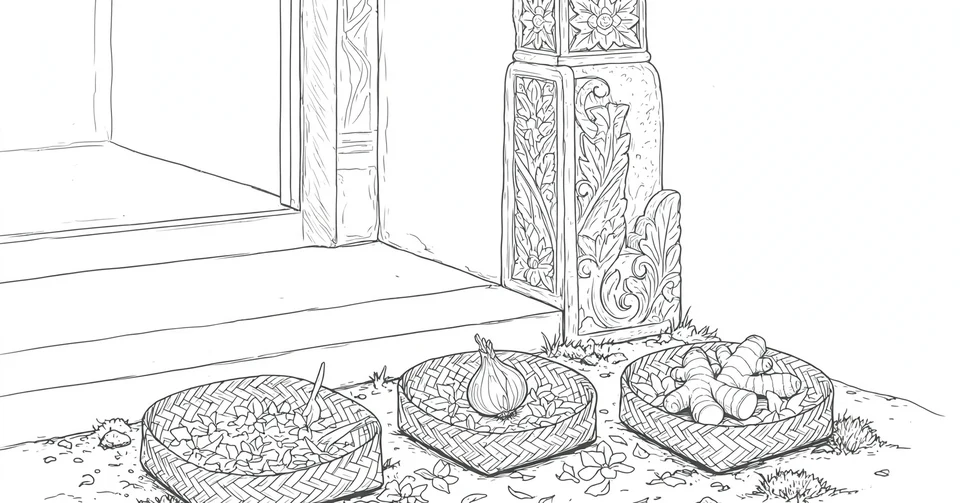
The height is the whole message. Offerings for the gods are lifted high because the gods are imagined above, in the direction of the mountain and the sky. Offerings for the bhuta kala stay on the ground because their realm is the lower one, the earth under the house and the road outside it. Priests are careful to say this is not an insult, and not a claim that spirits live in the dirt. It is simply correct addressing. Everyone in the Balinese cosmos receives their offering at the level where they belong, and the caru belongs at ankle height.
Who receives a caru
Bhuta and kala are Sanskrit words, and neither one translates neatly as demon. Bhuta points to the gross elements that make up the physical world and everything temporary in it, and by extension to the uncanny beings who embody that roughness. Kala means time, and also fate. Together, the bhuta kala stand for everything in the universe that is coarse, restless and inclined to disturb: appetite and temper, sickness, greed, the hunger that makes people and animals behave badly.
They are met at the edges of ordered space, at crossroads, gateways and thresholds, the places where one territory blurs into another. Balinese house compounds even keep a screen wall just inside the gate, the aling aling, partly because troublesome forces are believed to travel in straight lines and to corner badly. The offerings wait for them at exactly those corners.
A Balinese teacher will often add that the bhuta kala are not only out there at the crossroads. A human being is a small copy of the universe, so the same forces run inside a person, as illness in the body or a bad streak in the character. That is why the caru is not really about monsters. It is about the parts of existence, inner and outer, that cannot be argued with and will not simply go away.
Feeding them instead of fighting them
The thinking behind the caru comes straight from rwa bhineda, the Balinese philosophy of paired opposites that must be held in balance rather than resolved by victory. On that view, the dark side of things cannot be eradicated once and for all, because it is half of how the world is built. What can be done is maintenance. The bhuta kala are subdued and appeased, never annihilated, and a caru is the main tool of that appeasement.
There is a practical warmth to this that I have come to admire. The tradition does not ask anyone to love the forces that frighten them. It asks for something more modest and more achievable: put them on the guest list. A detailed account of these rites, a guide to Bali's caru ceremonies, stresses that a properly fed bhuta kala is expected not only to leave people alone but, at times, to help them. Fear, in this system, is handled the way you would handle a powerful neighbour you cannot move away from. You learn what he eats, and you never let him go hungry.
The smallest caru is a daily habit
At the bottom of the ladder sits the segihan, the only caru that involves no animal life at all. In some households it is made every day, and no household is supposed to let more than a Kajeng Kliwon pass without one. That is the day that falls every fifteen days in the Balinese calendar, when the spirits are believed to be most active. The word itself is usually traced to sega, meaning rice, or to segeh, meaning welcoming, which turns the segihan into something like a plate set out for a distinguished guest.
The commonest form, called ituk ituk, is a small triangular cup of coconut leaf holding a shallot and ginger. The pairing is deliberate. Shallot is considered cold and ginger is considered hot, so even this smallest caru carries the whole philosophy in miniature, a cold thing and a hot thing laid side by side to remind its recipients about balance. Other versions are as simple as two small portions of cooked rice, set at the entrance of a house so that passing bhuta kala lose interest in coming inside.
Details vary by village and by family. NOW! Bali's description of the segehan lists forms that range from plain white rice to the five coloured rices of the manca warna, each colour placed toward its own direction, with salt among the seasonings and a crossed pair of coconut husks, the api takep, standing in for incense. There is even a human shaped segihan, the wong wongan, made to ward off disaster, and a fullest form, the segihan agung, kept for major ceremonies. A few drops of arak or fermented rice wine may be sprinkled over the tray. Then the tray is left where it lies. The essence was the offering.
A ladder that climbs to a payment
From the segihan the ladder climbs by size and seriousness. The next rung, eka sata, centres on a single multicoloured chicken, and it is the caru performed at a melaspas, the purification of a new house, or on the day before a tooth filing. Above it, panca sata asks for five chickens of five different colours, set out for the directions of the compass, and many villages perform it once a year before Nyepi at their road intersections. Colour does the same directional work in the trays themselves, where piles of rice in white, red, yellow and black are set toward their own quarters of the compass around a mixed pile, the brunbun, in the centre. Higher rungs add a dog of a particular colouring, then a white duck, then a goose, each step matched to a weightier occasion, such as the rebuilding of a temple. The animals at these levels are treated with formal respect and given prayers of their own. Tradition holds that an animal offered this way takes a step upward in its next life, and nothing about the rite is casual.
The top of the ladder is the tawur, and the word is worth pausing on, because tawur literally means payment. The greatest of them, tawur kesanga, is held every year before Nyepi at Pura Besakih, the mother temple on the slopes of Mount Agung, and its offerings run from chickens up through a goat, a cow, a black pig and a water buffalo. It falls in the same dense season as melasti, when villages carry their gods down to the sea to be washed. First the world is cleansed, then its restless forces are paid in full, and only then can the island afford its day of silence.
Practitioners say the size of a caru is proportional to how long its peace is expected to last. A segihan buys a day. A small caru is credited with about six months. The offerings of the Eka Dasa Rudra, the vast ceremony held only in the longest of cycles, are said to hold for a hundred years. Whether or not a visitor shares the belief, the bookkeeping is revealing. Peace, in this religion, is not a permanent achievement. It is a subscription, and the caru is how you renew it.
When a caru is called for
Not every caru waits for the calendar. A household suffering a run of misfortune, a frightening omen, sickness that will not lift, or a disaster such as a flood or an epidemic can call for a caru to settle whatever has been stirred up. A caru is also held before greater ceremonies begin, clearing the ground in every sense, so that the offerings to the gods proceed undisturbed. The ground itself is prepared first, with a temporary shrine of woven bamboo, the sanggah cucuk, raised over the spot where the offering will be laid.
And unlike the offerings lifted to the gods, which are later shared and eaten by the family, what is laid out for the bhuta kala is not taken back to the table. When the rite is done, the remains are buried in a pit or given to a river. Some things are for the family. A caru is not one of them.
It is easy, from outside, to read all of this as fear. Standing in a Balinese yard at dawn, it looks more like housekeeping. The caru is placed at the lowest point of the house, the threshold and the dirt, because that is where trouble would enter, and it is renewed without drama, the way you sweep a step. Bali raises its most beautiful offerings toward the sky, but it keeps its balance at ground level, one small tray at a time.
More in Culture & Society
Latest posts
- Shimekasu Was Herring You Never Ate
- A Hana Donko Wears Its Cracks Like Flowers
- A Lembaga Perkreditan Desa Is a Bank the Village Owns
- Kaburiyu Is How You Talk Your Body Into the Bath
- Kuki Is the Spring the Sea Turned White
- Warangan Is the Wash That Reveals the Pattern
- Ganbanyoku Is Bathing Without Water
- The Obuki Throws Out Nine Thousand Litres a Minute
- Every Village Writes Its Own Awig-Awig
- Sainokawara Is a Bath You Share With a Hundred Strangers
- Umaji Refused to Disappear
- Rwa Bhineda Keeps Opposites From Going to War
- Kasepekang Is Exile Without Leaving Home
- Jamasan Washes a Blade Thinner Every Year
- Herring Fed the Fields That Fed Osaka