Tatsuko Wished for Beauty and Became a Statue
· 10 min read
On the shore of Lake Tazawa in Akita stands a golden girl who, in legend, prayed for eternal beauty. The tatsuko story turns a maiden into a dragon, and the real statue above the water has its own quieter history.
On the western shore of Lake Tazawa, in the mountains of Semboku in Akita Prefecture, a golden young woman rises out of the shallows with her back to some of the deepest water in Japan. She is Tatsuko. Boats slow down for her, the lakeside bus stops for her, and nearly every brochure about the lake puts her photograph first, usually without room to explain what she is doing there.
The short answer is that Tatsuko got what she asked for. In the legend told around the lake, she was a girl of extraordinary beauty who prayed to keep her youth and beauty forever, and the wish was granted in the only way a lake can grant such a thing. She stopped being a girl at all. What exactly happened to her depends on which version of the story you hear, and the versions have never quite agreed with each other.
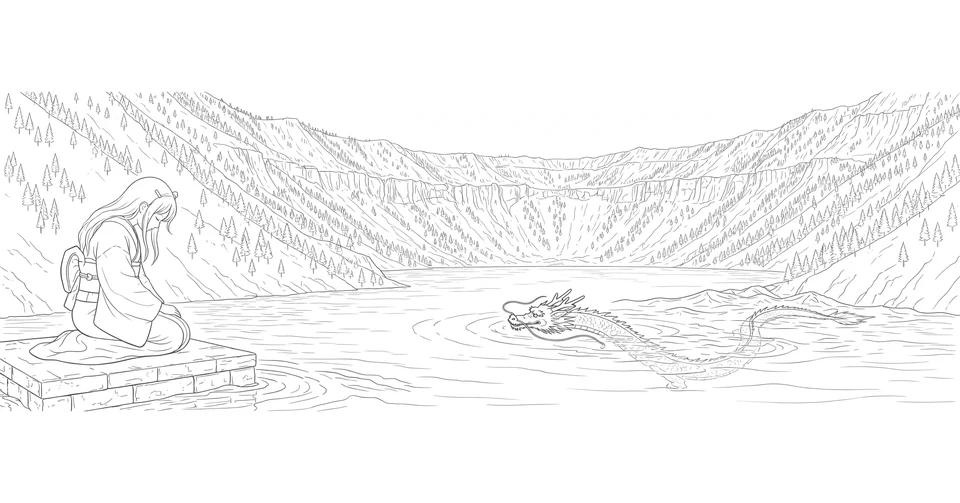
Below the statue, the water drops 423 metres to a volcanic floor, which makes Lake Tazawa the deepest lake in Japan. The golden figure of Tatsuko stands above all that depth like a bright full stop at the end of a long dark sentence. To understand why she is there, you have to hear the story the way the villages around the lake have told it for centuries, and then look honestly at what later happened to the water at her feet.
The girl who prayed for a hundred days
The version of the legend most often told today, the one kept by the tourism association of Tazawako and Kakunodate, begins in a village called Innai, beyond the mountains from the lake. Tatsuko lived there, and her beauty was famous enough to be a kind of problem, because she understood earlier than most people that it would not last. Youth goes. Faces change. Tatsuko wanted hers to stay exactly as it was, forever.
So she prayed. In the common telling, Tatsuko prayed to Kannon, the bodhisattva of mercy, honoured at a temple in the hills above her village, for one hundred days, asking to keep her youth and beauty for all time. On the night her hundred days of prayer were complete, an answer came in a divine message. If she drank the water of a spring that gushed forth to the north, her wish would be granted.
Tatsuko left home telling her family she was going to pick bracken in the hills. She followed the path through deep forest until she found the spring, clear water rising between moss covered rocks. Overjoyed, she scooped the water up in her hands and drank. And then something went wrong in the precise way that wishes go wrong in old stories. Instead of feeling her wish settle into place, Tatsuko grew thirstier. She drank again, and the thirst grew worse, and she went on drinking, lying flat against the spring, until she had drunk the spring dry.
When she finally lifted her head, Tatsuko had become a great dragon. The wish had been granted, after a fashion. She would not age now, and she would not fade, because dragons do not. Tatsuko sank into the deep water of Lake Tazawa and became its mistress and guardian, the dragon princess Tatsuko hime, and there, the story says, she remains.
The mother, the torch and the fish
The legend does not end with the transformation, and its saddest part belongs to Tatsuko's mother. When her daughter did not come home, the mother went looking for her, carrying a burning torch through the hills. She reached the shore of Lake Tazawa and learned what the water had done. In her grief, she threw the torch, or in some tellings the burning end of it, into the lake.
The torch became a fish. That fish, the story says, was the kunimasu, a fish found in Lake Tazawa and nowhere else on Earth. It is a lovely piece of storytelling, and it is also the moment where the legend quietly touches real history, because the kunimasu was a real fish, and its real fate turned out to be stranger than anything the legend invented. Its disappearance and improbable return are told in full in the story of the kunimasu that came back from extinction.
Beyond that core, the story refuses to sit still, and it is better to say so than to pretend otherwise. In some retellings, Kannon tells Tatsuko to drink from the lake itself rather than from a spring. In others, the dragon she becomes is white. Storytellers in later centuries gave Tatsuko a counterpart in Hachiro Taro, the dragon of Hachirogata, the great lagoon to the north, who is said to visit Lake Tazawa each autumn and spend the winter with her. That romance belongs to a wider web of tales that links Tazawa with Lake Towada and Hachirogata as dragon lakes of the north, a web woven out of originally separate local stories. Nobody knows who first told the tale of Tatsuko, or in what form. The legend is, as the reference books dryly put it, of unknown origin, and it has been growing and rearranging itself ever since.
What the golden tatsuko statue is really made of
The golden girl in the shallows is much younger than the legend, and everything about her can be dated and signed. The statue of Tatsuko is the work of Yasutake Funakoshi, a celebrated Japanese sculptor and painter who lived from 1912 to 2002. It was unveiled on May 12, 1968, at Katajiri on the western shore, and the city of Semboku records that it stands 2.3 metres tall on a base of black stone, placed just off the shore in the water. Funakoshi gave Tatsuko a face turned upward, expectant and a little shy, as if she were rising from a bath rather than posing for a monument.
The statue is bronze, and the gold that makes it shine is gold leaf laid over the whole surface. That detail sounds like decoration and is actually engineering. Semboku City states plainly that the gold leaf covers the bronze to protect it from the high acidity of Lake Tazawa's water. Hold that fact for a moment, because it is the hinge of the whole story. The maiden's beauty is preserved, in the end, not by a goddess but by a protective skin of gold, standing between the bronze and water that would otherwise eat into the metal.
What the sculptor chose to show also matters. There is no dragon in the shallows at Katajiri. The statue shows Tatsuko as the girl, in the moment before the wish, beautiful and unchanged, which is of course exactly what she asked for. A small shrine stands nearby on the shore, and local people have long treated Tatsuko as a genuine guardian of the lake rather than a mascot. She has become the face of Lake Tazawa in the most literal sense, the image on the posters and the covers of the guides. The lake she guards deserves a meeting on its own terms too, from its open winter water to its caldera depths, and a full tour of Lake Tazawa gives it one.
The lake below her nearly died
Here is the part of the story that is not legend at all. Lake Tazawa is a caldera lake with no natural river flowing in and no natural river flowing out, a sealed bowl of water. In 1931 its transparency was measured at 31 metres, a clarity to rival the most famous clear lakes in Japan, and the bowl was full of fish. Tatsuko, if she existed at all, guarded clean water.
In 1940, engineers diverted water from the Tama River into the lake, to feed a hydroelectric plant and new farmland. The Tama River drains a volcanic valley of fiercely acidic hot springs, and its water did to the lake what chemistry promised it would. By the late 1940s the pH of Lake Tazawa had fallen to 4.3, about the acidity of tomato juice. Transparency collapsed from 31 metres to less than 4 metres. The fish died until only the hardy Japanese dace survived, and the kunimasu, the fish of Tatsuko's own legend, was written off as extinct in its only home.
The state has been apologising to the lake with lime ever since. Neutralising treatment began in 1972, and a dedicated facility was completed in 1991, yet the measured record of the lake shows that in the year 2000 the water at 200 metres down still measured pH 5.14, and at 400 metres down it was 4.91. The surface has improved. The depths remember 1940. A lake 423 metres deep keeps its history the way it keeps its cold, at the bottom, for a very long time.
There is a fairness in how the rescue of the kunimasu happened, and the legend would have appreciated it. In 1935, five years before the acid arrived, fisheries officials had sent eyed kunimasu eggs to other lakes, including Lake Saiko far to the south. The experiment was written off as a failure. In 2010, researchers caught dark trout in Lake Saiko and proved by their breeding season, their gill rakers and finally their DNA that the fish were pure kunimasu, alive all along. The dragon's fish had survived its lake only by leaving it.
What forever turned out to mean
The legend of Tatsuko is usually filed away as a warning about vanity, and I think that reading is too small for it. Tatsuko did not ask for anything monstrous. She asked for the thing almost everyone asks for in some form, which is for time to leave one good thing alone. The story is not really about the asking. It is about the answer, and about how precisely a granted wish can miss the point of the wish. She wanted to remain herself. She remained, and she was not herself, and both halves of that sentence are the story.
The statue understands this better than the posters do. Tatsuko stands in the shallows in her girl's shape, gilt and serene, while below her the real lake carries on being deep, dark and only partly healed. Her gold skin exists because the water she guards is no longer the pure water of the legend. The lake of the story was clear to 31 metres. The lake she actually watches over still holds acid in its depths from a decision made in a single year, and its signature fish survives in somebody else's water, waiting on chemistry and patience.
I find that more moving than the legend on its own, because the two stories rhyme. A girl wished carelessly and a lake answered literally. Engineers wished carelessly in 1940, for power and rice fields, and the same lake answered them literally too. In both cases the water simply did what water does, and the consequences settled to the bottom and stayed there.
Stand at Katajiri on a quiet morning and Tatsuko looks less like a warning than like a witness. The wish she made is carved nowhere on her black stone base, and perhaps it does not need to be. She is still beautiful, the lake is still deep, and forever, it turns out, is not a state that anything gets to keep. It is just a very long time, spent changing slowly, under the eyes of whoever stops on the shore to look.
More in Culture & Society
Latest posts
- Shimekasu Was Herring You Never Ate
- A Hana Donko Wears Its Cracks Like Flowers
- A Lembaga Perkreditan Desa Is a Bank the Village Owns
- Kaburiyu Is How You Talk Your Body Into the Bath
- Kuki Is the Spring the Sea Turned White
- Warangan Is the Wash That Reveals the Pattern
- Ganbanyoku Is Bathing Without Water
- The Obuki Throws Out Nine Thousand Litres a Minute
- Every Village Writes Its Own Awig-Awig
- Sainokawara Is a Bath You Share With a Hundred Strangers
- Umaji Refused to Disappear
- Rwa Bhineda Keeps Opposites From Going to War
- Kasepekang Is Exile Without Leaving Home
- Jamasan Washes a Blade Thinner Every Year
- Herring Fed the Fields That Fed Osaka