The Obuki Throws Out Nine Thousand Litres a Minute
· 9 min read
The Obuki is the single vent behind Tamagawa Onsen in Akita, throwing out around 9,000 litres of near boiling water a minute, the largest output of any single hot spring source in Japan.
Most hot spring resorts in Japan are plural. They count their sources by the dozen, pipe them together, and boast about the combined total. Tamagawa Onsen, high in the mountains of Semboku in Akita, does the opposite. The whole resort runs on one vent, the Obuki, and the Obuki alone throws out around 9,000 litres of water every minute, at 98 degrees Celsius.
That makes the Obuki the most productive single hot spring source in Japan, and the water it delivers is not gentle. At about pH 1.2, built on hydrochloric acid, it is among the most acidic hot spring water in the country. One hole in a steaming valley feeds an inn, a second hotel down the road, and a small world of people who travel a long way to lie on hot rocks and take a cure.
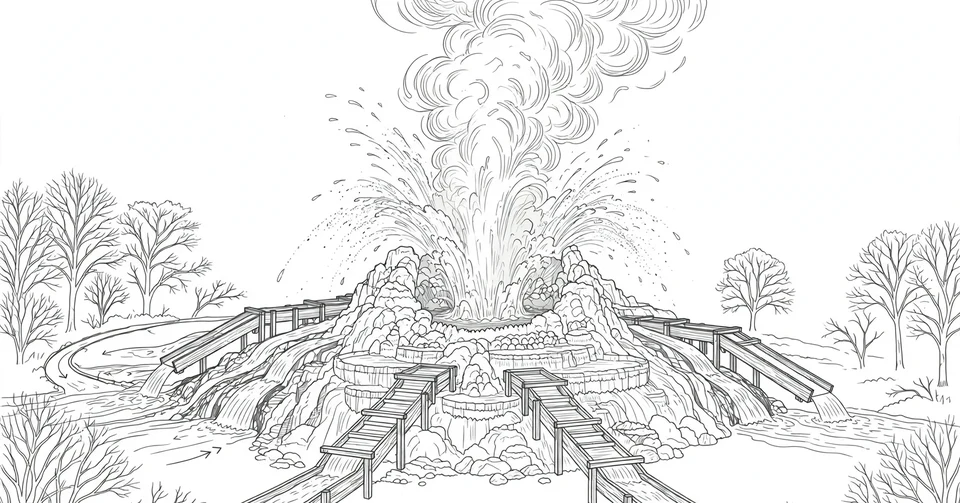
Stand on the walking path above the vent and the scale stops being abstract. The Obuki does not seep, and it does not bubble politely. It bursts out of the ground in a white, roaring surge, and the runoff leaves the valley as a stream some three metres wide, still far too hot to touch. Every bath, every meal cooked for a long stay guest, every line of the resort's reputation begins at that one violent point in the earth.
One vent doing the work of a whole town
The name is a plain description. Obuki reads roughly as great gusher, and the figures behind it are worth slowing down for. Nine thousand litres a minute is 540,000 litres an hour. Across a full day, the Obuki delivers close to 13 million litres of near boiling water, and it does this without pumps, without machinery, and without any sign of tiring. Guidebooks settle for calling it Japan's single most productive hot spring source, which is accurate and somehow still undersells it.
The resort built on top of this output is strikingly small. There is one traditional inn, Tamagawa Onsen itself, with a large number of simple rooms and a public bath, sitting a short walk from where the source surfaces in the valley, as japan-guide's page on Tamagawa Onsen describes it. Two kilometres down the road stands Shin-Tamagawa Onsen, a newer hotel that stays open through the winter, and it too draws every drop of its bathing water from the Obuki. Two inns, one throat. If the Obuki ever faltered, there would be no smaller version of Tamagawa to fall back on. There would simply be a quiet valley in Akita with an unusual smell.
I find that concentration more impressive than abundance spread thin. Plenty of resorts can point to a map dotted with springs and claim richness. Tamagawa points at a single hole in the ground. Everything the place is, it owes to the Obuki, and the honesty of that arrangement feels very Japanese to me: one gift, received properly, is enough to build a life around.
Water that has to be negotiated with
Volume is only half of the Obuki story. The other half is chemistry. The water carries hydrochloric acid as its main component, along with carbon dioxide, iron and aluminium chloride, and it leaves the vent at about pH 1.2, a level the spring's profile on Wikipedia notes makes it one of the most acidic hot springs in Japan. For comparison, that is far below lemon juice, and not far from the acid in a human stomach.
Water like this cannot simply be stepped into and enjoyed. At full strength it stings, and it finds every small cut and patch of sensitive skin within seconds. The inn answers by offering pools at different strengths, some fed directly from the source and others diluted to about half strength so that ordinary bathers can manage them. I have written before about what it means to bathe at Tamagawa Onsen, in water at pH 1.2, where a soak is measured in minutes, wooden steam boxes stand in for long baths, and rest is part of the treatment rather than an afterthought.
The reason people accept these terms is reputation. More than at almost any other resort in Japan, guests at Tamagawa come primarily for their health rather than for leisure, and they stay for weeks at a time in the old toji tradition of the long hot spring cure. The water has traditionally been touted for a long list of conditions, from skin disease and neuralgia to hypertension, and in recent decades the valley has become especially known to cancer patients who arrive hoping the Obuki can offer what medicine no longer promises them. None of that is established fact, and it should not be read as such. It is belief, tradition and hope, carried up a mountain road for well over a century. But hope, at Tamagawa, is a serious industry, and the Obuki is its entire foundation.
What the Obuki leaves behind
Water this loaded with minerals does not pass through a valley without changing it. As the stream from the Obuki cools, dissolved material settles out along its bed, crusting the rocks and slowly building new stone out of the flow itself. Among those deposits is hokutolite, a rare radioactive variety of the mineral barite that forms in only a tiny number of places on earth, and whose slow growth around this spring has been studied crystal layer by layer. The stone has its own strange biography, which I told in the piece on hokutolite and the handful of places that have it.
The same volcanic heat that drives the Obuki also warms flat slabs of bedrock beside the walking paths. On those slabs, visitors spread straw mats, lie down under blankets, and stay for hours, letting the stone's warmth work up through their backs. This is ganbanyoku, bedrock bathing, and Tamagawa is widely credited as the place where the practice began before it spread to spas across Japan. It is a neat symmetry. The Obuki supplies the water people soak in, and the heat behind the Obuki supplies the stone people lie on. Even the resort's second therapy is the same single source, wearing different clothes.
The valley itself is not a garden you wander freely. Around the Obuki there are smaller seeps, hissing sulphurous vents and streams of hot water running between the rocks, and the whole steaming field is viewed from set walking paths, including a nature research path of about a kilometre that loops past the vent. Given water at 98 degrees and acid at pH 1.2, the fencing is not bureaucratic caution. The Obuki is magnificent, and it is genuinely dangerous, and Tamagawa has never pretended otherwise.
A hunter, a sulphur mine and a newspaper name
For most of its known history, nobody bathed here at all. The springs were discovered by a local matagi hunter in 1680, one of the bear hunters of the northern mountains, but the valley was then worked mainly as a sulphur mine, its fumes and deposits worth more than its bathing. The Obuki gushed on through all of it, largely ignored, while miners took what they needed from the ground around it.
The first lodging was only erected in 1885, and the spring spent its early bathing years under another name, Kanoyu Onsen. It became Tamagawa Onsen thanks to an Asahi Shimbun reporter who praised the water's effectiveness against disease, a piece of newspaper enthusiasm that renamed a valley. Even then, the site could be reached only on horseback, with difficulty, until after the Second World War. In 1959 it was designated a National Health Resort, formal recognition of what the long stay guests had been saying for decades. Through every one of these reinventions, sulphur mine, horseback refuge, national resort, the constant was the Obuki, throwing out its nine thousand litres a minute for audiences of miners, hunters, journalists and the seriously ill alike.
One spring against a hundred
The contrast I keep returning to is Kusatsu, the other great acidic resort of Japan. Kusatsu draws on around a hundred separate sources spread beneath the town, an underground portfolio so diversified that no single vent matters much on its own. Tamagawa has the Obuki and, beside it, a supporting cast of small seeps and steam vents that are decoration next to the main event. Kusatsu is a choir. Tamagawa is one very loud voice.
That difference shapes the mood of the two places. A resort of a hundred springs feels civic and shared, a town that happens to sit on hot water. A resort of one spring feels almost monastic. Everyone at Tamagawa, the innkeeper, the day visitor, the patient beginning a sixth week of treatment, is there because of the same single fact, and everybody knows exactly where that fact lives: up the path, behind the steam, roaring.
There is a lesson in the Obuki that goes beyond hot springs, and it is the thought I leave with. We tend to measure richness by how many sources we can count, how many options feed the whole. The Obuki suggests the opposite measure. One source, fully itself, giving everything it has at a rate no rival can match, can carry a mine, a hospital in all but name, two inns and three centuries of hope. When the road closes for winter and the inn shuts its doors from early November to mid April, the valley empties of people entirely. The Obuki does not notice. It throws out its river into the snow, nine thousand litres a minute, exactly as it did for the hunter in 1680, asking for nothing and offering everything it has.
More in Life & Style
Latest posts
- Shimekasu Was Herring You Never Ate
- A Hana Donko Wears Its Cracks Like Flowers
- Hashigo-Nori Is Riding a Ladder Someone Else Holds
- At a Goma, Prayers Are Written to Be Burned
- The Sekaa Teruna Builds the Monsters
- A Lembaga Perkreditan Desa Is a Bank the Village Owns
- Every Melasti Goes to Fetch Tirta Amerta
- Kuki Is the Spring the Sea Turned White
- When the Kulkul Stops Sounding for You
- A Caru Is an Offering for the Ones You Fear
- Tatsuko Wished for Beauty and Became a Statue
- Warangan Is the Wash That Reveals the Pattern
- Every Village Writes Its Own Awig-Awig
- Umaji Refused to Disappear
- Rwa Bhineda Keeps Opposites From Going to War