Kaburiyu Is How You Talk Your Body Into the Bath
· 9 min read
Kaburiyu is the Kusatsu ritual of pouring bucket after bucket of undiluted spring water over your head and body, persuading your circulation to accept a three minute bath at 47 degrees.
Nobody climbs straight into the hottest bath in Kusatsu. At 47 or 48 degrees, in sulfur water that leaves the ground strongly acidic and completely undiluted, an unprepared body simply refuses, and the town has never pretended otherwise. So between the stirring of the water and the soak itself, Kusatsu inserted a negotiation. It is called kaburiyu: pouring the bath over yourself, bucket after bucket, until your body stops arguing and agrees to get in.
It is easy to mistake kaburiyu for washing, and it is not washing at all. The bather standing at the edge of the tub is already clean. What is happening is persuasion, carried out one ladle at a time, as skin, blood vessels and heartbeat are told, repeatedly and in advance, exactly what is about to happen to them.
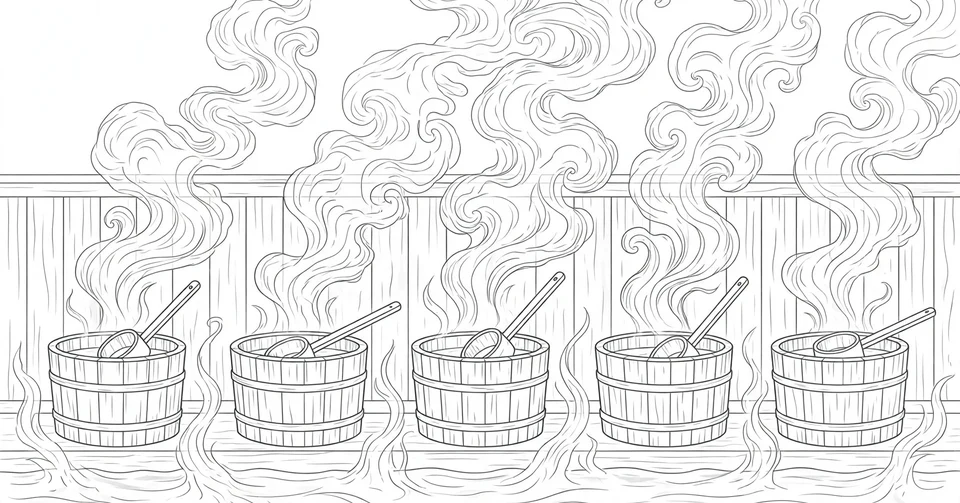
At the town's small communal baths, the tools of that negotiation wait in a row: wooden buckets and ladles lined up along the steaming edge of the water. Bathers take their turn sitting beside the tub, and for a while the only sounds in the room are splashing and quiet counting. Nobody hurries through kaburiyu, because hurrying is the one thing it exists to prevent.
What kaburiyu actually is
Kaburiyu is the middle act of jikan-yu, the timed bathing method that has been recommended at Kusatsu for over 130 years and that I have written about in jikan-yu, the bath that gives you exactly three minutes. First the water is stirred with long wooden boards in the yumomi ritual, shedding a few degrees without a single drop of cold water added. Then comes kaburiyu. Then, and only then, everyone slides in up to the neck for exactly three minutes.
Gunma's official tourist guide defines kaburiyu plainly: a technique in which water is repeatedly poured over the bather's head to increase blood circulation to the head and prevent dizziness when bathing. The water used is not some gentler supply kept aside for the purpose. It is the bath itself, at the bath's own punishing temperature, scooped straight from the tub.
Nor is kaburiyu a token splash before the real event. When researchers from Gunma University's hospital in Kusatsu later formalised the custom for a study, their protocol had each volunteer pour twenty pails of water over the top and back of his head before entering. Twenty pails is not a rinse. It is a rehearsal, and the body is expected to learn its lines.
Water too strong to meet all at once
To see why such a rehearsal is needed, consider the water. Kusatsu's springs emerge from the source at over 50 degrees Celsius, and the town's bathing culture is built on a refusal to tame them by dilution, the same stubbornness I explored in how Kusatsu refuses to water down its onsen. The water is yellow with sulfur and acidic enough, at around pH 2, that local legend claims it can cure anything except lovesickness.
The town does cool the water, but only by exposure and patience. At the Yubatake spring field in the centre of town, some 5,800 litres a minute run through a series of wooden sluices, shedding heat to the mountain air before the water is piped to the bathhouses. Nothing is added. What arrives at the tub is the spring itself, merely a few degrees less furious than when it left the ground.
Yumomi stirring cools the water part of the way, and it raises the pale mineral flakes called yunohana, which are said to settle on the skin as a thin coating and soften the bath's bite. Even after all that, a jikan-yu tub still sits in the high forties: 48 degrees in the prefecture's account, 47 in the researchers'. Sources disagree by that single degree, and honestly it hardly matters. Either figure is far beyond what a body can meet in one step, and that gap between bearable and unbearable is exactly where kaburiyu does its work.
I find the honesty of this appealing. The town never claims its water is gentle. It claims the water is strong, and then it teaches your body, patiently and in public, how to survive the introduction.
Kusatsu's other famous method makes the same point from the opposite direction. At Otakinoyu, bathers practise awaseyu, climbing a staircase of tubs that rise from a cool 38 degrees to a very hot 46, entering the heat one step at a time. Awaseyu stretches the gradient across several baths. Kaburiyu compresses it into a single doorway, one ladle at a time, but the philosophy is identical: the body is never asked to leap. It is always asked to climb.
Why kaburiyu aims at the head
Of all the places to pour, kaburiyu aims at the head, and the traditional reasoning is more specific than simple warming. The pouring was meant to avert a sudden rush of blood to the brain when the body hit the very hot water. Heating the head first, the custom holds, opens its blood vessels in advance, so the wave of heated blood that follows immersion arrives at a system that has already made room for it.
The method kaburiyu serves was taken seriously early. The German physician Erwin von Balz researched jikanyu in the late nineteenth century and believed the timed hot baths, together with the mountain air, did his patients good. His work helped put Kusatsu on the map as a serious spa, and the custom of the buckets survived alongside the reputation.
In 1998, researchers at Gunma University's Kusatsu branch hospital gave the head pouring a modest modern test, published in the journal of Japan's balneology society. Eight healthy men poured twenty pails of 47 degree water over their heads while the team measured stress related hormones, among them cortisol and beta-endorphin. The hormones barely moved. The researchers concluded that the pouring does not directly stir the body's stress chemistry, though it may still dilate the blood vessels of the head and prepare them for the abrupt inflow of heated blood that a very hot bath brings.
That is one small study with a careful, limited answer, and I think kaburiyu deserves to be described exactly that way: a traditional practice with a plausible explanation, not a proven medical treatment. Anyone with a heart condition should take questions about very hot bathing to a doctor, not to a bucket. But a custom does not need a laboratory's blessing to be sensible. Generations of bathers noticed that a prepared body fared better than an ambushed one, and they built the preparation into the ritual itself.
Context matters here. Kusatsu has been known for centuries as a place for taking the thermal waters, somewhere the sick once settled for long cures rather than quick dips. For guests staying weeks at a time, kaburiyu was not a one off ordeal to be endured once and forgotten. It was a daily discipline, repeated morning after morning, until pouring twenty pails over your own head became as unremarkable as washing your hands.
Kaburiyu is not kakeyu
Almost every bather in Japan performs a smaller cousin of this act. After washing at the showers, you ladle a few scoops of bath water over yourself before stepping in, a habit called kakeyu. It is partly courtesy, partly a warning shot of warmth so the bath is not a total surprise. Gunma's guide describes that modest version at Kusatsu's free baths, where carefully tipping a few buckets over yourself before entering counts as good etiquette.
Kaburiyu shares the wooden tools and nothing else. Kakeyu is a few ladles over the body, done once, almost absentmindedly, as much to keep the shared water clean as to warm the skin. Kaburiyu is the bath's own water at full strength, poured over the head again and again until the count runs into the dozens, at sessions in baths like Chiyonoyu reportedly following the bath leader's calls. One is a greeting. The other is conditioning. Confusing the two is like confusing a handshake with training.
There is a difference in who the act protects, too. Kakeyu protects the water and the other bathers as much as it protects you. Kaburiyu happens before you have earned any right to the water at all. It protects only you, and it does so slowly, in plain view, with everyone else in the little room doing the same undignified splashing beside you.
Where the buckets still line up
Today the full sequence survives in two forms. At Netsu-no-yu, the hall facing the Yubatake spring field, performers reproduce jikan-yu for an audience six times a day: the stirring with wooden planks, the Kusatsu-bushi sung to keep the rhythm, the buckets of hot water poured over each performer, and then the soak up to the neck for exactly three minutes. It is staged, but staged the way a cooking demonstration is staged. The recipe is real.
The unstaged version is still practised at a handful of bathhouses. Jizonoyu, one of Kusatsu's three free public baths alongside Shirahatanoyu and Chiyonoyu, is named by the prefecture as a place where jikanyu is still offered. These are tiny rooms holding two to four bathers at a time, with no lockers and barely a step between the street door and the steam. The buckets wait along the edge of the tub, and kaburiyu is simply what you do there before the water will have you.
Watch the show and you understand the sequence. Stand in the steam at Jizonoyu and you understand the need. Kaburiyu is the admission, paid in advance and in small change, that some experiences cannot be rushed into no matter how eager the mind is.
What I take from kaburiyu is its refusal to lie to the body. Most rituals of wellbeing promise that change can be painless, that you can pass from one state into another without paying anything in between. The buckets of Kusatsu promise the opposite. The water is 47 degrees and it will feel like 47 degrees. The only mercy on offer is time, ladled out twenty pails at a stretch, while your circulation catches up with your intentions.
You cannot bluff your way into a bath like that, and kaburiyu does not try. It talks the body into the water the way you talk anyone into anything difficult: honestly, gradually, and one small agreement at a time.
More in Life & Style
Latest posts
- Shimekasu Was Herring You Never Ate
- A Hana Donko Wears Its Cracks Like Flowers
- Hashigo-Nori Is Riding a Ladder Someone Else Holds
- At a Goma, Prayers Are Written to Be Burned
- The Sekaa Teruna Builds the Monsters
- A Lembaga Perkreditan Desa Is a Bank the Village Owns
- Every Melasti Goes to Fetch Tirta Amerta
- Kuki Is the Spring the Sea Turned White
- When the Kulkul Stops Sounding for You
- A Caru Is an Offering for the Ones You Fear
- Tatsuko Wished for Beauty and Became a Statue
- Warangan Is the Wash That Reveals the Pattern
- Every Village Writes Its Own Awig-Awig
- Umaji Refused to Disappear
- Rwa Bhineda Keeps Opposites From Going to War