At a Goma, Prayers Are Written to Be Burned
· 8 min read
At a goma fire ritual in Japan, worshippers write their prayers on wooden sticks called gomagi, and a priest feeds them one by one into the flames before Fudo Myoo. This is what the goma is, where it came from, and why the prayer has to burn.
In a temple hall in Japan, you can write your dearest wish on a thin stick of wood, hand it to a priest, and watch him feed it into a fire. Within a minute the words are gone. The name, the wish, the careful handwriting, all of it turns to smoke and ash while drums beat and the chanting rolls on around you. This fire ritual is called a goma, and the burning is not a flaw in the system. The burning is the system.
Most prayers are built to last. People carve them in stone, hang them on trees, fold them into charms they carry for a year. A goma prayer works in the opposite direction. It is written down precisely so that it can be destroyed, and the destruction is the delivery. Nothing about it is kept, framed or filed away.
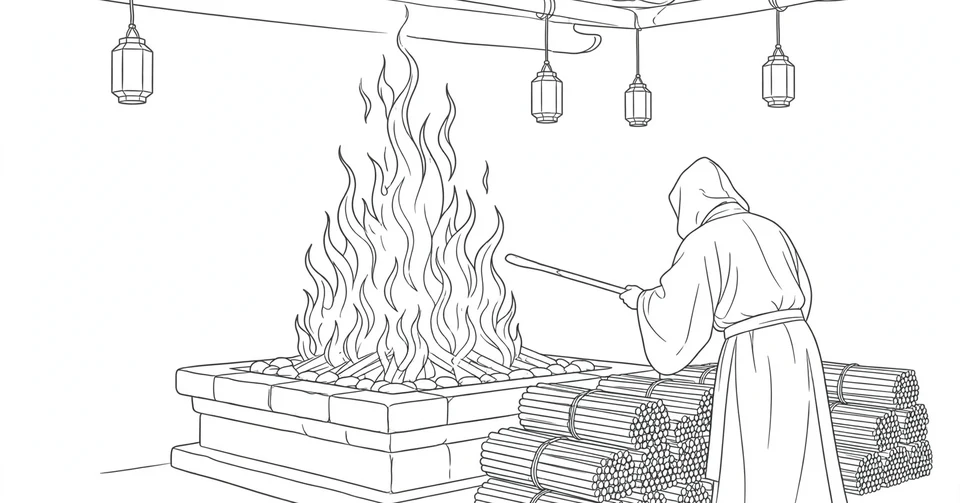
What rises from that fire is supposed to be two things at once. The smoke carries the wish upward to the deity it is addressed to. At the same time, the flames are understood to be burning the confusion, greed and fear inside the person who wrote the stick. One small piece of wood carries both the request and the problem, and the goma burns them together.
Where the goma comes from
The word goma comes from the Sanskrit word homa, which means an offering made into fire. The rite descends from the ancient fire offerings of India, where fire was treated as a messenger between human beings and the divine, carrying whatever was placed in it up and out of the human world. When esoteric Buddhism absorbed that idea, the fire offering became a structured ritual of mantra, hand gestures and offerings, and it travelled east with the teaching.
In Japan the goma is above all a ritual of the Shingon and Tendai schools of esoteric Buddhism. In the Shingon tradition it is said to have been handed down for more than 1,200 years, since the age of Kobo Daishi Kukai, the monk who brought esoteric Buddhism to Japan. Tendai temples perform it too, often with a flavour of the mountain ascetic practice that runs through that school. Some temples hold a goma every day, others on set days each month or at turning points in the year such as New Year and Setsubun, and most welcome anyone who wants to sit and watch, whatever their own faith.
At the centre of almost every goma stands one figure. The altar is set before Fudo Myoo, the Immovable Wisdom King, whose statue sits wreathed in carved flames and whose sword cuts through delusion. We have followed that fierce and strangely comforting figure before, in the story of Fudo Myoo and the fire he sits inside. The goma is where his fire stops being a symbol on a statue and becomes a real blaze on an altar, tended by hand.
The fire is the wisdom of Fudo Myoo
In the teaching behind the ritual, the flames on the goma altar are read as the wisdom of Fudo Myoo made visible. Wisdom, in this picture, is not gentle. It burns. It consumes bonno, the worldly desires and mental afflictions that cloud a person's judgement: attachment, anger, ignorance, arrogance and doubt. The priest does not perform the goma at a distance from that fire. Seated at the goma altar, he works through a long sequence of mantras and mudras, the sacred hand gestures of esoteric ritual, invoking the deity and then feeding the fire, item by item, in a set order.
The sticks are only the most personal of the offerings. Into the same flames go five grains, rice, wheat, foxtail millet, barnyard millet and beans, which in the Shingon reading stand for those very afflictions of attachment, anger, ignorance, arrogance and doubt. Fragrant woods and spices go in, and aromatic oil is poured so the flames leap. The logic is deliberate and a little bracing: you do not overcome your anger, greed and confusion by pretending they are not there. You name them, gather them up and burn them on purpose, in public, with help.
Different goma services lean toward different ends. The Shingon tradition groups its fire rituals into types, among them prayers to avert calamity and disaster, prayers to increase benefit and good fortune, and sterner prayers meant to subdue whatever is causing harm. A family asking for a safe year and a priest praying for protection from earthquakes are using the same fire for different work, and the ritual has room for both.
The stick you write is called a gomagi
The wooden stick at the heart of the goma is called a gomagi. It is a plain, thin slat of wood, and before the ritual the worshipper writes on it their name and the wish they want prayed for. Temples generally advise keeping the words short and clear: good health, safety for the household, success in an examination. A goma prayer is not an essay. Part of the discipline is deciding what you actually want, in a few words, on a small piece of wood that is about to disappear.
During the service the priest takes up the gathered gomagi and feeds them into the altar fire one by one while the chanting continues. The Japan Tourism Agency description of the ritual at Naritasan puts the belief plainly: the fire is thought to carry the written message directly to Fudo Myoo, so that he may answer it and lighten the worries of the person who wrote it. Watching your own handwriting catch and curl in the flames is the emotional centre of the whole rite, and for many people it is the reason they come.
Naritasan Shinshoji, the great temple in Narita, Chiba, is the name most Japanese people would give you first. The goma is the temple's central rite, performed every day at set times in its Great Main Hall, and temple tradition holds that it has been performed there since the tenth century, when it was first offered to quell a rebellion. Anyone may climb into the hall and take part. Worshippers there can also have a treasured possession passed through the flames in a rite called ohikaji, so that the object itself receives the protection of Fudo Myoo. A bag, a charm, even a set of car keys can go home having been held, briefly, inside that sacred fire.
When the goma leaves the hall
Not every goma burns indoors. Some temples take the fire outside and build it large, in an open air form of the ritual called a saito goma, performed by yamabushi, the mountain ascetics of the Shugendo tradition. The best known example near Tokyo belongs to Takao-san Yakuo-in, the Shingon temple on Mount Takao, whose annual Saito Goma-ku is held on the second Sunday of March at the foot of the mountain.
There, worshippers first rub their bodies with thin sticks called nadegi, which are then collected and thrown into a great pyre of branches. When the fire has burned down to embers, the yamabushi walk barefoot across the coals, and ordinary visitors follow them, praying for protection from sickness and calamity and for safety in the home. There is something honest and very Japanese in the contrast. This is a country where fire was for centuries the great terror of wooden cities, where the hikeshi firefighters of Edo mostly fought flames by tearing down the houses in their path. And yet the same culture also built a ritual that invites fire onto the altar, sits down calmly beside it, and trusts it to carry a prayer.
Why burn the prayer at all
It is fair to ask why a prayer needs to be destroyed to work. The goma offers an answer that feels psychologically shrewd, whatever you believe about its theology. A wish you keep is a wish you can keep checking, polishing and worrying over. A wish you burn is out of your hands. You have said it as clearly as you could, in a few words on a stick, and then you have watched it go. What remains is not the wanting but the resolve, and temples often hand out a talisman at the end of the service as a reminder of that resolve, a small paper witness to a fire you no longer control.
Personally, I find the goma one of the most honest forms of prayer I have encountered in Japan. It refuses the two easiest comforts: it does not promise that the wish will be granted, and it does not let you keep the wish as a possession. The fire takes the words seriously enough to consume them completely. What you wrote mattered, the ritual says, and that is exactly why it cannot stay.
Sit in a goma hall once and the rite stays with you: the heat on your face, the crackle of hundreds of small wooden prayers, the priest moving through the smoke with unhurried hands. Long after the details fade, the shape of the thing remains. Write it down. Mean it. Let it burn.
More in Culture & Society
Latest posts
- Shimekasu Was Herring You Never Ate
- A Hana Donko Wears Its Cracks Like Flowers
- A Lembaga Perkreditan Desa Is a Bank the Village Owns
- Kaburiyu Is How You Talk Your Body Into the Bath
- Kuki Is the Spring the Sea Turned White
- Warangan Is the Wash That Reveals the Pattern
- Ganbanyoku Is Bathing Without Water
- The Obuki Throws Out Nine Thousand Litres a Minute
- Every Village Writes Its Own Awig-Awig
- Sainokawara Is a Bath You Share With a Hundred Strangers
- Umaji Refused to Disappear
- Rwa Bhineda Keeps Opposites From Going to War
- Kasepekang Is Exile Without Leaving Home
- Jamasan Washes a Blade Thinner Every Year
- Herring Fed the Fields That Fed Osaka