Ganbanyoku Is Bathing Without Water
· 9 min read
Ganbanyoku is the Japanese bedrock bath, lying on heated stone instead of soaking in water. It began on the steaming ground of Tamagawa Onsen in Akita and grew into a standard room in spas across Japan.
There is a Japanese bath that contains no water at all. Ganbanyoku asks almost nothing of you: lie down on a slab of warm stone, fully clothed, and stay there while the heat works its way up through your back until you sweat. No immersion, no scrubbing, no bracing yourself against a too hot tub. You lie down, and the stone does the rest.
The name is plain about what it is. Gan means rock, ban means slab, and yoku means bath, so ganbanyoku is bathing on a rock slab. Today it is a standard feature of hot spring inns and city spas all over Japan, a quiet heated room somewhere near the baths. Its birthplace, though, was not a spa designer studio. It was a steaming mountainside in Akita, where the ground itself is hot and people had been lying down on it for generations before anyone thought to give the habit a name and a business model.
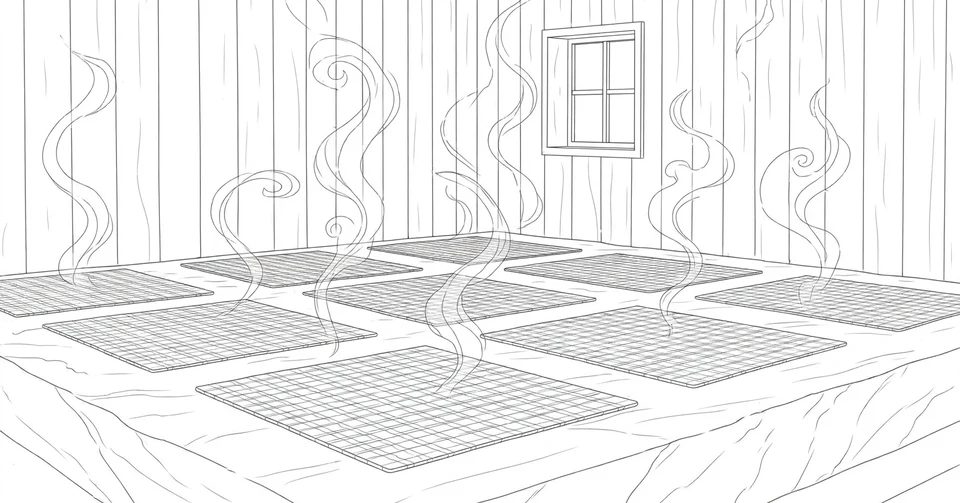
That gap between the wild original and the tidy modern version is what makes ganbanyoku worth a closer look. The modern room is comfortable, controlled, and frankly a little bland. The original was neither comfortable nor controlled. It sat beside one of the most extreme hot springs in Japan, and the people lying on that rock were not there on holiday. They were patients, and the stone was part of the treatment they had travelled a long way to undergo.
What ganbanyoku involves
In its modern form, ganbanyoku is simple to describe. Body sized slabs of stone, germanium among them, are set into the floor of a humid room, and the room is usually held somewhere between 40 and 50 degrees Celsius, warm rather than fierce. Bathers wear light indoor clothing, the loose kannaigi provided for moving around inside the facility, spread a bath towel over a slab, and lie down on it. Between the heat rising from the stone below and the warm air around them, they begin to sweat the way they would in a low temperature sauna, only lying flat instead of sitting on a bench. The standard reference description of ganbanyoku notes that because clothing is worn, these rooms are mixed gender and sit apart from the nude bathing areas, and that most people head into the onsen baths afterwards to wash the sweat off.
Almost every part of that arrangement is a softened copy of the original. The towel stands in for a straw mat. The thermostat stands in for a volcano. The mixed, clothed, unhurried format, though, is faithful to the source, because at Tamagawa the bedrock bathers were always clothed, lying side by side in the open air, men and women resting on the same warm ground in a way that ordinary onsen etiquette never allowed. Ganbanyoku kept that social shape even after it moved indoors, and it is one reason the format spread so easily: it is a bath that nobody has to get undressed for, and nobody has to be brave for either.
I have always liked that about it. Most bathing cultures ask something of you, endurance, cleanliness rituals, tolerance for very hot water or very cold. Ganbanyoku asks only that you lie still and let time pass, which may be the most honest description of rest ever built into a leisure industry.
The mountain where the ground is warm
Tamagawa Onsen sits high in the mountains of Semboku, in Akita Prefecture, inside Towada Hachimantai National Park. The spring was first discovered in 1681 and opened as a centre for toji, the traditional hot spring cure, in 1884. Toji was never tourism in the modern sense. Guests, often farmers between seasons or people with chronic illness, settled in for weeks at a time, cooking for themselves in simple self catering quarters and following a slow daily rhythm of bathing, resting, and eating plainly. Tamagawa became one of the great strongholds of that culture, and its bedrock bathing grew up inside the routine.
The reason the ground there can serve as a bath is the spring itself. The source, a single vent called the Obuki, delivers around 9,000 litres of water a minute at 98 degrees, the largest output of any single hot spring source in Japan, and the water runs at about pH 1.2, the most acidic in the country. I wrote about that extraordinary water in my piece on Tamagawa Onsen and its fiercely acidic spring, and it matters here because water that strong can only be taken in short doses. The bedrock offered the other half of the cure: long, gentle warmth to balance the brief, aggressive baths. The Japan Tourism Agency account of Tamagawa Onsen describes the nature research path that winds around the grounds, past vents where steam rises straight out of the earth, and explains that among those vents the rocks heated by geothermal energy become natural stone saunas, where people lie on mats to warm themselves from head to toe.
The stone under those mats is not ordinary rock. The bedrock around the source carries hokutolite, a rare mineral in which radium sits inside a lattice of barium and lead sulfate. It forms as the hot water cools on its way downhill, crusting the riverbed so slowly that a millimetre of growth takes about ten years, and it occurs naturally in only two places on Earth, Tamagawa and the Beitou springs in Taiwan. I covered the stone itself in my article on hokutolite and the handful of places that have it. At Tamagawa, guests spread straw mats over the warm bedrock, covered themselves with blankets against the mountain air, and lay there for long, unhurried stretches, alternating the stone with careful dips in the acid water. That practice, lying on geothermally heated hokutolite ground, is what Tamagawa is said to have given Japan: the original ganbanyoku, with no floor, no thermostat, and no walls.
How ganbanyoku left the mountain
For most of its life, bedrock bathing belonged to one valley and the patients who could reach it. The turn came when the practice was rebuilt as a product. The first specialised ganbanyoku facility opened in Kesennuma, in Miyagi Prefecture, in 2001, and from there facilities began opening across the country in what was widely called a ganbanyoku boom. Through the 2000s the heated stone room became a fashionable add on, installed in large bathing complexes, fitness clubs, and urban spas, often using stones chosen for their marketing as much as their geology. The volcano was replaced by electric heating and good insulation, and the patient was replaced by the office worker with an hour to spare.
Booms settle. The number of businesses specialising only in ganbanyoku later shrank, with hygiene concerns among the reasons given, since warm shared slabs and heavy sweating are not an effortless combination to keep clean. But the format itself survived the fashion cycle by retreating into the institutions that had borrowed it. Ganbanyoku rooms attached to onsen inns and bathing facilities are still found throughout Japan, and the practice settled into the background of Japanese bathing life: not a headline attraction, just another room you can use after the baths, as ordinary now as the sauna beside it.
There is something fitting in that trajectory. Ganbanyoku began as the quiet half of a severe medical routine, the rest between treatments. In the cities it became exactly the same thing at a smaller scale, the rest between the bath and the rest of the day. The setting changed completely. The function barely changed at all.
What the warm stone is asked to promise
Any honest account of ganbanyoku has to handle its claims carefully. The practice is commonly advertised as detoxifying the body, improving circulation, helping the skin, and easing stress. At Tamagawa, the expectations were heavier still: people with serious illnesses made the journey hoping that the radium bearing stone and the acid water would do what medicine had not. These are beliefs and traditions, and they deserve to be recorded as such. Generations of toji guests organised their lives around the cure, and the city of Semboku itself describes visitors as drawn by the therapeutic qualities said to come from the water and the rock. Said to is the operative phrase. Warmth, rest, mountain air, plain food, and weeks away from ordinary life are real things, and they are quite enough to explain why people felt better at Tamagawa without turning the stone into a medicine.
I find I do not need the stronger claims to think well of ganbanyoku. A heated slab is a modest technology. It warms you slowly and evenly, it makes you sweat, and it gives you a legitimate reason to lie down in the middle of the day and do nothing, which modern life otherwise makes surprisingly difficult to arrange. If the stone at Tamagawa carried a trace of radium and a century of hope, that hope was part of what the guests were paying for, and hope, honestly labelled, is not a fraud. It only becomes one when a spa brochure prints it as a promise.
What remains, once the claims are trimmed back to size, is the shape of the practice itself: a person, a mat, a warm stone, and time. Ganbanyoku travelled from a steaming valley in Akita to heated rooms across Japan without losing that shape, and it never needed the water it is named alongside. It is a bath made of nothing but heat and patience, and on a cold evening that turns out to be plenty.
More in Life & Style
Latest posts
- Shimekasu Was Herring You Never Ate
- A Hana Donko Wears Its Cracks Like Flowers
- Hashigo-Nori Is Riding a Ladder Someone Else Holds
- At a Goma, Prayers Are Written to Be Burned
- The Sekaa Teruna Builds the Monsters
- A Lembaga Perkreditan Desa Is a Bank the Village Owns
- Every Melasti Goes to Fetch Tirta Amerta
- Kuki Is the Spring the Sea Turned White
- When the Kulkul Stops Sounding for You
- A Caru Is an Offering for the Ones You Fear
- Tatsuko Wished for Beauty and Became a Statue
- Warangan Is the Wash That Reveals the Pattern
- Every Village Writes Its Own Awig-Awig
- Umaji Refused to Disappear
- Rwa Bhineda Keeps Opposites From Going to War