Kuki Is the Spring the Sea Turned White
· 8 min read
A kuki is the spring morning when spawning Pacific herring turn Hokkaido's Sea of Japan coast milky white. The sight vanished in the 1950s, and after decades of fry releases and restraint it has been seen again every year since 2020.
On the morning of May 6, 2023, the water inside Sandomari Port in Rumoi, on Hokkaido's Sea of Japan coast, was the colour of milk. People along the harbour were pulling in Pacific herring one after another, fish of around 30 centimetres, while the sea beyond them stayed white. The phenomenon has a name, kuki, and it is a sight that went unseen on this coast for 45 years.
Two months earlier, in February, a large kuki had spread along the shore at Esashi, further south. By the end of April that year, the white sea had been reported in at least eleven cities and towns along the coast, some of them more than once. A fisheries institute official quoted at the time remarked that sightings had become so frequent that not all of them were even reported any more.
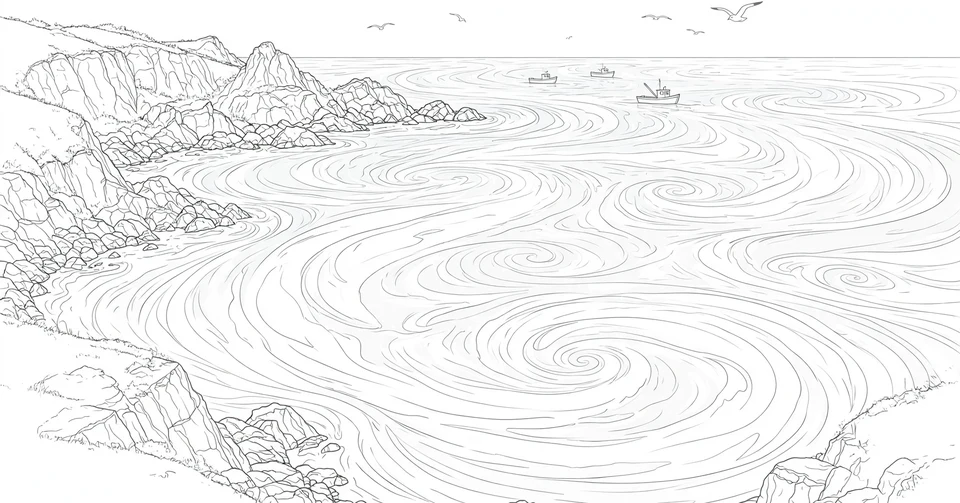
That ordinariness is the real story. A kuki is not a freak event that happened once and made the papers. It is a piece of the northern spring that disappeared within living memory, and its return, still small and still fragile, can be measured in something simpler than tons landed. It can be measured in mornings when the water changes colour.
What a kuki actually is
The Pacific herring, Clupea pallasii, is a silvery fish of roughly 30 to 35 centimetres that spends most of its life offshore. In late winter the schools come inshore to spawn, crowding into the shallows along Hokkaido's rocky Sea of Japan coast and inside Ishikari Bay. The females lay their sticky eggs over beds of seaweed, and the males release their milt at the same moment. When the school is big enough, the milt clouds the whole bay, and a kuki is what you see from the shore: the sea turned milky white.
The season runs from late January to early May, and it is busiest in February and March. Spawning often happens at night, so the water is at its whitest around dawn and usually clears by about noon. The conditions have to cooperate. A kuki needs a calm sea and water at around five degrees Celsius, and it seems to favour cloudy days. Seen from above, drone footage over the town of Obira shows the shape of it best, a white sash lying across the blue water, following the line of the coast.
The whiteness is not a thin sheen, either. In a big event the milt makes the water opaque, and the fish are so dense at the surface that they can be seen thrashing and rolling in it. A history of the fishery preserves the older, wilder version: beaches littered with eggs after a run, and water so crowded with herring that a pole pushed into it could almost stand upright on its own. Nothing in the recent, smaller returns looks quite like that, but the family resemblance is unmistakable.
There is a harvest hidden inside the spectacle, too. Herring eggs cling to whatever they are laid on, including kelp and wakame. Seaweed gathered with the roe still attached is salted into komochi kombu and komochi wakame, festive foods eaten for good luck. A heavy kuki was therefore never only a view. It was also next winter's delicacy, already written onto the seaweed beds.
A sign the whole coast organised its year around
Herring herald the spring in Hokkaido, and the language keeps the receipts. In haiku, nishin kuki, herring arriving in their schools, is a seasonal word for spring. For the fishing towns of this coast, a kuki was information you could read from the shore with no instrument at all: the fish had come, the year's great work could begin, and the sea would be generous or it would not.
The scale behind that signal was once enormous. At the peak of the fishery in the early twentieth century, Hokkaido's herring catch was reported at about a million tons a year, and the money built the famous herring palaces that still stand as museums. I have written here before about where most of that catch actually ended up, pressed into fertiliser for the cotton fields of the south, and about the kitamaebune trading ships whose routes carried the north's goods down this same coast. Every one of those industries rested, in the end, on the mornings when the sea turned white.
The white springs stopped
In 1954, a kuki was recorded along a twenty kilometre stretch of coast from Yoichi to Oshoro, northwest of Sapporo. After that, nothing. By the middle of the 1950s the herring had all but disappeared from the Sea of Japan side of Hokkaido. The causes the sources give are a familiar pair: decades of overfishing, and changes in the marine environment, in the water temperatures and the plankton the fish feed on.
What vanished was more than a stock of fish. A statistic can say a population is depleted without conveying that a whole coastline lost one of its colours, and that two generations grew up in these towns for whom a white sea was something grandparents described. Then, in 1999, a kuki was observed again, the first in 45 years. It made news precisely because so few people under retirement age had ever seen one.
In the decades between, the herring age survived mainly indoors. The palaces the fish had paid for became museums and restaurants, among them Otaru's great herring mansion, where visitors could eat herring soba in rooms built by a fishery that no longer existed. The coast kept the architecture and lost the announcement. When a kuki finally returned, it was news partly because it moved the story back outside, into the water where it belonged.
What brought the kuki back
The return was built slowly, and mostly out of restraint. Commissioned by the prefectural government, a project has been releasing herring fry along this coast since fiscal 1996, in recent years about 3.4 million fry a year. The fishermen themselves used nets with bigger mesh, so the youngest fish escape, and shortened their seasons. Researchers also credit changes in the sea itself, in temperature and plankton, which no one can order up but everyone can benefit from.
The numbers climbed in their unglamorous way. The catch on this coast, down to 200 or 300 tons a year in the early 2000s, passed 2,000 tons in 2009 and reached 5,326 tons in 2022, the best figure in twenty years. And the sightings followed the numbers up. Since 2020, kuki has been observed every year, and the report on the 2023 season counted it in at least eleven municipalities by the end of April alone.
The people releasing the fry are careful with their verbs. An official of the aquaculture corporation behind the releases said the number of fish was becoming stable, and that the kuki phenomenon could now be observed, and the hope attached to it was practical rather than poetic: that it would also lead to increasing fishermen's revenues. In Rumoi in May 2023, that looked like residents fishing from the harbour of a port whose water had turned white, taking home a fish their town was once famous for and then, for two generations, was not.
Honesty about scale matters here, and it is the part of the story I like most, because nobody involved seems tempted to skip it. Set 5,326 tons against a reported million at the peak and the recovery is roughly half of one percent. A kuki today is not the kuki of the palace building years, and pretending otherwise would insult what was lost. But a kuki is a threshold event. Below a certain number of fish, it cannot happen at all. Above it, the sea announces the fact itself, for free, at dawn.
Reading a sea that announces itself
That, to me, is what makes a kuki worth writing about. Fisheries statistics arrive late, in reports, in tables that only specialists read. A kuki is a census anyone standing on the shore can take in a single look. If the sea is white, enough herring came home to spawn in public. If it stays blue through February and March, no press release can argue with it.
If you are on this coast in late winter, the chances are best in February and March, early in the morning, on a calm day. Passengers on the coastal train between Otaru and Sapporo have photographed the white water from the window, and the Otaru shore is one of the likeliest places. Nothing is guaranteed. It depends on weather and fish, not on a timetable, and a kuki that does not come is also information.
The herring, of course, know nothing about being a recovery story. They come inshore because the water is right, and if there are enough of them, the sea turns white, the way it did for the great grandparents of the people now filming it from trains. Spring in Hokkaido used to announce itself in colour. Quietly, in patches, a few bays at a time, it has started to again.
More in Food & Travel
Latest posts
- Hashigo-Nori Is Riding a Ladder Someone Else Holds
- At a Goma, Prayers Are Written to Be Burned
- The Sekaa Teruna Builds the Monsters
- A Lembaga Perkreditan Desa Is a Bank the Village Owns
- Every Melasti Goes to Fetch Tirta Amerta
- Kaburiyu Is How You Talk Your Body Into the Bath
- When the Kulkul Stops Sounding for You
- A Caru Is an Offering for the Ones You Fear
- Tatsuko Wished for Beauty and Became a Statue
- Warangan Is the Wash That Reveals the Pattern
- Ganbanyoku Is Bathing Without Water
- The Obuki Throws Out Nine Thousand Litres a Minute
- Every Village Writes Its Own Awig-Awig
- Sainokawara Is a Bath You Share With a Hundred Strangers
- Rwa Bhineda Keeps Opposites From Going to War